October 1899. The British Empire, the largest the world had ever seen, was about to be humiliated by a ragged army of farmers. In the heart of South Africa, two small Boer republics—the Orange Free State and the Transvaal—dared to defy Queen Victoria’s might. The British laughed at their ultimatum. Within weeks, the laughter died.
The Boers, descendants of Dutch settlers, were armed with German Mauser rifles and a fierce belief in their right to self-rule. Their commandos, fast and deadly, outmaneuvered the lumbering British infantry at every turn. In just five days, they inflicted three stunning defeats on the empire, a period the British press would call “Black Week.” The world watched in disbelief as the greatest empire on earth stumbled.
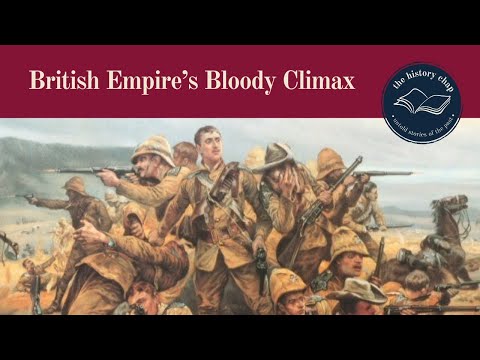
But the Boers’ early victories came at a cost. Their sieges of Ladysmith, Kimberley, and Mafeking bogged them down, giving Britain time to flood South Africa with troops. Soon, half a million British soldiers, including colonial volunteers from Australia, Canada, and New Zealand, arrived to crush the rebellion. Among them was a young Winston Churchill, captured and escaped, and a lawyer named Mahatma Gandhi, serving in an ambulance corps.
As conventional battles gave way to guerrilla warfare, the Boers proved relentless. General Louis Botha and Christian de Wet led lightning raids, striking British supply lines and vanishing into the vast veld. The British, frustrated and desperate, turned to a ruthless strategy: scorched earth. Farms were burned, crops destroyed, and livestock slaughtered. Boer families were herded into concentration camps, where disease and neglect would claim over 26,000 lives—mostly women and children.
The camps shocked the world. British humanitarian Emily Hobhouse exposed the horrors, forcing a scandalized government to reform the system. But the damage was done. The Boers, their homes in ashes, fought on as bitter-enders, even as their numbers dwindled. By 1902, both sides were exhausted. Peace talks began, and on May 31, the Treaty of Vereeniging ended the war. The Boers surrendered their independence but were promised self-government and financial aid. Yet the scars of the camps ran deep, and the British victory would prove hollow.
Within a decade, the former Boer republics merged into the Union of South Africa, with Louis Botha as its first prime minister. The Boers never forgot the dead children, and their resentment would fuel the rise of apartheid decades later. The Boer War was over, but its legacy was just beginning.
Yet beneath the surface of that uneasy peace, the seeds of a far stranger future were already germinating. The war had forged unlikely bonds across the lines of battle. Louis Botha and Jan Smuts, once hunted as rebels, now found themselves working alongside the very British administrators they had fought. It was a partnership born of necessity, not affection—but it would reshape the subcontinent.
Smuts, the philosopher-general, had spent the guerrilla years reading Kant in the saddle and drafting a vision of a united South Africa that transcended the old hatreds. He believed the war, for all its horrors, had melted the Boers and Britons into a single people. Whether the widows of the camps agreed was another matter entirely.
The black population, meanwhile, watched the peace with bitter irony. They had suffered in the camps too—over twenty thousand dead—and had served as scouts, laborers, and auxiliaries on both sides. Yet the treaty had explicitly postponed their franchise until the Boers themselves chose to grant it. That choice, as everyone understood, might never come.
In the dusty towns of the Transvaal, a new generation of Afrikaner children grew up hearing the stories. They learned the names of the camps by heart, and they learned to distrust the British smile. Among them was a young man named Daniel Malan, whose fiery sermons would one day electrify a movement. The war was over, but the memory war had only begun.
Britain, for its part, turned inward. The empire had been shaken to its foundations by a handful of farmers, and the lessons were debated fiercely in London. Some argued for a more humane imperialism; others simply resolved never to fight such a war again. The era of splendid isolation was ending, and a darker century was gathering on the horizon.
And in the veld, where the blockhouses still stood rusting, the last bitter-enders melted back into their farms. They would bide their time. The republics were gone, but the dream of an Afrikaner nation—pure, separate, and unbowed—had taken root in the ashes.
It was in this charged atmosphere that a young journalist named Winston Churchill, having parlayed his Boer War escape into a parliamentary seat, delivered a warning that few in Westminster wished to hear. “The Boers are a virile and stubborn race,” he told the Commons, “and the peace we have signed is but a truce dressed in treaty language.” He was roundly mocked for his troubles. The empire, after all, had won.
But Churchill had glimpsed something the accountants in London could not measure. He had shared a cell with Boer guards who treated him with a courtesy that unsettled him, and he had ridden through farmlands where the ashes of homesteads still smoked. The war had not ended on the veld; it had simply moved into the minds of men.
Smuts, too, understood this. In the years after Vereeniging, he shuttled between Pretoria and London, charming British statesmen with his erudition while quietly building the institutions of Afrikaner power. He once told a British friend, with a smile that did not reach his eyes, that the Boers had lost the war but intended to win the history.
The first test of that history came in 1914, when Britain declared war on Germany and expected its new South African dominion to follow. Smuts and Botha agreed—but thousands of Boer veterans did not. Old commandos like Christiaan de Wet, who had wept at Vereeniging, rose in rebellion against their own government. They would not fight for the empire that had burned their farms.
Botha crushed the revolt with grim efficiency, using Boer generals to hunt Boer rebels. De Wet was captured wearing a woman’s bonnet in a cart, a humiliation that stung worse than any defeat. The Maritz Rebellion, as it became known, was over in months—but it revealed the fault line that would crack South Africa open for a century.
Meanwhile, in the townships and mission stations, a different reckoning was brewing. The black South Africans who had served as scouts and laborers during the war had expected, at minimum, gratitude. Instead, the new Union of South Africa passed the Natives Land Act of 1913, restricting black ownership to a fraction of the country.
A young lawyer in Johannesburg, recently returned from London, watched this betrayal with cold fury. His name was Pixley ka Isaka Seme, and he founded the South African Native National Congress—the organization that would one day become the ANC. Its first delegation sailed to London to protest the land act, and was politely ignored.
The wheel was turning. The Boers had their self-government, the British had their gold, and the black majority had been handed a promise that everyone knew was a lie. The concentration camps had taught the world a grim new vocabulary; now the land act was teaching South Africa a grim new arithmetic.
In the farmhouse kitchens of the Free State, grandmothers told the children about the camps while kneading dough, and the children listened with wide eyes. They were learning who to blame, and who to trust, and who was not quite human. The war was over. The long war was just beginning.
By 1948, the arithmetic had become a creed. Daniel Malan’s National Party swept to power on a platform of apartheid—the formal codification of everything the war’s aftermath had seeded. The grandchildren of the camps now governed, and they remembered.
Smuts, the old philosopher-general, was defeated at the polls and retired to his farm, writing bitter letters about the smallness of men. He had wanted a united white South Africa; Malan wanted a separate and pure one. The dream of the veld had curdled into law.
Britain, exhausted and diminished after a second world war, watched from afar. It had won the Boer War but lost the peace, and now the empire itself was dissolving. South Africa slipped from the Commonwealth, a republic at last, its resentments enshrined in statute.
And yet the wheel kept turning. The black majority, denied for so long, found its voice in the ANC and its allies, and in 1994 the arithmetic finally broke. Nelson Mandela stood where Kruger once ruled, and the long war of memory seemed, for a moment, to soften.
But the camps and the blockhouses and the burning farms never truly faded. They live in the land question, in the inequality etched into every township skyline, in the names that still divide neighbors. The Boer War ended in 1902; its ghosts never signed the treaty.
Kruger had promised the price would stagger humanity. He was right—and the bill is still being paid. What do you think: did Britain win the war but lose the peace—or was the peace never really theirs to win?
Report this article
Select a reason for reporting:






