Colin Dwyer fixed fences for a living—the long, rusted, punishing kind that ran across sheep stations outside Dubbo, New South Wales, for kilometers in every direction. He was 21 in 1939, lean as a greyhound, quiet in the way country boys were quiet. He could look at a fence line running toward the horizon and tell you within ten minutes where the break was. Not from seeing it—from reading the land, the way the grass moved, the way the sheep clustered, the way the wire hummed differently when the tension changed. That skill had no name, no certificate, no military application any recruiting officer would have recognized.
But it was the same skill that would let him read a sky full of aircraft and know within two seconds which one was about to kill him. He didn’t know that yet. Nobody in Dubbo knew that yet.
When war broke out in September ’39, Colin didn’t rush to enlist. He talked to his father at the kitchen table while his mother pretended not to listen from the next room. His father had been at Gallipoli—not the famous parts, not the charges that made the newspapers. He’d spent four months carrying water up a hill and came home with a knee that never worked properly again. “It’s your choice, son,” his father said. “And don’t let anyone tell you it’s an adventure.”
Colin enlisted in January 1940—not in the army, the air force. He’d seen a Tiger Moth fly over the station when he was 16. It had banked low over the paddock, engine sputtering, and landed in a field about 800 meters from where he was working. The pilot was a mail carrier who’d gotten lost. Colin helped him refuel from a petrol tin, and sat in the cockpit for about 90 seconds while the pilot checked his map. Ninety seconds. That was all it took. He felt the rudder pedals under his boots. He smelled the oil and the leather. He looked through the windscreen at the flat brown earth stretching out forever and thought, from up there, you could see everything.
Five years later, he walked into the recruiting office in Sydney and said he wanted to fly. The officer behind the desk looked at his hands—calloused, scarred from wire, one fingernail permanently blackened from a fencing accident. “Any flight experience?” the officer asked. “Sat in a Tiger Moth once,” Colin said. The officer stared at him. “For about a minute and a half,” Colin added.
They took him anyway. Australia needed pilots desperately. The Empire Air Training Scheme was funneling men from every corner of the country into training pipelines barely six months old. Farm boys, station hands, clerks, school teachers—men who’d never been above the second floor of a building, let alone 30,000 feet. The scheme didn’t care about your background. It cared about your reflexes, your eyesight, and your ability to learn fast without panicking. Colin Dwyer could do all three.
He trained at Narrandera, then Mallala in South Australia—elementary flying on Tiger Moths, then Wirraways. The instructors noticed something about him early. He was calm. Not brave calm, not pretending calm—genuinely calm, the way a man who’d spent years reading landscapes from the ground now read them from the air. Where other trainees gripped the stick like they were strangling it, Colin held it the way he held fencing pliers: firm, steady, responsive. He didn’t fight the aircraft. He listened to it. “Dwyer doesn’t fly the plane,” his chief flying instructor wrote in a report. “He wears it.”
He graduated in October 1940—Sergeant Pilot, 22 years old. They shipped him to the Middle East in January ’41 aboard a transport that took six weeks to reach Egypt via South Africa. He spent those weeks playing cards, reading a dog-eared copy of a Banjo Paterson collection, and staring at the ocean. He’d never seen the ocean before Sydney. Now he was crossing it. The boy from Dubbo who’d never left New South Wales was heading to a war on the other side of the world.
He arrived in Egypt and was posted to 3 Squadron, Royal Australian Air Force. Remember that name, because the Germans were about to learn it—and they were never going to forget it.
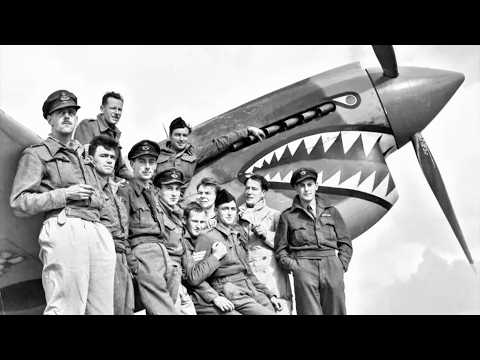
3 Squadron had been operating in North Africa since 1940. They’d started with Gladiators—biplanes, actual biplanes—while the Luftwaffe flew Messerschmitt 109s. The Australians were sent up in machines that belonged in the previous war and told to fight a modern one. They did it. They lost men doing it, but they did it. By the time Colin arrived, they’d transitioned to Tomahawks—P-40s. The Americans called them Warhawks, the British called them Tomahawks. The Australians just called them kites.
The Tomahawk was not the best fighter in North Africa. It wasn’t the fastest. It wasn’t the most maneuverable. It couldn’t climb with a 109. It couldn’t turn with an Italian Macchi. What it could do was dive. What it could do was take punishment. And what it could do in the hands of a pilot who understood it was kill.
Colin Dwyer understood it within a week. “It’s like a draft horse,” he told another pilot in the dispersal tent. “It’s not quick. It’s not pretty, but it’ll keep going when everything else quits.”
The other pilot, a bloke named Reggie Sullivan from Toowoomba, laughed. “You’re comparing a fighter plane to a horse?”
“I’m comparing it to the best horse I ever worked with,” Colin said. “Ugly bastard called Monty who could pull a plow through clay all day and never complain. And that’s a good thing. That’s the only thing that matters.”
He was right. He didn’t know how right. Not yet. But in three months, in the desert sky above Tobruk, that philosophy would keep him alive when better pilots in better planes died around him.
Picture the desert. Not the Hollywood desert. Not golden dunes and romantic sunsets. The Western Desert of North Africa in 1941. Dust that got into everything—your food, your ears, your engine. Heat that warped the air above the runway so badly that taking off felt like flying through water. Flies that covered your face the moment you stopped moving. Sand that stripped paint off aircraft fuselages in weeks. And wind. The Khamsin. A hot wind that came off the Sahara and reduced visibility to nothing and grounded every aircraft on both sides and drove men half mad with the grit in their teeth and the noise that never stopped.
Colin loved it. Not the discomfort, not the flies, but the vastness. It reminded him of home. The flat horizon, the empty sky, the way distance played tricks on your eyes. He’d spent his whole life reading a landscape that stretched to the edge of the earth. Now he was doing it again—just faster and higher and with people trying to kill him.
His first combat mission was a ground attack sortie against an Italian supply column south of Bardia. Six Tomahawks, low level. Colin was flying number four position. His hands were steady. His mouth was dry. He could hear his own breathing inside the oxygen mask. The flight leader’s voice crackled over the radio—clipped, flat, professional. “Target ahead. Trucks. Strafe on my lead. Watch for flak.”
They went in at fifty feet. Colin had never fired his guns in anger. He’d fired thousands of rounds in training at towed targets, at ground panels, at nothing. This was different. The trucks were real. The men running from them were real. The tracer coming up at him—bright, lazy-looking lines of light that seemed to float before whipping past at impossible speed—was real.
He pressed the firing button. The six .303 machine guns roared. The Tomahawk shuddered. Dust erupted across the convoy. A truck exploded. Another slewed sideways. Men scattered. Colin pulled up, banked hard, came around again. Second pass. More fire coming up now. A line of tracer stitched across his port wing. He felt the impacts through the airframe. He didn’t flinch. He pressed the button again.
They destroyed eleven trucks. Nobody in the flight was hit badly. Colin’s wing had three holes in it. He landed, climbed out, looked at the holes, and said, “Monty would have kept going, too.”
Reggie Sullivan heard him and shook his head. “You’re a strange bloke, Dwyer.”
He was. But he was alive. And in North Africa, that distinction was everything.
The months that followed were brutal. The desert war seesawed—Rommel pushed east, the Allies pushed west, and Rommel pushed east again. 3 Squadron moved with the front line, packing up, relocating, setting up again on airstrips that were nothing more than flattened patches of desert with fuel drums at the edges. They flew every day, sometimes three sorties a day. Ground attack, escort, reconnaissance, dogfights that erupted without warning from empty skies.
Colin didn’t become an ace overnight. His first aerial victory was ugly—a Stuka caught from behind, below, in its blind spot. He closed to 150 yards, fired a three-second burst. The rear gunner never got a shot off. The dive bomber trailed smoke, rolled, and hit the desert floor. Colin felt nothing. That surprised him. He’d expected something—triumph, horror. Instead he felt the same thing he felt when he killed a feral pig tearing up a paddock back home. A job done. Necessary. Not pleasant.
The intelligence officer looked at his combat report. “Engaged Ju 87. Three-second burst. Aircraft destroyed. No return fire.” He stared at Colin. “That’s it? Nothing about the angles? The tactics?” Colin looked at him. “I came up behind him and shot him. What else do you want me to say?”
This was the thing the Luftwaffe never understood about the Australians. The Germans respected the British. They feared the Poles. They admired the Americans’ equipment. But the Australians? They laughed at the Australians. Bush pilots, they called them. Colonials. Farm boys playing at being fighter pilots. German intelligence reports from early 1941 consistently rated the RAAF squadrons as inferior—capable of ground attack, but unlikely to survive sustained aerial combat against Jagdgeschwader pilots with hundreds of hours of experience over France and the Balkans.
They were catastrophically wrong.
The thing about the Australian pilots was this: they didn’t fight the way the textbook said. They didn’t fly tidy formations. They adapted. They improvised. They fought dirty when dirty was what worked. A German pilot trained at Schleissheim learned to fight within a system—rigid, hierarchical, precise. An Australian pilot trained at Mallala learned to fight with whatever he had. If the Tomahawk couldn’t climb with a 109, don’t climb. Dive. If you couldn’t out-turn a Macchi, don’t turn. Go straight. Use the Tomahawk’s one advantage—its incredible diving speed—and make every engagement happen on your terms, not theirs.
Colin Dwyer took this further than most. He developed a technique his squadron mates called the Dubbo drop. It wasn’t in any manual. It wasn’t taught at any school. It was pure instinct born from a lifetime of reading movement across open space. When he spotted enemy aircraft above him, he didn’t climb to engage. He waited. He watched. He read the formation the way he’d once read a fence line—not looking at the whole thing, but sensing where the weakness was. The straggler. The wingman who had drifted too far. The pilot scanning the wrong quadrant. Then he’d position himself below and behind. Let them come to him. Let gravity be his ally. When the moment came, he’d pull up into a steep climbing attack, fire at maximum convergence, and roll away before anyone above could react. It was patient. It was quiet. It was devastating.
“He hunts like a crocodile,” Squadron Leader Jeffrey Cunningham said after watching Colin’s gun camera footage. “He just waits in the water until something walks to the edge.”
Colin heard the comparison and shrugged. “Crocs aren’t stupid.”
“No,” Cunningham agreed. “They’re not.”
By June of 1941, Colin had four confirmed kills—two Stukas, one Messerschmitt 110, one Italian Fiat CR.42. He was 23 years old. He still wrote letters home in pencil because he couldn’t find ink that didn’t dry out in the desert heat. He still carried the Banjo Paterson book in his flight kit. He still called his Tomahawk Monty, after the horse back home, though he never painted the name on the fuselage. He said it would be bad luck.
He also hadn’t slept properly in two months. Nobody talked about that. Nobody talked about the way your hands shook when you tried to eat breakfast before a dawn sortie. Nobody talked about the dreams—the ones where you were in the cockpit and the controls stopped working and the ground came up and up and up. Nobody talked about Henderson, who’d been in the tent next to Colin’s, who’d gone up one morning and never come back. No radio call, no wreckage found. Just gone. A man-shaped hole in the world that the desert filled with sand and silence within a day.
Colin talked about it once to Reggie Sullivan, late at night, both of them sitting on fuel drums outside the dispersal tent, looking at stars so bright they seemed aggressive. “Do you reckon they feel it?” Colin asked.
“Feel what?”
“When they go in. The blokes who don’t come back. Do you reckon they know?”
Reggie was quiet for a long time. “I reckon it’s quick.”
“That’s not what I asked.”
“I know.” Reggie looked at the sky. “I don’t have a better answer, mate.”
Neither did Colin. He kept flying.
The battle that defined him came in November of 1941—Operation Crusader, the Allied offensive to relieve Tobruk, the largest tank battle North Africa had seen. On the 23rd, Colin was leading a section of four Tomahawks on patrol south of Sidi Rezegh. The fighting on the ground was savage—burning tanks dotted the landscape, smoke columns rose from every direction. The radio was a chaos of voices. Colin filtered it all. He listened the way he’d once listened to wind through fence wire. Not to every sound, but for the one sound that didn’t belong.
He heard it. A faint call from a ground controller, barely audible through the static. “Twelve plus bandits, angels fifteen. Heading south toward our armor. Somebody get up there.”
Nobody acknowledged. The call repeated, more urgent. Colin keyed his radio. “Dogtooth section. Four Tomahawks, we’re at angels twelve. Vector?”
The controller gave him a heading. Colin turned his section. Four aircraft against twelve or more German fighters protecting Stuka dive bombers about to hit Allied tanks caught in the open.
“That’s not great odds,” Reggie said over the radio. Reggie was flying Colin’s wing.
“They’re the odds we’ve got,” Colin replied.
They climbed. The Tomahawks strained—this was the aircraft’s weakness, the slow painful climb that ate time and energy and left you vulnerable. Colin knew it. Every second climbing was a second the Stukas got closer to the tanks below. He made a decision. He stopped climbing at angels fourteen. Below the incoming Germans. Against every instinct, against every piece of tactical advice he’d ever received. You always wanted to be above the enemy. Altitude was life. Every pilot knew it.
Colin didn’t want altitude. He wanted surprise.
“Stay low,” he told his section. “Let them come over us. We hit the Stukas first. Ignore the escorts.”
“Ignore the 109s?” That was Flight Sergeant Danny Briggs, number three. His voice was tight.
“They’ll be above, looking down. Looking for threats at their altitude or above. They won’t expect us below.”
“And if they see us?”
Colin’s voice was flat, calm—the same tone he’d used a thousand times on a thousand fence lines when something went wrong and panic was a luxury he couldn’t afford. “Then we’re in trouble, Danny. But those tanks are in trouble right now.”
They waited. The sky was enormous. Colin’s eyes scanned constantly—horizon left, horizon right, above, below. Check six. Repeat. His thumb rested on the firing button. His breathing was steady. His heartbeat was not, but his hands were still.
He saw them. Specks against the blue, high, moving south. The formation was textbook Luftwaffe—fighters stepped up above and behind the bombers, covering them like a roof. Twelve, maybe fourteen. The Stukas were lower, already beginning their descent toward the battle below. Colin counted eight Stukas, six 109s above. Four Tomahawks against fourteen German aircraft.
He didn’t hesitate. “Dogtooth section, targets twelve o’clock low. Stukas. We go through them once—one pass, make it count—then break south and get out.”
One pass. That was the key. One pass meant the escorts wouldn’t have time to react. One pass meant the Stukas would take fire before they could dive. One pass meant survival, maybe, if everything went right. A lot of ifs.
Colin pushed the throttle forward. The Tomahawks surged. The four fighters dropped out of the sky toward the Stuka formation like stones. The closing speed was enormous—three hundred miles an hour, four hundred. The Stukas grew from specks to shapes to aircraft with crosses on their wings in seconds. Colin picked his target—the lead Stuka, the formation leader. Take him out and the rest scatter.
He opened fire at two hundred yards, the convergence point of his six guns. The air filled with tracer. The Stuka’s canopy shattered. Pieces of the aircraft tore away. The dive bomber rolled slowly onto its back and fell. Colin didn’t watch it go. He was already shifting to his second target, a Stuka breaking left. He followed it for one second—one second of deflection shooting, leading the target, firing where it would be, not where it was—and his rounds tore through its engine cowling. Black smoke erupted. The Stuka dived, but not the controlled dive of a dying aircraft.
Two Stukas. Five seconds.
Around him, the other three Tomahawks were firing. Reggie hit a Stuka’s tail. Danny Briggs raked another across the fuselage. The fourth pilot, a new replacement named Tom Wheeler who’d been in the squadron eleven days, missed his target entirely but flew so close to a Stuka that the German pilot panicked and broke formation. The Stuka formation shattered. They scattered—five still flying, breaking in every direction, jettisoning their bombs over empty desert. The attack on the Allied armor was over before it started.
But the 109s were coming. Colin heard the call—Danny Briggs, voice cracking. “Snappers above! Six o’clock high! Breaking down on us!”
This was the moment. The one pass was over. Now they had to get out. Colin’s voice cut through the radio, calm, absolute. “Break south. All aircraft, deck level. Now.”
They dived—all four Tomahawks, straight down toward the desert floor. The Tomahawks’ one unbeatable advantage: diving speed. No Messerschmitt 109 could catch a Tomahawk in a dive. The physics wouldn’t allow it. The 109s tried. They rolled and followed. Tracer arced through the sky above the fleeing Tomahawks. But they were too high. Too late. The Australians were already pulling out at deck level, fifty feet above the sand, engines screaming, racing south at four hundred and ten miles an hour.
One burst hit Tom Wheeler’s aircraft. The Tomahawk shuddered. Glycol streamed from the engine, but Wheeler held it together. He kept flying. The engine ran hot, but it ran. They made it back to base—all four of them. Wheeler’s engine seized on final approach and he dead-sticked onto the strip, propeller frozen, aircraft trailing smoke. But he walked away from it.
Four Tomahawks had engaged fourteen German aircraft. They destroyed two Stukas confirmed, one probable, two damaged. Broken up an entire attack formation. Saved God knows how many Allied tankers on the ground below. And come home. Every single one of them came home.
Colin climbed out of his cockpit and sat on the wing. His hands were shaking. Not in the air—never in the air. But now, on the ground, where it was safe, where the adrenaline had nowhere to go. Reggie walked over. His face was white under the dust.
“You mad bastard.”
Colin didn’t answer.
“Four against fourteen. You mad bloody bastard.”
Colin looked at him. “The tanks needed us.”
“We could have died.”
“The tanks were dying.”
That was it. That was the whole conversation. Reggie stood there for a moment, then nodded once and walked away.
Squadron Leader Cunningham debriefed them that evening. He listened to the combat reports. He reviewed the gun camera footage. He was quiet for a long time. Then he looked at Colin and said, “Sergeant Dwyer, what made you decide to engage below the enemy formation instead of climbing to meet them?”
Colin thought about it. “The fences, sir.”
Cunningham blinked. “I’m sorry?”
“Back home, when you’re fixing fences, you don’t go looking for the break from the top of the hill. You work from the low ground. You see things from below that you can’t see from above. The angles are different. The weak points show up.”
There was silence in the tent. “You’re telling me you based a tactical decision against fourteen German aircraft on fence repair?”
“I’m telling you the principle’s the same, sir. Low ground gives you a different perspective. They weren’t looking down. They were looking across and up. We came from where they weren’t looking.”
Cunningham stared at him for five seconds. Then he wrote something in his notebook. Colin never found out what it was.
Three days later, Colin was commissioned as a pilot officer—battlefield commission. The paperwork cited “exceptional tactical initiative and leadership under fire.” Colin read it and said to Reggie, “They spelled Dubbo wrong.”
The commission changed his rank. It didn’t change him. He kept flying through the rest of Crusader, through the retreat when Rommel counterattacked in January of ’42, through the grinding back-and-forth of the Gazala battles. 3 Squadron lost pilots. New faces appeared. Some lasted weeks. Some lasted days. Colin remembered all of them. Every name, every bunk, every empty chair at breakfast that nobody mentioned.
He stopped counting his kills after eight. Not because he lost track—because counting felt wrong. Each number was a person, a German pilot who had a mother somewhere in Bavaria or Saxony who would receive a telegram. Colin didn’t feel guilt. He didn’t feel remorse. He felt something worse. He felt nothing. And feeling nothing about killing frightened him more than the killing itself.
He wrote about it in a letter to his father—not directly. He couldn’t say it plainly. He wrote about the desert, about the heat, about missing the green of home. And then one sentence buried in the middle of the page: “Some things get easier out here that shouldn’t get easy.”
His father never replied to that sentence. Maybe he understood.
The thing the Luftwaffe learned, slowly, painfully, through accumulating losses, was that the RAAF pilots in North Africa were not what the intelligence reports had claimed. They were not inferior. They were not bush pilots fumbling through a modern war. They were something the German training system had no framework for understanding. They were adaptive. They were unpredictable. They were impossible to categorize. A Luftwaffe pilot flew by doctrine. He followed the protocols taught at fighter school. He engaged according to prescribed patterns. This was effective—it had conquered Europe—but it was predictable. And against opponents who refused to follow any pattern at all, predictability was a vulnerability.
Colin Dwyer never flew the same way twice. He adapted every engagement to the conditions—wind speed, sun angle, cloud cover, the specific aircraft he was facing, the way the enemy formation was arranged, the behavior of the individual pilot he was targeting. Was he aggressive or cautious? Did he break left or right? Did he look behind him? Every fight was a new problem, and Colin solved problems the way he’d always solved them: by watching, by waiting, by acting at precisely the right moment.
By mid-1942, Colin had eleven confirmed kills. He was 24 years old. He was a flight lieutenant. He led eight aircraft. Every pilot in his flight trusted him absolutely. Not because he was brave, not because he was brilliant—because he brought them home. That was the measure. Not victories, not medals, not gun camera footage that impressed the intelligence officers. The measure was simple. Did your pilots come home? Colin’s flight had the lowest loss rate in 3 Squadron. He never talked about it.
When a new pilot named Arthur Jeffries arrived from training in Rhodesia and asked Colin how many kills he had, Colin said, “Enough.”
“But what’s your actual score?”
Colin looked at him with eyes that had aged ten years in eighteen months. “Ask me how many blokes I’ve lost.”
Jeffries went quiet.
“Two,” Colin said. “Henderson and Phillips. Both in ’41. Both before I was leading. I think about them every day. I don’t think about the Germans.”
He wasn’t lying.
The war in the desert ended for Colin in October of 1942—El Alamein, the battle that broke the Africa Corps. 3 Squadron flew constant sorties during the offensive. Colin flew three missions in one day during the height of the battle. On the third sortie, an Italian Macchi 202 caught him in a turning fight over the battlefield. It was the one thing you never did in a Tomahawk. You never turned with a Macchi. The Italian fighter could out-turn anything in the sky. Colin knew it. He’d told every pilot in his flight a hundred times: “Don’t turn with the Italians. Dive away. Reset. Come back on your terms.”
But he was tired. He was so tired. Twenty months of combat, hundreds of sorties, the accumulated weight of every dawn takeoff, every burst of flak, every friend who didn’t come home. Fatigue doesn’t make you stupid. It makes you slow. One half-second slow. One instinct late. And in a fighter aircraft at three hundred miles an hour, one half-second is the difference between living and dying.
The Macchi got behind him. Cannon rounds punched through the Tomahawk’s fuselage. One round hit the armor plate behind Colin’s seat—the impact slammed him forward against the harness. Another round severed a hydraulic line. Fluid sprayed across the cockpit. The control column went heavy. The aircraft yawed.
Colin didn’t panic. He rolled the Tomahawk onto its back and pulled. Negative G. The aircraft dived. The Macchi couldn’t follow. The Italian pilot, surprised by the maneuver, overshot. Colin pulled out at a hundred feet, trailing hydraulic fluid, one aileron barely responding, the engine temperature climbing. He nursed the Tomahawk back to base. Fifteen minutes of flying an aircraft that fought him every second.
He landed. The ground crew counted the holes. Thirty-seven. Colin sat in the cockpit for five minutes after the engine stopped. He didn’t move. He didn’t speak. When the crew chief climbed up to check on him, Colin’s hands were still on the stick, locked in place. The crew chief had to pry them off.
“You all right, sir?”
Colin looked at him. His eyes were somewhere else. Somewhere far from the desert, far from the war, far from everything. “Monty finally gave out,” he said.
The crew chief didn’t understand. Colin climbed down. He walked to his tent. He lay on his cot.
He didn’t fly again. Not that day, not the next day, not ever in combat. The flight surgeon grounded him three days later—not for his injuries; he had none beyond bruises from the harness—for exhaustion. The diagnosis was clinical and euphemistic: flying stress. It meant the human machine had reached its limit. That the nervous system could no longer sustain the demand. That continuing to fly would result not in heroism, but in death—his own, and probably others.
Colin didn’t argue. He didn’t protest. He sat on the edge of his cot and looked at his hands. The same hands that had fixed fences in Dubbo. The same hands that had held the stick through eleven kills and a hundred missions in the longest eighteen months of his life. They were shaking. They wouldn’t stop. For three days they shook. He couldn’t hold a cup without spilling.
Reggie Sullivan came to see him. Reggie had survived everything, too. They sat together in silence for a long time. The desert wind pushed at the tent walls.
“You’re going home?” Reggie asked.
“They’re sending me to a training unit in Palestine first. Then home.”
“Good.”
More silence.
“Remember the first day?” Colin said. “The Italian trucks?”
“Yeah.”
“I was terrified.”
“I know.”
“We all were.”
“I haven’t been terrified since. Not once. Not in any fight. Not when the Macchi hit me.” Colin paused. “That’s what’s wrong, Reg. I should have been scared. I wasn’t. I just wasn’t anything. And if you’re not anything, you can’t fly. You need something in you to fly. Fear, anger, something. I’ve got nothing left.”
Reggie didn’t say anything for a long time. “You’ve got enough,” he finally said. “You’ve got enough to go home.”
Colin went home. Not directly. He spent four months instructing at a training unit in Palestine—teaching new pilots. He stood in front of classrooms full of boys who looked the way he’d looked two years earlier. Young, brown, keen, ignorant. And told them things no manual contained. He told them about patience, about reading the sky, about the difference between courage and recklessness, about coming home. He never told them about the nothing. Some things couldn’t be taught. Some things couldn’t even be spoken.
He returned to Australia in March of 1943. He was 25 years old. He had eleven confirmed aerial victories, three probables, and countless ground targets destroyed. He had a Distinguished Flying Cross and a Mention in Despatches. He had a reputation in 3 Squadron that would outlast every man who served in it.
He stepped off the ship in Sydney and took a train to Dubbo. His father was waiting at the station—thinner than Colin remembered, greyer, leaning on the same bad knee from Gallipoli. They shook hands. His father looked at his face and said nothing. There was nothing to say. The father who’d carried water up a hill at Gallipoli looked at the son who’d fought in the sky over Africa, and they understood each other completely. Without a word.
His mother cried. She’d been saving letters—every letter Colin had sent. They were in a shoebox under her bed, arranged by date. She’d read each one dozens of times. She’d memorized the passages about the desert sunsets and the stars, and skipped over the ones where his handwriting got shaky and the sentences stopped making sense.
Colin went back to work. He fixed fences—the same fences, the same wire, the same flat paddocks under the same enormous sky. His hands still shook for the first month. He’d grip the pliers and the tremor would run through his fingers and he’d have to stop and breathe and wait for it to pass. He never told anyone. He just waited—the way he’d waited for everything. Patient. Quiet. Until it was time.
The shaking stopped in April. He never flew again. Not a fighter, not a trainer, not even a Cessna on a weekend joyride. People asked him about it over the years. “Don’t you miss it?” He always said the same thing. “I had my time.” Which meant yes. Which meant more than anyone asking the question could possibly understand.
Colin Dwyer lived the rest of his life in Dubbo. He married a woman named Margaret in 1945. They had three children. He ran the family property. He went to the RSL on Anzac Day and stood with the other men who’d been to the war and back, and drank beer, and said nothing about the things that mattered. He never marched. He never wore his medals. When his children found the DFC in a drawer and asked what it was, he said, “Something from a long time ago.”
He died in 1991, 73 years old, lung cancer—not from combat, from a lifetime of dust and cigarettes. His funeral was in Dubbo. Sixteen people attended. Nobody from 3 Squadron. They were all gone by then. Reggie Sullivan had died in ’87. Squadron Leader Cunningham in ’79. Danny Briggs in a car accident in 1952.
Colin’s son found the Banjo Paterson book in his father’s bedside table after the funeral. The same copy he’d carried across the ocean and through the desert. The spine was broken. The pages were yellow. Sand still fell from between them when you turned them. On the inside cover, in pencil, in handwriting that was steady and firm, Colin had written a list. Not kills. Not victories. Names. Every pilot who’d served in his flight. Everyone living and dead. Fourteen names. Two had lines through them. Henderson. Phillips. The two he lost.
Below the list, one sentence. “Brought the rest home.”
That was Colin Dwyer’s war. Not the kills. Not the medals. Not the tactical innovations that baffled the Luftwaffe. Not the Dubbo drop or the fence-line philosophy or the crocodile patience. All of that was real. All of that mattered. But it wasn’t the thing he carried. He carried the names.
The Germans laughed at Australia’s bush pilots. They stopped laughing over North Africa. Not because the Australians were the best equipped. Not because they flew the best aircraft. Not because they had the most training or the most doctrine or the most institutional support. They stopped laughing because men like Colin Dwyer—quiet, patient, stubborn, ordinary men from ordinary places—turned out to be exactly what modern air combat required. Adaptability. Resilience. The ability to solve problems nobody had anticipated. The willingness to fight from the low ground when everyone else was scrambling for altitude.
Colin Dwyer fixed fences for a living. He flew fighters for his country. He came home and fixed fences again. And in the space between, he became something the Luftwaffe had no name for and no answer to. A bush pilot. A farm boy. A man from Dubbo, New South Wales, who read the sky the way he read the land—from below, when nobody was looking.
If you’d met Colin Dwyer at the Dubbo RSL in 1975, what would you have asked him—about the war, the sky, or the fences?
Report this article
Select a reason for reporting:






