You already have a picture in your head. The screaming voice, the raised arm, the crowds stretching back to the horizon. A man who seemed to bend an entire nation to his will through sheer force of personality. That image is powerful. And that’s exactly the problem with it, because it is mostly wrong.
We tend to imagine evil on this scale as something superhuman, a mastermind, a monster built different from the rest of us. And there’s a strange comfort hidden in that idea. If he was a singular genius of cruelty, then he was a freak event, a thing that could never happen again, a one-time glitch in the human story. But the closer you look at the actual man, the stranger and more unsettling it gets. Not because he turns out to be more powerful than you imagined, but because he turns out to be so much less. An accident, a drifter, a patient, a body slowly shutting down while the people around him watched, weighed their options, and waited.
Nothing about him was normal. And once you understand which kind of abnormal he really was, the story stops being reassuring and starts being genuinely frightening.
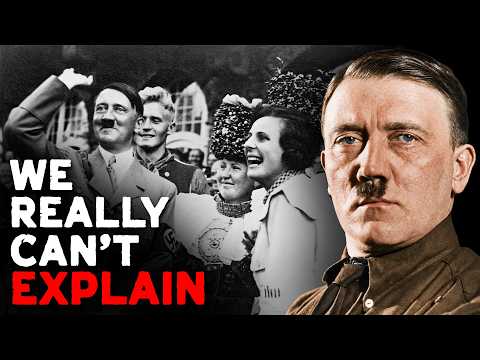
Start with the part almost nobody gets right. He was never actually elected. In 1928, the Nazi Party was a fringe joke. They pulled in just 2.6% of the vote. A splinter group of cranks at the edge of German politics. The kind of party most people forgot existed. Then, the world economy collapsed. The Great Depression tore through Germany, wiped out savings overnight, and threw millions of men out of work. And desperate people go looking for someone to blame.
By 1930, the Nazi vote jumped to around 18%. By July 1932, it hit 37%, making them the single largest party in the Reichstag. Those are big numbers, but here’s the reversal that matters. 37% is not a majority, and he never won one in a free election. The German people did not vote him into supreme power. On the 30th of January, 1933, an aging President Hindenburg, a man who personally disliked him and privately thought him beneath the office, simply appointed him Chancellor. It was a backroom deal.
A circle of conservative politicians had convinced themselves they could install this loud, useful agitator as a figurehead, and steer him from behind the curtain. They were certain they could manage him. They were certain he was the one being used. So, this wasn’t a conquest, and it wasn’t destiny. It was a series of doors that happened to swing open at the worst possible moment, held wide by a group of clever men who were sure they’d be the ones in charge once he was through. And the man walking through those doors had, only a few years earlier, been legally stateless, a person belonging to no country on Earth.
Before he was anyone at all, he was a failure twice over. And the men grading him had no idea what they were turning loose on the world. In 1907, and again in 1908, the Vienna Academy of Fine Arts rejected his application twice. The judges looked at his portfolio and decided he wasn’t good enough to study painting. For years afterward, he drifted through Vienna as a near vagrant, scraping by on copied postcards and small street paintings, sleeping in a men’s home, going precisely nowhere. There was nothing in that young man to suggest power or menace or history. He was a nobody who had already been told twice that he didn’t have the talent he was sure he had.
Now, hold that image, the broke, bitter, twice rejected art student against what came next. His book, Mein Kampf, turned him into one of the richest authors in the entire country. At its peak, royalties brought in close to a million dollars a year. The state itself bought copies by the million. Every newlywed couple in Germany was handed one as a wedding gift, whether they wanted it or not, until something like 8 million copies had moved by 1945. Sit with that arc for a moment. A man who couldn’t get into art school, who once sold hand-painted postcards just to eat, became a millionaire off a rambling book the government forced into the nation’s bedrooms. Even the way he got rich broke the rules. None of it followed the ordinary shape of how a life is supposed to go. And that pattern, the one where nothing tracks the way it should, is about to get much darker.
But before we go any further into the strangeness, there is a number that has to come first, because nothing that follows means anything without it. The doors that swung open in 1933 led directly to the deadliest crime in human history. The Holocaust murdered roughly 6 million Jews. Count the Roma, the disabled, Poles, Soviet prisoners of war, and the other groups the regime marked for death, and the total climbs to around 11 million people. All of it sat inside a war that killed tens of millions more. Most estimates land somewhere between 70 and 85 million dead worldwide before the guns finally went quiet. These are not figures to soften, and they are not figures to explain away. They are the fixed point this whole story turns around.
Everything that comes next, the drugs, the illness, the failing body, the failing mind, sits underneath these numbers, never above them. A man can be a physical wreck and a mass murderer at the very same time. Understanding how broken he was does not make him one degree less guilty. If anything, it makes the scale of what he was allowed to set in motion even harder to bear.
The German public was sold a very specific image of this man. And it was a lie built on purpose, brick by careful brick. He was presented as a kind of secular saint. The ascetic. The man of iron self-discipline who didn’t drink, didn’t smoke, refused even a simple cup of coffee, and ate a plain vegetarian diet while the nation looked on in admiration.
His speeches were engineered along the same lines. Staged in two deliberate phases. He would open quietly, almost gently. His voice low, drawing the crowd in close as if confiding a secret. And then he would build, slowly, patiently, layer on layer until the whole hall was swept up in a frenzy he had timed almost to the second. People walked out shaking, convinced they’d witnessed something holy. It was theater. Every clean, pure, disciplined detail of that image was constructed and polished for public consumption. And the reason it was built so carefully is that it was hiding something underneath. Something the German people were never, ever meant to see.
Behind the picture of the disciplined ascetic was a man getting injected almost every single day. His personal physician was a man named Theodor Morell. A doctor with a reputation for treating illnesses that didn’t exist. The kind of quack the rest of the medical establishment quietly sneered at over dinner. According to Morell’s own logs, he gave his patient one or two injections on most days. Drawn from a private pharmacy of more than 40 different substances.
Among them was Eukodal, a powerful opioid based on oxycodone. There was cocaine added later by another doctor, Erwin Giesing, after the July 1944 bomb plot left him with damaged ears. And there were amphetamine and methamphetamine preparations, stimulants that could swing a person between soaring untouchable confidence and total hollow collapse. A cocktail like that doesn’t keep you sharp. It keeps you upright while it quietly takes you apart from the inside.
Now, a serious word of caution here because this part matters a great deal. Much of the vivid version of this story comes from the writer Norman Ohler who worked through Morell’s notebooks for his book Blitzed. Plenty of respected historians think that account leans too hard on the methamphetamine angle and oversells how central the drugs really were to everything. The real evidence is messier and more uncertain than any clean headline. And Ohler himself has been clear about the single most important point. The drugs do not explain the Nazis’ crimes and they absolutely do not excuse them. This is the story of how a deteriorating man kept himself functioning. It is not, and can never be, a story that hands him an alibi.
And the drugs weren’t even the worst thing failing inside him. The people around him could see his hand shaking. And at least one corner of his own organization seems to have decided to do nothing about it. It started small. A tremor in his left hand noticeable from around 1940. By 1942, his inner circle could plainly see it. By 1944, it had crept to both sides of his body and in the newsreels from 1945 it is unmistakable. A hand he can no longer hold still, tucked behind his back the instant a camera turns his way. The most likely explanation is Parkinson’s disease, though the precise cause is still argued over by specialists to this day.
Here is the unsettling part. The people closest to power saw it too. In early 1945, a professor named Max de Crinis established the diagnosis and passed word up to the SS leadership. A special anti-Parkinson’s mixture was prepared for him. And then it was never actually given to him. One neurologist who studied the case reads that silence as a quiet decision. That elements of the SS had looked hard at their failing leader and concluded the time had come to simply let him fade away. That reading is an interpretation, not a proven plot. What’s actually documented is narrow. The diagnosis, the SS being informed, a treatment prepared and then withheld. The rest is inference drawn from that gap.
And it’s worth holding one more thing steady in view. The careful peer-reviewed consensus is that the disease had little real effect on how the war itself ended. He was falling apart, yes, but the machinery of catastrophe never needed a healthy man at the top to keep grinding.
Here’s the strangest confirmation of all. During the war, America’s intelligence service, the OSS, asked a Harvard psychologist named Dr. Henry Murray to build a profile of him. Murray delivered it in October 1943, while the war was still raging and the ending was anyone’s guess. He studied the man from across an ocean and found a personality that fit no clean category at all.
Murray’s blunt verdict was that this was a man who lacked the offsetting qualities that round out a balanced human personality. And then Murray did something genuinely remarkable. He predicted the ending. He wrote that this was a man who would never surrender, who would, when cornered and beaten, take his own life rather than be captured and put on display. Years before it happened, an analyst thousands of miles away called the final scene almost exactly.
The eerie thing isn’t the prediction, impressive as it is. It’s that the experts who looked closely came back with the same answer the rest of the evidence keeps handing us. Nothing about this man read as normal, not to the roaring crowds, not to the doctors filling his veins, not to the trained analysts paid to take him apart.
The man who couldn’t keep his own hand still finally ran out of doors to walk through. On the 30th of April, 1945, with Soviet troops fighting toward the center of Berlin street by burning street, he died in the bunker beneath the city, aged 56. For decades, conspiracy theories insisted he’d escaped to South America. The science has steadily slammed that door shut. In 2018, a French study of his teeth confirmed the bunker death. In November 2025, a Channel 4 documentary led by geneticist Turi King went further still, working from blood on an authenticated swatch of the bunker couch, confirming once more that he died there and putting to rest the long-running myth that he carried Jewish ancestry.
But not every loop closes neatly. The exact method of his death is still scientifically contested, and those 2025 findings have not yet been through peer review. We know where the story ended, and we know beyond reasonable doubt whose body it was. Some final details remain, even now, not fully settled.
So here’s the single thought worth carrying out of all of this. The comforting version of Hitler is the superman or the singular monster, a once-in-history freak so far outside the human range that he could never be repeated. That story lets us sleep at night, but it simply isn’t the true one. The real man was an accident-prone, twice-rejected drifter kept upright by injections, his body quietly shutting down, his mind judged by trained experts to fit no normal pattern at all. He did not seize power through genius. Economic catastrophe knocked the doors loose, and a circle of confident, self-satisfied men who were sure they could use him held those doors wide open.
That’s the part that should keep you up at night. Reality didn’t just fall short of the myth, it inverted it completely. We expected a mastermind and got an accident with a circle of enablers. And an accident, by its very definition, is the kind of thing that can happen again.
So ask yourself honestly: if the most monstrous figure of the twentieth century was this small, this broken, this accidental, what does that say about how easily the next one could slip through a door we leave open?
Report this article
Select a reason for reporting:






