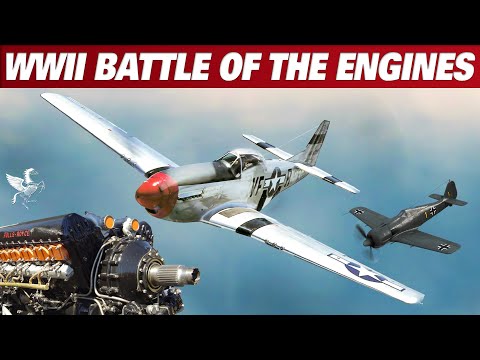
The P-51 Mustang, the most dominant escort fighter of World War II, helped pave the way from England all the way to Berlin for the US bomber force. The Mustang was a revelation, a war-winner, but its creation was triggered by a blend of genius and accident. Its marriage to the two-stage supercharged Merlin engine was the culmination of years of technological development from World War I to World War II. Yet, this union might never have happened. National pride delayed the coupling of these two great innovations, but a new deadly German opponent changed everything.
From 1941, the Focke-Wulf Fw 190 was a first-class fighter that terrorized the skies over Europe. British and American forces swallowed their pride and joined together to create the ultimate fighting machine.
On December 17, 1903, the Wright brothers’ Flyer lifted off successfully, setting aviation in motion. Mankind had already taken to the sky with gliders and balloons, but it was the first time an engine had propelled him through the air. The Wright engine was a raw-oil design that, by today’s standards, produced only 12 horsepower. It was an inline engine, meaning its four cylinders were mounted in a straight line—a layout that would inspire some of the most advanced piston aero engines ever created.
Despite its simple design, the Wright engine was innovative. It was the first engine to use a lightweight cast aluminum crankcase. Every pound counted; a heavier engine might not have written history that winter day in North Carolina. Weight and power would continue to be crucial to aviation development.
As World War I approached, the world’s newly formed air forces needed reliable engines with enough power to sustain flight during operations over France. A new type of powerplant would emerge to take up the fight in the air: the rotary engine. Rotary engines worked differently from the inline engines used by the Wright brothers. The cylinders were arranged in a radial pattern rather than a line. When the engine fired, the crankshaft remained stationary while the crankcase and cylinders rotated around it.
A rotary engine had a huge advantage over the inlines of the era: it was much lighter and thus gave a pilot better performance in combat or when trying to evade an enemy. But the rotary engine was not without its flaws. It had poor fuel economy since it ran at full throttle. It also produced an unpleasant stream of castor oil mixed with fuel for lubrication, resulting in heavy fumes, smoke, and an oil spray that could prove treacherous for pilots.
The gyroscopic effect of the rotating engine meant that turning right at full power could end in death. Rotary-powered aircraft remained part of air force inventories until the end of the war, but they were gradually displaced by the inline engine.
Inlines, based on the same principles as the one found in the original Wright Flyer, continued to improve in power and performance between the wars. Across the Atlantic, a new type of aircraft engine would emerge to dominate American aviation. The US Navy was looking for aircraft to populate its fledgling aircraft carriers. Space on board was extremely limited, but aircraft with inline engines often had long noses; their engines, built with rows of cylinders, took up too much space on cramped carriers. Rotary engines, though more compact, had too many other weaknesses to be serious contenders for the role.
There was, however, a third type of engine that had seen limited experimentation before the war: the radial engine. At first glance, these looked similar to rotary engines. It is only when they are started that the difference becomes clear. In a rotary engine, the crankcase and cylinders rotate around the crankshaft, but with a radial engine, the crankshaft rotates while the engine block is static. Radials were often not as powerful as inline engines, but they were less complicated. They were air-cooled by air flowing over the engine instead of through a liquid cooling system, making radials less vulnerable to battle damage that could rupture coolant lines.
Navy pilots, who might travel long distances over the ocean to reach a target, needed an engine that would be sure to get them home under any circumstances. Most importantly for the Navy, radials were smaller than inline engines, so a larger number of aircraft equipped with them could be stored aboard their carriers.
The Wright Aeronautical Corporation, a successor to the original Wright brothers’ company, used their aviation expertise to create the first reliable radial engine for the Navy: the J-5 Whirlwind. The J-5 was displayed for the world to see when Charles Lindbergh crossed the Atlantic in his Spirit of St. Louis in 1927. His flight cemented the J-5 radial’s reputation as a reliable powerplant. The burgeoning world’s airlines were looking for engines to power their passenger planes and bring passengers across continents and eventually around the globe. Reliable radial engines seemed the ideal choice. Radials would power many of the most important passenger planes in civil aviation history, from the Ford Tri-Motor to the Boeing 247 to the Lockheed Model 10 Electra.
Both the US Navy and US Army Air Corps would rely heavily on radial engines as they built up their inventories of fighters and other aircraft in the 1930s. The US had only one inline engine in development: the Allison V-1710, an engine that would one day power some of America’s great fighters. At the time, it seemed a sensible decision to rely on radials, but in the coming years and in the coming battles, it would leave the US scrambling to catch up with its allies and enemies in Europe.
In Europe in the 1930s, air forces and aircraft manufacturers sought speed above all else as they designed the next generation of fighters. Using streamlined designs and powerful V12 inline engines, they pushed their aircraft to speeds over 350 miles per hour. Their inline engines were not only more powerful; they also helped create more aerodynamic airframes with their elongated shapes, allowing for more streamlined designs compared to radials. Inline engines may have been more vulnerable to attack due to their complex liquid cooling systems, but no matter how durable a radial engine is, speed kills in a dogfight. Inline engines were built to provide exactly that.
It was from this European obsession with speed that some of the legendary fighters of World War II were born, including the Supermarine Spitfire, Hawker Hurricane, and Messerschmitt Bf 109. Under their elegant frames beat increasingly powerful inline engines from Rolls-Royce and Daimler-Benz, respectively.
In mid-1940, RAF pilots tested their mettle and their fighters’ endurance in some of the most spectacular air battles of World War II. Hermann Göring had promised to destroy the RAF and thus ease the invasion of Britain. Göring had at his disposal an armada of medium bombers protected by a deadly fighter force. The outcome of the Battle of Britain during the few vital months of 1940 is well known: there was a heavy toll in fighters and pilots on both sides. British and German engineers tried to squeeze every ounce of power from their engines; any small advantage could be the difference between life and death.
With Britain’s home industry under direct attack, she looked to her old colony more than ever to supply her with desperately needed aircraft. Even before the Battle of Britain, the British Purchasing Commission had already been looking for additional aircraft. The US’s initial offer of fighters was not suitable for the high-altitude air combat taking place over Europe. This was partly due to the available American engines. The US had concentrated on producing radial engines instead of inline engines like those so popular in European fighters.
They had the Allison V-1710. Like the British Rolls-Royce Merlin, it was a 12-cylinder inline engine, but it had a complex turbocharger that was often difficult to fit into an aircraft. To increase power to the thin air at high altitudes, the Allison engine used the heat from its exhaust to drive a turbine, thereby increasing airflow and power. An American aircraft, the Lockheed P-38, had the extra space needed to accommodate the turbocharger. It was a large twin-engine aircraft to begin with and had space in its tail booms for the extra equipment. But given the size of the P-38, it would not have done well against nimble single-engine German fighters in a dogfight.
Smaller fighters powered by the Allison engine, the P-39 Airacobra and Curtiss P-40 Warhawk, both failed to include Allison’s turbocharger. The P-39 had an innovative layout with its engine placed mid-fuselage behind the pilot. It was designed to house both the Allison engine and the turbocharger, but a scoop built into the left side of the fuselage to cool the turbocharger was deemed too aerodynamically costly. The scoop and turbocharger were eliminated from the production design. This change crippled the Airacobra’s ability to fight at high altitudes.
In the case of the P-40 Warhawk, a robust single-engine aircraft, the turbocharger was excluded from the design from the start. This limited its optimal altitude to just 15,000 feet and thus relegated the aircraft to ground attack. The British Purchasing Commission was still interested in the Warhawk, even with its limitations; they saw it as more of an army support aircraft. But the Curtiss factory was running at capacity and could not fulfill the order. Without suitable aircraft readily available for purchase, the British would turn to North American Aviation.
The British Purchasing Commission suggested that North American build the Warhawk under license from Curtiss. NAA president Dutch Kindelberger had a bolder plan. He guaranteed that he could create an even better aircraft using the same Allison engine in less time than it would take for him to retool for Warhawk production. The British said yes, and the end result was an aircraft that may very well have changed the outcome of World War II in Europe.
Back in Europe, Germany was looking for an aircraft to extend the Bf 109. In the Battle of Britain, the Bf 109 and Spitfire were closely matched, but the Bf 109 lacked the range to be highly effective in its escort role over Britain. In the summer of 1940, the Luftwaffe had a twin-engine escort, the Bf 110. It had the range to be an excellent escort, but it lacked the maneuverability to defend itself or its charges in a dogfight. It also used two Daimler-Benz 605 engines, making it an expensive sitting duck for British interceptors.
Looking for a quick fix to the escort problem, the Luftwaffe even considered having the 110s tow the 109s in combat to save fuel, but in the long run, using two aircraft to perform the role of a single fighter was an even more wasteful solution. What the Luftwaffe needed was a dedicated single-engine aircraft to fill in for the Bf 109 on longer-range missions and ideally something that could give them a decided advantage over British fighters.
Yes, but the Luftwaffe wanted to have its cake and eat it too. They wanted a new fighter, but they did not want to sacrifice any of the precious 605 engines intended for the Bf 109. To the Luftwaffe’s dismay, most of the new proposals from the German aircraft industry were to be built around this same engine. To solve Germany’s escort problems, one man, Kurt Tank, Focke-Wulf’s legendary designer and test pilot, did what was almost unthinkable at the time. Since the start of the war, British and German designers had relied on powerful 12-cylinder inline engines to power their fighters. To build Germany’s next fighter around a radial bomber engine—the air-cooled BMW 801 radial engine—had plenty of power and had proven reliable in the Ju 88 and Do 217. Radials in a fighter were a rare sight in Europe. It was difficult to build an aerodynamic fuselage to house them as one would when constructing one for a slender inline engine.
Despite the unconventional design path, Tank saw two reasons for encouragement. First, the National Advisory Committee for Aeronautics in the US had already researched improving airflow around radial engines. Over time, they had developed the NACA cowl, which at least helped reduce drag. This was a simple ring that fit closely around the cylinders of a radial engine, which not only made the engine more aerodynamic but also improved cooling. Second, Tank observed that the American and Japanese navies employed several modern aircraft, all with radial engines. Aircraft like the F4F Wildcat and the Japanese A6M Zero. The lightweight Zero had been almost unstoppable in the early part of the Pacific War. Tank could continue to explore ways to improve his new radial-engine fighter and reduce the drag effect, though some say his greatest task was selling the radial idea to the ministry’s bureaucrats.
Kurt Tank’s first prototypes must have quickly won over the ministry. Given the designation Focke-Wulf 190 and unofficially known as the Butcher Bird, the Luftwaffe’s latest fighter was quickly put into production. Fortunately for the Allies, the Fw 190 arrived after the conclusion of the Battle of Britain. In the summer of 1941, five Mark V Spitfires flying over the south coast spotted several radial-engine fighters at German airfields. At first glance, they were mistaken for US-built Republic Lancers. It was a deadly case of mistaken identity; the aircraft were in fact early model Fw 190s. The Spitfire pilots who survived the ensuing battle lived to tell how quickly their comrades had been lost. But Britain’s greatest loss that day was not pilots or aircraft; the battle marked the day Britain lost its superiority over the Luftwaffe.
The RAF had to do something, and all eyes quickly turned to Rolls-Royce, the manufacturer of the Merlin engine—the powerplant from the Spitfire, Hurricane, and so many of Britain’s great aircraft. Although the company had its next-generation engine, the 12-cylinder Griffon, under development, it was a good year away—more than enough time for Britain to lose the war. Earlier, there had been consideration of modifying a pair of Merlin engines for experimental high-altitude work to be carried out by a Wellington bomber. It was little more than an idea at the time, but in Britain’s hour of desperate need, Rolls-Royce engineers worked night and day to test the concept.
Merlin engines were already supercharged; an air compressor mechanically attached to the rotating camshaft increased airflow to the engine so it could burn more fuel and increase performance. Rolls-Royce engineers had theorized that adding an additional compressor could give the engine even more power for high-altitude work. Could a two-stage supercharger help the RAF regain air supremacy? The end result of the Rolls-Royce experiments was breathtaking. It was almost as if the two-stage Merlin was a completely different engine, while in fact it was only a modification.
When the twin-supercharged aircraft, called the Spitfire Mark IX, finally arrived in June 1942, the RAF had a rare opportunity to test it directly against a captured Fw 190. The test results were very different from the day a group of unfortunate RAF pilots ran into a flock of Butcher Birds. The two aircraft were nearly equal in performance. Captain Eric Brown, who had flown a captured Fw 190, had a chance to test the new Spitfire IX against the German aircraft in a mock combat.
“I had flown the 190 a lot, so I wasn’t that scared. I figured I knew what that aircraft could do, and I knew what my Spit could do, so I thought, go on, I can handle this guy. Hopefully he was one who had just come out of training school, but no, I picked one who really knew what he was doing, and we had, I would say, a trip and back over France, but neither of them could get the upper hand. We finally realized we would both run out of fuel, so we waved our wings at each other and left, and I realized that this really was a first-class fighter.”
The RAF had at least now equal terms with the Luftwaffe, but what the RAF really needed was an aircraft to give them the edge—an aircraft of American design.
Back in the US, North American Aviation had continued work on a Warhawk replacement that met the British Purchasing Commission’s specifications. They had specified that the aircraft would be powered by an Allison engine, cost less than forty thousand dollars, and be armed with four 0.303-inch machine guns. North American responded with the P-51 Mustang. It incorporated an advanced laminar flow wing for good aerodynamic efficiency and a wide-track undercarriage for safer landings.
Easy to fly, the newcomer quickly gained respect from both pilots and ground crews, though mainly at lower altitudes. There were some concerns about how the Mustang would perform if forced to ditch while crossing the Channel during a water landing, where its air scoop located under the fuselage could flood the aircraft or cause it to flip. The water tank was tested at Saunders-Roe to perfect techniques for ditching the aircraft.
Around the same time that the RAF was making the Spitfire Mark IX ready for combat and the Fw 190 was dominating the sky, Rolls-Royce test pilot Ronald Harker was tasked with evaluating all aircraft powered by non-Rolls-Royce engines. He was thoroughly impressed with the P-51A except for its poor high-altitude performance. Like the P-40 Warhawk, it had an Allison engine and no turbocharger. Harker considered how the aircraft might perform with the new Merlin engine. On paper, it was phenomenal. According to Rolls-Royce calculations, with the Merlin powerplant, the Mustang would not only outclass any American aircraft but even new Spitfires using the same engine.
Strangely enough, Harker had to push to get the Merlin 61 and Mustang paired, even though the twin-supercharged P-51 would also have outclassed the Fw 190. Harker finally arranged the marriage between the two great inventions, and test flights confirmed his hunch that the Mustang was a war-winner. The main challenge was producing enough aircraft and engines to regain the skies of Europe. North American would adapt the Mustang design to accommodate the Merlin 61 engine. It was a much more powerful engine, so the original P-51A airframe needed to be strengthened. The three-bladed prop was replaced with a four-bladed one. The addition of underwing drop tanks might have seemed a small change, but it would have a major impact on the coming air battles.
Packard began manufacturing the Merlin 61 engines in the US, where they were designated the V-1650. Packard had arranged a license agreement with Rolls-Royce earlier in the war. Ford was originally intended to build American-made Merlins and seemed a perfect choice due to the company’s industrial might, but Henry Ford was adamant that his company only built defensive weapons.
North American’s twin-supercharged aircraft, the P-51B and P-51C, first flew in the spring and summer of 1943. Air Vice Marshal “Paddy” Harbison remembered when Mustangs first arrived at his Spitfire squadron.
“Of course, the Mustang was a revelation. It was a much more comfortable aircraft than the Spitfire. I’ve heard people talk about the relative merits of both—they were both war winners. The Spitfire was meant as an interceptor; it could become a Mustang until I would climb in it, but it didn’t have the legs most of the time, and of course, if you can’t get the right fighters, you’re not effective.”
As the P-51 began arriving in Europe, the war changed. The Mustang was the perfect aircraft for the time the US took the war to Germany. They bombed the German war industry out of operation. The only problem was that their bombers were being shredded by fast German interceptors. The US had pinned their hopes on their bombers’ ability to defend themselves by maintaining a tight box formation. When this strategy failed, they desperately needed an escort fighter. The P-38 Lightning was simply not agile enough to take on the role. Then there was the P-47 Thunderbolt; it was a great radial-engine fighter that was more than capable of taking care of itself in combat, but it had two major flaws: it was expensive, and it lacked the range to take the bombers all the way to Berlin and back.
The P-51B and C arrived just in time. They were designed to carry drop tanks, and with the addition of a fuel tank behind the pilots, they had more than enough fuel to escort American bombers to Hitler’s lair. The Mustang proved to be more than a match for Germany’s Fw 190 and Me 109. Slowly, American bombers closed in around Berlin. Suddenly, the Germans found themselves on the defensive.
Kurt Tank’s radial-engine Fw 190 struggled at the higher altitudes where the bombers roamed. Tank swapped his radial engine for an inline; the long-nosed aircraft was nicknamed Dora. The later Dora was a splendid fighter with an engine change—not really any structural changes beyond those needed to accommodate the engine. But it meant that here was an aircraft that could keep up with the hunt as the war years progressed. So from 1942 all the way to the end of the war, the Focke-Wulf 190 was at the top of the fighter or fighter-bomber class.
The P-51 Mustang also continued to evolve as mechanics and engineers incorporated changes based on feedback from pilots who had tested the aircraft in combat. Its canopy underwent several permutations; the British swapped the original for a sliding Malcolm Hood similar to a Spitfire’s for improved visibility. The P-51D, the final version of the Mustang, had a bubble canopy that offered 360-degree visibility. North American also upgraded the D’s firepower; it had six .50-caliber machine guns compared to four in earlier models, and it had solved the problem of gun jams during hard turns. The fuel tank behind the pilot may have increased range, but it created other problems: the aircraft had poor directional stability when the tank was full. To counter this, engineers added a small dorsal fin to the D model. These and other improvements would help the Mustang open the way to Berlin for America’s bombers.
Reichsmarschall Hermann Göring, commander of the Luftwaffe, was quoted as saying, “When I saw Mustangs over Berlin, I knew the jig was up.”
When the European war ended, the battle still raged in the Pacific. The Mustang was the best escort available, but even with its incredible range, it could not accompany an aircraft like the B-29 Superfortress on extended bombing missions over Japan’s vast ocean expanses. The distances were too great. Engineers at North American struggled with the problem of extending the Mustang’s range. Their solution was the Twin Mustang—by merging two Mustangs together, they hoped to dramatically increase range while preserving its excellent dogfighting abilities. The new Mustang, the F-82, had an incredible range of 2,000 miles. Although the prototypes were powered by Packard-built Merlin engines, the US Army Air Corps was adamant that the production version should be all-American made. Unfortunately for the F-82, without Merlin engines, it was not the same aircraft. When equipped with the Allison V-1710, its speed dropped and high-altitude performance suffered. It was one of the few cases of a prototype outperforming the production model of an aircraft. By the time the F-82 was ready, Japan had surrendered and the war was over.
After the war, the P-51 continued to serve while other piston-engine fighters of the era quietly retired. Even though it was the beginning of the jet age, there was still a place for the Mustang in a variety of roles. Colonel Rayo Roberts flew the Mustang during its second life.
“At the time I flew it, they called it the F-6, which is a P-51 with cameras. It also had weapons, and you could have bombs and gun armament, and we participated in the post-war mapping program. We mapped, revised all the Japanese maps that were photographed, took aerial photography in Japan and Korea.”
When the Korean War arrived, Mustangs that had been mothballed for long-term storage were suddenly sent across the Pacific on aircraft carriers. Unable to compete with the next generation of jet fighters in the dogfighting role, Mustangs returned to where they started. In Korea, Mustangs made excellent ground-attack aircraft. They didn’t have the speed of jets, but they had the endurance to come from Japan to Korea on bombing runs. The F-82 also had a chance to taste combat for the first time; F-82s flew strike, escort, and night-fighter missions.
The marriage of the P-51 Mustang and the Merlin 61 engine produced incredible results. It gave the Allies an effective escort that hammered the final nail into Germany’s coffin. Perhaps the most amazing thing about the P-51’s stellar career is that it might never have happened. If the Merlin and Mustang had never been paired, following Harker’s suggestion at Rolls-Royce, the P-51 might have had an unremarkable career as a reliable ground-attack aircraft rather than an elite dogfighter. It arrived at the right time and the right place in history, just when the Allies needed an escort fighter. The P-51 was the end result of years of aircraft and engine development. Although jet-powered aircraft would displace it, the impact of the Mustang and Merlin on military history cannot be erased or denied.
As the Mustang’s propeller gave way to the jet age, another British visionary had already seen the future. Frank Whittle’s turbojet, born of a student thesis and years of bureaucratic neglect, finally took flight in 1941. “Frank, it flies,” his colleague whispered—words that would reshape the world.
Whittle’s journey mirrored the Mustang’s: genius delayed by doubt, then vindicated by war. Germany’s jet program, led by Hans von Ohain, had surged ahead, but Britain’s perseverance paid off. The Gloster Meteor entered service in 1944, and the age of jet combat began.
Whittle and von Ohain later became friends, united by their shared vision. “I can only say that it is extremely satisfying,” Whittle reflected, watching jets cross oceans in hours.
Sir Frank Whittle died in 1996, his ashes buried at Cranwell—where jet history began. The Mustang and the Merlin, the jet and its inventor: two stories of unlikely partnerships that changed the world.
What do you think—was the Mustang or the jet engine the greater leap forward?
Report this article
Select a reason for reporting:






