For centuries, the thunder of hooves and the glint of lance tips had decided the fate of Europe. Heavy cavalry, the armored knights of medieval legend, ruled the battlefield with an iron fist. When their charge shattered infantry lines, the slaughter that followed was absolute. But in the 15th century, a ragtag army of farmers and herdsmen from the Swiss mountains would shatter that dominance forever.
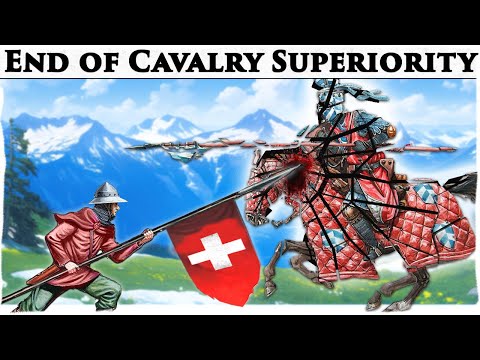
Their weapon was not a new invention, but a revolutionary tactic: the pike square. A dense, bristling hedgehog of men wielding eighteen-foot spears, it was a formation that could stop a charging warhorse dead in its tracks. This is the story of how the Swiss Confederacy turned the tide of war and changed the face of Europe.
The 14th century was a time of transition. Pure infantry armies still struggled against mounted knights, and victories like the Battle of the Golden Spurs in 1302 were rare exceptions. At Courtrai, the Flemish infantry had used rivers and swamps to neutralize the French cavalry, cutting them down in the mud and seizing 500 golden spurs as trophies. But such triumphs relied on terrain, not on a new way of fighting.
The Swiss, however, learned from these examples and improved upon them. They deployed in deep formations called Gewalthaufen, or “crowd of force,” which could absorb a cavalry charge and hold its ground. Yet even they initially had to lure enemies into bottlenecks and forests, as at the Battle of Morgarten in 1315, where they ambushed a Habsburg army in a mountain pass.
Around the middle of the 15th century, the Swiss made a crucial adjustment. They increased the number of heavily armed men wielding long pikes, forming the outer ranks of the square. These men wore half-armor that protected vital parts but was cheap and did not restrict agility. This innovation allowed infantry to resist cavalry in open field for the first time.
Previously, Swiss armies were mostly lightly armored levies with assorted weapons. Now, pikes up to six meters long outmatched cavalry lances and deterred horses from charging. The pike square was not just a defensive anvil; it became a hammer. At the Battle of Laupen in 1339, the Swiss used a square to defend against cavalry while the rest of the infantry charged the enemy foot, then turned on the cavalry.
When facing cavalry, the Swiss closed ranks, lowered pikes, and braced for impact. After the charge lost momentum, halberdiers burst from the square to cut down the attackers. Against infantry, they charged with lowered weapons, forcing enemies to impale themselves or retreat. The mass and momentum of the formation often broke enemy lines on impact.
This aggressive spirit was noted by historians, who described a “primal force of the wild farmer and herdsman” that gave the Swiss pike square a terror-spreading impetus. Their all-or-nothing mentality was exemplified at the Battle of Grandson in 1476, where they faced the modern Burgundian army of Charles the Bold.
Despite enduring artillery fire, the Swiss squares held steady until reinforcements arrived. Then they charged, catching the Burgundians off guard and routing them, seizing treasures including the famous Sans Souci diamond. This battle showed that a cheap infantry force could defeat the best-equipped army in Europe.
The Swiss tactics worked so well that they were soon adopted by other European powers. The Landsknechts, German mercenaries, copied the pike square, and clashes between Swiss and Landsknechts became known as “bad war” due to their ferocity. The Spanish also hired Swiss instructors and based their infantry on the Swiss model.
But the Swiss would soon face their own challenge. At the Battle of Cerignola in 1503, Spanish arquebusiers and cannon decimated a French-Swiss force, marking the first battle in Europe won by gunpowder. The pike square had met its match, and the Swiss were slow to adapt. Yet their innovations left a lasting legacy: cavalry would never again dominate the battlefield as it once had.
The age of pike and shot was dawning, and the Swiss mercenaries, though eventually overshadowed, had ignited a revolution in warfare that would shape the centuries to come.
The echoes of that revolution rippled outward from the Swiss mountains into every corner of Europe. Kings and princes who had once poured gold into the coffers of knightly retinues now stared at their ledgers and saw a different arithmetic. Why pay the revenues of a small barony for a single man-at-arms when a hundred pike-wielding farmers could be drilled for a fraction of the cost? The question answered itself on battlefield after battlefield.
Yet the story of the pike square is not simply one of triumphant peasants humbling proud knights. It is a story of relentless adaptation, a military arms race in which every innovation bred a counter-innovation. The cavalry did not simply vanish from the field; it evolved, shed its heavy armor, and learned new tricks.
By the early 16th century, the man-at-arms had become a ponderous creature. His armor, including that of his horse, could weigh up to 150 kilograms—roughly 350 pounds. A single warhorse could no longer bear such a burden for long, so each knight kept two or three mounts at the ready. The cost was staggering, and commanders began to question whether such expensive warriors still earned their keep.
It was in this crucible of cost and necessity that a new breed of cavalry emerged. The German Schwarze Reiter, or Black Riders, abandoned the lance and the full harness for a lighter approach. They carried pistols—short, wheel-lock firearms that could be discharged at close range before wheeling away to reload. This “caracole” tactic allowed cavalry to harass pike formations without ever committing to a suicidal charge.
The Spanish, meanwhile, had been busy perfecting their own synthesis of Swiss and Moorish traditions. Their tercios combined pike squares with arquebusiers and musketeers in a formation that could both withstand cavalry and deliver devastating firepower. The tercio was not merely a defensive hedgehog; it was a self-contained army in miniature, capable of advancing, firing, and repelling attacks from any direction.
At the Battle of Pavia in 1525, the Spanish tercios demonstrated their lethal efficiency against the flower of French chivalry. King Francis I of France was captured, and his heavy cavalry, once the terror of Europe, was broken by disciplined infantry and massed gunfire. The message was unmistakable: the age of the knight as the decisive arm of battle had passed.
But the pike square itself was not destined to rule forever. The growing sophistication of firearms—arquebuses, then muskets, then field artillery—slowly eroded the dominance of massed infantry. A deep column of men made a tempting target for cannonballs, and the smoke and noise of gunpowder battles demanded new levels of discipline and coordination.
Military thinkers across Europe wrestled with these problems. Maurice of Nassau, the Dutch stadtholder, introduced a system of drill and countermarch that allowed soldiers to fire and reload in continuous rotation, maximizing the firepower of every formation. His reforms, later refined by Gustavus Adolphus of Sweden, pointed toward a future in which firepower, not cold steel, would decide battles.
The Swiss mercenaries, once the most sought-after soldiers in Europe, found themselves increasingly sidelined. Their pike squares, so formidable against cavalry, were vulnerable to well-handled artillery and disciplined musketry. The very efficiency that had made them famous now made them predictable, and predictability on a gunpowder battlefield was a fatal flaw.
Yet the Swiss legacy endured in more subtle ways. The concept of a standing, drilled infantry force—cheap, loyal, and effective—had taken root in the minds of Europe’s rulers. The idea that common men, properly trained and led, could defeat the aristocratic elite of the battlefield was a genie that could not be put back in the bottle.
As the 16th century gave way to the 17th, the battlefields of Europe grew ever more complex. Armies swelled in size, logistics became as important as tactics, and the distinction between infantry, cavalry, and artillery blurred into a combined-arms dance. The pike square and the knight had both been transformed by the same relentless logic of innovation and adaptation.
But before the age of pike and shot reached its zenith, one more great clash would remind Europe of the terrible price of outdated tactics. The memory of Cerignola lingered, a warning to those who clung too long to the methods of the past.
That warning was not lost on the Swiss themselves. Their defeat at Cerignola had stung, and the confederacy’s captains understood that the hedgehog alone could no longer win battles. Slowly, grudgingly, they began to attach small detachments of handgunners to their squares—a few men with primitive firearms who could fire a volley before retreating behind the wall of pikes. It was a modest reform, but it signaled that the Swiss were willing to learn from their enemies.
The problem was one of speed and scale. The Swiss system was built on mass, momentum, and the shock of the charge. Firearms demanded patience, precision, and a tolerance for standing still under fire—qualities that ran against the grain of the mountain infantry’s aggressive spirit. Their handgunners were too few, too slow to reload, and too lightly supported to make a real difference against the disciplined volleys of Spanish arquebusiers.
Meanwhile, the Spanish had taken the Swiss lesson and improved upon it. Their tercios were not merely pike squares with a few guns bolted on; they were integrated formations in which pikes and firearms protected each other. The arquebusiers could shelter behind the pikes to reload, and the pikemen could advance under the covering fire of the shot. It was a synergy that the Swiss, with their separate contingents, could not match.
By the middle of the 16th century, the battlefield had become a testing ground for these competing systems. In Italy, in the Low Countries, and along the frontiers of the Holy Roman Empire, captains watched and learned. The French, who had once relied on their gendarmes and their Swiss mercenaries, began to experiment with their own mixed formations. The Habsburgs, masters of Spain and Austria, fielded tercios that seemed invincible.
Yet the pike did not disappear. It remained the queen of the battlefield for another century, because nothing else could stop a determined cavalry charge or anchor a line of infantry. The pike square had become the foundation upon which all other arms depended—the steady rock around which the waves of shot and horse broke.
The cavalry, for its part, had not given up. The Black Riders and their pistol tactics were only the beginning. In France, the gendarmes adapted by charging in shallower ranks, relying on speed and shock rather than the ponderous weight of full armor. In Poland, the winged hussars would soon develop a charge so devastating that it could break even the most disciplined infantry.
But the age of the knight as the decisive arm was over. The future belonged to the combination of pike and shot, to the drill and discipline of professional soldiers, and to the growing power of gunpowder. The Swiss had lit the fuse, and Europe was only beginning to feel the explosion.
By the dawn of the 17th century, the pike square had become the backbone of every major army in Europe. From the Dutch Republic to the Swedish Empire, commanders drilled their men in the same fundamental rhythms the Swiss had pioneered. The hedgehog of steel was no longer a curiosity of mountain farmers—it was the foundation of modern warfare.
Yet the Swiss themselves had become relics. Their confederacy, once the terror of Europe, now sold its sons as mercenaries to the highest bidder. The French kings still kept a Swiss Guard, but their role was ceremonial—a living monument to a revolution they had sparked but could not control.
The lesson of the pike square outlived the pike itself. It proved that ordinary men, drilled and determined, could shatter the mightiest knights. That idea would echo through the centuries, from the musket lines of Napoleon to the trenches of the Somme.
So the question remains: when the next revolution in warfare arrives, will we recognize it before it runs us down? What do you think—are we facing such a moment today?
Report this article
Select a reason for reporting:






