In the annals of wartime atrocities, few stories are as chilling as the tale of two Japanese officers who allegedly raced to behead 100 people with their swords. It was a contest that would later shock the world, spark decades of controversy, and become a symbol of the brutality of the Nanjing Massacre. But what really happened on the road to Nanking in 1937? And how did a newspaper story turn into a global controversy that still reverberates today?
The story begins in December 1937, when the Osaka Mainichi Shimbun and Tokyo Nichi Nichi Shimbun published a series of articles describing a macabre competition between two lieutenants, Toshiaki Mukai and Tsuyoshi Noda. According to the reports, the two men had set out to see who could be the first to kill 100 Chinese people using only their swords. The contest, they claimed, took place during the heat of battle as the Japanese army advanced toward Nanking.
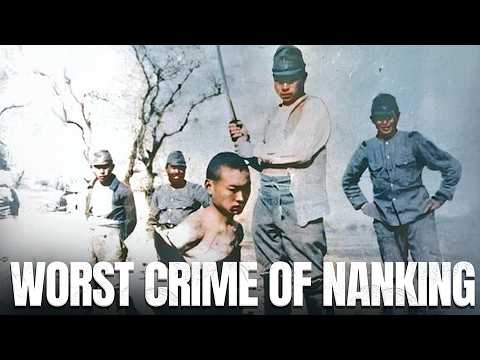
The newspapers sensationalized the story, with headlines like “Incredible record in the competition to behead 100 people. Mukai 106, 105 Noda. Both second lieutenants go into overtime.” The articles captured the public’s imagination, portraying the officers as modern-day samurai engaged in a noble duel. But behind the glory, a darker truth lurked.
As the Japanese army closed in on Nanking, the competition reportedly continued. The two men, according to the papers, had surpassed their goal during the chaos of battle, making it difficult to determine a winner. So they decided to extend the contest to 150 kills. The story was picked up by other newspapers, including the Japan Advertiser, and the two officers became minor celebrities back home.
But the tale began to unravel when Noda himself, after returning to Japan, admitted in a speech that “I killed only four or five with the sword in real combat. After capturing an enemy trench, we would tell them, ‘Nilai lai.’ The Chinese soldiers were stupid enough to come out of the trench toward us one after another. We lined them up and cut them down from end to end.” His words painted a picture not of honorable combat, but of cold-blooded execution.
After the war, the story resurfaced in the documents of the International Military Tribunal for the Far East. In 1947, Mukai and Noda were arrested by the US Army and detained in Sugamo Prison. They were then extradited to China and tried by the Nanjing War Crimes Tribunal. Alongside them stood Gunkichi Tanaka, a captain who had personally killed more than 300 Chinese prisoners and civilians with his sword during the massacre. All three were found guilty of atrocities and sentenced to death. On January 28, 1948, they were executed by firing squad at Yuhuatai District.
But the story did not end there. In Japan, the event faded into obscurity until 1967, when historian Tomio Hora published a paper on the Nanjing events. Then, in 1971, journalist Katsuichi Honda brought the subject back to public attention with a series of articles in the Asahi Shimbun, based on interviews with Chinese survivors. The articles ignited a fierce debate over the Nanjing Massacre and the truth of the killing contest.
Some argued that the contest was a fabrication by journalists, while others insisted it was a real reflection of the brutality of the Japanese army. The controversy deepened in 2003 when the families of Mukai and Noda filed a defamation lawsuit against Honda and the media companies. The Tokyo District Court ruled against the plaintiffs in 2005, stating that discussions about the soldiers’ behavior did not infringe on their rights since they were deceased. The court also noted that the newspaper article was highly questionable but that second-hand discussions did not constitute defamation.
In the end, the story of the beheading contest remains a controversial and dark chapter in history. It serves as a reminder of the horrors of war and the power of media to shape public perception. As we delve deeper into this story, we will explore the evidence, the testimonies, and the lasting impact of this macabre competition.
The 2005 ruling did not settle the matter. Instead, it left historians and the public grappling with a fundamental question: if the contest was exaggerated by journalists, why did it resonate so deeply? The answer lies in the broader context of the Nanjing Massacre, where countless atrocities were committed, and the killing contest became a grotesque symbol of that violence.
In the years that followed, researchers like Bob Wakabayashi examined the newspaper articles and military records with fresh eyes. Wakabayashi concluded that while the contest itself was likely a fabrication, it inadvertently exposed a truth: the Japanese army routinely executed prisoners of war in mass numbers. The lieutenants’ own admissions, along with testimonies from other veterans, confirmed that beheadings of captured Chinese soldiers were commonplace.
One such veteran, Shintaro Uno, described his own experience of decapitating nine prisoners in his autobiography. He wrote that as a young man, he had been inspired by stories of hand-to-hand combat, but after the war, he realized those deaths were nothing more than brutal executions. “No matter what you say, it’s nonsense to argue whether it happened this way or that way when the situation is clear,” Uno wrote. “There were hundreds of thousands of soldiers like Mukai and Noda, including myself, during those 50 years of war between Japan and China.”
His words echoed the grim reality that the killing contest, whether real or invented, was not an anomaly but a reflection of systemic violence. The Japanese press had glorified the officers, turning them into folk heroes, but the truth was far more disturbing.
In China, the story took on a different meaning. The Nanjing Massacre Memorial Hall includes an exhibit about the contest, presenting it as evidence of Japanese brutality. Yet some historians, including Wakabayashi, have warned that relying on a fabricated story can backfire. “Accepting the story as true and accurate requires a leap of faith that no balanced historian can make,” Wakabayashi wrote, citing Joshua Fogel. The exhibit, while powerful, has given revisionists an opening to question the entire memorial’s credibility.
Meanwhile, in Japan, the debate over the Nanjing Massacre continued to simmer. Conservative politicians like Tomomi Inada demanded retractions from the Asahi and Mainichi newspapers, arguing that the contest story had been debunked. The Asahi eventually retracted some of its wartime reports in 2014, but the move only intensified the controversy. For many, the retraction seemed to validate the revisionists’ claims, even though the broader evidence of atrocities remained overwhelming.
Filmmakers also seized on the story. The 1994 film Black Sun: The Nanking Massacre depicted the contest as a symbol of the horror, while the 2009 film John Rabe included it as a background detail. These portrayals kept the story alive in the public imagination, ensuring that each new generation would confront its unsettling legacy.
But perhaps the most poignant perspective came from the soldiers themselves. Noda’s confession—that he had killed only four or five in actual combat and the rest were executed prisoners—revealed the gap between the myth and the reality. The contest was not a duel of honor; it was a cover for mass murder. And yet, the newspapers had sold it as a heroic tale, a testament to the power of propaganda.
As the 21st century progressed, the killing contest became a case study in how history is distorted, contested, and weaponized. It was no longer just about two officers and their swords; it was about memory, truth, and the ways in which nations confront—or avoid—their darkest chapters.
In the decades that followed, the killing contest continued to cast a long shadow over Sino-Japanese relations. Whenever tensions flared between the two nations—over territorial disputes, historical textbooks, or memorial ceremonies—the story of Mukai and Noda resurfaced as a flashpoint. For Chinese commentators, it was proof of Japanese denialism; for Japanese nationalists, it was proof of Chinese exaggeration. Neither side seemed willing to let the ghosts of 1937 rest.
Yet beneath the political noise, a quieter reckoning was taking place among Japanese veterans and their families. Some, like the relatives of the executed officers, struggled with a complicated inheritance. They had grown up hearing stories of brave soldiers who died for their country, only to discover that those same men had been convicted of war crimes. The 2003 defamation lawsuit was, in part, an attempt to reclaim a version of their ancestors that the postwar world had rejected.
The court’s refusal to grant that reclamation was a bitter pill. Judge Akio Doi acknowledged that the original newspaper reports were “extremely questionable,” but he stopped short of declaring the officers innocent. Instead, he suggested that the contest, even if embellished, pointed to a larger truth: that Japanese soldiers had killed prisoners of war with swords. That conclusion, carefully worded and legally cautious, infuriated both sides. The families had wanted exoneration; the activists had wanted condemnation.
What emerged from the trial, however, was something more valuable than a verdict. The proceedings forced a public airing of documents and testimonies that had long been buried. Military records, diary entries, and eyewitness accounts were submitted as evidence, painting a detailed picture of the Nanjing campaign. For the first time, ordinary Japanese citizens could read, in their own language, what their army had done.
One of the most damning pieces of evidence came not from Chinese survivors but from Japanese soldiers themselves. A private named Yoshio Kondo testified that he had witnessed officers ordering prisoners to kneel at the edge of trenches before decapitating them. “It was like a competition to see who could cut the cleanest,” he recalled. “The officers would laugh and compare their technique.” Kondo’s testimony was not about Mukai or Noda specifically, but it lent credence to the idea that such contests—formal or informal—were not unheard of.
Historians like Wakabayashi seized on these accounts. They argued that the killing contest, whether or not it happened exactly as reported, was a symptom of a military culture that normalized atrocity. The Japanese army in China operated with a brutal logic: prisoners were a burden, resources were scarce, and brutality was rewarded. In that environment, beheading a captive was not a crime but a chore.
This interpretation gained traction in academic circles but struggled to penetrate popular memory. In Japan, the story of the contest remained either unknown or dismissed as enemy propaganda. In China, it was remembered but often simplified into a morality tale of good versus evil. The nuance—that the contest was likely exaggerated but pointed to real horrors—was lost in the shuffle.
Meanwhile, the families of Mukai and Noda faded from public view. They had lost their legal battle, but they had also lost something more intangible: the ability to mourn their ancestors without ambiguity. In a small ceremony in 2007, a few relatives gathered at a temple in Kyoto to pray for the two men. They did not speak to reporters. But one elderly woman, identified only as a niece, whispered to a local journalist: “I just want people to know they were human beings, not monsters.”
It was a plea that resonated with some and angered others. For the victims of Nanjing, the humanity of the perpetrators was precisely the problem. How could ordinary men—fathers, brothers, sons—commit such acts? And how could a nation move forward without confronting that question?
The niece’s plea hung in the air, unanswered. In Nanjing, survivors and their descendants lit incense at the memorial, their grief still raw after seventy years. “They were not monsters,” one survivor said, “but they were killers. We cannot forget.”
The killing contest, whether fact or fiction, had become a mirror. It reflected the worst of humanity and the best of our attempts to reckon with it. The two lieutenants, executed for their crimes, left behind a legacy of shame and debate that refuses to die.
Today, as the last witnesses fade, the story remains a warning. It asks us to confront uncomfortable truths about war, memory, and the stories we tell. What do we owe the dead—and what do we owe the truth?
What do you think? Should the killing contest be remembered as fact, symbol, or lie? Share your thoughts below.
Report this article
Select a reason for reporting:






