In the golden age of Hollywood, where spotlights blinded and cameras captured only what studios allowed, love stories unfolded in shadows. Behind the glamorous premieres and manufactured romances, some of the industry’s biggest stars lived secret lives, their hearts entwined in relationships that could destroy careers if exposed. These are the untold tales of ten real gay celebrity couples—partnerships that defied societal norms, survived decades of deception, and left an indelible mark on history.
From tragic reckonings to triumphant escapes, each story reveals a different facet of the struggle for authenticity in a world that demanded conformity. Their courage and sacrifice paved the way for future generations, and their legacies continue to resonate today.
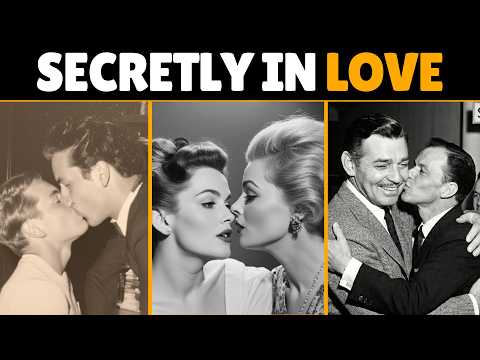
Rock Hudson, the ultimate heartthrob of romantic comedies, lived a double life that ended in tragedy. Behind closed doors, he shared a significant partnership with Mark Christian, a love that lasted into the 1980s. But when Hudson kept his AIDS diagnosis secret from Christian, it sparked a landmark lawsuit that forced America to confront both the disease and the devastating cost of secrecy. Hudson’s death in 1985 marked a turning point, exposing the human toll of the closet.
Equally compelling is the story of Raymond Burr, television’s Perry Mason. For over three decades, Burr shared his life with actor Robert Benevides, constructing an elaborate deception that included a fictional deceased wife and son. Their love endured through Perry Mason’s entire nine-season run and beyond, hidden in plain sight. They built a vineyard together in Sonoma County, a tangible legacy of their shared life, while the world remained oblivious.
Then there’s Cary Grant and Randolph Scott, two of the era’s most dashing leading men. They lived together on and off throughout the 1930s and early 1940s, their beachside bachelor pad infamous among industry insiders. Photographed in domestic bliss, wearing matching outfits and cooking side by side, they were initially promoted as charming evidence of male friendship. But the whispers never stopped, and when Paramount pressured them to separate residences, colleagues reported both men seemed genuinely heartbroken.
James Dean burned bright and fast, leaving behind just three major films and a legacy of rebellion. During his meteoric rise, he was involved with advertising executive Jack Simmons. Simmons later spoke about their connection, describing Dean as tortured by the impossible standards of masculinity Hollywood demanded. Dean’s bisexuality was an open secret among his circle, but the studio system worked overtime to craft his image as the ultimate heterosexual rebel. Simmons attended Dean’s funeral in 1955 but sat unrecognized among the mourners, his role erased from the official narrative.
Sal Mineo’s story is particularly complex. He publicly dated women, including actress Jill Haworth, while privately pursuing relationships with men. Haworth later confirmed their romance was partly for show, a mutual arrangement that benefited both their careers. Mineo became one of the first major stars to acknowledge his sexuality before his death, telling a magazine in 1976 that he was bisexual—a staggering act of courage for the time. Tragically, he was murdered just weeks later at only 37 years old.
Will Geer, beloved as Grandpa Walton, had a relationship with Harry Hay in the 1930s. Hay would go on to found the Mattachine Society, one of America’s first gay rights organizations. Geer, meanwhile, pursued acting while remaining active in leftist political circles, eventually blacklisted during the McCarthy era. His relationship with Hay occurred before his marriage to actress Herta Ware, whom he openly told about his sexuality. Ware accepted it, and they raised three children together while Geer maintained involvement in both gay rights and progressive causes.
Montgomery Clift’s tortured genius is well documented, but his relationship with actor Jack Larson is less known. Larson, who played Jimmy Olsen on the original Superman series, was part of Clift’s inner circle during his most troubled years. Friends described their connection as deeply intimate, though both men also had relationships with women. Clift struggled intensely with his sexuality, living in a time when exposure could mean career death. Larson stood by him through the worst of it, part of a small group of friends who tried desperately to help Clift.
George Nader and Mark Miller offer a rare happy ending. As rumors about Nader’s sexuality grew, Hollywood turned cold. Rather than fight it, Nader made a radical choice: he walked away from American stardom and moved to Europe with his partner Mark Miller. Their relationship lasted over 50 years, far from Hollywood’s judging eyes. Nader found new success in Germany, and the two eventually settled down, building a life together that defied the era’s expectations.
Liberace’s relationship with Scott Thorson became one of Hollywood’s most sensational scandals when Thorson sued for palimony in 1982. The lawsuit exposed not just their relationship, but the elaborate measures Liberace took to hide it, including allegedly having Thorson undergo plastic surgery to look more like him. Liberace vehemently denied everything, but the damage was done. His carefully constructed public persona crumbled, though he never publicly acknowledged the truth.
Finally, Kerwin Mathews, the heroic lead in fantasy adventures like The Seventh Voyage of Sinbad, made a quiet exit from the spotlight. He moved to San Francisco and lived openly with his partner Tom Nicoll for over 40 years. Their relationship existed far from Hollywood’s glare, in a city that offered more freedom and acceptance. Friends remembered them as a devoted couple who found genuine happiness by stepping away from an industry that would never have let them be themselves.
These ten couples remind us that love existed even when society demanded silence, and that genuine partnerships flourished behind the studio system’s manufactured romances. Their stories are not just about hidden love, but about the resilience of the human heart.
What binds these ten stories together is not merely secrecy, but strategy. Each couple developed their own private architecture of survival—some through fabricated families, others through geographic exile, and a few through the simple, radical act of living openly in communities that allowed it.
Consider the mechanics of Burr’s deception more closely. He didn’t merely omit the truth; he constructed an alternate reality so detailed that it fooled journalists for decades. He spoke of a wife and son lost in a plane crash, a tragedy that invited sympathy rather than scrutiny. The fiction served as armor, and Benevides moved through Burr’s world as a business associate, tending orchids and vines while the man he loved performed heterosexuality for the cameras.
Grant and Scott operated differently. Theirs was a partnership conducted in the open, dressed up as bachelor camaraderie. Studio publicists actually leaned into the arrangement at first, framing two handsome men sharing a home as a Depression-era story of thrift and friendship. Only when the whispers grew too loud did Paramount intervene, and the separation that followed left both men visibly diminished.
James Dean’s story carries a particular cruelty. He was celebrated precisely for the raw authenticity he brought to the screen—that coiled vulnerability in Rebel Without a Cause—while being forbidden from living that authenticity off-screen. Jack Simmons watched from the periphery as the industry packaged Dean’s pain into a marketable image of straight rebellion. The funeral detail lingers: Simmons in the crowd, mourning a man the world believed he had no claim to.
Sal Mineo’s arc bends toward a different kind of tragedy. He told the truth in 1976, weeks before his death, and the timing feels almost unbearable—as though honesty and oblivion arrived together. Jill Haworth, his beard and genuine friend, understood the arrangement for what it was: two careers propped up by a performance neither of them enjoyed. Mineo’s murder robbed him of the years when his confession might have become a platform rather than a footnote.
Then there is the matter of Will Geer and Harry Hay, where the personal and the political fused. Geer’s marriage to Herta Ware was not a cover in the conventional sense—Ware knew, accepted, and built a family alongside him. What Geer modeled was something rarer: a life where queerness and marriage and activism coexisted without any one identity canceling the others. Hay took the lesson further, founding the Mattachine Society and transforming private pain into public movement.
Montgomery Clift and Jack Larson represent the cost when secrecy meets self-destruction. Clift’s accident, his dependence on alcohol and pills, his spiraling—Larson witnessed all of it. Larson later called Clift the love of his life, a confession that arrived decades after the man himself was gone. The parties they attended together, hidden gatherings in the hills, were brief reprieves in a life otherwise spent performing damage control.
And then there are the escapes. Nader and Miller chose Europe. Mathews and Nicoll chose San Francisco. Both couples discovered the same truth: the closet was not a place but a condition, and the only cure was distance from the machinery that demanded it. Their happy endings were not granted—they were built, deliberately, at the cost of fame.
What emerges from these ten lives is a pattern of quiet rebellion, each couple improvising its own survival. Some paid with their lives, others with their legacies, and a few with nothing more than the anonymity they willingly embraced.
The pattern extends beyond these ten, of course. Every studio-era contract contained an unwritten clause: your private life belongs to us. Actors who refused the terms simply vanished from marquees, their names scrubbed from casting lists with no explanation offered. The system didn’t need to destroy people openly—it only needed to withhold work until they complied or disappeared.
What changed, eventually, was not the industry’s generosity but its economics. When audiences began rewarding honesty, the calculus shifted. Stars who came out in later decades discovered that authenticity, once fatal, had become a kind of currency. The closet stopped being profitable, and that—more than any moral awakening—is what finally cracked it open.
Still, the old stories matter. They matter because the people in them never got to see the world they made possible. Hudson didn’t live to witness the turning point his death helped force. Mineo didn’t survive to build on his confession. Clift never knew that his love would one day be spoken aloud.
Their silence purchased something for the generations that followed, and the least we can do is remember who paid. The vineyard still stands in Sonoma. The beach house still holds its ghosts. Love, it turns out, leaves evidence even when history tries to erase it.
So here’s the question worth carrying forward: if the price of honesty was once everything, and the price of hiding was the same—which choice would you have made?
Report this article
Select a reason for reporting:






