Every day, billions of people handle the US dollar bill without a second thought. It feels eternal, as American as the flag itself. But here’s the shocking truth: the modern dollar bill—the small, green, standardized note you know—did not exist until 1929. For over 150 years after independence, there was no such thing. What Americans used as money was so chaotic, so bizarre, and so riddled with fraud that it will change how you see the paper in your pocket.
Imagine walking into a store in 1750. You might pay with a Spanish silver coin cut into pieces, a British pound, or even tobacco. There was no national currency—just a free-for-all of foreign coins, barter, and local scrip. The word “dollar” itself came from a German coin, and the Spanish piece of eight was the de facto currency. When colonists needed change, they literally sliced the coin like a pie—giving us the phrase “two bits.”
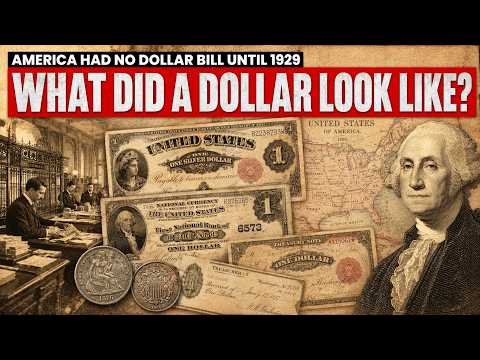
The Revolution brought the first national paper money: Continentals. But the government printed them with reckless abandon, and by 1781 they were worthless—“not worth a continental.” The trauma was so deep that the Founding Fathers refused to allow paper money in the Constitution. Instead, they built the system on metal, creating the silver dollar in 1792. But coins were heavy and scarce, so private banks filled the void.
From 1837 to 1863, the Free Banking Era unleashed 8,000 different kinds of banknotes from 1,600 banks. Counterfeiting was epidemic. “Wildcat banks” issued worthless paper from remote locations, vanishing before anyone could redeem them. Merchants consulted thick “counterfeit detectors” just to verify a bill. It was financial anarchy.
The Civil War finally forced the federal government to act. In 1862, the Legal Tender Act created the first “greenbacks”—paper money not backed by gold or silver. The first $1 bill featured Salmon P. Chase, not George Washington! These large, ornate notes circulated alongside national banknotes, silver certificates, and gold certificates, each with different colors and backing.
By the early 20th century, the system was a logistical nightmare. The Panic of 1907 led to the creation of the Federal Reserve in 1913, which introduced Federal Reserve notes. But the physical money remained stuck in the 19th century—oversized and varied. That is, until 1929, when everything changed.
On July 10th, 1929, the government began issuing a completely redesigned currency. Every note was shrunk to a uniform size—about 6.14 by 2.61 inches, roughly 30% smaller than the old “large-size” bills. For the first time in American history, a $1 bill was the same size as a $100 bill. The Treasury estimated the smaller notes would save $800,000 a year in paper and ink alone. But the redesign was about more than money—it was about standardization.
Each denomination was assigned a permanent portrait: Washington on the one, Jefferson on the two, Lincoln on the five, Hamilton on the ten, Jackson on the twenty, Grant on the fifty, Franklin on the hundred. These are the same faces that stare back at you today, nearly a century later. The backs were redesigned too, though it took a few more years for the final versions to appear.
The first small-size $1 notes issued in 1928 featured an oddly plain reverse—a large printed ONE in a simple green border. People thought they looked so strange they nicknamed them “funnybacks.” It wasn’t until 1935 that President Franklin Roosevelt and his Secretary of Agriculture, Henry Wallace, commissioned a new reverse design featuring the Great Seal of the United States.
And here’s a detail almost nobody knows. Wallace had been reading a book about the Great Seal and was struck by the Latin phrase novus ordo seclorum—”a new order of the ages.” He brought the idea to Roosevelt, suggesting that the unfinished pyramid with the Eye of Providence above it would be a powerful symbol for a nation rebuilding itself during the Great Depression. Roosevelt agreed, and the design went to print.
It’s one of the most analyzed and speculated-about images in American culture, inspiring conspiracy theories and secret-society lore for decades. But its origin was remarkably practical: two government officials flipping through a book and deciding they liked the look of it.
Now, step back for a moment and consider what this entire journey actually reveals. For over 150 years, the United States—the nation that would eventually become the world’s dominant economic power—could not figure out what its money should look like. From Spanish coins cut into pieces with knives, to worthless Continental script, to thousands of competing private banknotes, to oversized greenbacks issued in a Civil War, to a confusing jumble of gold-backed, silver-backed, and government-backed paper all circulating at once—the story of the American dollar is a story of constant improvisation, political compromise, and periodic catastrophe.
Each phase reflects something deeper about the country itself. The colonial reliance on foreign coins speaks to the reality of imperial dependence. The Continental disaster reveals the fragility of revolutionary ambition when it isn’t backed by economic power. The Free Banking Era’s chaos mirrors a nation expanding faster than its institutions could keep up—a country so committed to decentralization that it couldn’t even agree on what counted as money.
The Civil War greenbacks represent the moment the federal government finally asserted authority over the national economy, using the crisis of war to do what it couldn’t do in peacetime. And the creation of the Federal Reserve in 1913, followed by the redesign of 1929, marks the culmination of a century-long struggle to build a monetary system worthy of a global superpower.
But there’s another thread running through this story, one that matters enormously to the present day. Every major change in American currency was driven not by rational planning but by crisis. The Continental was born from the desperation of revolution. The greenback was born from the desperation of civil war. The Federal Reserve was born from the Panic of 1907, when the entire banking system nearly collapsed and had to be rescued by a single private citizen, J.P. Morgan, because there was no central bank to act as lender of last resort.
And the 1929 redesign arrived just months before the stock market crash that triggered the Great Depression—a crisis that would transform the dollar yet again when Roosevelt took the country off the gold standard in 1933. Over and over, the pattern repeats. The system works until it doesn’t. Then crisis forces a change. Then the new system works until it doesn’t either.
This raises a question that feels especially urgent right now, in a world where the dollar’s dominance is being challenged by digital currencies, by the rise of the Chinese yuan, by talk of de-dollarization among the BRICS nations. If the history of the dollar teaches us anything, it’s that the money we use is never as permanent as it feels.
The colonists trusted Spanish silver. The revolutionaries trusted Continentals. The Victorians trusted gold. The twentieth century trusted the Federal Reserve. And each of those systems, at some point, came undone. The dollar bill sitting in your wallet right now—that little green rectangle with George Washington’s unsmiling face—is not a timeless artifact. It’s a snapshot of a specific moment in a very long and very messy story.
It carries within it the echoes of Spanish mines, of revolutionary printing presses, of wildcat banks and Civil War battlefields, of political backroom deals and financial panics. It is, in a very real sense, the product of over five hundred years of trial, error, fraud, genius, and compromise.
And the next time you pull one out to buy a coffee, maybe take a second to look at it. Really look at it. Because that simple piece of paper is anything but simple. It is one of the most extraordinary inventions in human history—and the fact that we take it for granted may be the most remarkable thing about it of all.
But the story doesn’t end with that satisfying click of the printing press in 1929. Because the moment the new small-size bills entered circulation, they collided head-on with the worst economic catastrophe in American history. The stock market crashed in October, and within three years, thousands of banks had failed. And here’s where the dollar’s story takes a turn most people never hear about.
In 1933, Franklin Roosevelt took the country off the gold standard. For a century, Americans had been told their money was as good as gold—literally redeemable for metal. Now it wasn’t. The government even made it illegal for private citizens to hoard gold coins, ordering them to turn in their holdings at a fixed price. Overnight, the rules of money changed again. The dollar was no longer a promise of metal. It was a promise of faith.
And yet, the physical bills kept evolving in ways that seem almost invisible to us now. In 1957, the Treasury added the motto In God We Trust to paper currency—a Cold War flourish meant to distinguish American money from godless communism. In 1963, the first $1 Federal Reserve notes appeared, and the old silver certificates began their slow fade from circulation. By the late 1960s, the last of those blue-sealed notes were gone.
Then came the security race. As photocopiers and later computers made counterfeiting easier, the government kept adding invisible armor to the bills. A security thread woven into the paper. Microprinting too small to reproduce. Color-shifting ink that changes from green to copper. Each new series was a quiet admission that the old design was no longer safe.
But there’s a deeper irony here. The very thing that made the dollar so trusted around the world—its stability, its predictability—is what makes it so vulnerable today. Roughly half of all US currency in circulation is held outside the country. Foreign governments, cartels, and ordinary savers from Buenos Aires to Hanoi stash dollars because they trust it more than their own money. That trust is the dollar’s real backing now.
And that’s why the next chapter of this story is already being written. Central banks are experimenting with digital currencies. Private companies have tried to launch their own stablecoins. The question isn’t whether money will change again—it’s what form it will take, and who will control it. The green rectangle in your wallet has survived wars, panics, and revolutions. But it has never faced anything quite like what’s coming.
Because if history has shown us anything, it’s that the dollar’s greatest strength and its greatest weakness are the same thing: it is a promise, printed on paper, backed by nothing but our collective belief. And beliefs, as the colonists with their cut-up Spanish coins and the revolutionaries with their worthless Continentals both learned, can shift in an instant.
The story of American money is, at its heart, a story about trust—how it’s built, how it’s shattered, and how it’s rebuilt in the aftermath of crisis. From the barter of tobacco leaves to the digital blips of tomorrow, every form of money is a shared fiction we agree to believe in. The dollar bill survives not because of gold in a vault, but because enough people wake up each morning and act as if it has value.
That’s the real lesson of five hundred years of monetary chaos. The Spanish silver, the Continentals, the wildcat notes, the greenbacks—they all worked until the collective faith wavered. And when it wavered, no engraving or seal could save them. The modern dollar is simply the latest, most polished version of that ancient bargain.
So the next time you hand over a crumpled bill, remember what you’re really passing along: a fragment of a promise, centuries in the making, tested by war and panic, and still—for now—holding. That’s the quiet miracle in your pocket.
But here’s the question that should keep us all up at night: if every currency in history has eventually failed, what makes us so sure ours is the exception? What would it take for you to stop trusting the dollar? Let me know in the comments below.
Report this article
Select a reason for reporting:






