The soldier peered through the mist at the mouth of Baltimore Harbor, his heart hammering against his ribs. Across the water, the British fleet stretched so far he could barely see its end—five bomb ships, each carrying a mortar capable of lobbing a 200-pound exploding shell two miles into the air. He was one of roughly 1,000 Americans behind the walls of a star-shaped fort, and in minutes, every one of those mortars would be aimed at him.
What followed was one of the most brutal bombardments in the history of warfare up to that moment. For 25 straight hours, the British fleet pounded Fort McHenry with an estimated 1,500 to 1,800 exploding shells, cannonballs, and Congreve rockets. The ground shook so violently that people felt the tremors nearly 50 miles away. The noise was so continuous and deafening that one witness said it seemed as if the gates of hell had been thrown open.
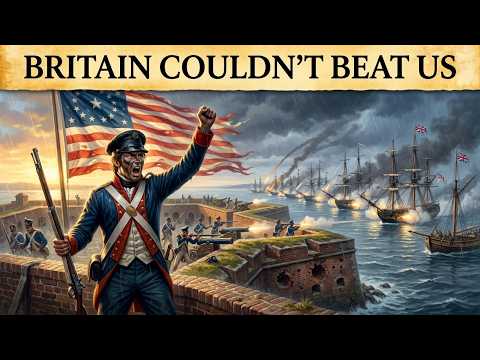
Yet those 1,000 Americans held their ground. They couldn’t return fire for most of the battle—the British ships lay beyond the range of their guns. They couldn’t retreat—the city of Baltimore itself was at stake. All they could do was hunker down behind their star-shaped walls and survive.
By dawn the next morning, the British fleet was withdrawing. The American flag still flew over the fort. And a lawyer named Francis Scott Key, who had watched the entire bombardment from a British ship, pulled out a letter and began writing the words that would become the national anthem of the United States.
This is the story of Fort McHenry’s defiance.
To understand why the British bombarded Fort McHenry in the first place, you have to go back a few weeks. On August 24, 1814, British forces had marched into Washington, D.C., and burned it to the ground. The Capitol, the White House, the Library of Congress—all consumed by fire. It was one of the most humiliating moments in American history, and it happened because the American defenders at the Battle of Bladensburg collapsed so quickly that the engagement earned the nickname “the Bladensburg Races.”
The man leading the British land forces was Major General Robert Ross, a veteran of the wars against Napoleon. His naval counterpart was Vice Admiral Alexander Cochrane, who commanded one of the largest fleets Britain had ever assembled in North American waters. Both had just watched Washington fall with barely a fight, and they were confident Baltimore would be next. They expected it to surrender just as easily.
But Baltimore was not Washington. Baltimore was the third-largest city in the United States at the time, a vital commercial port, and a base for American privateers who had been raiding British merchant ships throughout the war. The British despised Baltimore. Some called it a nest of pirates, and Baltimoreans knew that hatred made their city a target.
So while Washington had done almost nothing to prepare for attack, Baltimore had been getting ready for more than a year. Major General Samuel Smith of the Maryland militia had taken charge of the city’s defenses about 18 months before the battle. He ordered earthworks dug along the eastern approaches to the city. He placed artillery batteries on the hills overlooking the harbor. He gathered a force that eventually grew to about 15,000 men—a mix of regular army soldiers, state militia, and civilian volunteers from as far away as Pennsylvania and Virginia.
But the key to the entire defense was a single point on the map. Fort McHenry sat at the tip of Whetstone Point, right where the Patapsco River bends toward Baltimore’s inner harbor. Any British ship trying to reach the city’s waterfront would have to pass within range of the fort’s guns. If the fort held, the fleet couldn’t support a land attack. And without naval support, any army attacking Baltimore’s fortified positions at Hampstead Hill would face the defenders alone—outnumbered nearly three to one.
Everything depended on Fort McHenry.
And the man responsible for holding it was a 34-year-old army major named George Armistead. Armistead knew exactly what was coming. He had seen the smoke rising from Washington three weeks earlier, and he understood that the same fleet and the same army would soon turn toward Baltimore. So he made a decision that summed up everything about his confidence and his defiance.
He commissioned a Baltimore seamstress named Mary Pickersgill to sew a garrison flag so large that the British would have no trouble seeing it from the river. The flag was 30 feet long and 42 feet wide. It had 15 stars and 15 stripes, representing every state in the Union at the time. It was sewn from 400 yards of woolen fabric. When it rose over the walls of Fort McHenry, it was visible for miles in every direction.
That was exactly the point. Armistead wanted the British to see it. He wanted them to know that someone was waiting for them.
But Armistead’s preparations went far beyond symbolism. Fort McHenry itself was a massive piece of military engineering. Built between 1799 and 1805 according to a design by a French military engineer named Jean Foncin, the fort was shaped like a five-pointed star with thick earth-and-timber walls reinforced with brick and stone. Each of the five points, called bastions, jutted out from the central structure so that defenders on one bastion could fire along the walls of the adjacent bastions. That meant there was no angle of approach where an attacker could avoid being caught in crossfire from two directions at once.
Around the base of the star was a dry moat—a deep ditch that forced any infantry assault to climb down and then scale the fort’s walls under direct fire from above. The design was centuries old, refined through generations of European warfare, and built to withstand exactly the kind of sustained bombardment the British were about to unleash. The sloped earth walls could absorb cannonballs that would shatter traditional straight walls. Shells that struck at an angle would ricochet or bury themselves harmlessly in the packed earth.
By September 1814, the fort was armed with about 36 guns along its walls, including some heavy French-made 42-pounders on a water battery right at the river’s edge. Smith had also ordered additional batteries at Lazaretto Point across the channel and at Forts Covington and Babcock to the west along the shoreline. Together, these positions created interlocking fields of fire that could tear apart any ship trying to slip past McHenry into the inner harbor.
One final defensive measure completed the picture. A floating barrier—a chain of old ship masts lashed together and stretched across the 600-yard gap between Fort McHenry and Lazaretto Point—closed off the main channel. Behind it, several merchant ships were deliberately sunk to create additional obstacles. Any British warship trying to force its way through that barrier would have to navigate a narrow kill zone under fire from multiple directions at once.
Armistead’s garrison was made up of men. They included soldiers from the 12th, 36th, and 38th U.S. Infantry regiments, artillerists from the Corps of Artillery, the Baltimore Fencibles, several companies of volunteers, and a detachment of sailors from the U.S. Navy. They were not the elite veteran troops the British had honed against Napoleon’s armies in Spain and Portugal. Many had never seen combat at all. But they were in strong positions, with good weapons, and a commander who had spent weeks drilling them for this exact moment.
The British plan for taking Baltimore was a two-pronged attack. The army would land at North Point, about 14 miles southeast of the city, and march overland to assault Baltimore’s eastern defenses. Meanwhile, the fleet would batter Fort McHenry into submission, then advance through the wreckage into the harbor and support the army’s attack with naval gunfire from behind American lines.
The British attack went wrong almost from the start. On September 12, as the British troops advanced overland from North Point toward Baltimore, General Ross rode forward to scout the American positions. An American sniper spotted him and put a bullet through his chest. The general bled to death within hours. Colonel Arthur Brooke took command of a force that had just lost its most aggressive leader in the middle of its advance.
Brooke pressed on and fought a sharp engagement with the 3rd Maryland Brigade under Brigadier General John Stricker at what became known as the Battle of North Point. The Americans took casualties but withdrew in good order toward Baltimore’s main defensive line, buying crucial time to strengthen the fortifications at Hampstead Hill. By evening, Brooke found himself facing nearly 12,000 American soldiers and 100 cannons arrayed along a two-and-a-half-mile ridge line. Without naval firepower to smash those positions, a frontal assault would be catastrophic.
That meant everything now depended on the fleet. If Cochrane could silence Fort McHenry, his warships could sail into the harbor and bombard Hampstead Hill from behind while Brooke’s infantry attacked from the front. If he couldn’t, Brooke’s army would be stuck.
At 6:30 a.m. on September 13, the bombardment of Fort McHenry began.
Five British bomb ships took their positions about two miles from the fort and opened fire. Each of the Terror, Volcano, Meteor, Devastation, and Aetna carried a massive mortar that lobbed exploding shells in high arcs, dropping them inside the fort’s walls to burst in the courtyard. Beside them, the rocket ship Erebus began launching Congreve rockets—those distinctive projectiles that left long trails of sparks and were designed to terrify as much as to destroy.
The sound was staggering. The mortars thumped with a deep boom that shook the chest, followed by the sharp whistle of the shell cutting the air. Then a brief, terrifying silence as the shell reached the top of its arc and began to fall. Finally, the earth-shaking crash of the explosion. The rockets screamed across the sky in unpredictable spiraling paths, leaving trails of fire. One soldier inside the fort later said he prayed to God to be spared that crackling and hissing he had never heard in his life.
Armistead ordered his men to return fire, and the fort’s guns roared back. Several shots struck the British ships, and the garrison erupted in cheers. One soldier later wrote that joy filled every heart. But then the British commanders did something that stripped the defenders of their ability to fight entirely. They pulled their ships back slightly to about two and a half miles—just beyond the fort’s maximum effective range.
Now the Americans found themselves in the worst tactical position possible. The British could keep firing at them, while the Americans could do nothing to reply. The bombs and rockets kept falling, and the garrison had no choice but to endure it. By 11 a.m., Armistead ordered the gunners to slow their fire and conserve ammunition, since their shots were falling short anyway. For the next two hours, the garrison endured a continuous barrage of explosives with almost no way to respond.
One defender later described the experience: “The men felt like pigeons tied by the legs to be shot at.” Armistead ordered the men to take cover in the fort’s dry moat, where the thick earthen walls offered some protection from the exploding shells. They crouched in that ditch, listening to the explosions above, feeling the ground shake beneath their boots, breathing air thick with brick dust and the sulfur smell of gunpowder. The noise was so constant it became a kind of physical weight pressing down on everything—something the men felt in their bones and their teeth.
Then at about 2 p.m., a bomb exploded directly over Bastion 3. The blast knocked a 24-pounder cannon out of service and killed Lieutenant Levi Claggett of the Baltimore Fencibles. Moments later, a second bomb burst over the same bastion, and a jagged iron fragment about the size of a silver dollar struck Sergeant John Clemm in the neck, tore through his body, and buried itself deep in the ground beneath him. Clemm died before anyone could reach him. These were real men who lived real lives. Soldiers who served alongside Clemm described him as a young man of good character and genuine courage. Clemm was one of the Baltimore residents who had volunteered to defend their city. Their deaths sent a wave of shock through the garrison, but no one broke. No one fled. The men stayed at their posts.
And then the British made a move that nearly changed the course of the entire battle. Believing the garrison was distracted and weakened by hours of relentless bombardment, Admiral Cochrane ordered the bomb ships and the rocket ship Erebus to advance. The ships moved forward from two and a half miles to nearly a mile and a half—putting them directly within range of Fort McHenry’s heaviest guns.
Armistead waited. He let the British ships drop anchor and settle into position. Then he gave his order. The fort and its water battery opened fire with everything they had. For nearly an hour, the American gunners worked at maximum speed, loading and firing. The Volcano took five hits. The Devastation was taking on water from damage so severe she was in danger of sinking. The Erebus was hit repeatedly, and when Cochrane signaled her to withdraw, her captain either didn’t see the signal or ignored it, forcing other ships to tow the crippled vessel out of range.
The fifers and drummers inside Fort McHenry struck up “Yankee Doodle,” and the entire garrison cheered—but the moment was brief. The damaged British ships withdrew to their original safe distance, and the bombardment resumed from beyond the range of the fort’s guns. The Americans went back to enduring.
As the afternoon of September 13 turned to evening, a nor’easter blew in from the coast. Heavy rain drenched both sides. The defenders lowered the massive garrison flag to protect it from the storm and raised a smaller storm flag in its place. The rain soaked their uniforms, flooded the ditch where many of them sheltered, and turned the interior of the fort into a scene of churned mud and standing water. The temperature dropped, and the bombs kept falling.
The British didn’t stop the bombardment when night fell. In fact, the nighttime bombardment created a terrifying, surreal spectacle most of the garrison had never witnessed. Each mortar shell left a glowing arc across the black sky as its fuse trailed sparks during its long flight upward. The Congreve rockets drew jagged lines of orange and red. From a distance, the sky over Fort McHenry looked as if it were being torn apart by streaks of fire.
And from that distance, Francis Scott Key was watching. Key was a 35-year-old lawyer from Georgetown who had sailed out to the British fleet under a flag of truce to negotiate the release of an American prisoner—a doctor named William Beanes. The British agreed to release Beanes but refused to let Key return to shore until the attack on Baltimore was over. He knew too much about the fleet’s strength and positions. So Key stood on the deck of a ship anchored about eight miles from the fort, watching the bombardment light up the night sky, powerless to do anything but wait and watch.
Every time a bomb burst over the fort, its flash illuminated the outline of the fortifications and, for a brief moment, the flag above them. As long as Key could see that flag, he knew the fort was still holding. But between the explosions, in those moments of darkness between the barrage, there was nothing to see but the sound of distant thunder rolling across the water.
Inside the fort, the most dangerous moment of the entire battle was unfolding. At some point during the bombardment, a British shell pierced the roof of the fort’s powder magazine. This was a brick building with a tile roof holding between 200 and 300 barrels of gunpowder—enough explosive force to destroy the entire fort and kill every man inside. The shell crashed through the roof, brought down part of the ceiling, and came to rest among the powder barrels. It did not explode. Had that fuse burned a few seconds longer, had that single shell detonated inside the magazine, there would have been no fort left to defend. Baltimore harbor would have been wide open. The British fleet would have sailed through. The city would almost certainly have fallen. And the national anthem would never have been written. Perhaps the entire course of the War of 1812 would have changed because of one faulty fuse.
Armistead knew something the rest of the garrison did not. He knew the magazine was not bombproof. After the shell fell, he ordered the powder barrels removed and distributed along the fort’s outer walls to prevent a chain explosion. A exhausted soldier was said to have sat down on a powder barrel during the transfer before realizing what he was resting on.
Meanwhile, the British launched one final attempt to break the defenses. Around midnight, Admiral Cochrane sent about 1,000 men in 20 boats to slip behind the fort under cover of darkness, land to the west, and attack from the rear. The plan was to coordinate this attack with Brooke’s army for a joint assault at dawn. The boats crept through the Patapsco River in heavy rain, the rowers trying to move as quietly as possible. But the defenders at Babcock Battery—an earthwork with six guns about a mile and a half west of Fort McHenry—heard the muffled sound of oars in the water. Marine Captain John Webster stared into the rain, spotted the dark shapes of the approaching boats, and fired an 18-pounder directly into the lead boat. Fort Covington opened fire next. Then Fort McHenry itself joined in, directing its guns toward the boats.
The British returned fire with rockets and bow-mounted cannons, but they were in a completely untenable position. At least one boat was hit and capsized, throwing British sailors into the cold waters of the Patapsco. One of them was heard screaming from the boats that they would be blown out of the water. The surviving boats turned and retreated under fire that continued for nearly two hours. The bodies of British sailors washed up on the riverbanks over the next two weeks.
By 3 a.m. on September 14, Colonel Brooke had made his decision. Without naval support, after the failure of the diversionary boat attack, and facing an American force three times his size behind fortified positions, he ordered his troops to begin falling back to the ships waiting at North Point. Around 4 a.m., the last British boats returned to the fleet. The bomb ships continued firing, but it was becoming clear to everyone—British and American alike—that the bombardment had failed.
Fort McHenry had taken an estimated 400 shells that landed inside its walls. Hundreds more fell short of the fort or overshot the defenses entirely. The sloped earth walls of the star fort had done their job exactly as centuries of military engineering had designed them to. The bastion geometry had absorbed the shock and kept the garrison alive.
At 7 a.m., the rain finally stopped, though the sky was still heavy with gray clouds. At about 7:30 a.m., the Volcano fired the last bomb of the battle. And then, as one witness described it, there was a dead silence. For the first time in 25 hours, the guns were quiet. The smoke drifted slowly across the water. Aboard a British ship anchored miles away, Francis Scott Key strained to see through the haze covering the harbor. All night long, every flash of an exploding bomb had given him a glimpse of a flag still flying over the fort’s walls. But now, in the silence and the pale gray light of morning, he didn’t know what had happened. He didn’t know if the fort was still holding.
Then the clouds began to break. A light breeze blew from the west, and as the morning brightened, the men inside Fort McHenry lowered the small storm flag and raised the massive garrison flag Armistead had commissioned from Mary Pickersgill—the one measuring 30 by 42 feet with its 15 stars and 15 stripes, billowing wide in the clear sky. The flag rose slowly, filled with wind, and unfurled to its full size for all to see in the harbor. The fifers and drummers began to play, deliberately loud enough to carry across the river to the British fleet. The garrison cheered.
Eight miles away, Key saw it. Through the lifting haze, he could make out the shape of the huge flag waving over the battered but unbroken fort. The British fleet had already begun to raise anchor. The bomb ships were moving away toward the river’s mouth. The greatest naval force on earth had thrown everything it had at 1,000 Americans behind the walls of a star-shaped fort, and those Americans had held.
Key reached into his coat, pulled out a letter he had been carrying, turned it over, and began writing a poem on the back. Its first words were: “O say can you see, by the dawn’s early light…”
The cost of defending Fort McHenry was remarkably light for the defenders—four killed and 24 wounded. Against a bombardment of 1,500 to 1,800 shells over 25 hours, those numbers are a testament to the star fort’s engineering and the discipline of the men inside it. The British fared worse than their casualty reports suggested. General Ross, their most capable field commander in North America, had been killed at North Point before the bombardment even began. The nighttime boat attack was a disaster that cost them men, boats, and morale. Brooke’s army withdrew without ever launching its assault on Hampstead Hill. Admiral Cochrane later wrote to London describing the entire Baltimore operation as a successful demonstration—polished language from a commander spinning a defeat as a strategic choice. The fleet sailed south to Jamaica and then to New Orleans. They never returned to Baltimore.
For the young nation that had watched its capital burn just three weeks earlier, the defense of Fort McHenry became far more than a military victory. It became proof—proof that the country could absorb the hardest punishment the mightiest army on earth could deliver and still refuse to break. The battle silenced the voices calling for surrender and gave American negotiators at the peace talks in Ghent the confidence to demand favorable terms. Major George Armistead became a national hero overnight. The massive flag that flew over the fort that morning passed through his family for generations before eventually reaching the Smithsonian Institution, where it is still on display today—faded and fragile after more than 200 years, but still intact.
The poem Key scribbled on the back of that letter was published in newspapers across the country within days. Its original title was “The Defense of Fort McHenry.” It was set to the tune of a popular English drinking song, and it spread across the country with a speed that surprised Key himself. Over the following decades, it was gradually renamed “The Star-Spangled Banner.” In 1931, President Herbert Hoover signed a law making it the official national anthem of the United States. Every time it is played, it tells the story of this night. It tells the story of this fort. It tells the story of 1,000 men who endured 25 hours of bombardment behind star-shaped walls and refused to lower their flag.
If this story made you think, hit the like button, subscribe to the channel, and leave a comment telling us which moment in this battle surprised you the most. If you know someone who loves history, send them this video.
So here’s the question for you: if a single faulty fuse on a British shell had detonated the powder magazine that night, how different would America’s story be today—and would we still be singing the same song?
Report this article
Select a reason for reporting:






