In the annals of World War II, the names Montgomery, Patton, and Rommel dominate the spotlight. But ask Dwight D. Eisenhower—the man who commanded them all—and he’d give you a different answer: Bill Slim. The general who turned defeat into victory in the forgotten jungles of Burma.
While Montgomery basked in the glow of El Alamein and Patton raced across Europe, Slim fought a war of attrition against a fanatical enemy in some of the harshest terrain imaginable. His story is one of resilience, innovation, and an unbreakable bond with his men.
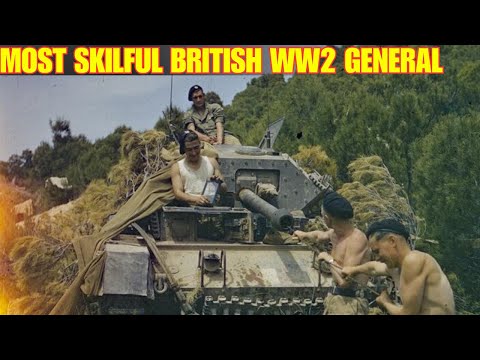
But Slim wasn’t the only contender. From the deserts of North Africa to the beaches of Normandy, Britain’s generals fought on every front. Each had their moment of brilliance—and their flaws. So who truly deserves the title of Britain’s most skilful general?
Take Montgomery. His victory at El Alamein in October 1942 was a turning point. Facing Rommel’s Afrika Korps, he meticulously built up overwhelming artillery and armor. Over 12 days, his forces broke through, forcing Rommel into a long retreat. The victory transformed British morale and ended Axis hopes of taking Egypt. But Montgomery’s cautious approach often frustrated subordinates and allies alike.
In Normandy, he commanded all Allied ground forces during the critical early phase after D-Day. Operations Epsom and Goodwood pinned down German Panzer divisions, preventing them from crushing the American breakout at St. Lô. Critics argued he promised more than he delivered, but the strategy worked. The Germans were tied up, and the Allies burst through in Operation Cobra.
Then there’s General Richard O’Connor. In December 1940, he commanded the Western Desert Force in Operation Compass against the Italians in Libya. Outnumbered more than 3 to 1, he used deception, speed, and surprise to overwhelm Italian fortified camps. His small mechanized force swept across 500 miles in just 10 weeks, capturing Bardia, Tobruk, and Beda Fomm. By February 1941, O’Connor had captured over 130,000 Italians, destroyed 10 divisions, and effectively ended Italy’s offensive capacity in North Africa. But his career was cut short when he was captured by a German patrol shortly after Rommel’s arrival. Even so, his early campaigns remain among the most brilliant mobile operations of the war.
Other contenders include Harold Alexander, who oversaw the final defeat of Axis forces in Tunisia and later commanded Allied forces in Italy, and Miles Dempsey, who commanded the British Second Army from D-Day to the Rhine. Both were skilled, but neither achieved the decisive, war-changing victories of Slim or Montgomery.
But if talent means consistent operational brilliance combined with the ability to inspire, Bill Slim stands out. When he took over the British 14th Army in 1943, his men were weary from years of retreat in Burma. He rebuilt them into an effective jungle fighting force. His greatest test came in 1944 when the Japanese launched Operation U-Go, aiming to invade India through Imphal and Kohima. At Kohima, just 1,500 British and Commonwealth defenders held a ridge against thousands of Japanese soldiers in brutal close-quarters fighting. Battles were fought over a tennis court, trench by trench. Reinforced by Slim’s forces, the British and Indian troops counterattacked and drove the Japanese back.
Meanwhile, at Imphal, Slim used air supply to keep his army fighting—an innovation in a theater with no roads and monsoon-swollen rivers. The Japanese suffered over 50,000 casualties in the twin defeats, losing almost their entire invasion force. Slim then launched a lightning offensive in late 1944, recapturing Mandalay and Rangoon. His ability to manage logistics, coordinate multinational forces, and outthink a determined enemy in impossible terrain makes his record extraordinary.
So who was the most skilful? Montgomery delivered at El Alamein and Normandy. O’Connor achieved perhaps the most stunning early war victory in North Africa. But Slim’s mastery of strategy, logistics, and morale—recognized by allies and opponents alike—makes him Britain’s most talented wartime general. Eisenhower himself said, “Of all the great leaders of World War II, I would rate Slim as the finest general.”
Yet the debate rages on. Was Slim’s achievement in Burma greater than Montgomery’s in Europe? Could O’Connor have become Britain’s greatest if not for his capture? And what of Alexander and Dempsey—do their contributions deserve more recognition?
To answer that, we need to dig deeper into the criteria. Talent in generalship isn’t just about winning battles—it’s about doing so with the resources at hand, under the conditions imposed, and against the enemy faced. By that measure, Slim’s achievement in Burma is almost without parallel. He inherited a defeated army, with morale at rock bottom, and faced a Japanese enemy that had not yet been stopped in jungle warfare. He didn’t just stop them—he destroyed them.
At Kohima and Imphal, Slim’s forces inflicted the worst defeat the Japanese Army had suffered in its history. The twin battles were fought in some of the most inhospitable terrain imaginable—thick jungle, steep hills, and during the monsoon, when rivers became torrents and the air turned to soup. Air supply was Slim’s lifeline. With roads nonexistent, he kept his army fighting by dropping everything from ammunition to food from the sky. It was a logistical masterpiece that few commanders could have conceived, let alone executed.
But Slim’s genius didn’t stop at logistics. He understood his enemy. The Japanese relied on speed and surprise, often infiltrating behind Allied lines. Instead of trying to defend every inch of ground, Slim devised a system of ‘box’ defenses—fortified perimeters that could hold out even when surrounded. He let the Japanese come to him, then destroyed them with superior firepower and coordination. It was a revolutionary approach in jungle warfare, and it worked.
Montgomery, by contrast, enjoyed overwhelming material superiority at El Alamein. He had more tanks, more guns, and more men than Rommel. His victory was impressive, but it was also a matter of attrition—a battle of material that the Axis could not win. In Normandy, he had the full weight of Allied industry behind him. Critics argue that Montgomery’s cautiousness prolonged the campaign. His failure to take Caen on D-Day, despite promising to do so, frustrated his American allies and allowed the Germans to consolidate their defenses.
O’Connor’s achievements were brilliant, but they were against an Italian army that was poorly led and equipped. When he faced the Germans, his career was cut short before he could prove himself against a first-rate opponent. Who knows what O’Connor might have achieved had he not been captured? But potential isn’t the same as performance.
Alexander and Dempsey were competent, even skilled, but they never faced the kind of odds Slim did. Alexander commanded vast Allied forces with overwhelming air and naval support. Dempsey’s Second Army was part of a massive coalition with abundant resources. Neither had to improvise like Slim.
What sets Slim apart is the human element. He was a soldier’s general. He knew his men, understood their fears, and inspired them to fight on when all seemed lost. He once told his troops, ‘You are not a defeated army. You are an army that has not yet won.’ That kind of leadership can’t be taught. It’s innate.
Eisenhower’s endorsement carries weight, but he wasn’t alone. Field Marshal Alanbrooke, Britain’s chief military advisor, called Slim ‘the finest commander of the war.’ Even his Japanese opponents respected him. After the war, a Japanese officer remarked that Slim was the only Allied general who truly understood jungle warfare.
Yet the debate persists because Montgomery was a master of publicity. He understood the power of the press and cultivated his image as the hero of El Alamein. Slim, by contrast, was self-effacing and rarely sought the spotlight. He once said, ‘I don’t want to be a hero. I just want to win.’ That modesty may have cost him the recognition he deserved.
But if we strip away fame and focus on pure generalship—the ability to win battles with what you have, against a determined enemy, in impossible conditions—Bill Slim emerges as Britain’s most talented general of World War II.
Yet even as we crown Slim, we must consider the counterarguments. Montgomery’s defenders would point out that El Alamein was not merely a battle of material—it was a battle of nerve. Churchill needed a victory, and Montgomery delivered it. The Prime Minister had famously said, ‘Before Alamein we never had a victory. After Alamein we never had a defeat.’ That psychological turning point cannot be overstated.
Moreover, Montgomery’s meticulous planning at El Alamein involved a deception campaign so elaborate that it fooled Rommel himself. Operation Bertram—the creation of a phantom army of dummy tanks and trucks—was a masterpiece of military illusion. Montgomery may have had material superiority, but he used it with surgical precision, husbanding his armor and striking only when the moment was right.
In Normandy, the criticism is sharper. Montgomery’s failure to take Caen on D-Day—a city he had promised to seize within hours—allowed the Germans to dig in. His subsequent operations, Epsom and Goodwood, were costly and failed to break through. But here’s the paradox: those very failures pinned down the German armor, enabling the American breakout in Operation Cobra. Was that Montgomery’s design, or a happy accident? Historians still argue.
O’Connor’s case is tantalizing. Operation Compass was a masterpiece of maneuver warfare—perhaps the most brilliant British campaign of the entire war. His use of speed and surprise against a numerically superior enemy echoed the blitzkrieg tactics that Germany would soon unleash. But the Italians were a demoralized, poorly equipped foe. When O’Connor faced Rommel, he was captured before he could demonstrate whether his genius would hold against a first-rate opponent.
Alexander and Dempsey, meanwhile, were coalition builders and administrators as much as battlefield commanders. Alexander’s ability to manage the complex Allied coalition in Italy—Americans, British, Canadians, Poles, French, and Brazilians—was a diplomatic triumph as much as a military one. Dempsey’s Second Army executed the Normandy breakout and the race to the Rhine with efficiency, but he never had the independent command that would have allowed him to shine.
So the debate comes down to a fundamental question: what do we value most in a general? If it’s the ability to win decisive victories against a formidable enemy with limited resources, Slim is unmatched. If it’s the management of large-scale coalition warfare and the ability to bend vast industrial power to strategic ends, Montgomery and Alexander have strong claims.
But there’s one more factor to consider: the test of adversity. Montgomery never faced a defeated army; he inherited one brimming with confidence after El Alamein. O’Connor’s career was cut short before he could face real adversity. Alexander and Dempsey operated within a comfortable margin of material superiority. Slim alone took command of a broken force, in a forgotten theater, and forged it into a victorious army.
That is why Eisenhower’s verdict carries such weight. He saw all these generals up close. He knew their strengths and weaknesses. And he chose Slim.
Perhaps that is the fairest verdict of all. Not because Slim won the most famous battles, but because he won the ones no one else wanted to fight. He took the forgotten war and made it unforgettable.
Montgomery will always have El Alamein. O’Connor will always have Compass. But Slim has something rarer: the proof that leadership itself can be a weapon. He turned a beaten army into a conquering one—and asked for no statue in return.
So when Eisenhower named Slim the finest general of the war, he wasn’t just praising a commander. He was defining what greatness looks like when the cameras are pointed elsewhere.
Maybe that’s the real test of talent: what you do when history isn’t watching.
Who do you think deserves the crown—Slim, Montgomery, or a dark horse like O’Connor? Tell us in the comments below.
Report this article
Select a reason for reporting:






