When you hear “Spanish Inquisition,” you probably picture dark dungeons, hooded monks, and the agonizing screams of heretics. But that image—burned into our minds by centuries of propaganda—is a lie. The truth is far more chilling, and it has almost nothing to do with religion.
It begins not with torture, but with paperwork. Not with faith, but with greed. And at its heart lies a question that still haunts us today: What happens when a state needs an enemy to hold itself together?
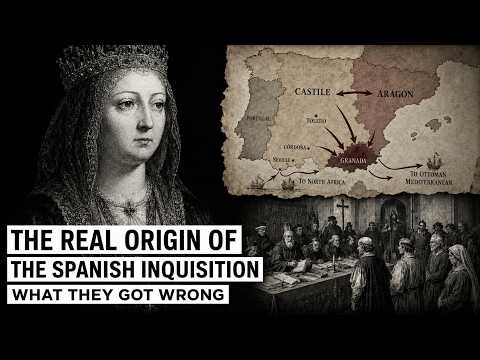
For nearly 700 years, Spain was a patchwork of Muslims, Christians, and Jews living side by side—a fragile but real coexistence called the convivencia. Jews served as physicians, diplomats, and tax collectors. Muslim architects built palaces that Christian kings would later claim as their own. It was messy, imperfect, but it worked.
Then, in 1391, a wave of anti-Jewish violence swept across the peninsula. Mobs stormed Jewish quarters, offering a single, brutal choice: convert or die. Tens of thousands were baptized at sword-point. These forced converts—the conversos—became a new class, officially Christian but secretly Jewish. And within a generation, they had climbed to the highest rungs of Spanish society.
They became bishops, royal advisers, and financiers. Two conversos even bankrolled Columbus’s voyage to the New World. But their success bred resentment. Old Christians—those who could prove pure ancestry—seethed with jealousy. “They are not really Christian,” they whispered. “They converted only to steal our wealth and power.”
Out of this toxic brew came a poisonous idea: Limpieza de sangre—purity of blood. It didn’t matter how devoutly you prayed. If your grandmother was Jewish, you were tainted. The first blood-purity statute appeared in Toledo in 1449, decades before the Inquisition was even born. It barred conversos from office, not for their beliefs, but for their ancestry.
This was racial thinking, long before the modern world invented the word. And it spread like wildfire. Neighbors denounced neighbors. Genealogies were forged and weaponized. An entire bureaucracy of suspicion emerged, turning ordinary people into informants.
So when Ferdinand and Isabella established the Inquisition in 1478, they weren’t creating something new. They were institutionalizing a machine of fear that had been building for decades. The Inquisition answered only to the crown—not to local bishops, not to the Pope. It could reach across borders, override local laws, and seize property with terrifying efficiency.
And seize it they did. Convicted heretics had everything taken—homes, businesses, savings. The wealth flowed straight into the royal treasury, funding the war against Granada. The first Grand Inquisitor, Tomás de Torquemada, himself of converso descent, directed that confiscated assets be used for the campaign. The Inquisition was never just about faith. It was a massive transfer of wealth, sanctified by prayer and driven by greed.
The terror was real—torture, public burnings, the knock on the door at midnight. But the popular image of millions burned is a myth. Modern research suggests roughly 3,000 to 5,000 executions over 350 years. The true horror was the surveillance state: the anonymous denunciation, the presumption of guilt, the destruction of families for generations.
And it all began with a choice—to manufacture an enemy, to blame the successful, to call it justice. The Spanish Inquisition was not a medieval relic. It was a blueprint for power that we still recognize today.
But to understand how that blueprint was drawn, we have to look more closely at the machinery itself—the daily grind of the Holy Office, the way it actually worked. Because the Inquisition was not a single tribunal. It was a network of local courts, each staffed by a handful of inquisitors, a prosecutor, a constable, and a small army of informants and familiars. These were laymen granted special privileges for their service—the right to bear arms, exemption from certain taxes, and the intoxicating power of being untouchable.
The process began with the Edict of Grace. Inquisitors would arrive in a town, summon the local population to church, and read out a list of heresies. They offered a period of grace—usually thirty to forty days—during which anyone who came forward voluntarily to confess would be reconciled with the Church, often with light penance. But the edict came with a knife hidden in its folds. Anyone who knew of a heretic and failed to report them would be excommunicated.
Neighbors turned on neighbors. Servants informed on masters. Business rivals settled old scores with a whispered accusation. The Edict of Grace was designed to break the bonds of community trust, and it worked with devastating precision.
Once the grace period ended, the real terror began. Accusations poured in—often anonymous, often motivated by envy or revenge. The accused were arrested without warning, their property seized immediately to cover the costs of their own trial. They were thrown into secret cells, kept in isolation, and left to wonder for weeks or months what they had been accused of. The charges were never fully disclosed. The accusers’ identities were kept hidden.
The interrogation followed a script. The accused was asked to recite the Lord’s Prayer, the Hail Mary, and the Ten Commandments. A slip of the tongue, a forgotten phrase, a mispronounced Latin word—these were treated as evidence of secret Judaism. If you could not recite your prayers perfectly, you were presumed guilty.
Confession was the goal. Not truth, but confession. The Inquisition’s own manuals instructed inquisitors to lie to the accused, to promise mercy they had no intention of granting, to claim that other witnesses had already condemned them. The rack, the strappado, the water torture—these were tools of last resort, used when psychological pressure failed. And when a confession was finally extracted, the accused was required to repeat it the next day, freely and without coercion. If they recanted, the torture resumed.
And here is the detail that makes the whole system so chilling. The Inquisition kept meticulous records. Every confession, every denunciation, every piece of gossip was written down, filed, and cross-referenced. A careless word spoken in Seville could resurface decades later in Toledo. The bureaucracy was the terror. It remembered what everyone else wanted to forget.
This is why the Inquisition outlasted the monarchs who created it. Ferdinand died in 1516. Isabella had died twelve years earlier. Torquemada was long gone. But the institution endured because it had become something more than a royal tool—it had become a self-perpetuating machine, with its own budget, its own career ladder, its own institutional interests. Inquisitors were paid from confiscations. The more they convicted, the more they earned. The incentive structure was monstrous in its simplicity.
And yet, the story grows stranger still. Because by the 17th century, the Inquisition had begun to lose its appetite for blood. The great autos da fe became rarer. Executions slowed to a trickle. The Holy Office shifted its attention from heresy to censorship—banning books, policing morals, investigating bigamy and blasphemy. It became, in effect, a ministry of cultural conformity.
But the fear remained. The fear always remains. And in the shadow of that fear, something else was taking root—something that would reshape the entire world. Because while the Inquisition was busy policing the souls of Spain, Spanish ships were crossing the Atlantic, carrying the same logic of purity and persecution to a continent that had never heard of it.
The New World offered the Inquisition a fresh canvas. But here is what few people realize: the Holy Office never formally established itself in the Americas with the same sweeping authority it held in Spain. Instead, it sent its familiars, its informants, its bureaucratic tentacles. In Mexico City and Lima, tribunals were eventually set up, but their reach was limited, their resources thin, and their targets different. They chased after blasphemers, bigamists, and renegade priests more often than secret Jews.
Yet the logic of Limpieza de sangre crossed the ocean with the first conquistadors. In the colonies, purity of blood became a legal category, a social ladder, a way of sorting the deserving from the damned. Spaniards born in the Americas—the criollos—were considered tainted by the very soil of the New World. They could never hold the highest offices. Their blood was suspect, their loyalty questioned.
And beneath them, a vast hierarchy of castes emerged, each defined by ancestry, each ranked by proximity to an imagined purity. Mestizos, mulattos, zambos—the colonial world invented an entire vocabulary of racial classification, complete with elaborate charts and genealogical rules. It was the Inquisition’s logic, exported and industrialized.
Meanwhile, back in Spain, the Inquisition was facing a new kind of enemy: the Enlightenment. Philosophers in France and England were writing books that questioned everything—the divine right of kings, the authority of the Church, the very idea of inherited sin. These books were smuggled into Spain, hidden in false-bottomed trunks, passed from hand to hand in secret. And the Inquisition responded with the only weapon it had left: the index of forbidden books.
The Index Librorum Prohibitorum became the Inquisition’s final battleground. Inquisitors compiled lists of banned titles, raided bookshops, and interrogated suspected readers. Possessing a copy of Voltaire or Rousseau could land you in a cell. But the tide was turning. The French Revolution had shattered the old order. Napoleon’s armies would soon march across the Pyrenees, and with them came ideas the Inquisition could not burn.
When Napoleon invaded Spain in 1808, the Inquisition was abolished for the first time. It was restored six years later when the monarchy returned, but it was a shadow of its former self. Its property had been seized. Its authority was contested. Its reputation, even among conservative Catholics, was increasingly an embarrassment. The world had moved on.
By the time it was finally abolished in 1834, the Spanish Inquisition had become a relic—a bureaucratic dinosaur that had outlived its purpose. But its legacy was not dead. It had simply mutated. The techniques it perfected—surveillance, denunciation, the weaponization of paperwork, the manufacture of internal enemies—did not disappear. They were absorbed into the machinery of the modern state.
And here is the uncomfortable truth that historians rarely emphasize. The Inquisition’s true heir was not some medieval dungeon. It was the modern bureaucracy. The passport office that demands proof of identity. The immigration form that asks where your grandparents were born. The database that cross-references your name against a list of suspects. These are the children of the Holy Office, stripped of their religious language but retaining their essential logic.
The Inquisition taught the world a lesson that has never been unlearned: that the most efficient way to control a population is not through violence alone, but through the fear of being watched, the terror of being reported, the dread of being classified. It is easier to rule a people who police each other than a people who must be policed by force.
Spain itself has spent nearly two centuries trying to forget this legacy. The Inquisition’s archives were sealed for generations. Its records were scattered, its crimes left unacknowledged. Only in recent decades have historians been allowed to sift through the thousands of trial records, the mountains of denunciations, the ledgers of confiscated property.
And what they have found is not a story of fanaticism, but of banality. The inquisitors were not monsters. They were bureaucrats. They filed reports, collected salaries, worried about budgets, complained about paperwork. They were ordinary men doing an extraordinary evil, one form at a time.
That is the real horror of the Spanish Inquisition. Not the flames, not the racks, not the hooded monks. The horror is that it was ordinary. It was a system, built by people who believed they were doing good, sustained by people who were afraid to object, and remembered by a world that prefers to believe such things could never happen again.
But they do happen. They happen every time a society decides that some of its members are not fully human. They happen every time a government creates an enemy to distract from its own failures. They happen every time we choose the comfort of purity over the messiness of coexistence.
The convivencia was imperfect. It was fragile. But it was real. And the Inquisition was built to destroy it—not because it failed, but because it worked. Because a society where Muslims, Christians, and Jews could live side by side, trade with each other, learn from each other, was a society that could not be easily controlled. Diversity was not the problem. Diversity was the threat.
And so the machine was built. And when it had finished with the Jews, it turned on the Muslims. When it had finished with the Muslims, it turned on the Protestants. When it had finished with the Protestants, it turned on the readers, the thinkers, the dreamers. It devoured everyone who did not fit, and it called it salvation.
The last auto da fe was held in 1781. The last execution was in 1826. The institution was abolished in 1834. But the logic of the Inquisition—the logic of purity, of suspicion, of the internal enemy—that logic never died. It simply changed its clothes.
Today, the Inquisition’s archives are open. Historians sift through its meticulous records and find not monsters, but clerks—men who filed reports, worried about budgets, and went home to their families. The banality of evil was perfected here, one form at a time.
Spain still lives with the ghosts. In 2015, it offered citizenship to descendants of expelled Sephardic Jews—a gesture five centuries late. Anti-Semitic surveys still reveal uncomfortable echoes. The past is not past.
So the next time someone mentions the Spanish Inquisition, remember: it was never about God. It was about power—finding an enemy, taking what they had, and calling it justice. That game is still being played.
Where do you see the logic of the Inquisition at work in the world today—and what will you do to question it?
Report this article
Select a reason for reporting:






