The cheers were deafening, a tidal wave of adoration crashing against the bulletproof glass. Below, thousands of stormtroopers marched in perfect, terrifying unison, their torches carving a river of fire through the Berlin night. Above, framed in the window of the Chancellery, stood the man they had come to worship. He was no longer a fringe agitator or a failed revolutionary. He was the Chancellor of Germany. But the scene was not a spontaneous outpouring of joy—it was a meticulously crafted product, the culmination of a decade-long campaign to sell a single, simple idea: that one man could save a broken nation.
This was the genius of Adolf Hitler. He understood, with a chilling clarity, that the path to absolute power did not lie in bullets alone, but in the alchemy of words, symbols, and spectacle. He was not just a politician; he was the first modern brand manager of hate, a master of the new mass media who packaged a mythology of national rebirth and sold it to a traumatized people. The story of how he achieved this is a story of manipulation, of grievance weaponized, and of a democracy that voted for its own destruction.
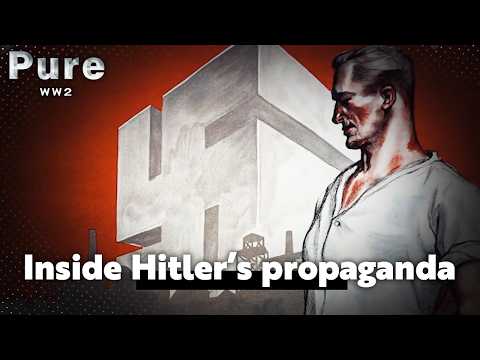
To understand the spell he cast, you must first understand the wound he promised to heal. The Germany of the 1920s was a crucible of humiliation and rage. The Treaty of Versailles, signed in 1919, had not just ended a war—it had shattered a nation’s soul. Germany was forced to accept total blame for the conflict, to disarm, to surrender territory, and to pay crippling reparations. For a proud people who had been told their army was undefeated, this was a stab in the back. The Weimar Republic, the fragile new democracy, was seen as the vessel of that betrayal, the ‘November criminals’ who had sold out the Fatherland.
It was into this fertile ground of despair that a young, unknown corporal named Adolf Hitler planted his first seeds. In September 1919, he attended a meeting of a tiny, insignificant group called the German Workers’ Party. With only a few dozen members, it was a fringe outfit with no money and no influence. But Hitler saw in it a platform. He saw a vehicle for his own toxic ideology. By November, he was the party’s chief propagandist, and he immediately began to apply the lessons he had learned in the trenches of the First World War.
He believed that Germany had not lost the war on the battlefield, but in the battle for hearts and minds. He was obsessed with the power of Allied propaganda—the British and Americans, he believed, had created a ‘magic’ that destroyed the invincible German army. He studied their techniques, their use of simple, believable messages, and their mastery of visual symbolism. He would not make their mistakes. He would not portray the enemy as bumbling fools; he would portray them as a demonic, existential threat. And he would not just use propaganda—he would perfect it.
His first building block was attention. The party’s early meetings were held in beer halls, and Hitler’s first task was to fill them. He designed vivid, striking posters with powerful colors and stark images—a dragon being slain, a giant figure crushing smaller enemies. They were impossible to ignore. He was the party’s first PR man, and his product was outrage. The second building block, and the one that would become his signature, was the power of the spoken word.
Hitler was a phenomenon on the stage. He did not speak to a crowd; he spoke through it. He would begin quietly, almost hesitantly, gauging the mood of the room. Then, slowly, he would build, his voice rising in volume and pace, his gestures becoming more dramatic, his language more visceral. He found that short, punchy sentences and rhetorical questions worked best. The audience did not want intellectual debate; they wanted slogans, they wanted scapegoats, they wanted to feel something. And Hitler gave them exactly that.
In February 1920, the party renamed itself the National Socialist German Workers’ Party—the Nazi Party. At a mass meeting of 2,000 people, Hitler presented their 25-point plan. What could have been a dry reading of a political manifesto became a rousing, evangelical sermon. He railed against the Treaty of Versailles, the ‘November criminals,’ and the Jews and Bolsheviks he accused of stabbing Germany in the back. He gave the people enemies—a simple, external explanation for their complex suffering. And he gave them a savior: himself.
His reputation as a mesmerizing speaker grew with astonishing speed. In his first year, he delivered over 30 speeches to crowds of hundreds, then thousands. He was a genuine voice, not a Prussian aristocrat with a clipped accent, but a man of the streets, a veteran who had been gassed for his country. His raspy, guttural voice became a symbol of authenticity. He was not a politician; he was one of them. And he was telling them what they desperately wanted to hear: that their shame was not their fault, and that he had the means to make Germany great again.
But words alone were not enough. Hitler understood that to build a movement, you needed more than a message—you needed a mythology. He was a voracious consumer of art, music, and theater, particularly the operas of Richard Wagner. He saw in Wagner’s mythological storytelling a template for his own political theater. The staging, the lighting, the music, the use of ancient symbols—all of this would become part of the Nazi aesthetic. He was not just a politician; he was a failed artist who had found his medium in the masses.
His genius was in his ability to borrow and adapt. He was ideologically opposed to the communists, yet he stole their tactics. He adopted the color red for his own flags and posters, a brazen attempt to attract workers to his cause. He sent his stormtroopers to disrupt communist meetings, knowing that the resulting violence would get his party mentioned in the newspapers. Any publicity was good publicity. He even modeled his paramilitary organization, the SA, on Mussolini’s blackshirts. He saw the Italian dictator’s March on Rome as a masterpiece of political theater, a ‘manufactured revolution’ that looked spectacular on newsreel and had handed him power.
In November 1923, Hitler decided to stage his own march on Berlin, starting in Munich. He had studied Mussolini’s blueprint and believed the time was right. Germany was in chaos. Hyperinflation had rendered the currency worthless, and the French had occupied the industrial Ruhr region in response to unpaid reparations. The conditions seemed ripe for revolution. But Hitler had misread the German people and the German state. He had mistaken their anger for a willingness to overthrow the government. When he and his followers marched into the center of Munich, they were met not with cheering crowds, but with a police barricade and a hail of bullets.
The Beer Hall Putsch was a humiliating failure. It was a lesson in reality that Hitler would never forget. He had tried to fight the state with force, and the state had won. But the failure would become the foundation for his greatest propaganda triumph. At his trial for treason, Hitler turned the courtroom into his stage. He was allowed to speak for hours, and he used the opportunity to speak directly to the nation. He was no longer a fringe radical; he was a patriot, a martyr for the German cause. The national press reported his speeches, and his fame spread far beyond Bavaria. For the first time, his name was on everyone’s lips.
In prison, he was visited by his photographer, Heinrich Hoffmann, who took a photo of him standing outside the gates, looking resolute and defiant. This image was published across Germany. It was a carefully constructed visual narrative of a man who had been unjustly punished for his love of country. It was the beginning of the Hitler image cult. He spent his time in prison dictating ‘Mein Kampf,’ a book that was part autobiography, part political manifesto, and part propaganda manual. In it, he laid out his worldview, his theories on race, and his techniques for mass manipulation. He wrote about the ‘big lie’—the idea that people will believe a huge falsehood more readily than a small one—and the power of endless repetition. The book was a blueprint for the coming nightmare.
When he was released in December 1924, Hitler faced a new reality. He had been banned from public speaking, and the party was in disarray. But he had learned his lesson. He would no longer fight the state with force; he would use the tools of democracy to destroy it. He would use propaganda to win power legally. It was a strategy of patience, of relentless messaging, and of building a brand that was as recognizable as any commercial product. The seeds of the next decade had been sown, and the man who had failed to seize power by force was now preparing to win it by persuasion.
The ban on his speaking was a blessing in disguise. It forced Hitler to refine his message and build a movement that could survive without him in the room. He wrote editorials for the party newspaper, the Völkischer Beobachter, and built a network of local propaganda chiefs across Germany. The party became a national movement, not just a Bavarian curiosity. And the man who would become his most devoted disciple, Joseph Goebbels, discovered him through those very words.
Goebbels’s diary entries from 1924 reveal a man utterly seduced by the power of Hitler’s rhetoric. He compared him to Christ, a figure of passion and nobility. This was the power of the brand—it could turn skeptical intellectuals into fanatics. By 1926, Goebbels and Gregor Strasser had spread the Nazi message north, making it a truly national force.
The symbols were as important as the words. Hitler designed the party flag himself—a black swastika on a white circle, set against a sea of red. Red for the social idea, white for nationalism, and the swastika for the Aryan struggle. It was a visual advertisement that required no explanation. He adopted the Roman salute, made it mandatory for party members, and turned his own body into a symbol of power. His photographer, Heinrich Hoffmann, produced millions of images, all personally approved, crafting a persona of a man predestined to save Germany.
Then came the crisis. The Wall Street Crash of 1929 shattered the fragile German economy. Unemployment soared to six million. The Weimar Republic was crumbling. Hitler presented himself as the only savior, the one man who could restore order from chaos. The Nazi vote skyrocketed from 2.5% in 1928 to 37% in July 1932. They were not elected to power, but they became the largest party, a force that could not be ignored.
Behind the scenes, conservative elites—frightened of communism and contemptuous of Hitler—believed they could control him. They would ‘hire’ him, as one put it. On January 30, 1933, President Hindenburg appointed Hitler Chancellor. The man they thought was a buffoon had just been handed the keys to the state. That night, torchlight parades filled the streets of Berlin. Hitler stood in the Chancellery window, illuminated and triumphant. The brand was complete. The myth was now reality.
What had been built was not a political party, but a machine of deception. It had taken ten years of relentless propaganda—words, images, symbols, and spectacle—to turn a fringe agitator into a national messiah. The lesson is as chilling today as it was then: a democracy can be undone not by force, but by the very tools it protects. The story of Hitler’s rise is a warning about the power of grievance, the allure of simple answers, and the terrible price of looking away.
What do you think is the most dangerous tool of modern propaganda—and are we seeing it used today?
Report this article
Select a reason for reporting:






