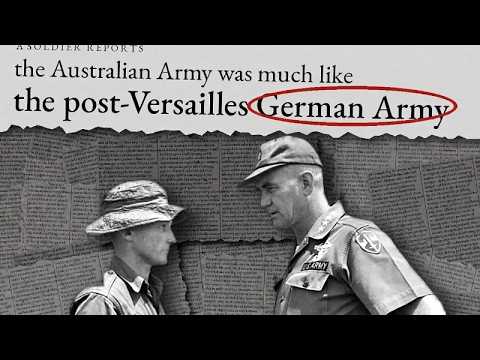
In June 1965, a US Army helicopter settled onto the edge of Bien Hoa airfield, and a four-star general stepped out. General William Westmoreland, commander of US Military Assistance Command Vietnam, had come to inspect the defenses of the 1st Battalion, Royal Australian Regiment—the only Australian battalion in the country at the time. He walked the perimeter, stopping to talk with officers and soldiers at their posts. An Australian Army photographer, Brian Dun, captured him in an informal discussion with Lieutenant Colonel Avon Brumfield, Major John Healy, and Warrant Officer Class 2 Jack Crump. What Westmoreland said to the men in the trenches that day was never recorded.
Eleven years later, in 1976, Westmoreland published his memoirs, A Soldier Reports, and in it he wrote that the Australian Army was very much like the German Army in the post-Versailles period. He meant one German army in particular: the Reichswehr, the 100,000-man professional force allowed by the Treaty of Versailles in 1919, before Hitler came to power. In that army, he wrote, even soldiers in the lower ranks could have been leaders in a less capable force. Lower ranks meant non-commissioned officers and privates—men without officer commissions. A four-star American general had looked at Australian soldiers of that kind and judged that in a less capable army, they would have been the ones giving orders.
Most of what follows is drawn from American documents. The general’s memoirs are one source. His daily journal is another, quoted by historian David Horner from the historical records of the US Army itself. Then there is the memorandum Secretary of Defense Robert McNamara sent to President Lyndon Johnson in late November 1965, and notes from a White House meeting in July 1967, recorded with the general at the table. The official US Army study of its allies in Vietnam, published in 1975, provides the numbers. Photographs from the Australian War Memorial of his visits to Australian troops provide the names in their captions. The judgment in this story does not rest on any Australian saying it about himself.
The fact of that German army takes a few minutes to tell. How many times Washington asked for more Australian troops takes longer, because the requests are in US government files, each with its own date. Then comes what the general wrote about the Australians in his own records while the war was still on. And whether his book, when it appeared, did them justice.
If you want history built on documents rather than myth, subscribe now. It costs nothing and means the next segment will reach you. And if your father or grandfather served at Bien Hoa, Nui Dat, or Coral, keep his unit in mind, because in the end there is a question for him. In 1968, according to the US Army’s own count, the Republic of Korea had 50,003 soldiers in South Vietnam within 22 maneuver battalions. It was the largest allied force in the country and had been since 1965. Australia that year had 7,661 soldiers in three battalions. For every Australian soldier, there were more than six Koreans. For every Australian battalion, there were more than seven Korean battalions. Both figures come from the same American table, calculated the same way. And when the general sat down to rank the foreign forces that served in Vietnam, he placed the Australians first.
Article 160 of the Treaty of Versailles, signed on 28 June 1919, set a maximum limit for the German Army. It could contain 100,000 men, including officers and depot establishments, and no more than 4,000 of them could be officers. Article 173 abolished universal compulsory military service in Germany, so every man in that army was there by choice. The next article bound sergeants, corporals, and privates for 12 consecutive years, while the one after that bound officers for at least 25 years. The army built within those limits was the Reichswehr, officially from 1 January 1921. Hans von Seeckt, chief of army command from 1920 to 1926, shaped it as a cadre force, a small army designed to expand if needed, and he considered himself a commander’s army. Historian James Corum, writing in 1992, says its officers and NCOs were trained to lead at least one level above their own.
In March 1935, Hitler’s proclamation of military sovereignty absorbed it into the Wehrmacht. Westmoreland’s comparison stops before that. His phrase was “the German Army of the post-Versailles period.” The Reichswehr is the name that army was known by, and the word does not appear in his sentence.
In 1964, the Australian Army had four battalions. In November of that year, the government announced national service. Twenty-year-olds were balloted by date of birth, and those whose dates came up served two years full-time, then three years part-time. The scheme was designed for an army of 40,000 full-time soldiers and was set to run until December 1972. With the national servicemen, and a shift to a nine-battalion tropical establishment, the army grew from four battalions in 1964 to nine in 1967. In the early months of 1965, that growth was still ahead.
In March, the 3rd Battalion sailed for Borneo, and a squadron of the Special Air Service went with it. That left a short list to choose from when Canberra decided to send a battalion to Vietnam. Prime Minister Menzies told Parliament on 29 April 1965 that the 1st Battalion would go. Three days later, a planning team led by Brigadier Ken Mackay was in Saigon, welcomed by Westmoreland. The Australians would be under his operational control, and the Americans would provide full administrative and logistic support.
The battalion arrived in June and joined the 173rd Airborne Brigade at Bien Hoa. On 21 July, a New Zealand battery of 105mm howitzers, the 161st, arrived and was attached to the same brigade. The US Army study records its primary mission in a single line: to support the Australian battalion. From its first weeks in the country, the Australian infantry in Vietnam had New Zealand guns behind them and an American brigade around both.
Lieutenant General Sir John Wilton, Chief of the General Staff, was in Saigon on 22 June, and by his account he laid down a condition. He told Westmoreland and the airborne brigade commander that the Australian battalion would not be treated the way the general treated an American battalion, and that Australia would not agree to it. He said he left with an assurance that the battalion commander would be consulted. That is what Wilton said in a 1976 interview, as quoted by Horner.
In July, Westmoreland planned a general reserve built around the 173rd, a force that could be sent anywhere in Vietnam, and the 1st Battalion was nominated for it. Wilton refused. In a letter to the Minister for the Army, he wrote that this would mean a series of hazardous operations, which would inevitably lead to heavy casualties. Then the conditions changed, step by step. On 2 September, after a call from Wilton, Westmoreland wrote in his journal that he had told him the latest proposal to use the Australians in operations alongside Bien Hoa was acceptable at this stage of the war. Horner quotes this entry too.
The next day, Wilton noted that the 1st Battalion was the best battalion in the theater, and that its morale would suffer if it were not used to best advantage. On 1 October, the battalion was permitted to conduct operations away from Bien Hoa. Westmoreland wanted to know where an Australian task force could go before Canberra agreed to send one. The man he asked was David Jackson. Jackson led the Australian Army Training Team and, by May 1965, was also commander of Australian Army forces in Vietnam, then a colonel, and a brigadier by July. When the general reserve was being planned that month, it was Jackson who recommended including the 1st Battalion, while Wilton refused it.
His answer to the general’s question, as he recalled it years later, was that Australian forces were trained for jungle and mountain operations, especially patrolling. Without heavy equipment support, he said, they were not suited to the Mekong Delta. On 12 August, Jackson reported that Westmoreland would be very pleased to know how far the possibility of forming an Australian task force had progressed. There was no task force for it to progress. There was one Australian infantry battalion at Bien Hoa.
Jackson also recalled that the US Marine commander near the demilitarized zone said he would be glad to have an Australian force there. At the end of September, Australia added its own battery of 105mm guns, a field engineer squadron, and an air reconnaissance flight. By the end of 1965, there were 1,557 Australians in Vietnam and 119 New Zealanders.
McNamara and General Earle Wheeler, Chairman of the Joint Chiefs of Staff, spent a day and a half with Westmoreland in Vietnam on 28 and 29 November. They went to the 173rd Airborne Brigade, which was hosting the Australians, and to the 1st Cavalry Division. On the 29th, McNamara told the Australian ambassador in Saigon that a request for a second battalion would be coming soon. On the 30th, he wrote to the President: “I…” The memorandum is in the Johnson Library and has been printed by the State Department in its documentary series, Foreign Relations of the United States.
Its first recommendation was for Korea, increasing nine combat battalions to 18 before July 1966 and to 21 before October. The second was for Australia. It stated that the Australian government should be asked to increase its current deployment from one combat battalion to two before October 1966. The third was for the Americans themselves, an increase of 34 battalions to 74 by the end of 1966. The memorandum says that Ambassador Lodge, General Wheeler, Admiral Sharp, and General Westmoreland had concurred. It also counts the battalions already in the field: 130 South Vietnamese, nine Korean, one Australian, and 34 American. The President saw it.
The official US Army study of its allies, written by Lieutenant General Stanley Larsen and Brigadier General James Collins and published in 1975, gives the general’s goal a name drawn from Gallipoli. It says his long-range objective was for Australia and New Zealand to deploy a full brigade of the Australian and New Zealand Army Corps—an ANZAC brigade—within the next year. His short-range objective was to get one additional Australian battalion immediately.
By the end of 1965, the matter was still unresolved. On 23 December, according to Horner, Major General Charles Long of the Australian Defence Staff in Washington reported the structure that was forming in the general’s mind: two Australian battalions and one New Zealand battalion, with supporting arms and logistic units and a squadron of the Special Air Service. It was a brigade conceived by an American for two other countries to man.
The Joint Planning Committee in Canberra did its own sums. The 4th Battalion was still in Borneo. The 5th and 6th would be ready in May or June 1966, the others later. On those figures, the most Australia could sustain in Vietnam for an indefinite period was a two-battalion task force. Horner is clear about what drove the decision. Australia was responding to a specific American request for a second battalion.
On 2 March 1966, the government approved the task force. It would consist of two infantry battalions, a Special Air Service squadron, combat and logistic support, and eight Iroquois helicopters of the Royal Australian Air Force—about 4,500 men, including national servicemen. Prime Minister Harold Holt announced it on 8 March. Wilton returned to Saigon that month to fix the task force’s destination and the chain of command it would answer to. Westmoreland would deal with the Australian commander in Vietnam, a major general. Operational control of the task force would pass through the commander of II Field Force, and the force would go to Phuoc Tuy, the coastal province southeast of Saigon.
In 1976, Wilton told an interviewer that his two-battalion task force was the equal of any three-battalion American brigade. That claim is his alone, and no one else’s.
On 13 March, Westmoreland visited the 1st Battalion during Operation Silver City. Three days later, Horner records that three Viet Cong battalions attacked an American battalion, and Australian gunners fired continuously for four hours to repel the assaults. Wilton and Westmoreland signed the military working arrangement on 17 March. The general’s journal, as quoted by Horner, noted that the Australians were happy to work with Americans, and that there appeared to be mutual friendship and shared vision. “Apparently” was the general’s own word.
From the Australian side, Air Marshal Sir Frederick Scherger called for a single national command. The alternative, as he put it, was submission to a tactical doctrine Australia might not approve. Ten years later, in his book, Westmoreland summed up the arrangement in one sentence: the Australians, and later the New Zealanders and Thais, relinquished operational or tactical control.
The first table in the US study counts allies by calendar year. In 1964, Australia and Korea were equal at 200 men each, with 30 New Zealanders. That was the last year they were equal. In 1965, Korea had 20,620 men in 10 battalions; Australia, 1,557 in one battalion. In 1966, Korea had 45,566 in 22 battalions; Australia, 4,525 in two. Korea’s 22 battalions remained fixed through the end of the table. Australia’s became two, then three in 1968. Australia’s highest figure is 7,672 in 1969. The Australian War Memorial, using another method, estimates the peak Australian force at about 8,500. The peak New Zealand force was about 550. Every man in those columns is counted the same way by the same army.
The general’s own sentence about the Australians starts from the same premise. He wrote that they were few in number, and the War Memorial lists the tasks of task force patrols: taxes and recruits were on that list. The 6th Battalion arrived in June 1966 and with the 5th formed the 1st Australian Task Force at Nui Dat in Phuoc Tuy Province. “Once the base was secured, the task force began patrolling the province. The patrols sought out the enemy, engaged him, denied him supplies, and curtailed his contact with villages where he collected taxes and found recruits.” Some soldiers on those patrols were national servicemen. The SAS squadron served as the task force’s eyes and ears, small patrols inserted by helicopter.
On 18 August, one company of the 6th Battalion fought at Long Tan inside a rubber plantation. Colin McArthur, an Australian historian, quotes a line from the general’s own record in a 1992 introductory history of East Asia. The line reads: “The Australians are very inactive.” McArthur says the general recorded it in February 1967. An article in the Australian Army Journal, citing the official Australian history, dates the general’s visit to the task force to January. In any case, we are in early 1967. According to the same records, the general expressed disappointment to the new task force commander, Brigadier Stuart Graham, and later raised the matter with the Australian ambassador and General Mackay. The official Australian history also records his pressure on the Australian commander, Major General Tim Vincent, to adopt a more aggressive approach. Nearly a year earlier, he had wanted an ANZAC brigade. Now he was disappointed, and he wrote it down.
In a chapter on the 5th Battalion’s counterinsurgency approach in 1966, published by the Australian National University in 2020, Horner sets the two methods side by side. In his summary, the Americans favored a direct approach using heavy firepower to neutralize as many enemy soldiers as possible. The Australians preferred a more methodical approach to counterrevolutionary war. They believed their deliberate patrolling was more effective, and according to the official history, the general’s calls met with little response. None of that removed the Australians from under his command. Operational control remained entirely American with Westmoreland and then II Field Force.
Michael Coleridge photographed the general at Nui Dat in August 1967 in what the War Memorial captions describe as a short visit to the task force. Brigadier Graham received him. The caption records the month and place without specifying the day. They are the same general and the same brigadier who appeared in the record of disappointment earlier that year. What passed between them at Nui Dat is not in any source this report could find. The task force still consisted of two battalions. Since May, a New Zealand rifle company, V Company, had served with it, the first of the two rifle companies the general’s book later mentions.
At 1:25 p.m. on 13 July 1967, a meeting began in the White House family dining room. At the table sat President Johnson, McNamara, Wheeler, Westmoreland, and George Christian. Tom Johnson took notes. McNamara reported complete agreement on the force question, a total American strength of 525,000, and said the matter should be discussed with allies before final decisions. Wheeler reported on the allies. He said the Australians might be able to provide one additional battalion. He had military reports that they were ready and willing, and that the Australian government would be responsive to a request for additional forces. McNamara saw more Australians and Koreans as a valuable gain to the total effort. The President asked whether he should send envoys on missions to discuss possible troop increases from allies. The group agreed. According to the notes, Westmoreland said he had not requested a specific number of troops. At a quarter to three, it was over.
In December 1967, the task force got its third battalion. At home, the 9th Battalion was raised in November, giving the army its nine battalions. The second New Zealand rifle company, W Company, arrived in the same month of December. On 1 March 1968, an ANZAC battalion was formed. The word the general had wanted for a brigade ended up on a battalion. In February, Centurion tanks of C Squadron, 1st Armoured Regiment, arrived. According to US Army counts, 1968 was the first year with three Australian maneuver battalions in Vietnam. Nothing in the papers behind this account links that third battalion to Wheeler’s July report.
The fire support base Coral was about 25 miles northwest of Saigon, by the War Memorial’s designation, roughly 40 km, and entirely outside Phuoc Tuy. In May 1968, the Australians there repelled attacks on the base on the 13th and again on the 16th. Afterwards, Westmoreland paid a quick visit and spoke with Brigadier Ron Hughes, who was then commanding the task force. Graham’s tenure had ended, and Hughes succeeded him. The general had less than four weeks left in his command in Vietnam. The caption records Hughes, the place, and the dates, but omits what the general said. He returned in June on what the War Memorial calls a farewell visit. The fire support base Balmoral had been attacked a few days before. At Coral, he spoke with men of a troop of C Squadron, 1st Armoured Regiment, about an enemy attack. Kevin Thurgar photographed them in front of a Centurion tank. The caption names the crew: Corporal Bill Burton, the tank commander, and Troopers Jock Tait, Phil Payne, and Peter Lucas. One corporal and three troopers, men of the lower ranks.
On 11 June, the general handed over command in Vietnam. On 3 July, he became Chief of Staff of the United States Army. Doubleday published A Soldier Reports in Garden City, New York, in 1976, four years after he stepped down as Chief of Staff, and Dell issued a paperback in 1980. The Australians get their paragraph directly after his paragraph on the South Korean forces. He wrote: “Aside from American soldiers, the Australians were the most professional foreign force ever to serve in Vietnam.” Then comes the sentence that began this story. The Australian Army, small in number and well trained, especially in guerrilla warfare, was like the German Army of the post-Versailles period, where even the simplest soldiers could have been leaders in a less capable force. He names the Australian commanders next. New Zealand gets its own sentence after that. “Forces from New Zealand,” he wrote, “initially a battery of 105mm howitzers and later two infantry companies, worked with the Australians and were of similar quality.”
These are the words of a commander about his own war, set down after he left the army. The same paragraph includes a three-battalion task force with artillery, armor, and other support arriving in mid-1965 and serving in Phuoc Tuy. The records show one battalion arriving in June 1965 at Bien Hoa, attached to an American brigade. A two-battalion task force went to Phuoc Tuy in 1966. The third battalion arrived in December 1967 and the tanks in early 1968. His sentence on New Zealand mentions the battery and the two infantry companies arriving together in mid-1965. The battery came in July 1965. The two infantry companies in 1967. A few lines later, he discusses the battle of Long Tan in the book: “A company of just over one hundred men, in the middle of monsoon rains that obscured visibility and prevented tactical air support, held off an enemy force of 1,500 fighters for three hours.” The War Memorial’s page on the 6th Battalion mentions 108 men engaged with between 1,500 and 2,500 enemy soldiers for more than three hours. The War Memorial’s general overview estimates the enemy force at more than 2,000 and the battle at four hours. The general’s numbers fall at the low end of the War Memorial’s range, and the War Memorial’s own two pages do not agree with each other.
Set the two armies side by side, and part of that similarity can be measured. Both were small by design. Versailles limited Germany to 100,000 men, and Australia’s national service scheme was based on an army of 40,000 full-time soldiers. Both were built to expand. Seeckt shaped the Reichswehr as a cadre that could be expanded. The Australian Army grew from four battalions to nine between 1964 and 1967. On training, the records are less detailed. The Reichswehr kept its ordinary soldiers for 12 years, and by Corum’s account trained its officers and NCOs to lead at a higher level. The Australians, according to the 1965 report to the general, trained for jungle and mountain warfare and, above all, patrolling. The SAS of the task force worked in small patrols that were self-reliant once the helicopter left. The last part of his sentence, “men in the ranks who could have commanded in a smaller force,” is his own judgment, and no table proves it.
Article 173 is where the similarity breaks. The Reichswehr could not accept conscripts, and every soldier in it signed a 12-year contract. The task force, according to the War Memorial’s records, included conscripts called up under national service, men selected by a birthday ballot at twenty, who served two years full-time with training during those two years. The cabinet task force of March 1966 included national servicemen from the start. The German soldier in his twenties had 12 years to learn his trade. The Australian national serviceman at Phuoc Tuy had a fraction of that. The general’s sentence covers both kinds of Australian soldiers and does not distinguish between them.
Below officer rank, the War Memorial’s captions name five of the men he met. Warrant Officer Class 2 Jack Crump of Sydney was photographed with his commander and Major Healy on the Bien Hoa perimeter in June 1965, while the general spoke with them. Corporal Bill Burton and Troopers Jock Tait, Phil Payne, and Peter Lucas stood in front of a Centurion tank at Coral in June 1968. Three years separate the two photographs, almost the same month. In the first, the Australians in Vietnam are one battalion inside an American brigade. In the second, they are a three-battalion task force with tanks fighting outside their own province. The photographs were taken by Brian Dun in 1965 and Kevin Thurgar in 1968. Michael Coleridge took the one in between at Nui Dat with Graham.
The book deals with the Australian commanders in a single sentence. It praises a succession of competent administrative commanders, Major Generals Kenneth Mackay, Douglas Vincent, and A. L. MacDonald, and talented field commanders, Brigadiers O. D. Jackson, R. L. Hughes, and S. S. C. Graham. Douglas Vincent is Tim Vincent, whom he pressured to be more aggressive. O. D. Jackson is David Jackson, the Australian he asked in 1965 where an Australian task force might go, who told him jungles and mountains and patrolling, not the Mekong Delta without heavy equipment. When the general came to name the field commanders he called talented 11 years later, Jackson’s name came first.
The general was already in Washington when the task force’s work changed. From 1969, its focus shifted to training South Vietnamese regional and popular forces. That year, the 6th Battalion served in Vietnam with a New Zealand company in its ranks, the 4th Company, as 6th Battalion, Royal Australian Regiment, ANZAC New Zealand. The task force remained in Phuoc Tuy for more than 5 years. The last Australian battalion left Nui Dat on 7 November 1971. Westmoreland was still Chief of Staff then, and he remained in the post until 30 June 1972. National service ended in December 1972, six months after Westmoreland stepped down as Chief of Staff. The ballot system had lasted 8 years. About 60,000 Australians served in Vietnam, and more than 60,000 according to the War Memorial’s count. 523 of them lost their lives as a result of the war, and nearly 2,400 were wounded. A Soldier Reports appeared more than 4 years after the last battalion left Nui Dat. Its paragraph on the Australians consists of a few sentences, preceded by a paragraph on the Koreans and followed by another on the New Zealanders.
A battalion called itself “the Hardcore.” It was the 4th Battalion, 39th Infantry, of the US 9th Infantry Division, and since early January 1969, under the command of Lieutenant Colonel David Hackworth, it had been operating in the Mekong Delta. There was no Australian in it. He wrote an article about the battalion titled “The Gorilla Battalion, American Style.” In his account, the battalion’s basic tactic was the ambush. It operated in platoons or smaller groups, dispersed across an area of operations 50 km wide, and its company commanders were carefully chosen. One sentence in the article mentions the Australians. Hackworth wrote that his company commanders trained with an Australian infantry company for 4 weeks, where they learned platoon and company tactics from the best jungle fighters in the world. He does not name the company. He does not say when the four weeks were or where. Nothing else in the article fills that gap, and this account will not guess it. It is a sentence by an American battalion commander about the officers he handpicked to lead his companies in the Delta.
When the article appeared, Westmoreland was Chief of Staff in Washington. Infantry magazine was described as a professional bulletin, prepared for publication every two months by the US Army Infantry School at Fort Benning, Georgia. Hackworth’s article appeared in the January-February 1971 issue on pages 22 to 27. By January 1988, the task force had been gone from Nui Dat for more than 16 years. National service had ended 15 years earlier, and A Soldier Reports had been in print for 12 years. That month, the bulletin reprinted Hackworth’s article in an edited version. The four weeks with the Australian infantry company were still there on page 27.
If your father or grandfather served in Vietnam in those years, here is the question for him. Did he see General Westmoreland there at Bien Hoa in 1965, at Nui Dat in 1967, or at Coral in 1968? Tell us in the comments. The unit and the year are enough. If there was a soldier in his platoon who could read a map better than anyone else, we would like to hear about him too. And if your father was with the 173rd at Bien Hoa or with an American battalion in the Delta, his memories are welcome here as well. Subscribe to the channel so you don’t miss the next part. Thanks for watching.
Report this article
Select a reason for reporting:






