In the dead of night on January 14, 1942, three Axis ships lay anchored in the neutral Spanish port of Santa Isabel on Fernando Po, their crews carousing at a lavish party ashore. None suspected that a team of British commandos, their faces blackened, were silently paddling toward them in kayaks. Within hours, the ships would vanish, leaving the Spanish authorities humiliated and the British government denying any involvement. This was Operation Postmaster—a raid so audacious it seemed ripped from the pages of a spy novel. In fact, one of its masterminds was Ian Fleming, the future creator of James Bond.
The operation was the brainchild of the Special Operations Executive (SOE), a clandestine force sanctioned by Winston Churchill to “set Europe ablaze.” But the target was thousands of miles from Europe, off the coast of West Africa, where German U-boats were wreaking havoc on Allied shipping. British intelligence suspected that three vessels—the Italian merchant ship Duchessa d’Aosta, the German tug Likomba, and the diesel barge Bibundi—were acting as eyes and ears for the U-boats, reporting convoy movements and providing supplies. All three were in a neutral port, but the port’s governor was sympathetic to the Axis. Eliminating them would require more than just firepower; it would demand guile, deception, and a plausible deniability that could withstand international scrutiny.
Major Gus March-Phillipps, a veteran of Dunkirk, was chosen to lead the raid. He assembled a team of unconventional soldiers from No. 62 Commando—men who didn’t think or fight like regular troops. Among them were Captain Geoffrey Appleyard, a Cambridge-educated skier, and Captain Graham Hayes, a seasoned commando. Their plan was simple yet daring: under cover of darkness, they would board the ships, overpower the crews, blow the anchor chains with explosives, and tow the vessels out to sea. There, the Royal Navy would intercept them, and the British would claim the ships as prizes of war, insisting the crews had mutinied and tried to escape.
But first, they needed intelligence. Two SOE agents were dispatched to Fernando Po. One, Leonard Guise, posed as a diplomat and casually rowed around the harbor, measuring the anchor chains. The other, Richard Lippett, befriended a German woman and convinced her to host a party for the ship’s officers on the night of the raid. He even bribed a local official to turn off the town’s lights earlier than usual. “The party was in full swing when three flashes and explosive roars interrupted the proceedings,” but the drunken officers, blinded by the dark, assumed it was an air raid and continued celebrating.
Meanwhile, March-Phillipps and his men moved with precision. They secured the Bibundi after finding a German flag aboard, then boarded the Duchessa d’Aosta, locking the sleeping Italian crew in their quarters. “No shots were fired, and no lives were lost.” The ships were towed out of the harbor, and by the time the lights came back on, the port was empty. The Spanish were furious but had no proof. The British, of course, denied everything.
The success of Operation Postmaster was a triumph for the SOE, proving that unconventional warfare could achieve what conventional forces could not. It also sent a chilling message to the Axis: even neutral ports were not safe. But the story didn’t end there. The men of No. 62 Commando would go on to further daring exploits, and their fates would be intertwined with tragedy and heroism. Gus March-Phillipps, Geoffrey Appleyard, and Graham Hayes would all pay the ultimate price before the war was over. Their legacy, however, would live on—in the annals of military history and, decades later, on the silver screen.
As the tugs chugged into the Nigerian port, the crews aboard the captured vessels must have felt a strange mixture of triumph and disbelief. They had pulled off something that, on paper, sounded like madness. Not a single shot had been fired, and not a single life had been lost on either side. The Spanish authorities, meanwhile, were left sputtering with rage, demanding answers that no one in London had any intention of giving them.
The diplomatic fallout was immediate. In Madrid, the Spanish government summoned the British ambassador and accused Britain of blatant piracy. The foreign office, following the script to the letter, expressed utter bewilderment. “His Majesty’s Government has no knowledge of any such incident,” they declared, with a straight face that would have impressed the most seasoned thespian. But the Spanish had a problem: they had no proof. The harbor had been dark, the officers drunk, and the only witness of substance was a German woman who genuinely knew nothing.
Berlin, however, was not so easily fooled. German radio broadcasts howled with indignation, claiming that British destroyers had entered the harbor and dropped depth charges to blow the anchor chains—a version of events that was almost comically wrong but served its purpose. The British seized on this with glee. “If the Germans say there are Axis ships on the high seas,” a naval spokesman noted dryly, “then we shall certainly keep an eye out for them.” And keep an eye out they did.
On January 19, HMS Violet, a corvette patrolling the Gulf of Guinea, spotted a large merchant vessel flying an Italian flag. It was the Duchessa d’Aosta, sailing under a scratch crew of commandos who were doing their level best to look like mutineers. The boarding party from HMS Violet arrived with bayonets fixed and found a scene of theatrical chaos: the Italian crew locked below, the commandos above deck waving their hands in surrender, and a story already rehearsed to perfection. The officers, they claimed, had been ashore when the explosions went off, and the crew had seized the opportunity to escape. The Royal Navy, arriving conveniently on the scene, had no choice but to take the vessel as a prize of war.
The Likomba and the Bibundi were intercepted in similar fashion, and all three ships were soon safely in British hands. The prisoners—twenty-nine in total—were packed off to a camp in the back end of Nigeria before being transferred to South Africa. By the time the full story emerged, Italy had been knocked out of the war, and the diplomatic storm had largely blown over. In Fernando Po, Richard Lippett was released from custody but told he could not leave the island pending further questioning. Ever resourceful, he commandeered an African canoe and paddled the thirty miles to the Nigerian mainland under cover of darkness.
Back in London, Churchill was elated. The operation had been a gamble, and the foreign office had hated every minute of it, but the results spoke for themselves. Ten thousand tons of Axis shipping had been captured, the U-boat supply chain in the region had been disrupted, and not a single British life had been lost. Medals were showered on the team. Major Gus March-Phillipps was awarded the Distinguished Service Order, while Captain Graham Hayes received the Military Cross. Captain Geoffrey Appleyard was awarded a bar to his existing Military Cross, and Private Anders Lassen—the young Danish sailor who had leapt aboard the Duchessa d’Aosta first—was given a commission in the field and awarded the Military Cross as well.
But the most remarkable award went to the men who had made the raid possible from the shadows. Richard Lippett and Leonard Guise were both appointed Officers of the Order of the British Empire. Lippett, the man who had thrown the party, bribed the engineer, and paddled to freedom in a canoe, had proven himself as valuable as any soldier. “It was the sort of bloody-minded action that their leader General de Gaulle might have sanctioned,” one SOE report noted, with more than a hint of admiration.
Yet even as the celebrations faded, the men of No. 62 Commando knew their work was far from done. The SOE had proven its worth, but the war was only growing more brutal. In the months that followed, they would be sent on raid after raid along the French coast and the Channel Islands—each one more dangerous than the last. And it was on one of those missions, on a beach that would later become known to history as Omaha, that the bill for Operation Postmaster would finally come due.
The raid on Fernando Po had been a bloodless masterpiece, but blood was about to be spilled. In the summer of 1942, No. 62 Commando was folded into the Small Scale Raiding Force, a unit tasked with hitting the French coast and the Channel Islands. The work was relentless and the margins razor-thin. Every raid was a roll of the dice, and the men knew it.
On the night of September 12, 1942, Gus March-Phillipps led a raid on the beach at Sainte-Honorine-des-Pertes in Normandy—a stretch of shoreline that would one day be designated Omaha Beach. The mission, codenamed Operation Aquatint, was to capture prisoners and gather intelligence. But the weather turned, the landing craft scattered, and the Germans were waiting. March-Phillipps was killed in action, shot on the sand at the age of thirty-four. He had been married to Marjorie Stewart for just five months.
Graham Hayes was one of only four men to survive the debacle. Wounded, he evaded capture for weeks, spirited along by the French Resistance, passing through Paris and making a desperate run for the Spanish border. But a suspicious Spanish border guard handed him back to the Germans. Hayes was held in solitary confinement for nine months before being executed on July 13, 1943. He was thirty-one.
The cruelest coincidence of all came on that same day. In Sicily, Geoffrey Appleyard—now serving with the Special Air Service—was reported missing in action during the invasion of the island. The two men, who had stood side by side on the deck of the Duchessa d’Aosta, had died on the same day, half a world apart. Appleyard was twenty-five.
Anders Lassen, the young Dane who had leapt aboard first, seemed to lead a charmed life. He joined the SAS, rose to the rank of major, and was awarded the Military Cross three times over—a feat almost unheard of. But his luck ran out in Italy in April 1945, just weeks before the war in Europe ended. He was killed in action and awarded a posthumous Victoria Cross, the only member of the SAS to receive Britain’s highest gallantry award during the Second World War.
As for the ships themselves, the Duchessa d’Aosta was reflagged, renamed the Empire Yukon, and served as an Allied troop ship for the rest of the war. At the end of hostilities she was sold to the Canadian government, then to an Italian company, and finally scrapped in Italy in 1952—a quiet, ironic full circle for the vessel that had once been the pride of Mussolini’s merchant marine.
The Maid of Honor, the little trawler that had carried the commandos three thousand miles across the Atlantic, was left behind in Nigeria. She slipped out of the historical record entirely, her fate unknown. Some ships, like some men, simply vanish into the fog of war.
But the legacy of Operation Postmaster refused to fade. The raid had proven that a handful of unconventional men, backed by clever intelligence and a willingness to break the rules, could achieve what fleets and armies could not. It had sent a message to Berlin and Rome that no port, however neutral, was truly safe. And it had given a certain naval intelligence officer named Ian Fleming a story worth remembering.
Fleming would go on to mastermind another scheme—Operation Golden Eye—a covert plan to keep watch on Spain should the Germans ever invade. But it was in the 1950s, sitting at his typewriter in Jamaica, that the old lessons truly bore fruit. James Bond, the suave spy with a license to kill, was born in part from the men Fleming had watched risk everything in a dark harbor in West Africa. Bond’s boss, after all, was known only as M—the same code name Brigadier Colin Gubbins had used during the war.
Marjorie Stewart, the actress-turned-agent who had married Gus March-Phillipps and lost him five months later, returned to the stage and screen through the 1940s and 1950s. She never became a star, but she lived a full life, dying in London in 1988 at the age of seventy-six. She rarely spoke publicly of the raid, or of the husband she had known so briefly.
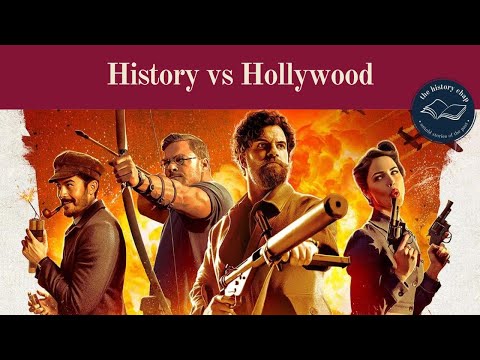
The world, too, largely forgot. The files gathered dust in the archives, the heroes aged and passed away, and Operation Postmaster became a footnote in the vast history of the Second World War. That is, until a filmmaker named Guy Ritchie decided to put it on the big screen—loosely, of course.
And perhaps that is the strangest twist of all. A raid designed to leave no fingerprints, to vanish into the night without a trace, has now been seen by millions. The men who pulled it off would surely have approved of the irony.
So there it is—the real Operation Postmaster. No Nazi firefights on a remote island, no shootouts in the Canaries, and no female agent on the raid itself. Just a handful of men in kayaks, a well-timed party, and a plan so audacious it left the Spanish with nothing but wounded pride. Guy Ritchie’s film is a thrill ride, but the truth is arguably stranger and braver.
Churchill got his blaze, Fleming got his inspiration, and the men of No. 62 Commando got medals—and, for too many of them, graves far from home. The Maid of Honor sailed into history and never sailed out again.
What do you think—does the real story beat the movie, or does Hollywood’s version deserve its own place in the spotlight? Let me know in the comments below.
Report this article
Select a reason for reporting:






