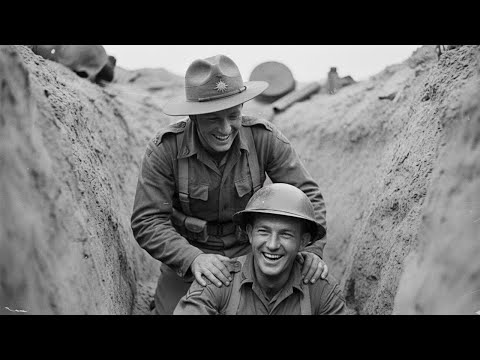
April 1941, Tobruk, Libya. The desert sun blazed overhead as 14,000 Australian troops huddled behind makeshift defenses, surrounded by 38,000 German and Italian soldiers. The odds were impossible: outnumbered nearly three to one, cut off from supply lines, and facing General Erwin Rommel—the legendary Desert Fox whose Afrika Korps had just torn through British defenses like a hot knife through butter. German intelligence gave the Australians 48 hours at most. Rommel himself predicted he’d be drinking coffee in the port commander’s office by the weekend.
Inside a bunker 15 feet underground, Major General Leslie Morshead studied maps by candlelight. The air smelled of damp earth and diesel fuel. Before the war, he’d been a school teacher in Sydney, teaching history and mathematics to fidgeting children. Nobody expected a former teacher to stop the greatest general in the German army. When Morshead presented his defensive plan to British commanders, they stared at him like he’d lost his mind. “You want to stay and fight?” one general asked, his voice dripping with disbelief. “You want to hold this position with no reinforcements coming?” Another called it suicidal stubbornness. The smart move, they insisted, was to evacuate by sea while there was still time.
But Morshead saw something the experts missed. He walked the perimeter in the scorching afternoon heat, examining every hill, every ridge, every dry riverbed. The British saw a death trap. Morshead saw opportunity. The desert terrain wasn’t flat and open like everyone assumed—it had folds and dips, rocky outcrops perfect for hiding positions, ground hard enough to dig deep and soft enough to tunnel through. Most importantly, it had 30 miles of Italian-built defensive trenches from an earlier campaign, abandoned and waiting.
Morshead called his senior officers together. “Gentlemen,” he said, his voice calm and steady. “The Germans think we are trapped here. They think this position is indefensible. They are wrong. This is not their trap. This is our fortress.” He spread a hand-drawn map across the wooden table. Red lines showed the old Italian trenches. Blue circles marked where his men would dig new positions. Green arrows pointed to no man’s land beyond the wire. “We will not sit here waiting to be killed. We will not surrender when Rommel expects us to break. We are going to attack.”
The digging started before sunrise. Australian soldiers grabbed picks and shovels and attacked the desert floor like their lives depended on it—because they did. Morshead’s plan required 30 miles of interconnected trenches and tunnels. The men looked at that number and felt the weight settle on their shoulders like wet sandbags. But they kept digging. The sound of metal striking earth mixed with the distant rumble of German tanks. Sweat poured down their faces in the 100-degree heat. Their hands blistered and bled. They kept digging anyway.
Each trench had to reach exactly 15 feet deep to survive German artillery shells. Anything shallower and the explosions would kill everyone inside. Anything deeper and the digging would take too long. The soldiers measured every foot with careful precision, shoring up walls with wooden beams salvaged from bombed buildings. At night, they could hear German patrols moving above them, boots crunching on sand, completely unaware that Australian soldiers lay hidden just beneath their feet.
Morshead ordered observation posts built every 200 yards along the defensive line—127 fortified positions in total, each connected by the tunnel network. From these posts, Australian spotters tracked German movements, counted enemy vehicles, and radioed coordinates to artillery crews. The Germans thought they were attacking a desperate, disorganized rabble. Instead, they faced a web of eyes watching their every move.
But the real surprise came at night. During the first week of the siege, Australian patrols slipped out of their tunnels under cover of darkness. They moved like ghosts across the sand, faces blackened with charcoal, weapons wrapped in cloth to prevent noise. These patrols ranged three to five miles beyond the defensive wire—deep into territory the Germans thought they controlled. In just seven days, the Australians conducted 23 separate night raids. They ambushed supply convoys. They cut communication lines. They planted mines on roads the Germans used every morning. By the end of that first week, 400 German and Italian soldiers were dead or wounded. The attackers had become the attacked.
The numbers told a story the Germans did not want to believe. Intelligence had promised Tobruk would fall in two days. After a full month of fighting, Rommel’s forces had captured only 1.2 square miles of ground. Every inch cost blood and ammunition. German commanders sent increasingly frustrated reports back to Berlin. How were these surrounded Australians still fighting? Where were they getting supplies? Why would they not surrender like reasonable soldiers?
British high command in Cairo sent urgent cables to Morshead. The messages were polite but firm: evacuate while you still can. The Royal Navy will send ships. Get your men out before it is too late. Morshead read each cable, crumpled it up, and threw it in the trash. He sent back a two-word reply: “We stay.”
Then Winston Churchill himself intervened. On April 25th, a coded message arrived from London. The prime minister’s words were clear and direct: Hold Tobruk at all costs. The world is watching. Churchill understood what the British generals in Cairo did not. Tobruk was not just a military position anymore. It was a symbol. It was proof that the Allies could still fight back. It was hope in the middle of defeat after defeat.
Morshead posted Churchill’s message where every soldier could read it. The men stood a little straighter after that. But holding Tobruk required supplies, and supplies required ships. The Royal Navy committed to nightly runs through German-controlled waters. Destroyers and small cargo vessels raced into Tobruk Harbor under darkness, unloaded food and ammunition in less than an hour, and raced back out before dawn. German bombers hunted these ships like hawks hunting mice. The Navy lost 30% of the vessels assigned to the Tobruk run. One out of every three ships never came home. But the supplies kept coming. Night after night, British sailors risked death to feed the surrounded Australians.
On April 30th, Rommel decided to end the embarrassment with one massive assault. He gathered his best troops, his heaviest tanks, and his most experienced officers. At dawn, German artillery opened fire with everything they had. The bombardment lasted three hours. The ground shook so hard that soldiers’ teeth rattled in their skulls. Then the tanks came, followed by waves of infantry. The Germans expected to roll right through the Australian lines. Instead, they ran into a nightmare.
The underground positions absorbed the artillery with minimal damage. Australian anti-tank guns, carefully hidden in camouflage positions, opened fire at point-blank range. German tanks exploded into fireballs. Infantry advancing behind the tanks walked into pre-sighted machine gun fields. The battle lasted four hours. When the smoke cleared, 1,200 German soldiers lay dead or wounded on the sand. The Australians had held every inch of ground. Rommel’s diary entry that night contained words he rarely wrote: “Attack failed. Enemy resistance unexpectedly strong.”
But the Germans still had one weapon left: propaganda. On May 1st, the radio broadcasts started up again. This time, a different voice spoke. The British called him Lord Haw-Haw—an English traitor who worked for German radio. His real name was William Joyce, and he specialized in demoralizing Allied troops. “Poor rats of Tobruk,” he said, his voice dripping with fake sympathy. “Rats living in holes. Rats eating scraps. Rats waiting to be exterminated. How does it feel to be rats abandoned by your own side?”
The German propaganda ministry thought they had found the perfect insult. Rats were vermin. Rats were disease carriers. Rats were things you poisoned and threw in the trash. Calling the Australians rats would break their spirit. It would make them feel worthless and forgotten. At least that was the plan.
Inside the tunnels and trenches of Tobruk, the Australians listened to Lord Haw-Haw’s broadcast and started laughing. One soldier grabbed a piece of charcoal and drew a cartoon rat on the wall—standing upright, holding a rifle, grinning with sharp teeth. “That’s us,” he said. “We’re the rats.” Another soldier found a scrap of metal and hammered it into the shape of a rat. He wore it on his helmet. Within a week, every Australian in Tobruk was calling himself a rat. They painted rat emblems on tanks. They carved rat figures from spent shell casings. They sent letters home proudly signing themselves as the Rats of Tobruk.
The Germans had tried to insult them. Instead, they had given them the perfect name—because rats survive. Rats adapt. Rats are almost impossible to kill. And these particular rats had very sharp teeth. The comparison was impossible to ignore. Just six months earlier, the British garrison at Bardia, only 70 miles down the coast, had fallen in three days. The British had similar numbers to what the Australians now had in Tobruk. They had similar defensive positions. They faced a similar enemy force. But they surrendered in 72 hours. The Australians, by contrast, were now entering their second month of siege—then their third, then their fourth.
The siege that German intelligence predicted would last two days was stretching into what would become 241 days—eight full months of constant fighting. The experts had been wrong, catastrophically wrong. The statistics told a story of defiance that shocked both sides. German forces launched four major assaults against Tobruk. Each one carefully planned, each one supported by tanks and aircraft. All four failed. Between these big attacks, German and Italian troops probed the Australian lines with over 1,000 smaller raids. 1,000 attempts to find a weak spot, a gap in the defenses, a place where they could break through. The Australians turned them all back.
Rommel lost 3,000 men trying to capture a port city that was supposed to fall without a fight. The Australians, fighting from prepared positions with the advantage of knowing every inch of their territory, lost 800. The math was brutal and one-sided—just not in the direction anyone expected.
Every single day, the German artillery pounded Tobruk with 15,000 shells. 15,000 explosions, shaking the earth from dawn until dusk. The sound was constant and overwhelming, a thunder that never stopped. Soldiers learned to tell the difference between shells just by the whistle they made falling through the air. High-pitched meant small caliber—get down, but stay calm. Low and rumbling meant big shells, the kind that could collapse an entire section of trench. The Australian gunners answered back with 8,000 shells of their own. They had less ammunition, so they made every shot count.
The Rats of Tobruk name spread like wildfire through the Australian ranks. What started as a handful of hand-drawn cartoons became a full identity. Soldiers painted rat emblems on their helmets using whatever paint they could find. Tank crews drew elaborate rat designs on their armor—rats with guns, rats with grenades, rats baring teeth at the enemy. The rats were always shown fighting, never running. In the underground bunkers, men carved rat figures from pieces of wood and metal. They sent these carvings home in letters to Australia. Parents showed them to neighbors with pride. Newspapers picked up the story and ran headlines celebrating the fighting rats. Within three months, every Australian in North Africa wanted to be called a rat. The name that was supposed to destroy morale had become a source of strength.
Back in Berlin, the German propaganda ministry realized their terrible mistake. Internal memos flew between departments: Stop using the rat terminology immediately. Find a different insult. But it was too late. The damage was done. British radio broadcasts were now mocking the Germans for giving their enemies such a perfect symbol. American newspapers ran cartoons showing fierce Australian rats chewing through German tanks. The propaganda had backfired so completely that it became a case study in how not to demoralize your enemy. You never give them a unifying identity. You never give them something to rally around. The Germans had done both.
Rommel’s diary entries traced his growing frustration. “The Australians are stubborn beyond all reason,” he wrote in June. By August, his tone had shifted to something close to respect: “The Australian soldier is among the finest I have encountered.” The Desert Fox was admitting that school teachers and sheep farmers from the other side of the world had stopped him cold.
December 1941. After 241 days, the Rats finally saw relief columns approaching across the desert. The men who emerged from their tunnels looked like ghosts—uniforms in tatters, skin burned dark, many barely able to hear. But they walked out with heads high, still wearing those hand-painted rat emblems on their helmets. They had done what everyone said was impossible. They had held.
Rommel later admitted the lesson in his memoirs: “I learned that a determined force with good positions can hold against superior numbers indefinitely.” The insult had become armor. The siege had become legend. And the name the Germans meant to shame them became the highest compliment of all.
So here’s the question: when the world labels you with its worst insult, do you crumble—or do you bare your teeth and become the rat that refuses to die?
Report this article
Select a reason for reporting:






