The jungle floor was a liar. For the American infantryman, the war in Vietnam was not just against an elusive enemy—it was against the very ground he walked on. A patch of dry leaves could hide a punji pit. A vine could be a tripwire. The earth itself was a weapon, and the Viet Cong and North Vietnamese Army were its masters.
But for the Australian Special Air Service Regiment, the jungle was not a place to be conquered—it was a text to be read. They moved in five-man teams, silent as ghosts, eyes fixed downward. They didn’t look for the enemy; they looked for the story in the dirt. A single overturned leaf, a missing spiderweb, a smudge of mud out of place—these were the clues that kept them alive.
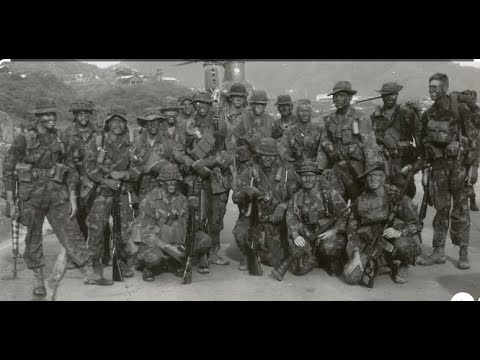
The SAS had learned from the best trackers in the world—Aboriginal Australians and the native trackers of Borneo and Malaya. They didn’t just see the jungle; they saw through it. And that skill was about to be tested as never before.
The NVA had learned a new trick. They were no longer content with bamboo spikes and rusty nails. They had begun to steal the most devastating ambush weapon in the American arsenal: the M18A1 Claymore mine. A curved plastic box packed with C4 and 700 steel ball bearings, it was designed to shred human waves. The instruction embossed on its face was simple: FRONT TOWARD ENEMY. But in the fluid battlefield of Vietnam, the definition of ‘front’ and ‘enemy’ became dangerously ambiguous.
For the NVA sappers—the elite ‘Dong’—stealing a Claymore was like finding a bar of solid gold. They would crawl through barbed wire, inch by inch, and carefully unplug the blasting cap. Sometimes they didn’t steal it; they simply rotated it 180 degrees, so the ‘front’ faced the American foxhole. When the terrified sentry squeezed the clacker, he would blow himself up with his own weapon.
Against the SAS, the NVA adapted. They took their stolen Claymores into the deep bush and rigged them with trip wires. The trap was brutal in its simplicity: a stolen American mine, lashed to a tree, waiting to shred the lead scouts of an SAS patrol. It was a way to kill the phantoms of the jungle without ever pulling a trigger.
But the SAS were not ordinary soldiers. They hunted traps. And when they found one, they didn’t just destroy it. They saw an opportunity.
The point man would freeze, sensing something wrong—a discoloration on a tree trunk, a glint of copper wire in the ferns. He would signal, and the patrol would melt into the vegetation. Then, with surgical precision, he would crawl forward and neutralize the trigger. But instead of disarming the mine, he would carefully detach it, rotate it 180 degrees, and lash it back to the tree. The trap was now live again—but the geometry of death had been reversed.
They called it the Claymore Boomerang. The logic was cold and calculating. The NVA felt safe near their own traps. They would walk confidently, never noticing that the lethal convex curve was now staring directly at them. When they tripped the wire, the jungle would erupt—but the steel balls would fly in the opposite direction. The psychological impact was devastating. If they couldn’t trust their own traps, what could they trust?
The SAS didn’t stop there. They knew the enemy might spot the reversed mine and try to recover it. So they introduced the anti-lift device. After reversing the Claymore, the trooper would dig a shallow hole beneath it and place a live grenade with its pin pulled, the spoon held down by the weight of the mine. If an NVA sapper tried to lift the mine, the grenade would detonate in his face. It killed the experts—the careful ones who thought they had outsmarted the SAS.
This tactic weaponized the enemy’s competence. It slowed their movements to a crawl. Every object on the jungle floor had to be treated as if it were sitting on a trigger. The fear of the click under the mine became as potent a psychological weapon as the explosive itself.
For the SAS, leaving an anti-lift device was the final signature. It was a way of saying, We were here. We saw your trap and we made it better.
The NVA had turned the jungle into a weapon. The SAS turned it back. And in doing so, they proved that in the jungle, the greatest weapon is not a bomb—it is a brain.
The psychological aftershocks rippled far beyond the immediate kill zone. Captured documents recovered months later revealed a directive circulating among NVA sapper units: any Claymore discovered in the field was to be treated as hostile until proven otherwise. The men who had once harvested American mines with impunity now approached them like unexploded ordnance. The hunters had become the hunted.
But the SAS understood that fear alone was not a strategy—it was a multiplier. A patrol that hesitated was a patrol that could be ambushed. And so the Australians began to exploit the hesitation they had created.
They would seed a trail with a single reversed Claymore, then withdraw a hundred meters and wait. The NVA would send a scout forward to inspect the mine. He would freeze, uncertain, perhaps calling back to his comrades. In that moment of paralysis, the SAS would initiate their own ambush—not with explosives, but with a single silenced shot from a position the enemy had never suspected.
The real genius of the boomerang was not the steel it threw, but the time it stole. Every minute an NVA patrol spent second-guessing a trip wire was a minute they were not moving supplies, not reinforcing positions, not hunting the Australians.
One SAS patrol leader later recalled a captured sapper’s interrogation. The man had been a veteran of a dozen infiltrations, a man who could crawl through concertina wire without drawing blood. You are not soldiers, the prisoner said through a translator. You are the jungle itself. We cannot fight the jungle.
The Australians had achieved something remarkable. They had taken a weapon designed to erase human waves and turned it into a tool of psychological erosion. They had made the enemy afraid of the ground, afraid of the trees, and worst of all, afraid of their own weapons.
But the NVA were nothing if not adaptable. Within weeks, reports began to filter back to SAS headquarters of a new countermeasure. The enemy had started using a crude but effective technique: they would attach a long length of vine to suspected mines and pull from a safe distance. If the mine was booby-trapped with an anti-lift device, the grenade would detonate harmlessly. The SAS’s signature tactic was being neutralized.
The game had shifted again. And the Australians knew they would have to shift with it.
The SAS response came not from the armory but from the classroom. Veterans of the Malayan Emergency were flown in to lecture on a technique the regiment had all but forgotten: the art of the passive ambush. If the NVA were now pulling mines from a distance, the Australians would simply stop giving them mines to pull.
The new doctrine was elegant in its cruelty. Instead of reversing a discovered Claymore, the point man would mark its location with a subtle notch cut into a nearby sapling—a code only SAS trackers could read. The patrol would then slip past the trap and establish a lying-up position fifty meters beyond it, on the enemy’s likely withdrawal route. They weren’t baiting the trap. They were baiting the men who came to check it.
The results were immediate. An NVA sapper team, dispatched to investigate a suspected tampered mine, would find it untouched and relax. That relaxation was the kill zone. The SAS would open fire from three concealed positions, then vanish before the survivors could organize a response. The enemy had learned to fear their own traps; now they learned to fear the men who checked them.
But the NVA had one more card to play, and it was a card the Australians had not anticipated.
It began with a single patrol that failed to report in. Then another. The SAS command chalked it up to radio failure or deep penetration into a dead zone. But when a third patrol vanished without a trace, the mood at the regimental headquarters turned from concern to cold fury.
A search team was dispatched to the last known coordinates of the third patrol. They found the site of a contact—spent brass, blood trails, the churned earth of a firefight. But what they found next stopped every man in his tracks.
Lashed to a tree, facing the direction the SAS patrol had come from, was a Claymore mine. It had been reversed—not by the Australians, but by the enemy. And beneath it, half-buried in the leaf litter, was the unmistakable shape of an Australian-issue grenade, its spoon held down by the weight of the mine.
The NVA had learned the anti-lift device. They had captured a fallen SAS soldier’s grenade, replicated the technique, and turned it back on its creators. The boomerang had come full circle.
The message was as clear as it was chilling: the students had become the masters. And somewhere in the green gloom of Fuaktui province, a new game was beginning—one in which the Australians could no longer assume that the ground beneath their boots belonged to them.
The SAS patrol leader stared at the reversed mine, the grenade nestled beneath it like a viper’s egg. He felt no fear—only a cold, clinical respect. The enemy had not just copied the tactic; they had understood it. That understanding was a compliment, and a threat.
He signaled his team to withdraw. No words were needed. They melted back into the undergrowth, leaving the trap untouched. But as they moved, the point man paused. Something was wrong. The leaf litter ahead was too uniform, too perfect. He dropped to his belly and crawled forward, inch by inch, until his nose was inches from the dirt.
There it was: a single strand of fishing line, almost invisible, running parallel to the trail. It was not connected to the Claymore. It was connected to something else—a buried artillery shell, rigged as a command-detonated mine. The reversed Claymore was not the trap. It was the bait.
The patrol leader smiled grimly. The NVA had not just learned the boomerang—they had built a layered ambush around it. A lesser unit would have died there. But the SAS were not lesser. They marked the artillery shell’s location, withdrew silently, and called in airstrike coordinates on the entire grid.
Two hours later, the jungle shook with the roar of a dozen 500-pound bombs. The NVA ambush team, waiting in their spider holes for the Australians to return, never knew what hit them.
Back at base, the patrol leader wrote in his after-action report: The enemy has learned our tricks. We must now learn to think two moves ahead, or we will lose this war one trap at a time.
The jungle was still a liar. But the SAS had learned to read between the lies. And in that silent, deadly conversation of wits and steel, the question remained: when the enemy becomes your mirror, who will blink first?
What would you have done—destroy the bait, or follow it to the real trap? Tell us in the comments below.
Report this article
Select a reason for reporting:






