I never knew my grandfather, Elmer Lang. He died of a heart attack when I was just four years old, on a family vacation at a lake. My father told me he never talked about the war—World War II, where he served in Italy with the 85th Infantry Division. I always wondered why. Was it to protect us? Or was it something deeper?
Then, decades later, my childhood friend returned from Iraq, where he’d served as a medic. He was different. Quieter. He didn’t talk about it either. And that’s when I began to understand.
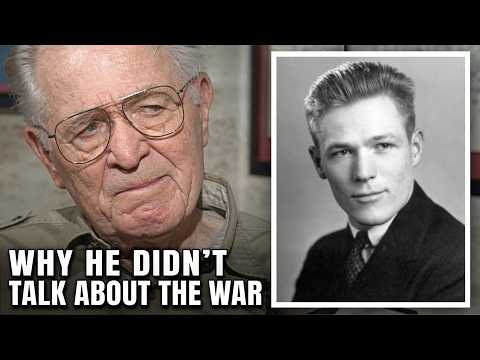
Major Dick Winters, the legendary commander of Easy Company, explained it best. In an interview, he said, “You can’t always talk to men because they were in the army. But you had to share the experiences of the battles that you were in… to talk to a civilian or somebody who’s never been overseas, again, you have to withdraw yourself because he won’t know what you’re talking about.” And you don’t want to come across as bragging. It’s not bragging—it’s sharing a memory. But it’s hard.
Dick Winters’ words hit home. Soldiers don’t talk because no one else can truly understand. Not really. How could they? Unless you were there, in the foxhole, you can’t grasp the horror, the fear, the bond.
Don Malarkey, another Easy Company veteran, tried to share a memory with his college fraternity brothers after the war. He climbed onto a desk to demonstrate a parachute jump. “I was going through the whole works,” he recalled, “when I heard some snickering behind me. There, in the hallway, were a bunch of frat brothers watching, laughing like hell. It had been a setup, a joke, just to make me look like a fool. At the time, I wasn’t laughing.” That moment, and others like it, made men like Malarkey close off even more. His service had been reduced to the butt of a joke.
It would be decades before Malarkey found comfort, reconnecting with his fellow veterans at reunions. Only then did he realize he wasn’t alone.
My grandfather never had that chance. He carried his burden silently. One story he did share, according to my aunts, was about a young soldier he mentored in Italy. They shared a foxhole. One day, the young man was on watch, peering over the edge. A German sniper’s bullet struck him in the throat. My grandfather and the medic couldn’t save him. He died right there. My grandfather was always troubled, feeling he had let the young soldier down.
Why did he share that story? Maybe some memories are too painful to keep bottled up. Maybe he needed to hear, “It’s not your fault.”
I can’t begin to understand the lifelong toll such experiences take on our veterans. But I’m grateful that men like Dick Winters and Don Malarkey found healing in reconnecting with those who served with them. And I pray for those who haven’t—who carry the weight alone, out of fear that others won’t understand.
We owe them a debt we can never repay.
My aunt’s voice faltered as she finished the story. She looked down at her hands, folded in her lap. “He never said another word about it after that,” she said. “Not once.”
My father, sitting across from us with his mild dementia clouding his memory, suddenly spoke up. “He kept a photograph,” he said quietly. “In his wallet. A young man in uniform. I found it after he died.” None of us had ever seen it. None of us knew who it was. But we all understood.
That photograph was my grandfather’s way of talking about the war—a silent, private conversation he had with himself for the rest of his life. He didn’t need to tell us the young soldier’s name. He carried him anyway.
Later that night, I sat on my back porch and thought about my friend, the medic who came home from Iraq. He never talked about it either. But one evening, years after his return, we were sitting in silence when he suddenly said, “You know what I remember most? The quiet. Not the explosions. The quiet after.” I didn’t ask any questions. I just nodded. That was enough.
That’s what Dick Winters understood. That’s what Don Malarkey learned at those reunions. That’s what my grandfather never had. The men who came home from World War II didn’t stay silent because they were hiding something. They stayed silent because they had no one to share it with.
But there’s another side to this story. One that I’ve come to realize as I’ve grown older. The silence wasn’t just a burden—it was also a gift. My grandfather didn’t talk about the war because he wanted to give his children something he never had: a normal life. A life where the horrors of Italy stayed in Italy. Where a father could come home and be just a father.
Maybe that’s why he shared that one story about the young soldier. Not to unburden himself, but to remind himself. To remember the boy who died so that he could come home and raise a family. To remember the cost.
My aunt told me something else that day. She said that after the war, my grandfather never missed a Memorial Day parade. He’d stand on the sidewalk, hat in hand, and watch the veterans march by. He never joined them. He never wore a uniform again. But he watched. Every year. Until he couldn’t anymore.
That was his way of talking about it. That was his way of remembering. And maybe, just maybe, that was his way of saying, “It’s not your fault.”
I never got to ask my grandfather about the war. But I think I understand now. He didn’t need to tell us. He showed us—in the life he built, in the family he raised, in the quiet dignity with which he carried his memories.
And that’s a language we can all understand.
But understanding my grandfather’s silence didn’t answer every question. It only opened new ones. What about the men who never found their way back to a reunion, who never had a Don Malarkey to sit beside and say, “I know. I was there too”? What happened to them?
I thought of the photograph again—the young soldier in my grandfather’s wallet, nameless and frozen in time. My father couldn’t tell me who he was. My aunts didn’t know. So I did the only thing I could think to do: I went looking.
It started with a box. My aunt had kept my grandfather’s military records in a cardboard box in her attic, the kind of box that gathers dust and gets moved from house to house without anyone ever opening it. She handed it to me without a word. I think she knew I needed to hold it.
That night, I spread the contents across my kitchen table. A discharge certificate, yellowed and brittle. A few black-and-white photographs of young men squinting into the Italian sun. A small diary with only a handful of entries, written in my grandfather’s careful, cramped hand.
The diary entries were spare, almost clinical. Dates, locations, the weather. “Rain. Mud. No sleep.” But on one page, near the end, he had written a single sentence that stopped my heart: “He was too young. I should have been watching.” No name. No explanation. But I knew.
I searched for the young soldier’s identity for months. I contacted the 85th Infantry Division association, scoured online archives, even posted the photograph on a World War II history forum. Nothing. It was like the boy had vanished into the Italian countryside, known only to my grandfather and God.
Then, a breakthrough. A historian at the National Archives found a roster of Company C, 337th Infantry. There were three men listed as killed in action near the date my grandfather’s diary mentioned. One was named Private First Class Harold J. Simmons, age nineteen, from Ohio. The photograph in my grandfather’s wallet—a young man with a shy smile and ears that stuck out—matched Harold’s service photo perfectly.
I sat in my car outside the archives and cried. For Harold. For my grandfather. For all of them.
I wrote to Harold’s surviving family—a niece, it turned out, who had been named after him. She wrote back within a week. She told me that Harold had been the youngest of five, that he loved baseball and fixing cars, that he’d enlisted right out of high school. “We never knew how he died,” she wrote. “Just that he was killed in action. My grandmother never got over it.”
I sent her a copy of the photograph. She sent me a letter Harold had written home just before shipping out to Italy. “Don’t worry about me,” he’d written. “I’ve got a good sergeant looking after me.”
That sergeant was my grandfather.
I read that letter on a cold November morning, the kind of morning that feels like a held breath. And I finally understood the weight my grandfather carried. He wasn’t just mourning a soldier. He was mourning a boy he’d promised—silently, implicitly—to bring home safe. And he had failed. Not through negligence, not through cowardice, but through the simple, brutal arithmetic of war.
I drove to my grandfather’s grave that afternoon. I hadn’t been there in years. The headstone was simple, a government-issue marker with his name, rank, and dates. I knelt in the grass and placed a small American flag next to it. Then I took out the photograph of Harold Simmons and propped it against the stone.
“You did good, Grandpa,” I whispered. “You brought him home the only way you could.”
I sat there for a long time, thinking about silence. My grandfather’s silence. My friend’s silence. The silence of a generation that saved the world and then came home and never spoke of it. It wasn’t emptiness. It was a language of its own—a language of sacrifice, of love, of a debt that can never be repaid but is always remembered.
And I realized that the question I’d carried for so long—why didn’t they talk about it?—had a simpler answer than I’d ever imagined. They didn’t talk because there were no words. Only the quiet after.
Now it’s your turn. Do you have a veteran in your family who never spoke about their service? Have you ever found a photograph, a letter, a diary that told a story they couldn’t? Share it in the comments below—because sometimes, the silence speaks loudest when we finally listen.
Report this article
Select a reason for reporting:






