On the 2nd of October 1919, a group of soldiers crossed the war-shattered fields of the Somme in search of the dead. Over the following days, weeks, and months, they uncovered more than 1,000 of the fallen—one man for every single yard of ground. But this was no ordinary battlefield. This was Square 25, a patch of land near the village of Thiepval that would witness the entire sweep of World War I, from the first shots of 1914 to the final armistice in 1918. What happened here would leave scars on the land—and on the men who fought—that would last a century.
Today, the Somme is synonymous with carnage, but in 1914, it was a quiet sector. The village of Thiepval was a peaceful farming community of 300 souls, with a church, a café, a baker, a butcher, and a magnificent 13th-century château. Then war came, and the fields around the village became a fortress. German troops moved in, turning houses into billets and digging deep, complex trenches that would soon earn this place a reputation as one of the toughest nuts to crack on the Western Front.
By 1915, the Somme was still considered a quiet posting compared to the slaughter at Ypres and Verdun. But that was about to change. The British army, growing ever larger, took over more of the line from the French, and with them came new plans for a great offensive. “The area was so tough that throughout 1915, there had been no concerted French efforts to actually assault Thiepval.” But the British were determined to break through. They stockpiled a million shells and, in June 1916, unleashed a week-long bombardment that reduced the village to rubble. “The once imposing château was reduced to a mound of rubble.”
On the 1st of July 1916, the first day of the Battle of the Somme, the Ulster Division attacked from Thiepval Wood. They made initial gains, capturing the formidable Schwaben Redoubt, but German counterattacks forced them back. “By the following dawn, they were back in their trenches, having suffered 5,000 casualties in one day.” For four more months, the fighting raged. The battlefield became a moonscape of shell holes and mud. “Hundreds of shell holes pepper the landscape. No houses remain. No trees remain.” It wasn’t until late September that the 18th Division finally retook the ruins of Thiepval.
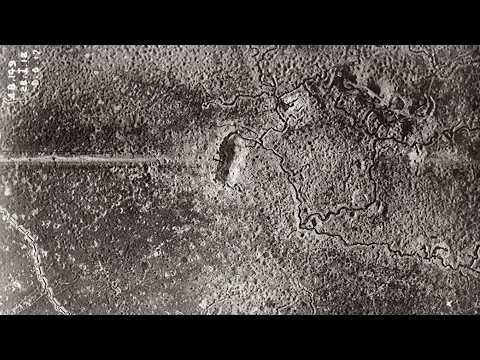
But the war was far from over. In February 1917, the Germans withdrew to the Hindenburg Line, and for a time, the front moved away. The villagers returned to find nothing but rubble. “This photograph taken on the 30th of June 1917 gives an idea of that destruction. See this light-colored smudge on the landscape? That’s the village.” Then, in March 1918, the Germans launched their Spring Offensive, sweeping back across the Somme and retaking Thiepval. But the advance stalled, and by August, the Allies were on the attack again. On the 24th of August 1918, Welsh troops of the 38th Division passed through the rubble of Thiepval, and the war in Square 25 was finally over.
The cost was staggering. “Unofficially known as body density maps, they were created around 1919… In Square 25, these four quadrants alone read 150, 513, 125, and 463.” That’s an average of 1.2 bodies per square yard. And even today, the fields still give up their secrets—the iron harvest of unexploded shells, bullets, and bones. “On the 2nd of October 1919, men of the 148th Labour Company recovered 15 bodies. Of that number, 12 remain unidentified.” The Thiepval Memorial now bears the names of 72,000 British missing, a stark reminder of the price paid for this patch of ground.
But the story of Square 25 does not end with the armistice. The land itself had been so thoroughly churned, so saturated with the debris of war, that it would take decades before it could be farmed again with any sense of normality. “Each spring, when the farmers begin the plowing of Square 25, we get the iron harvest.” Shells, shrapnel, bits of kit—all dragged back to the surface after a century underground. The soil here remembers what the history books sometimes forget.
And yet, the most haunting legacy is not the metal. It is the silence. Walk across these fields today and you will see nothing that immediately speaks of the carnage. The modern village of Thiepval sits quietly on the ridge, its rebuilt church a pale imitation of the original. The woods are green again. The fields are neat. But beneath the surface, the trenches are still there, waiting.
That is where LiDAR comes in. “By looking at light off at Thiepval Wood today, we get this incredible image. It shows the remnants of the old trenches still buried in the undergrowth of the forest a century on.” The ghost lines of White Church Street, the old British front line, the German support trenches—all of it is still etched into the earth, invisible to the naked eye but perfectly preserved in the laser scan.
What LiDAR reveals is not just the scale of the fortifications but the intimacy of the fighting. These were not distant armies maneuvering on open plains. They were men living yards apart, sometimes able to hear each other cough or curse. “At one point, there are only 85 yards between the two front lines.” In some places, the gap was even narrower. You could throw a grenade from one trench to the other. You could smell the enemy’s cooking.
It is this proximity that makes the story of Square 25 so compelling. The men who fought here were not abstract casualties on a map. They were butchers and bakers from Thiepval, French soldiers from the south, German reservists from Bavaria, British volunteers from Ulster and Wales. They lived in the same shattered landscape, breathed the same poisoned air, and died in the same churned mud.
And still, they keep being found. “This report, dated 18th of January 1938, details the recovery of two more bodies from the Somme. One being positively identified by his identity disc and shoulder titles as Private C. Martin, 1st Battalion Hertfordshire Regiment.” Private Martin had been killed in the Battle of the Ancre in November 1916, his remains lost for more than two decades. The report gives a precise grid reference: 57 D R 25 B 1575. Square 25, quadrant B. A few yards of ground that had held a man’s body for twenty-two years.
Most were never so lucky. The body density maps, with their cryptic pencil numbers, suggest that thousands of men were simply obliterated—pulverized by shellfire, buried by explosions, or swallowed by the mud. “Of the 15 bodies recovered by the 148th Labour Company on the 2nd of October 1919, 12 remain unidentified.” Twelve men who died for a patch of ground and whose names are known only to God.
It is worth pausing on those pencil numbers, because they tell a story that the neat rows of war cemeteries cannot. The men of the Graves Registration Units worked methodically, quadrant by quadrant, walking the ground with maps and notebooks, marking where crosses had been planted by comrades years earlier and where bodies lay exposed. “If this indeed relates to the numbers of bodies recovered, it means that taking only marked graves, as of mid-1919, there were an average of 1.2 bodies recovered for every single yard of Square 25.” And that, as the records make clear, was never the whole number.
What makes Square 25 unusual is not simply the density of the dead. It is the way the same few acres were fought over, abandoned, reoccupied, and fought over again across four full years. Most battlefields have a single story. This patch of ground had four. The men who dug the first German trenches in 1914 could never have imagined that Welsh infantry would be passing through the rubble in 1918, or that a British labour company would still be pulling bodies from the earth a year after the guns fell silent.
The landscape itself became a kind of archive. Every new trench cut through an old one; every shell hole exposed a previous generation of corpses. “The dotted lines here represent old trench lines that had fallen into disrepair, and only the ones marked by solid lines were still occupied.” By June 1918, most of Square 25 had reverted to a strange kind of peace—not the peace of farming, but the peace of exhaustion. The trenches were still there, but the men were elsewhere, and the ground waited.
When the Welshmen of the 38th Division entered Thiepval on the 24th of August 1918, they found no village to liberate. They found heaps of rubble, shattered trees, and the smell of death that four years of war had baked into the soil. “That advance, part of the famous Hundred Days Offensive, would prove decisive, and despite extremely bloody fighting, would only end on the morning of the 11th of November, 1918, with the signing of the armistice.” The war in Square 25 was over. But the reckoning had barely begun.
In the months that followed, the fields around Thiepval filled with labour companies, burial parties, and the slow, grim bureaucracy of remembrance. The 148th Labour Company was just one of many. Their reports, page after page of names, grid references, and the recurring word “unknown,” are among the most sobering documents of the entire war. “Of note are these three, which in response to the question, was a cross found on the grave, state no. All three are unknown.” No cross. No name. No marker. Just a body in the mud, found by men who would never know who he was.
Private Charles Martin was one of the lucky ones. His identity disc and shoulder titles survived, and so his name was restored. But for every Charles Martin there were dozens of unknowns, and for every unknown there were men who were never found at all. The body density maps, with their cryptic pencil figures, were an attempt to reckon with that scale—a rough accounting of the unaccountable.
Today, the Thiepval Memorial stands on the site of the old château, its arches visible from miles around. “A staggering 72,000 of the British missing are remembered on the site of the former Thiepval Chateau.” Seventy-two thousand names, carved into stone, for men who have no grave but this patch of ground. Many of them fell within a few hundred yards of where their names are now inscribed.
And yet the story is not finished. The iron harvest continues. Farmers still plow up shells, bullets, and bones. Archaeologists still survey the ground with magnetometers and ground-penetrating radar. “More than a century on, these fields are still giving up their secrets.” Square 25 is not a closed chapter. It is a place where the past refuses to stay buried, where each spring brings something new to the surface.
Perhaps that is the real lesson of Square 25. It was never a place where history happened once and then stopped. It was a place where history kept happening, layer upon layer, season after season. “The war in Square 25 was over. But, at what cost?” The answer is written in the soil itself.
Walk the fields today and you will hear birdsong, not shellfire. You will see wheat, not wire. But beneath your feet, the trenches remain, the dead remain, and the questions remain. What does it mean to remember a place that has forgotten nothing?
So here is my question for you: if you stood in Square 25 today, knowing everything that happened there, what would you leave behind—a poppy, a prayer, or simply silence? Tell us in the comments below.
Report this article
Select a reason for reporting:






