In the smoldering ruins of Hitler’s Germany, the Allies faced a question that defied simple answers: how do you erase an ideology that had infected an entire nation? With 8.5 million Nazi Party members and millions more in affiliated organizations, the task seemed insurmountable. Yet, within a few short years, the Allies declared denazification complete. But was it truly successful, or merely a façade?
The world watched as the victorious powers—the United States, Britain, France, and the Soviet Union—embarked on a mission to purge German society of Nazi influence. They revoked laws, removed symbols, and renamed streets. They put high-ranking Nazis on trial at Nuremberg, hoping to demonstrate justice. But beneath the surface, the process was riddled with contradictions, compromises, and Cold War calculations that would leave a lasting legacy.
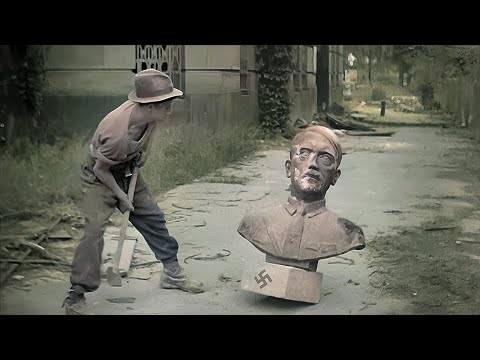
In the American zone, General Dwight D. Eisenhower predicted it would take at least half a century to rid Germany of Nazi ideology. Yet, the urgency of the Cold War soon overshadowed the pursuit of justice. Former Nazis with scientific or intelligence value were quietly recruited, their crimes overlooked. Operation Paperclip brought 1,800 German scientists to the US, including some with Nazi ties. The CIA and British intelligence employed ex-Gestapo officers, creating a shadowy network of spies and informants.
Meanwhile, ordinary Germans faced a bewildering bureaucracy. They filled out forms detailing their Nazi affiliations, hoping for exoneration. Some bought fake certificates on the black market. The Americans, overwhelmed by millions of cases, released many former Nazis by 1948, declaring denazification a success. But the truth was far more complex. In West Germany, former Nazi Party members quickly regained positions of power. By 1957, 77% of senior officials in the Ministry of Justice were ex-Nazis.
The Soviet zone took a harsher approach, but their efforts were also politically motivated. They installed communist regimes and used denazification as a tool to punish political opponents. In the chaos, many Nazis escaped to South America via ratlines, with help from sympathetic officials and even the Vatican.
As the Iron Curtain descended, the Allies’ priorities shifted. Denazification became a secondary concern. The world moved on, but the scars remained. The question lingers: did Germany truly confront its past, or was denazification a convenient fiction?
The answer, as with most things in history, lies somewhere in the uncomfortable middle. To understand how denazification was declared complete so quickly, we have to look at the machinery that made it possible—and the shortcuts that made it collapse.
At the heart of the American effort was the Fragebogen, a questionnaire so detailed it asked Germans to list every organization they had ever joined, every book they had ever read, and every trip they had ever taken. By 1946, the US military government had distributed over 13 million of these forms. The sheer volume was staggering. Clerks worked around the clock, filing, cross-referencing, and sorting Germans into the five categories: major offenders, offenders, lesser offenders, followers, and exonerated persons.
But the system was drowning in its own paperwork. In Bavaria alone, more than 1.5 million cases were pending by mid-1946. The military government hired thousands of German clerks to process the forms—many of whom had themselves been Nazi Party members. In one notorious case, a former Gestapo officer was put in charge of vetting his own colleagues. The irony was lost on no one, least of all the Germans who quickly learned to game the system.
And game it they did. A thriving black market emerged for Persilscheine—the coveted exoneration certificates. Named after the popular Persil laundry detergent, these documents were said to “wash clean” a person’s Nazi past. For the right price, a German could obtain a certificate signed by a sympathetic priest, a bribed official, or even a former resistance fighter who could be persuaded to vouch for them. One Munich lawyer reportedly issued over 2,000 Persilscheine for a fee, no questions asked.
The Americans soon realized that their meticulous system was producing absurd results. A factory worker who had joined the Nazi Party in 1937 to keep his job was classified as a “follower” and fined. A doctor who had been a party member since 1933 but had never committed a crime was labeled an “offender” and barred from practicing medicine. Meanwhile, industrialists who had profited from slave labor often escaped with a fine and a clean record, thanks to their connections and their usefulness to the postwar economy.
By 1948, the American military government was desperate to wrap things up. The Cold War was heating up, and the US needed a stable, friendly West Germany to counter the Soviet threat. The Fragebogen was abolished, and the responsibility for denazification was handed over to the newly formed German courts. Of the 3.6 million cases processed in the American zone, only 1,654 people were classified as major offenders. The vast majority—over 2.5 million—were simply labeled followers and fined small sums.
The British and French zones followed similar patterns. In the British zone, the process was notoriously lenient. One British officer quipped that the only Nazis they were interested in were the ones who could help them build a new Germany. The French, preoccupied with their own internal purges, paid even less attention. By 1949, the Federal Republic of Germany was established, and the Allies formally ended their denazification efforts.
But the story was far from over. As the new West German state took shape, former Nazis quietly slipped back into positions of power. Konrad Adenauer, the first chancellor of West Germany, was himself a former member of the Cologne city council during the Nazi era. His government included dozens of former party members, and the new intelligence service, the Bundesnachrichtendienst, was built around Reinhard Gehlen’s network of ex-Nazi spies.
The Soviet zone took a different path. There, denazification was swift and brutal, but it was also a tool for political consolidation. Former Nazis were given a choice: join the communist cause or face the consequences. Many chose the former, and by the time the German Democratic Republic was founded in 1949, the Soviet zone had its own cadre of ex-Nazis in positions of authority—men who had simply swapped one totalitarian ideology for another.
So how did Germany denazify so quickly? The answer is that it didn’t. The process was declared complete long before it truly was. The Allies, faced with the enormity of the task and the emerging threat of the Cold War, chose pragmatism over principle. They traded justice for stability, and in doing so, they left a legacy that Germany would grapple with for decades.
The legacy was not just political but personal. For decades, former Nazis lived quietly in West German towns, their pasts buried under new names and clean paperwork. Children grew up unaware that their teachers, doctors, and even fathers had once worn the brown shirt. The silence was a kind of second denazification—this time by forgetting.
It was not until the 1960s, when a new generation demanded answers, that the reckoning truly began. The Frankfurt Auschwitz trials of 1963–1965 put former camp guards in the dock, forcing Germans to confront crimes they had long ignored. Students marched, asking their parents a simple, devastating question: “What did you do during the war?”
Yet even then, the answers were halting. The Cold War had made former Nazis useful, and the new Germany had made them comfortable. By the time the Berlin Wall fell in 1989, the generation that had lived through the Third Reich was fading, but the questions remained.
Denazification, in the end, was less a surgical purge than a messy compromise—a race against time that the Allies won only on paper. The ideology was outlawed, but the people who carried it were often left to carry on. Germany’s true denazification came not from questionnaires or tribunals, but from decades of painful, piecemeal reckoning.
So what do you think—can a nation ever truly erase an ideology, or does it simply learn to live with its ghosts? Share your thoughts in the comments below.
Report this article
Select a reason for reporting:






