In the annals of Australia’s military aviation, no aircraft has left a mark as deep as the F-111. Affectionately known as ‘the Pig,’ it became an icon of air power, even long after its retirement. But behind its legendary status lies a story of desperate necessity, a decade-long search for a weapon that could defend a continent.
As the 1960s dawned, Australia faced a rapidly deteriorating security environment to its north. The fall of Singapore in WWII had exposed the Northern Territory to air raids, and now new threats loomed. Indonesia, under President Sukarno, was militarizing with Soviet backing, acquiring TU-16 Badger bombers capable of striking Australian cities. With no aircraft able to intercept them, Australia was vulnerable.
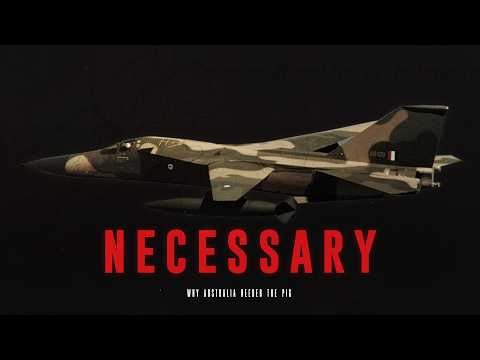
The Menzies government had first considered replacing the Canberra fleet in 1954, but the requirements were daunting. The new aircraft would need strategic bomber range, the ability to penetrate complex air defenses, and advanced navigation to operate over vast oceans and sparse terrain. Most available options fell short. The British V-bombers were expensive and outdated. The French Mirage IV was too costly. The British TSR-2 lacked government support. None could meet the demanding specifications.
As tensions escalated, the situation grew more urgent. Indonesia’s confrontation with Malaysia in 1963 brought the threat closer to home. Rumors of TU-16s overflying the Northern Territory undetected circulated, prompting the deployment of Sabres and Bloodhound missiles to Darwin. Meanwhile, the war in Southeast Asia intensified, China tested its first nuclear weapon, and Britain announced its withdrawal from the region. Australia risked isolation.
The need for a long-range strike platform became undeniable. It had to be fast, with a wide combat radius, large payload, and all-weather capability. It needed to fly low to evade radar, deliver precision weapons, and return safely without tanker or electronic warfare support. Essentially, it was a single aircraft that could deny access to any adversary, far from home.
In 1963, the Hancock study formalized the search. Among the candidates, the American TFX project, which would become the F-111, stood out. With its variable-sweep wings, terrain-following radar, and impressive range, it promised everything Australia needed. On October 24, 1963, Australia announced it would become the only foreign customer of the F-111, ordering 24 aircraft. But the road ahead was fraught with delays and technical issues, including the infamous wing box problem that pushed deliveries back indefinitely.
As the F-111’s development stumbled, Australia leased 24 F-4E Phantoms as a stopgap. The Phantom was advanced, but it lacked the range and payload to truly replace the F-111. The debate over whether to keep the Phantoms raged, but ultimately, the Aardvark’s unique capabilities won out. Its role as an area denial weapon, capable of penetrating enemy defenses and striking far offshore without support, was irreplaceable.
Finally, on July 1, 1973, the first F-111C landed at RAAF Base Amberley, entering Australian service. Over the next 37 years, it would become the most iconic and important aircraft in the RAAF’s history. But the story of why Australia needed the F-111 is more than just a tale of procurement; it is a story of a nation’s determination to defend its skies against overwhelming odds.
The F-111C that touched down at Amberley that July morning was not merely an aircraft; it was a statement. With its long, tapered nose and variable-sweep wings, it looked like nothing else in the RAAF inventory. To the crews who would fly it, the Pig was a demanding mistress—unforgiving on the ground, awe-inspiring in the air.
Training on the type was an ordeal in itself. Australian crews sent to America discovered that the F-111 demanded a new kind of airmanship. Terrain-following radar allowed the jet to scream through valleys at 500 feet in pitch darkness, but it also required absolute trust in the machine. Instructors at Cannon Air Force Base were stunned when RAAF crews completed a four-ship night strike through mountainous terrain—a mission they had never before permitted their own pilots to attempt.
Back home, the F-111’s arrival transformed the RAAF’s operational calculus. For the first time, Australia possessed a platform that could launch from Amberley, strike targets deep in the Indonesian archipelago, and return without refueling. No tanker support. No electronic warfare escort. No naval cover. Just a single aircraft, a crew of two, and the cold mathematics of deterrence.
The Pig’s range was staggering—over 4,000 kilometers with a full weapons load. Its terrain-following radar let it hug the earth, slipping beneath enemy radar horizons. Its precision navigation systems, advanced for their day, meant it could find a target in the featureless expanse of the Timor Sea and put bombs within meters of the aim point.
But the F-111 was not without its critics. Maintenance crews cursed its complexity. The variable-sweep wing mechanism was a marvel of engineering and a nightmare of hydraulics. Engine problems plagued the fleet intermittently, and the cost per flight hour was eye-watering. Yet none of this diminished its strategic value.
Through the 1980s and 1990s, the F-111 remained the RAAF’s premier strike asset. It participated in exercises across the Pacific, often outperforming newer aircraft from allied nations. In 1999, during the East Timor crisis, F-111s were deployed to Darwin as a visible deterrent—a reminder to Jakarta that Australia could reach any target in the region at will.
By the 2000s, the fleet had been upgraded with digital avionics and new weapons, but age was catching up. Cracks in the wing spars, rising maintenance costs, and the emergence of fifth-generation fighters signaled the end. In 2010, the government announced the F-111 would be retired, replaced by the F/A-18F Super Hornet—a capable aircraft, but one that lacked the Pig’s unique combination of range, payload, and low-level penetration.
On December 3, 2010, the final F-111 touched down at Amberley, marking the end of an era. Crews who had flown the Pig gathered to watch, many with tears in their eyes. The aircraft that had once been dismissed as a costly mistake had become the backbone of Australia’s air power for nearly four decades.
But the story of the F-111 did not end with its retirement. In the years that followed, the question of what came next—and whether anything could truly replace the Pig—became a recurring theme in Australian defense debates. The Super Hornet filled the gap, but it was never a direct successor. It required tanker support for long-range missions. It could not hug the terrain at 500 feet in total darkness. And its range, while respectable, fell well short of the Aardvark’s legendary legs.
Defense analysts began to speak of a “capability gap”—a polite term for the uncomfortable truth that Australia had lost a unique tool. The F-111 had been a strategic deterrent in a single airframe, and no other aircraft in the region could match its combination of reach and penetration.
The gap became more acute as the geopolitical landscape shifted. China’s military modernization accelerated through the 2010s, and the South China Sea became a flashpoint. Australia’s northern approaches, once again, demanded attention. The F-35 Joint Strike Fighter, while stealthy and advanced, was a multi-role aircraft optimized for different missions. It could not carry the F-111’s payload over the same distances, nor could it loiter deep over the Timor Sea without refueling.
In 2016, the RAAF began receiving its first F-35As, and the conversation turned to long-range strike options. The government announced plans to acquire AGM-158C LRASM anti-ship missiles and to explore hypersonic weapons. But these were add-ons, not a new Pig. The B-21 Raider, America’s next-generation stealth bomber, was mentioned in think-tank papers as the closest modern equivalent—but it was not for sale, and Australia had no plans to acquire a strategic bomber fleet.
Veterans of the F-111 community watched these developments with a mixture of pride and frustration. They had known, decades earlier, what the rest of the world was only now beginning to understand: that geography dictated strategy, and that Australia’s vast northern approaches demanded an aircraft that could go the distance alone. “The Pig was built for our backyard,” one former pilot recalled. “No tankers, no escorts, no excuses. Just get in, hit the target, and get home. Nobody else understood why we needed that. Now they do.”
The F-111’s cultural legacy endured as well. Airshows across Australia featured retired airframes as static displays, and the distinctive howl of its TF30 engines became a nostalgic sound for a generation. Model kits, documentaries, and memoirs kept the legend alive. In 2019, a group of enthusiasts launched a campaign to return one F-111 to flying condition—a long shot, but a testament to the affection the aircraft still inspired.
Meanwhile, the RAAF pressed on with its modernization. The MQ-28 Ghost Bat, an Australian-designed loyal wingman drone, hinted at a future where uncrewed platforms might take on some of the F-111’s roles. But the Pig’s combination of speed, payload, and manned decision-making remained unmatched in the annals of Australian aviation.
As the 2020s unfolded, the lessons of the F-111 procurement saga echoed in new debates. The AUKUS pact, announced in 2021, promised Australia nuclear-powered submarines and access to advanced technologies. Some commentators drew parallels to the F-111 decision—a bold, controversial purchase that took decades to deliver but ultimately proved visionary. Others warned that history was repeating itself, with delays and cost overruns threatening to undermine the strategic intent.
Through it all, the Pig remained a symbol of what Australia could achieve when it dared to think differently about its defense. It was not the cheapest option. It was not the simplest. But it was the right one for a continent that needed to defend itself against threats that others could not see.
In the end, the F-111’s story is not just about an aircraft. It is about a nation’s willingness to invest in a capability that no one else wanted, for a mission that no one else understood. And for the crews who flew it, the ground crews who maintained it, and the strategists who fought for it, the Pig was never just a machine—it was a promise that Australia would never again be caught unprepared.
That promise, more than any airframe, is the true legacy of the F-111.
Decades later, that promise still shapes the RAAF’s thinking. The F-111 taught Australia that geography is destiny, and that deterrence sometimes requires a machine that can go the distance alone. Its shadow lingers over every new procurement, every strategic review.
When the last Pig roared into the sky for its final flight, it left behind more than memories. It left a template for what Australian air power must be: self-reliant, far-reaching, and unafraid to punch above its weight. “We never replaced the Pig,” a retired air marshal once said. “We just learned to live without it.”
Today, as new threats emerge and technology evolves, the question remains: can any modern platform truly fill the void? The F-111 was a product of its time, but its spirit—of bold choices and hard-won capability—endures.
So, what do you think? Should Australia pursue a dedicated long-range strike aircraft again, or have drones and missiles made the manned bomber obsolete? Share your thoughts in the comments below.
Report this article
Select a reason for reporting:






