April 1945. The war in Europe was staggering to its end, but in the western Netherlands, a silent, merciless killer was just reaching its peak. Millions of civilians were trapped in a nightmare of hunger, reduced to eating tulip bulbs and sugar beets just to survive another day. Children collapsed in the streets, their bodies ravaged by malnutrition. And yet, in this darkest hour, salvation would come from the unlikeliest of sources: the very bombers that had spent years raining destruction on Europe.
This is the story of how former instruments of war became angels of mercy, and how a daring mission saved a starving nation in the final days of World War II.
The crisis began months earlier, in September 1944, when Allied forces launched Operation Market Garden, an ambitious attempt to seize bridges across the Netherlands and open a direct route into Germany. In response, the Dutch government in exile called for a nationwide railway strike to hinder German troop movements. The German occupation authorities, led by Reichskommissar Arthur Seyss-Inquart, retaliated with a brutal embargo on food shipments to the densely populated western provinces.
The impact was immediate and devastating. The western Netherlands, home to cities like Amsterdam, Rotterdam, and The Hague, depended on food transported from the agricultural north and east. With rail and water transport halted, supplies quickly dwindled. As the war dragged into the winter of 1944-1945, conditions deteriorated dramatically. Temperatures plummeted, canals froze, and fuel shortages left homes without heat. Families burned furniture and floorboards to stay warm.
By late 1944, the official adult ration had dropped to roughly 800 calories per day. By early 1945, it had fallen to as little as 400 to 500 calories—far below the 2,000 calories needed for survival. People turned to substitute foods: sugar beet, normally used as livestock feed, became a staple. Bakeries experimented with grinding tulip bulbs into flour. Families boiled potato peels and scraps that would ordinarily have been discarded.
Thousands of civilians undertook desperate journeys out of the cities in search of food. Traveling on foot or by bicycle, they walked long distances into rural areas to barter possessions for small quantities of potatoes or grain. These journeys became known as “hunger expeditions.” Despite these efforts, malnutrition spread rapidly. Hospitals reported increasing numbers of starvation cases, particularly among children and the elderly. By early 1945, famine conditions had developed across large parts of the western Netherlands. Historians estimate that around 20,000 Dutch civilians ultimately died from starvation and related illnesses during what became known as the Hunger Winter.
By spring 1945, the military situation had shifted dramatically. Allied forces had liberated large parts of the Netherlands, but the most densely populated western provinces remained under German control. The civilian population there was effectively trapped behind enemy lines. Without large-scale outside assistance, the death toll from famine was expected to rise sharply. Some form of relief operation had become urgently necessary.
But relief efforts for the Netherlands required an extraordinary step. The western part of the country was still occupied by German forces, and Allied aircraft entering the airspace risked being shot down by anti-aircraft guns or intercepted by German fighters. Any relief operation would therefore require negotiations with the very forces the Allies were still fighting.
These negotiations culminated in a remarkable meeting on April 28, 1945, in the village of Achterveld in the central Netherlands. Present at the discussions were representatives from several sides of the conflict. The German occupational authorities were represented by General Johannes Blaskowitz, commander of German forces in the Netherlands. The Allied side was represented by senior officers including Lieutenant General Walter Bedell Smith, Chief of Staff to General Dwight D. Eisenhower. Also involved was Prince Bernhard of the Netherlands, who served as commander of the Dutch armed forces in exile and played a key role in facilitating communication between the parties.
The purpose of the meeting was to arrange humanitarian relief for the starving Dutch population without interrupting ongoing military operations. After negotiations, an agreement was reached allowing Allied aircraft to deliver food to the western Netherlands under carefully controlled conditions. As part of these temporary local humanitarian arrangements, specific flight corridors were agreed upon. The bombers would fly at very low altitude, generally around 400 to 500 feet, along predetermined routes. German anti-aircraft batteries were instructed not to engage aircraft flying within these corridors.
The arrangement was fragile. The war had not yet ended, and German forces still controlled the areas where the food would be delivered. However, both sides recognized the desperate humanitarian situation. With these temporary guarantees in place, preparations began immediately for a large-scale food drop operation carried out by Allied bomber aircraft.
Within hours, RAF Bomber Command crews in England were being briefed for one of the most unusual missions of the war. The first mission took place on April 29, 1945. Before the full operation began, a small preliminary Lancaster flight was sent ahead of the main force to carry out a trial drop over the Netherlands. The aircraft released food supplies near Valkenburg airfield close to The Hague while flying at the agreed low altitude. The crews watched closely for any sign that German anti-aircraft units might open fire. None did. The trial confirmed that the negotiated arrangements were being honored, clearing the way for the much larger formations that would follow later that day.
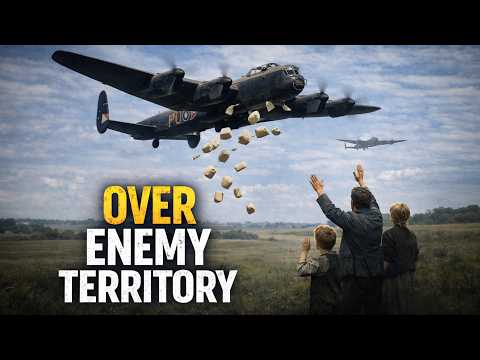
Later that afternoon, aircraft of RAF Bomber Command lifted off from bomber stations across Eastern England, particularly in Lincolnshire, the heartland of Bomber Command. Most of the aircraft involved were Avro Lancaster heavy bombers—the same aircraft that had spent years carrying out strategic bombing operations over Germany. But instead of bombs, the aircraft carried food supplies packed into the bomb bays. The loads included flour, dried vegetables, powdered milk, tinned meat, and other emergency rations supplied largely through Allied relief organizations.
The drop zones were carefully selected open areas near major cities where starving civilians could quickly reach the supplies. Early drop locations included fields near The Hague, Rotterdam, and Leiden, as well as the airfields at Valkenburg and Eindhoven. The drop zones were marked by Dutch resistance members and local authorities using ground panels and signals to guide the aircraft.
Unlike normal bombing operations, which were conducted at high altitudes, the Lancasters descended to extremely low level as they approached the Dutch coast. Crews typically flew at around 400 to 500 feet following the corridors agreed with German forces. For Bomber Command crews, the experience was unlike any other mission of the war. At the designated drop zones, the bomb bay doors were opened and the food loads released. Initially, the supplies were packed into large sacks, but crews quickly discovered that many burst open when they struck the ground. So, to reduce losses, crews began modifying their drop methods using containers and reinforced packaging where possible.
From the ground, Dutch civilians watched the bombers approach at low level. Many waved sheets or laid out large signals in the fields to guide the aircraft to the correct drop zones. As the food supplies hit the ground, crowds rushed forward to collect them. For many people, it was the first substantial food they had seen in months. For the RAF crews, the reaction was unforgettable. Instead of the destruction normally associated with Bomber Command missions, they saw civilians waving and cheering as the aircraft passed.
Over the following days, the scale of the operation grew rapidly. Hundreds of Lancaster sorties were flown as Bomber Command continued dropping food across western Holland. By the end of Operation Manna, the RAF had delivered thousands of tons of food to the starving Dutch population.
The relief effort soon expanded beyond the RAF. On May 1, 1945, the United States Army Air Forces began their own food drop missions under the code name Operation Chowhound. These missions were conducted by B-17 Flying Fortress bombers of the US 8th Air Force—many of the same aircraft that had spent the previous two years carrying out daylight strategic bombing raids over occupied Europe and Germany. Like the RAF Lancasters, these B-17s were loaded with food rather than bombs. Their bomb bays were filled with large containers packed with flour, canned goods, powdered milk, dried vegetables, and other emergency rations.
The aircraft followed the same negotiated flight corridors into the western Netherlands and descended to low altitude for the drops, typically at roughly 400 to 500 feet. For American crews accustomed to high-altitude combat missions deep over Germany, the sight below was strikingly different. Instead of flak and fighter opposition, they saw thousands of Dutch civilians gathered in fields waiting for the aircraft to arrive. As the B-17s approached the drop zones, the bomb bay doors opened and the food containers were released. On the ground, civilians rushed forward to collect their supplies almost immediately after they landed.
Between May 1 and May 8, 1945, American aircraft flew hundreds of sorties, delivering thousands of tons of food to the starving population. By the end of Operation Chowhound, the US 8th Air Force had delivered over 4,000 tons of food supplies to the western Netherlands. Together with the RAF’s Operation Manna, the combined airlift represented one of the largest humanitarian food drop operations carried out during the Second World War.
While Allied bombers were delivering food from the air, a parallel relief effort was being organized on the ground. This operation was known as Operation Faust. The plan involved transporting large quantities of food by truck from Allied-held territory directly into the still-occupied western Netherlands. Responsibility for the operation fell largely to the First Canadian Army, which by the spring of 1945 had liberated much of the eastern and northern Netherlands and was positioned along the front lines facing the remaining German forces in the west.
Just as with the air drops, Operation Faust required careful negotiation with the German authorities still controlling the region. Arrangements were made that allowed convoys carrying humanitarian supplies to pass through German lines without interference. The food itself came primarily from Allied stockpiles assembled in liberated parts of the Netherlands and Belgium. Supplies included flour, canned meat, dried vegetables, and other essential foodstuffs similar to the items being delivered by air.
In the final days of April and early May 1945, long columns of military trucks loaded with food supplies began traveling toward the western provinces. These convoys moved under carefully controlled conditions along routes agreed with German commanders. At designated transfer points near the front lines, the supplies were handed over for distribution deeper inside the occupied territory. Dutch civil authorities and relief organizations then organized the delivery of the food to towns and cities suffering from famine.
For the starving population, the arrival of these truck convoys provided another crucial lifeline. While the air drops delivered large quantities of food quickly, the ground convoys allowed a more sustained flow of supplies to reach the population. Together with the Allied air operations, Operation Faust formed part of a coordinated humanitarian effort that brought desperately needed food into the western Netherlands during the final days of German occupation.
The combined impact of Operations Manna, Chowhound, and Faust was enormous. Between April 29 and May 8, 1945, Allied bomber forces flew thousands of low-level relief sorties over the western Netherlands. During Operation Manna, RAF Bomber Command aircraft flew approximately 3,100 sorties, delivering roughly 6,600 to 6,700 tons of food supplies. The United States Army Air Forces’ contribution under Operation Chowhound added a further 2,200 sorties, delivering more than 4,000 tons of food. Combined, the Anglo-American air operations delivered over 11,000 tons of food by air in just over a week. On the ground, Operation Faust brought additional supplies into the western Netherlands by road under the supervision of the First Canadian Army, further reinforcing the relief effort.
For millions of Dutch civilians weakened by months of famine, these deliveries arrived at a critical moment. Without this intervention, historians widely believe the death toll from the Hunger Winter would have risen dramatically in the final weeks of the war. By early May 1945, the relief flights had become a daily sight over the western Netherlands. For civilians weakened by starvation, the steady appearance of Allied bombers and the arrival of truck convoys signaled that the long winter of famine was finally coming to an end.
At the same time, the military situation across Europe was collapsing rapidly for Nazi Germany. Allied armies were advancing deep into German territory, and German forces across occupied Europe were beginning to surrender. In the Netherlands, German forces under General Johannes Blaskowitz formally surrendered on May 5, 1945, in Wageningen to Canadian forces under General Charles Foulkes. As Allied troops closed in from several directions, the local capitulation formed part of the wider disintegration of German resistance across the continent.
Only days after the first food drops had begun, the war in Europe itself came to an end. On May 8, 1945, Victory in Europe Day was declared. For the Dutch population, liberation arrived almost simultaneously with the life-saving food supplies that had begun falling from the skies only days earlier.
For years, Allied bombers had crossed the skies of Europe carrying bombs and destruction. But in the final days of the war, many of those very same aircraft carried something entirely different: flour, bread, and hope. Operation Manna, Operation Chowhound, and Operation Faust remain one of the most remarkable humanitarian efforts of the Second World War. At a moment when millions of civilians were facing starvation, former instruments of war became tools of relief. And in the skies above the Netherlands, bombers that once brought devastation instead helped save a nation.
In the decades that followed, the crews who flew those missions rarely spoke of them as heroics. They had simply done what was asked. Yet for the Dutch families who gathered in those frozen fields, the memory never faded. Children too weak to walk were carried to the drop zones, and grown men wept as sacks of flour split open on the grass.
Every year since, the Netherlands has remembered. Schoolchildren tend the graves of Allied airmen, and in towns like Terbregge and Voorschoten, memorials mark the fields where bread once fell from the sky. For the Dutch, the bombers that came in April 1945 were not weapons of war, but messengers of life.
War had taken everything from them. Then, in its final breath, war gave something back. What does it say about humanity that even in the darkest hours, enemies can pause to save a stranger?
Report this article
Select a reason for reporting:






