The bunker reeked of gasoline and despair. Just hours after Adolf Hitler bit into a cyanide capsule, Joseph Goebbels—the man who had orchestrated the Nazis’ most venomous propaganda—found himself the unlikely Chancellor of a crumbling Reich. It was May 1, 1945, and the Soviet tanks were rumbling through the streets of Berlin, their shells shaking dust from the bunker’s ceiling. Goebbels had one day to leave his mark on history, and he would spend it trying to negotiate a peace that no one would accept.
“I will not surrender unconditionally,” he snarled, his face pale under the flickering lights. The Führer was dead, but the fight—or at least the pretense of it—was not.
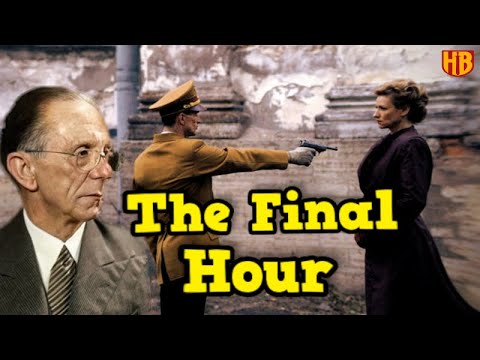
Goebbels had not sought this poisoned chalice. He had been Hitler’s loyal propaganda minister, the architect of the Big Lie, the man who had urged total war and promised wonder weapons that never came. But in the final days, as Göring and Himmler betrayed their Führer, Goebbels remained steadfast. He moved his entire family—his wife Magda and their six children—into the bunker, a decision that would seal their fate.
His one-day government began with a desperate diplomatic gamble. At 10 p.m. on April 30, he dispatched General Hans Krebs, a fluent Russian speaker, to negotiate with the Soviets. Krebs met General Vasily Chuikov, but the Soviets demanded unconditional surrender. No terms, no ceasefire, no escape for the Nazi leadership.
When Krebs returned at 6 a.m. on May 1 with the predictable rejection, Goebbels flew into a rage. Surrender was unthinkable. He had spent years preaching that the German people deserved their fate if they could not win. Now, with the Red Army at the doorstep, he decided that he and his family would not be taken alive.
While other bunker inhabitants scrambled to escape—some heading west to surrender to the Americans, others hoping to join the new government under Admiral Dönitz—Goebbels and Magda prepared for death. They contacted Dr. Helmut Kunz, the bunker physician, to administer morphine to the children. Six innocent lives, aged 4 to 12, were put to sleep before cyanide capsules were crushed between their teeth. Magda, who had once begged Hitler to spare her children, now participated in their murder.
That evening, around 8:30 p.m., Goebbels and his wife stood in the bunker’s exit stairwell. He raised his pistol, fired into his wife’s head, then turned it on himself. Their bodies were doused with gasoline and burned, but the fire was insufficient—the charred remains were easily identifiable by the Soviets.
Goebbels’ one-day chancellorship was over. His most significant act had been to try to negotiate a peace that was never within reach. In the end, he chose annihilation over surrender, following his Führer into the flames of a burning Berlin.
The charred remains told a story the Soviets would use for propaganda. Within hours, Red Army soldiers had photographed the bodies—Goebbels’ twisted leg, the gold party badge still pinned to his blackened uniform, Magda’s face frozen in a grimace. They were dragged to a courtyard, filmed from every angle, and eventually buried in an unmarked grave somewhere in Berlin. The Soviets wanted no shrine, no martyrdom, no whisper of a legend.
But the story of those final hours did not end with the flames. In the days that followed, the bunker emptied. General Krebs, who had carried Goebbels’ futile peace offer to Chuikov, remained behind. He had no desire to flee. On the night of May 1, after Goebbels and Magda were dead, Krebs sat down with his staff, shared a bottle of schnapps, and spoke quietly about the end. Then he pulled his pistol and shot himself in the head. The man who had spoken Russian fluently, who had once served as a military attaché in Moscow, chose the same fate as his Chancellor.
Others tried to run. A group of soldiers and SS men, including Hitler’s personal adjutant Otto Günsche, gathered in the Reich Chancellery garden and attempted a breakout under cover of darkness. They slipped through Soviet lines, moving west toward the Americans. Some made it. Some did not. The streets of Berlin were a slaughterhouse—civilians, soldiers, and fanatics all caught in the same trap.
By the time the sun rose on May 2, the city had fallen. General Helmuth Weidling, the commander of Berlin’s defenses, surrendered to the Soviets. He broadcast a message to the remaining German troops: the fight was over. Thousands of soldiers laid down their arms. The swastika was torn from the Brandenburg Gate.
But the war in Europe was not yet finished. In the north, Admiral Karl Dönitz—the man Hitler had named as his successor in his final will—now led a rump government from the town of Flensburg near the Danish border. Dönitz was no fanatic. He knew the war was lost. His priority was to save as many German soldiers and civilians as possible from the advancing Red Army, and to surrender to the Western Allies rather than the Soviets.
For a week, Dönitz played a dangerous game. He offered partial surrenders to the British and Americans, trying to buy time. Field Marshal Montgomery accepted the surrender of German forces in northern Germany on May 4. The Americans took the surrender of forces in Bavaria two days later. But the Soviets demanded a full, unconditional surrender of all German forces on all fronts. Stalin would not accept anything less.
On May 7, in a small schoolhouse in Reims, France, General Alfred Jodl signed the instrument of unconditional surrender on behalf of the German High Command. The Soviets insisted on a second ceremony in Berlin, in the ruins of the German capital. Just after midnight on May 8, 1945, Field Marshal Wilhelm Keitel signed the final document. The war in Europe was over.
Dönitz’s government lasted another two weeks. He was arrested by the British on May 23, along with the rest of his cabinet. The Third Reich, which Hitler had promised would last a thousand years, had survived just twelve.
Back in Berlin, the bunker where Goebbels had spent his final hours was sealed off by the Soviets. The charred stains on the walls, the empty morphine vials, the children’s toys scattered in their room—all of it was buried under concrete and silence. For decades, the site would be a parking lot, a nondescript patch of asphalt where children played and tourists walked without knowing what lay beneath.
But the question of what might have happened if Goebbels had surrendered lingered. What if he had taken his children and fled west, as so many others had done? What if he had stood trial at Nuremberg, like Göring and Ribbentrop and the rest? Would he have been hanged, or would he have cheated the gallows as Göring did with his cyanide capsule? The world would never know.
What the world did know was that Goebbels had chosen death over surrender, and in doing so, he had taken his children with him. Six small bodies, burned beyond recognition, were found in the bunker—a final, grotesque testament to a man who had once said that if the German people were defeated, they deserved to perish.
The story of the bunker, however, was not just a story of death. It was also a story of survival. Traudl Junge, Hitler’s young secretary, had escaped the bunker in the final days. She would live for another fifty-seven years, haunted by the things she had seen. She later wrote: “I was not a Nazi, but I was too young to understand what was happening. I was just a girl who wanted to work for a great man.” Her words would echo through the decades, a reminder that the line between innocence and complicity was not always clear.
As the sun set over the ruins of Berlin on May 8, 1945, the city was silent. The guns had stopped. The swastikas were gone. The bunker was dark. And somewhere in the rubble, the ghosts of the Goebbels children lay waiting to be remembered.
Yet the silence of that May evening did not last. Within days, the ruins of Berlin became a stage for a different kind of reckoning. Soviet soldiers combed the Chancellery garden with methodical fury, searching for any trace of the men who had ruled from beneath the rubble. They found the bodies of Goebbels and his wife again, half-buried in a shell crater, and this time they made sure the world would see them. Photographs were taken, autopsies performed, and the charred jaw with its distinctive gold bridgework became the proof Stalin wanted: the propaganda minister was truly dead.
But the hunt for the living was just as relentless. The Soviets rounded up anyone who had served in the bunker—secretaries, cooks, orderlies, guards. Interrogations began immediately, and the accounts that emerged were contradictory and self-serving. Some claimed Goebbels had been shot by his own guards; others swore he had bitten a cyanide capsule. The truth, buried under gasoline and fire, was already becoming a myth.
Among those taken prisoner was Dr. Helmut Kunz, the man who had administered morphine to the six children. He would later claim he had no idea what Magda intended, that he had merely followed orders he could not refuse. His testimony would be contradicted, dissected, and dismissed by historians for decades. The children’s deaths, like so many horrors of the Reich, had no clean accounting.
Meanwhile, in Flensburg, the ghost government of Admiral Dönitz clung to its final days. The British, who had tolerated the rump regime for nearly three weeks, finally moved to dissolve it on May 23. Soldiers of the 11th Armoured Division surrounded the government compound and arrested Dönitz, Speer, Jodl, and the rest. The admiral, who had once commanded the U-boat fleet, offered no resistance. He simply packed his briefcase and walked into captivity.
But the capture of Flensburg raised an awkward question for the Allies. What were they to do with the men who had carried out Hitler’s orders to the bitter end? The answer would come in the form of a trial unlike any the world had ever seen. In London, the four victorious powers—the United States, Britain, France, and the Soviet Union—signed an agreement to establish an International Military Tribunal. The venue chosen was Nuremberg, the city of the old Nazi rallies, now a heap of rubble.
As preparations for the trial began, investigators sifted through the captured archives of the Reich. Goebbels’ diaries, recovered from the Chancellery ruins, became a central exhibit. Page after page revealed the mind of a man who had lied with such conviction that he had convinced himself. He wrote of the Jews as a “world enemy,” of the need for “total war,” of his contempt for the German people who had failed to live up to his Führer’s vision.
One entry, dated just weeks before the end, read: “If we do not win, we will drag the world down with us. That is our mission.” The words would be read aloud in the Nuremberg courtroom, not as evidence against Goebbels—he was beyond trial—but against the system he had served and the men who had enabled it.
Yet the question of individual responsibility remained. In the dock sat Göring, the man Goebbels had despised as a useless buffoon; Ribbentrop, the champagne salesman turned foreign minister; and Speer, the architect who had claimed he knew nothing of the death camps. Each would offer his own defense, his own version of the truth. But the shadow of the bunker hung over them all—the memory of the man who had chosen to die rather than face the judgment of his enemies.
The Nuremberg trials began in November 1945, and the ghost of Goebbels hovered over every session. His diaries were read aloud, his speeches replayed, his words used to damn the men who had once stood beside him. Göring, the man Goebbels had called “completely useless,” cheated the gallows with a cyanide capsule smuggled into his cell. Ribbentrop and the others were hanged in the gymnasium of Nuremberg prison.
Speer, the architect who had claimed ignorance, received twenty years. He served his time in Spandau and walked free in 1966, a free man who never stopped insisting he had not known. The world was left to wonder how many others had hidden behind the same lie.
As for the bunker, its secrets were buried under concrete and asphalt. The children’s toys, the morphine vials, the charred stains—all vanished into silence. Yet the question lingers, as it always will: what if Goebbels had surrendered, had faced the judges, had answered for his crimes? Would justice have been served, or would he too have cheated the rope?
What do you think—was Goebbels’ suicide an act of cowardice or the final propaganda stroke of a man who refused to let his enemies write the ending?
Report this article
Select a reason for reporting:






