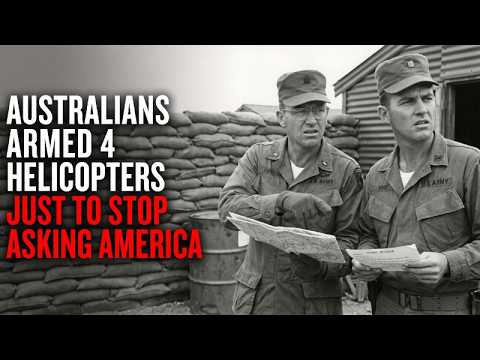
In January 1967, General William Westmoreland, commander of US forces in Vietnam, flew to a rubber plantation in Phuoc Tuy Province to inspect the war his Australian allies were waging on his behalf. He toured the base, read patrol reports, studied the operation maps, and left unconvinced. The American view was that the Australian effort was too slow, yielding few results for the investment. Westmoreland pressed Brigadier Tim Vincent, commander of the Australian task force, to push his men to fight more aggressively. The two armies were fighting different wars in the same country.
The American approach measured success in body counts. Search-and-destroy operations aimed to find the enemy and use massive firepower and mobility to attrit them until they stopped replacing losses. The Australians sent infantry companies on deliberate patrols supported by artillery and armored personnel carriers, with helicopters on call, seeking to cut the link between the Viet Cong and the villagers who supplied them with food. Westmoreland wanted engagement. The task force wanted to wrest the enemy from the population and expand government control a few kilometers at a time.
“The Australians were under American operational control throughout the war, but the agreement Canberra negotiated allowed the task force to apply its own doctrine within its province.” Westmoreland could issue orders to the Australians, and he did. What he could not do was make them run Phuoc Tuy the way the rest of the country was run. By that January visit, he had realized they had no intention of changing.
Over the next five and a half years, the Australians did four things that American command had dismissed as unworkable. They took a British tank designed to stop Soviet armor on the North German Plain and drove it into jungles everyone agreed were too soft to bear it. They stripped four helicopters from transport duties and rebuilt them as gunships so their infantry would not have to wait in line for American fire support. They flew a short-takeoff transport into roughly 115 airstrips scattered across South Vietnam, many of which existed only on paper. And they sent men into enemy territory in teams of five.
Six things about the Australians in Vietnam that American command could not accept, each one documented as it happened. Some worked the way the Australians said they would. Some did not. They recorded that too, in reports that make uncomfortable reading.
It began in Nui Dat in mid-1966, at a rubber plantation that had to be cleared of the enemy before the task force could move in. The first disagreement was not about tanks or helicopters. It was about whether an ally under your operational command had the right to refuse to fight your way.
The 1st Australian Task Force controlled Phuoc Tuy Province from mid-1966 to the end of 1971. Phuoc Tuy sits on the coast southeast of Saigon, with long, high hills in the south and dense scrub and rubber plantations stretching north and east. The National Liberation Front had run large parts of it for years before the Australians arrived. The infantry rotating through Nui Dat often came as Anzac battalions with New Zealand rifle companies within the Australian battalion structure, and New Zealand gunners served alongside Australian artillery throughout the campaign. The 4th Battalion, Royal Australian Regiment, served its tours as an Anzac battalion. The New Zealanders were in that province from the first year to the last.
The first thing American command would not accept was an ally refusing to fight the American way. Westmoreland’s war was a war of attrition, and attrition needs numbers. Units were evaluated on how many enemies they found and how many they killed. That drove commanders toward operations that generated contact quickly—sweeping operations behind heavy preparatory fires and direct air assaults on suspected positions. It produced numbers that could be tallied at the end of the week and sent to Saigon. It also gave the enemy significant warning, because a battalion moving into a valley behind artillery preparation would never be a surprise.
The Australians had learned their trade elsewhere. Their officers and noncommissioned officers had been through the Malayan Emergency and the confrontation in Borneo, where the mission was to find a small enemy living among the civilian population without destroying that population to get to him. That produced a doctrine based on patience. Small groups moved quietly and stayed out for days at a time, setting ambushes on trails and water points, working the villages, and cutting the enemy off from the rice and information he lived on. Contact happened when the Australians chose it, which meant it was rare and on their own terms.
From Saigon, it looked as if the task force was standing still. So the pressure continued for years. American command wanted the task force to be more active and wanted to see its results clearly in the weekly reports. The requests did not stop with one general’s visit in January. Australian commanders in Nui Dat spent the entire campaign managing a relationship with a command that rejected their methods and had the authority to say so. They listened to the criticism, agreed where they had to agree, and kept patrolling the way they had been trained in Malaya and Borneo. No one in Nui Dat was going to win that argument in the meeting rooms, and the task force did not waste much effort trying. Instead, the answer came from the reality of the province.
The second thing American command would not accept was that a province could be cleared by patrolling instead of firepower. By the time the Australians and New Zealanders finished their work in Phuoc Tuy, the main-force units that had controlled the ground were no longer operating in it. The National Liberation Front’s main-force battalions had been driven out of the province entirely. The two local battalions that were supposed to hold it had been worn down to the point of uselessness: D445 was reduced to remnants, and D440 never recovered its strength. That was achieved by companies walking, watching, and setting ambushes, with guns brought in only when there was a target worth shelling.
The mechanics were unglamorous and took years. Patrols out of Nui Dat kept mapping the trails, caches, and bunker systems, and the ground itself was swept again and again until the enemy’s movement patterns were better known to the Australians than to the men using them. Villages were cordoned and searched. The enemy’s infrastructure was pulled out from within, and the local force units lost the food, recruits, and warning network they depended on. When a main-force battalion entered the province looking for a fight, it found artillery already zeroed on the likely approaches and companies already sitting on the trails. The province stopped being a safe place to base.
Here is the part that does not fit a quick summary. The Australians knew what would happen when they left. They said so in writing. Officers in Phuoc Tuy and in Saigon reported that South Vietnamese units would struggle to hold the province once the task force went home, and the government in Canberra took that assessment into account when it decided to withdraw in 1971. In September of that year, as the Australians were preparing to leave, signals intelligence spotted the 33rd North Vietnamese Army Regiment moving into the northern part of Phuoc Tuy. They had driven the regular enemy out of the province, and they warned their government that it would not stay that way without them.
The third thing American command would not accept was that a British tank designed for a European war could be useful in the jungle. The Centurions were built in Britain to fight on the North German Plain, where the ground was firm and the fields of fire were long, and the enemy was expected to be Soviet armor coming from the east. It weighed over fifty tons. The belief that it was too heavy for the soft ground of southern Vietnam was not an American invention; much of the doubt came from within the Australian armored corps itself.
What the doubters got right was the nature of the ground. The monsoon mud of Phuoc Tuy swallowed the tank up to its belly plates, and the engineers spent a large part of the campaign pulling armor out of creek beds and muddy holes. What the doubters got wrong was everything the tank could do once it reached its destination.
A Centurion could cross a bunker system that would have cost an infantry company dearly to clear on foot, fire a twenty-pound shell through a wall at point-blank range, and stay in the open to take fire that would have killed infantry instantly. The argument stopped being theoretical in a village called Binh Ba.
On 6 June 1969, a Centurion and an armored recovery vehicle were moving on the road north of Binh Ba, a rubber-plantation village a few kilometers north of the task force base. A rocket-propelled grenade fired from inside the village hit the tank. The round penetrated the turret and wounded one crewman badly. The village had been quiet. It was full of civilians, and it now sheltered a North Vietnamese and Viet Cong force that had entered and did not intend to leave.
Two and a half hours later, the task force launched Operation Hammer. An understrength company of the 5th Battalion, Royal Australian Regiment, entered Binh Ba supported by tanks, armored personnel carriers, and artillery, alongside South Vietnamese forces trying to retake their village. What followed was two days of house-to-house fighting in a built-up area, the kind of work that exhausts infantry.
The tanks moved down the streets first and knocked down walls, and the soldiers followed through the gaps they left. By the morning of 8 June, the village had been cleared.
The casualty figures from Binh Ba are messy, and anyone who gives you a single confident number is only guessing. Australian losses were recorded as between one and four men who did not come home, with ten to seventeen wounded, depending on which account you read. Enemy losses ran from fifty-one killed and eleven captured according to the 5th Battalion’s report, up to at least 107 in other sources.
What is not in dispute is what 5 RAR later wrote, which credited the tanks as the decisive factor in winning the battle and considered them the main reason Australian casualties stayed low. A machine designed to stop the Red Army on the North German Plain had just decided a street fight in a Vietnamese village in the middle of a rubber plantation.
The fourth thing American command was not prepared to accept was the Australians stopping their requests for fire support. In the early years of the campaign, any Australian company in trouble called for gunships and waited its turn in an American queue, because the helicopters were American. Officers in the Australian Army and the Royal Australian Air Force had argued for a long time that having their own aircraft would be better than this constant dependence. By 1969, the argument was won and the request was accepted in Australia.
Four Iroquois helicopters of No. 9 Squadron were converted into gunships. Each carried a minigun on each side firing 7.62mm ammunition at a rate that made the aircraft sound like a tearing note in the air. With a seven-tube rocket pod on each side firing 2.75-inch rockets, and twin M60 machine guns operated from the doors. The call sign was Bushranger.
The conversion was a formal decision taken at government level in Australia, and it was carried out on the squadron’s own airframes by men who had to invent combat methods for the aircraft they had just built. They were declared operational on 21 April 1969.
The mission was to escort transport helicopters into landing zones of unknown consequence, to support Special Air Service patrols that were usually in serious trouble by the time they got on the radio, and to provide fire support for the task force within its province. The difference this made was about availability more than firepower.
The American gunship section followed an American priority list, and any company in contact in Phuoc Tuy was placed on that list according to the order of other battles that day. Since 21 April, an Australian infantryman on the radio in that province could call for gunships and get Australian ones. They came from the same squadron that carried his supplies and evacuated his wounded, flown by men who would be in his base that night. And the response time was a decision for the task force rather than a negotiation with another headquarters.
No. 9 Squadron had been in Vietnam since 1966, moving troops, supplies, and casualties, and the gunship conversion gave it a way to protect its own aircraft when a landing zone turned out to be occupied. Four aircraft is a small number by the standards of that war. But they were four aircraft answering the call of the men who needed them.
The fifth thing American command would not accept was that serious air transport could be run into airstrips that barely qualified as airfields. No. 35 Squadron’s Caribou was slow, high-winged, and unglamorous, with a tail that dropped near the ground so vehicles could drive straight on. Nobody would have put it on a recruiting poster. What it could do was land and take off from places that were hardly runways at all.
They became “Wallaby Airlines,” flying into roughly 115 strips across South Vietnam—some real bases with fuel and control, others just a strip of laterite beside a local headquarters with a windsock and a man with a radio. Every remote site that kept receiving supplies did so because a Caribou came in over the trees, put its wheels on a short dirt strip, and vanished again.
The sixth thing American command would not accept was that reconnaissance could be done by five men. The Special Air Service patrolled the borders of Bien Hoa, Long Khanh, and Binh Tuy, staying out for days, reporting battalion movements before they became a problem. Between 1966 and 1971, the squadrons ran a patrol out or back almost every single day. Five men leaving the wire at Nui Dat were deciding where the task force went next and what it would find when it got there.
The withdrawal came in 1971. The tanks were loaded, the Bushrangers flew home, and the rubber trees at Nui Dat still stood in their rows. The men who returned spent the next twenty years explaining at barbecues that Phuoc Tuy was a province, not a battle—and none of them bothered to mention that the argument with their allies lasted longer than the fighting itself.
So here is the question for you: when an ally fights a different war than the one you ordered, and wins it on their own terms, was it stubbornness—or was it the only way that war could actually be won?
Report this article
Select a reason for reporting:






