Major Dick Winters, the real-life hero portrayed by Damian Lewis in HBO’s Band of Brothers, had a complicated relationship with the series that made him a household name. While he publicly praised the miniseries for its realistic depiction of combat and its focus on the bond between soldiers, he harbored private disappointments that he rarely voiced. In the final decade of his life, Winters opened up about his critiques, revealing a man who valued authenticity above all else—and who struggled with the compromises inherent in bringing his story to the screen.
When Tom Hanks asked Winters what he thought of the series after its premiere in 2001, Winters didn’t hold back. “I wished it would have been more authentic,” he told Hanks. “I was hoping for 80% accuracy.” Hanks, ever the showman, replied with a grin: “Look, Major, this is Hollywood. At the end of the day, we will be hailed as geniuses if we get this 12% right. We are going to shoot for 177%, and if we succeed, you need to be satisfied.” Winters, ever the pragmatist, accepted the argument—but the sting of inaccuracy lingered.
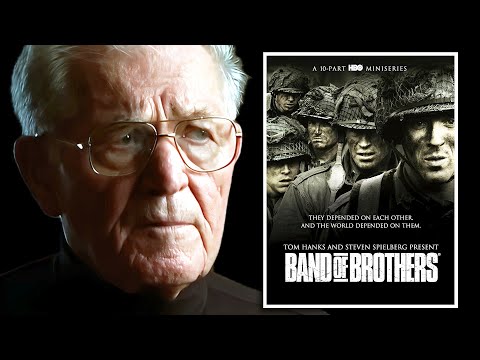
Winters’ disappointment was rooted in his deep involvement with Stephen Ambrose’s book. He had agreed to cooperate only on the condition that everything in it was accurate. Yet he had far less control over the series. When writers changed details for dramatic effect, Winters would ask, “Why couldn’t you use it the way I remembered it?” He understood the need to adapt for a broader audience—like camouflaged guns on D-Day that had to be shown plainly for clarity—but that didn’t make it easier.
One specific criticism he voiced was about Damian Lewis’s portrayal. “At the beginning, he should have been more forceful,” Winters told the Patriot News. “But he got better as the series went on. He only had a few days while I had five years to learn how to be a soldier.” It was a minor gripe, but it revealed Winters’ perfectionism—and his awareness that no actor could fully capture the reality of war.
More troubling to Winters was the series’ treatment of Albert Blithe, a fellow Easy Company veteran. In the show, Blithe is shot in the neck and dies in 1948. In reality, Blithe was shot in the collarbone, survived, and went on to serve in the Korean War, rising to Master Sergeant and earning three Purple Hearts, a Silver Star, and three Bronze Stars before his death in 1967. “The way Albert Blithe’s story is presented in Band of Brothers is unfair to the man and it’s exaggerated,” Winters said. “It’s not fair to the man in any sense of the word.” The series never corrected the error, even as later editions of the book did.
These embellishments were part of why Winters turned down many interviews—he considered them tantamount to bragging, and the exaggerations only made it worse. Yet despite his criticisms, Winters remained largely positive about the series. He felt the battles were shown realistically, without glorifying or sanitizing war, and he believed the miniseries captured his philosophy: success depends not on heroics but on bonding, character, getting the job done, and hanging tough.
Without Winters’ involvement and insistence on accuracy, Band of Brothers might have deviated even further from reality. He helped ensure the series focused less on glorified heroics and more on the bond that united the men—a true band of brothers. And for that, he was most proud.
But there was another layer to Winters’ unease that he rarely discussed in public—one that went beyond swapped details and composite characters. In the years after the series aired, he began to notice something subtler: the way viewers consumed the story. Young men would approach him at book signings and tell him they wished they had been there, as if the war had been an adventure they had missed out on. “They see the camaraderie and the purpose,” Winters once remarked to a friend, “but they don’t see the nights I still can’t sleep.”
That admission cut to the heart of his deeper disappointment. The series, for all its grit, could not transmit the smell of a foxhole in January, the weight of a frozen foot, or the particular silence that followed a shell burst. Winters had spent decades wrestling with what he called “the ghosts”—the faces of men he couldn’t save. Band of Brothers gave him a measure of peace by honoring those men, but it also resurrected them in ways he hadn’t anticipated.
He was particularly protective of the soldiers who had died and could no longer speak for themselves. When he watched the episode depicting the death of his friend Warren “Skip” Muck and the others lost in the artillery barrage, Winters reportedly sat in silence long after the credits rolled. “They got the noise right,” he said quietly to his wife, Ethel. “But they can’t get the quiet after.”
There was also the matter of what the series left out entirely. Winters had always believed that the true story of Easy Company was not about the battles but about the men who fought them—the pranksters, the poets, the farmers, the kids from the coal towns. Some of those men, he felt, were flattened into archetypes on screen. “We weren’t saints and we weren’t superheroes,” he told historian Larry Alexander in one of his final interviews. “We were scared boys who did our jobs. I worry sometimes the show made it look easier than it was.”
Yet even as he voiced these concerns, Winters never disavowed the series. He understood that Band of Brothers had done something no history book could: it had made a generation of Americans care about a group of ordinary men from a small corner of Pennsylvania. He received letters from teenagers who had joined the military because of the show, and from veterans of later wars who said the series helped them understand their fathers.
In the end, Winters reconciled himself to the paradox. The series was not a documentary, and it was not his memoir. It was a story—and stories, he knew, had their own rules. “If they remember the men,” he said near the end of his life, “then the details don’t matter as much as I thought they did.” It was, for a man of his precision, a remarkable concession—and perhaps the most honest thing he ever said about the series that made him famous.
That concession did not come easily, and it did not come all at once. In the years between the premiere and his death in 2011, Winters kept a quiet ledger of the series in his mind—what it got right, what it got wrong, and what it simply could not reach. He never published that ledger, but fragments of it surfaced in letters to veterans, in conversations with his family, and in the occasional interview he granted to those he trusted.
One of those fragments concerned the series’ portrayal of leadership. Winters had always insisted that command was less about issuing orders than about earning trust—“You can’t lead men you don’t know,” he once told a group of West Point cadets. He felt the miniseries captured this in spirit but sometimes reduced it to shorthand: a stern look, a raised hand, a decisive line. “Leadership is mostly listening,” he said. “You don’t see that on film because it’s boring. But it’s the truth.”
He was also uneasy about how the series handled fear. Winters had known men who froze, men who broke, men who never spoke of what they saw. He believed the show was honest about cowardice in flashes—Blithe’s paralysis, the replacement who couldn’t fire his rifle—but that it too often resolved those moments with redemption arcs that real war rarely offered. “Some men never came back,” he said, “even when they came home.”
Perhaps the most revealing of his late-life reflections concerned the final episode’s framing. The real Winters had indeed been asked to speak about the war, and he had done so with characteristic modesty. But he was uncomfortable with the way the series positioned him as the moral center of Easy Company—the wise elder, the steady hand. “I was one of many,” he insisted. “The show needed a narrator. I happened to be convenient.”
He worried, too, that the spotlight on him had obscured men he considered his equals. He would name them in conversation—Compton, Speirs, Lipton, Foley—and note with quiet frustration that audiences remembered the actor who played them more than the man himself. “They gave us medals,” he said of the real veterans, “and then they gave us faces.”
Still, Winters never allowed his reservations to curdle into bitterness. He understood that Band of Brothers was a gift to the families of the men who had died, and he saw how it drew new generations toward service and sacrifice. When a young soldier once thanked him for the series, Winters corrected him gently: “Don’t thank me. Thank the men who didn’t make it back. They’re the ones who earned the story.”
And yet, in his last years, he began to speak more openly about the cost of that story—not to the audience, but to himself. He admitted to his friend Colonel K.C. Kingseed that watching the series could still bring on a heaviness he couldn’t shake. “It’s like opening a door you thought you’d nailed shut,” he said. “The men come in. They sit down. They don’t say anything. And then they leave.”
That image—the silent visitors—stayed with Kingseed, who later reflected that Winters had spent his whole life trying to be worthy of the men he led. The series, for all its flaws, had given him one more way to honor them. But it had also given him one more way to miss them.
In the end, the ledger balanced itself. Winters’ criticisms—the camouflaged guns, the weak start of Damian Lewis, the unfair fate of Albert Blithe—were real, and he never pretended otherwise. But they were outweighed by something larger: the sight of his men, long forgotten, suddenly remembered.
He saw the series do what he could not do alone. It carried Easy Company into living rooms, classrooms, and barracks across the world. It made strangers care about Skip Muck and George Luz and a quiet farmer from Pennsylvania who never wanted to be a hero.
“I was hoping for 80% accuracy,” he had told Hanks. He got less than that. But he got something else—a new generation that knew the names, honored the sacrifice, and understood, however imperfectly, that the bond was the thing.
When Winters died in 2011, the men he had led were waiting for him. And the series, with all its Hollywood flourishes and swapped details, had done its part. It had kept the door open long enough for the rest of us to walk through.
So here is the question that lingers: if a story moves us to remember the men—even when the details are wrong—has it not done the most important work of all? Or should we still demand the full 80%, for their sake?
Report this article
Select a reason for reporting:






