On July 6, 1918, a 32-year-old Australian soldier placed his rifle on the parapet of a newly captured trench near the French village of Villers-Bretonneux. He grabbed two Mills bombs. Then he walked alone toward a German machine-gun post that had been cutting his company to pieces all morning. He never expected to come back.
That soldier was Walter Ernest Brown—everyone called him Wally. He was a grocer from Tasmania, barely five-foot-four, with a chest like a barrel and hands that had spent more years weighing sugar than holding a weapon. But on that morning, he did something that would earn him the Victoria Cross.
He threw his first bomb. It fell short. The German gunner opened fire. Bullets kicked up dirt on both sides of him. He kept running. When he reached the post, he punched the nearest German in the face, knocking him into the mud. Then he raised his second live grenade, thumb pressed on the safety lever, and held it where every man inside could see it. Thirteen German soldiers surrendered to him.
He marched them back across seventy yards of open ground, under renewed fire from other German positions. He delivered them to his platoon commander. Then, according to the kind of men who fought in that war, he probably lit a cigarette.
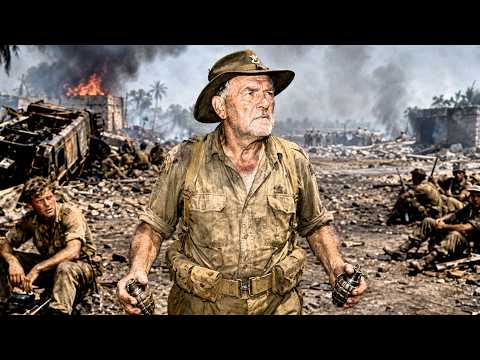
Twenty-four years later, on February 15, 1942, the same man stood in a gun pit in Singapore. He was 56 years old now. The British Empire had just surrendered the island to the Japanese—the largest capitulation in its history. Orders came down: every man was to lay down his arms.
Wally Brown listened. He looked at the men beside him, the ones who would soon be marched into years of brutal captivity. He walked to a box of hand grenades. He took some. Then he said four words that would echo through history:
“No surrender for me.”
He turned his back on his own lines and walked toward the Japanese. No one stopped him. No one went with him. No one ever saw him again.
His name was Walter Ernest Brown. He had done this once before—and survived. This time, all we know is that he went.
To understand why a 56-year-old grocer would choose to walk into enemy fire rather than surrender, you have to go back to the beginning. To a mill town in Tasmania. To a boy who had no logical reason to become the man he did.
Walter Ernest Brown was born on July 3, 1885, in New Norfolk, a small town on the River Derwent, about twenty miles from Hobart. His father worked at the mill. His mother came from a large Irish family and ran a house full of children with a broom in one hand and a wooden spoon in the other.
Wally was the kind of Tasmanian boy who came from a small town and expected to stay there. He left school at fifteen. He was small for his age and stayed small—five-foot-four. But he had broad shoulders and a grip that came from hauling flour sacks. He was polite to older women. He tipped his hat. He didn’t swear in front of them. That’s how he was raised.
At sixteen, he worked in a grocery store in Hobart. He weighed sugar. He counted eggs. He cut cheese with a wire. He measured tea from a lead-lined chest into brown paper bags. He was good at it. He remembered what people liked. He knew who needed credit until the end of the week. Grocers in 1900 were half traders, half neighbors. Wally Brown was both.
For the first thirty years of his life, that was all he was. A grocery counter in Tasmania, then a grocery counter in New South Wales. A man who kept ledgers and combed his hair and had never carried a rifle in his life.
Then the war began.
He didn’t join the first wave of volunteers. He waited almost a year. On July 11, 1915, he walked into a recruiting office in Sydney and put his name on paper. He was thirty years old. He listed his occupation as grocer. He listed his height as five-foot-four. And in a twist that would have been funny if it weren’t so tragic, the army assigned him to the Light Horse—mounted infantry.
He reached Egypt in January 1916. He looked around at the sand and the camels and decided he had joined the wrong army. He wanted France. He wanted the trenches he had been reading about in the Sydney papers. But once you were in a mounted unit in Egypt, the army didn’t send you to France just because you asked.
The story that stayed in his records—the one his mates told for years afterward—is that Wally Brown deliberately lost his false teeth. He announced to his officers that his dentures had been lost in the desert and that he couldn’t eat the rations without them. He had to be sent to Cairo to get a new set. There’s no way to prove he did it on purpose. There’s also no other way to explain how a thirty-one-year-old grocer’s teeth became a matter of official correspondence in the summer of 1916.
Whatever the truth about the teeth, he got to Cairo. And from Cairo, he managed to join a reinforcement draft for the 20th Battalion, an infantry unit from New South Wales fighting on the Somme. By the winter of 1917, he was in France.
He served briefly with the 55th Battalion. He spent about six months, oddly enough, in an Australian field butcher unit because someone at a desk noticed he had once been a grocer and decided that was close enough to a butcher. They handed him a cleaver instead of a rifle. He hated it. He kept requesting a transfer to the front lines. In the summer of 1917, his transfer to the 20th Battalion was finally approved. He was thirty-two years old. He had been in uniform for two years and hadn’t fired a shot in anger.
Then came Passchendaele.
They fought it through the autumn of 1917 in Belgian mud so deep it swallowed men and horses whole. The rain turned the battlefield into a soup of clay and shell water. Men slipped off the duckboards and disappeared. Stretcher-bearers took hours to move a hundred yards. The 20th Battalion went in during October. Wally Brown went in with them.
Somewhere in that mud, between the sixteenth and twenty-second of October, he did what earned him the Distinguished Conduct Medal. The citation was dry. It said he attended to the wounded under heavy fire. It said that when his platoon sergeant was hit and couldn’t fight, he took command of the platoon himself. It said he set a fine example of courage and leadership.
Attending to the wounded in that mud meant kneeling in it. It meant sometimes lying flat, sometimes plunging his arms elbow-deep to pull a man’s face out of it. It meant using personal belts as tourniquets. It meant carrying men across ground that could swallow a whole horse. It meant doing all of that while German shells rained down on the exact spot where he knelt.
Fewer than one in a thousand infantrymen ever wore the DCM. He was still a private when he won it. Later he was promoted to lance corporal, then corporal. That was the rank he held nine months later in the morning at the Accroche Wood, where he did what he did with two Mills bombs and thirteen prisoners.
The Victoria Cross arrived by autumn. The King himself pinned it to his tunic at Buckingham Palace alongside a group of other Australians. Wally walked the red carpet in khaki. He tilted his head. The King leaned forward and fixed the small dark cross to his chest. The band played. Wally stepped back, turned, and walked away. According to him, he later couldn’t remember what the King said to him.
Wait.
After the ceremony, he went back to his battalion and finished the war as a sergeant. He was wounded twice, once in August 1918 during the great Allied advance that began at Amiens. Then he sailed home to Australia at the end of 1919 aboard the transport ship Nestor. He was discharged from the Australian Imperial Force in Sydney in February 1920. He was thirty-four years old.
He carried in his pocket a piece of purple ribbon that most men would have spent the rest of their lives bragging about. He rarely showed it to anyone. He didn’t talk about the trench at Accroche Wood. He didn’t talk about the run, or the bomb that fell short, or the punch he threw into a German soldier’s face. He didn’t tell his mates in the pub about it. If someone asked, he changed the subject to the weather.
For a while, he had no idea what to do with his life. He tried to go back to his old life. He returned to work in shops, but he couldn’t stay in them. He drifted through several jobs in Sydney. Through most of the twenties, he worked in copper finishing, a workshop trade where he filed and polished metal fittings that other men had cast. It was a modest trade in a hot back room. It was as far as a man could get in civilian Australia from the sound of a Mills bomb exploding in the mud.
In 1927, a small part of the country tried to remember what he had done. He was selected as the millionth visitor to the Australian War Memorial, which was then in Sydney, not yet in Canberra. Photographs from that day show a solidly built man in a hat and suit, standing beside bureaucrats and generals, looking like he wished he were anywhere else. He was famous for one afternoon, and then the afternoon ended and he went back to the copper workshop.
In 1930, he moved to Leeton in the Riverina district of New South Wales. Leeton was one of the new inland towns of the twenties, built around the Murrumbidgee irrigation area—a vast network of channels feeding orchards, rice fields, and dairy farms. He took a position with the state water authority. The authority was the Water Conservation and Irrigation Commission of New South Wales, and his job title was water bailiff.
In practice, that meant he walked or rode a horse to inspect rural irrigation channels, making sure farmers took only their share of water, closing gates on those who took more, and filing his report at the end of the week. It was outdoor work. It was a small, respectable job in a small, respectable town. He was in his mid-forties. It suited him.
At Bexley in Sydney on June 4, 1932, he married a woman named Maud Dillon. He was forty-six. She was younger. The wedding was small, according to him. It wasn’t small in reality. Someone had quietly arranged for an honor guard of eight men, all Victoria Cross recipients, to line the church aisle. Eight men who had done things not so different from what Wally Brown had done stood in dark suits and polished shoes while the bride walked past them on her father’s arm.
Wally hadn’t asked for them. They were there because the ribbon in his pocket meant something to them, even if it meant little to him. It was an honor guard of the man’s peers. That kind of thing only happens to a man whose true peers can be counted on the fingers of two hands.
Photographs from that day show him small among men taller than him, with a slightly bewildered look, as if he had wandered into the wrong wedding by accident. He and Maud had two children, a daughter named Pamela and a son also named Walter, born a few years later. He worked the irrigation channels at Leeton. He checked the channels at dawn light and walked them in the heat of the day, then came home to his wife and family and a dinner waiting on the table.
He reached his fifties by the end of the decade. By every measure the world uses, he was a man whose war was over.
Then, in September 1939, another war began.
He was fifty-four when news of the German invasion of Poland came over the wireless in his kitchen at Leeton. The Second Australian Imperial Force was being formed. Younger men, men in their twenties. The age limit for enlistment was thirty-five in most trades. Wally Brown was nineteen years past it.
He waited nine months. He gave the new force time to get its work started. He watched his neighbors’ sons put on the slouch hat. He watched them walk down Leeton’s main street with their kit bags on their shoulders. He watched their mothers not wave from the curb because the mothers didn’t trust themselves to wave.
Then, on June 21, 1940, in a recruiting office in Wagga Wagga, he walked in and did the thing he had done twenty-five years earlier in Sydney. He put his name on the paper. He wrote his date of birth as July 3, 1900. That would make him a man of forty on the day he enlisted. He had shaved fifteen years off his age with one stroke of a pen.
His real date of birth was in his birth certificate in a courthouse in Tasmania. His real date of birth was in his World War I enlistment papers in a filing cabinet in Sydney. His real date of birth was in the citation for his Victoria Cross, published in the London Gazette in 1918. But he wrote 1900 anyway.
They didn’t notice that day. He was short. He was slight. His hair was greying, but plenty of men in their forties in New South Wales in 1940 had greying hair. His hands were the hands of a man who worked outdoors. Perhaps the recruiting sergeant suspected. Perhaps the recruiting sergeant looked at the small man in front of him with the water bailiff’s complexion and the calm eyes and knew perfectly well he wasn’t forty. If the recruiting sergeant knew, he said nothing.
They took him. They gave him a service number, NX35492. They attached him to the 8th Battalion as a corporal. Then someone in the records office in Sydney matched his name to a list of Victoria Cross recipients, and someone else matched his date of birth to his 1915 enlistment papers, and the truth came out of the filing cabinet, and there was an awkward conversation about a man in his fifties who had just enlisted as a private.
They didn’t throw him out. He had a Victoria Cross and a Distinguished Conduct Medal. Those weren’t papers you tore up just because a man had lied about his age. Instead, on the first of July, they promoted him to lance sergeant. In November, they transferred him to a new artillery unit being formed for the 8th Division, the 2/15th Field Regiment of the Royal Australian Artillery.
Then Wally Brown did something no other man of his age and record would have thought to do. He asked to be demoted. He put in a request to drop his rank. He wanted to be a gunner. A gunner in a field regiment was the lowest rank there was. The man who carried the shells to the gun. The man who rammed the shell home. The man who sponged out the barrel between firing. The man who took orders from every corporal, every sergeant, every officer in the battery.
To be a gunner at fifty-five, with a Victoria Cross on your record and a Distinguished Conduct Medal beneath it, meant you were deliberately making yourself small. They approved his request. No one knows exactly why he did it. His mates later guessed he wanted to make sure he went overseas, that a soldier in a gun crew with an infantry division was more likely to go than a corporal on an administrative list at a depot in Australia. Others said he had never wanted rank in the first place, that after his second enlistment he had had enough of the paperwork that came with stripes.
Whatever the reason, he was Private Brown again by the time the unit sailed. He was Private Brown when the unit was inspected before departure. He was Private Brown when the younger men in his gun crew realized that the small, older man in their team was actually a holder of the Victoria Cross. Some of them had heard the story. Some hadn’t. Wally wasn’t going to tell it either way. If a new man asked about the ribbon, he shrugged and said it was a long time ago and there was work to be done.
That was the answer. There was work to be done.
The unit left Sydney in August 1941. It reached Singapore. It moved up into Malaya. It waited for the Japanese to arrive.
On December 8, 1941, the Japanese 25th Army landed on the beaches of northeastern Malaya. In the weeks that followed, they moved south faster than any British or Imperial planner had believed possible. The 2/15th Field Regiment was pushed back. Its batteries were spread among Indian and Australian brigades in a running fight down the peninsula. Jitra, Muar, Ayer Hitam. The gunners fired thousands of shells. They retreated 150 miles from where the war had started for them, giving up ground to a Japanese army that was faster and better led and better trained in the jungle.
By the last week of January, they had crossed the causeway onto the island of Singapore. Their guns were pointed out over the strait against a landing they now knew was coming. On the eighth and ninth of February, the landing came. The Japanese crossed the strait at night. They came ashore through the mangroves. The Australians and British and Indians were pushed back into the city itself.
Fighting inside a city with field guns is not what field guns are built for. But by the twelfth and thirteenth of February, the 2/15th was firing point-blank at Japanese infantry inside its own perimeter. Gunners were being killed at the trails of their guns. Gun pits were blown apart by Japanese counter-battery fire.
On February 15, the British commander, Lieutenant-General Percival, went to meet his counterpart, General Yamashita, at the Ford Motor Factory at Bukit Timah. He signed a surrender document. It was a Sunday evening. It was the largest surrender of British and Commonwealth forces in history. Nearly 80,000 men were ordered to lay down their arms.
Somewhere in the city, at a gun position of the 2/15th Field Regiment, news of the surrender reached a group of gunners who were cleaning up around a piece that had fired its last round. The barrel of the gun was still hot. The sandbags of the pit were torn. There were dead men laid out under a tarpaulin behind the position. A signaller was crying somewhere and trying not to be heard. The city was burning in patches to the north and south. There was an oil haze over the harbor where the fuel depots had been set alight to keep them out of Japanese hands.
Somewhere in the streets outside the perimeter, the sound of the Japanese guns had gone quiet because they no longer needed to fire.
One of the gunners was fifty-six years old. He had listened to the men in charge for a long time. In Egypt in 1916, in France in 1918, in Wagga in 1940. He had usually done what they told him to do. But he had also done something different twice in his life.
He got to his feet. He walked toward a box of hand grenades. He took some. His mates watched him. They said nothing. There was nothing to say. This was Wally Brown. He had won a Victoria Cross for charging a machine gun with a Mills bomb in each hand in France when they were all still young. If Wally Brown decided he was going somewhere, he was going.
“No surrender for me.”
He turned. He walked away from the gun. He walked out of the position. He walked in the direction of the Japanese lines. No one went with him. No one stopped him. His mates stood by the gun and watched him go. The last they saw of him was his back and the shake of the grenades in his hands. Then he turned a corner and was gone.
And then he was gone.
That is where the story ends for the men who watched him. He was reported missing on February 16. On February 28, the army recorded a date of death beside his service number. His body was never found. His name was later carved on the Singapore Memorial at Kranji, where the names of the missing are kept.
There are other versions of the ending. One came from a man who said he knew Brown by sight: that Wally asked his commander for permission to escape, led a small group south by rowing boat to Sumatra, and was killed somewhere near Padang while waiting for transport.
Another came from his daughter Pamela. Two soldiers appeared at the family’s dinner table near the end of the war and said they had seen him on a Sumatran beach, where men and nurses were being shot as they ran for the water. He had a seat in one of the last boats. A terrified young soldier was clinging to its side and wouldn’t let go. Wally gave up his place.
Three versions. All of them end the same way. Wally Brown chose to leave the group. Wally Brown chose not to save himself.
In July 1945, a man walked into an RSL club in New South Wales and claimed to be Wally Brown, VC, DCM. The army replied that Brown was still officially missing, believed killed. The impostor vanished. Being Wally Brown was worth something—even to a stranger who wanted his life.
His Victoria Cross and Distinguished Conduct Medal now sit in the Hall of Valour at the Australian War Memorial in Canberra. His son, Walter, died of meningitis in 1943 at the age of seven and never knew his father was a hero. His wife Maud lived quietly in Leeton until 1963.
He walked toward the enemy twice in his life. The first time, we know exactly what happened. Thirteen men surrendered. He brought them back. A king pinned a cross to his chest. The second time, all we know is that he went.
His name was Walter Ernest Brown. His mates called him Wally. Grocer, copper finisher, water bailiff, husband, father. A sergeant in one war, a gunner in the next. At fifty-six, five-foot-four, born in a mill town in Tasmania, he walked toward a machine gun once and survived, and walked out of a surrender once and never came back.
So here is the question that remains: when the moment comes and the group is surrendering, do you stay with the many—or do you walk alone toward the guns? What would you have done?
Report this article
Select a reason for reporting:






