They were the undisputed bosses of East End gangland, twins who ruled London’s underworld with an iron fist and a chilling aura of evil. Ronnie and Reggie Kray: were they born villains, or did fate shape them for the role? In the poverty-stricken streets of post-war East London, the line between right and wrong had long been blurred. Many of life’s simple pleasures—late-night drinking, card games, and betting—were outlawed, turning ordinary citizens into lawbreakers and fostering a deep-seated distrust of the police.
In this world, the Krays emerged not just as criminals, but as folk heroes to some, and ruthless predators to others. “They had something about them that was almost indefinable,” one observer recalled. “To say they were personalities is wrong because they projected an aura of evil, of power.” They would resort to violence at the slightest provocation to establish a reputation, and they did so very successfully.
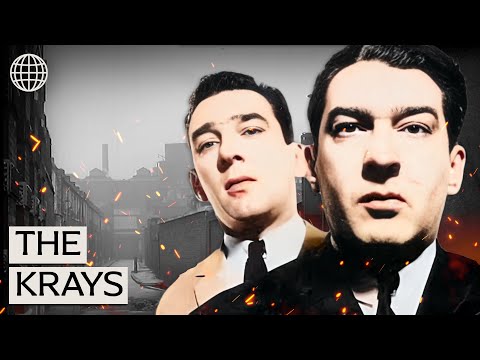
But if the Krays were so evil, why did the community put up with them for so long? The answer lies in the unique code of honor that governed the East End—a code that exposed the community to exploitation by professional criminals who turned it to their own advantage. In the East End, the law that was enforced was often the law of the Kray twins. They ran that part of London like an iron rod. “There was nothing that went on in that East End that they didn’t know about,” a local said. “If there was a wrongdoing, get off the manor, because they would come down on you like a ton of bricks.”
Their protection racket was different from the usual thuggery. People actually went to them, asking to be looked after. “Rather than pay three, four, five, ten bullies, it’s better to go and ask Ronnie and Reggie Kray, ‘Could you just appear for ten minutes or have one or two drinks in our pub on a Saturday night?'” Once it was known as a pub the Krays used, the publican didn’t have any more trouble. They only went into people who were breaking the law—those running illegal gambling or after-hours drinking. “No way could they ever go into straight people, because the first thing you do is pick the phone up, give me the police, and that was it.”
To take the heat off their activities, the Krays maintained an elaborate facade of public relations. They organized charity nights, getting others to donate money, then handing it over to the cameras and taking the glory. News of these up-and-coming charitable sportsmen hit Fleet Street, but to some crime reporters, the story didn’t quite add up. Norman Lucas of the Sunday Mirror sought to win the Krays’ confidence in search of the truth. He found the twins at their club, The Double R, where there was a constant flow of villains in and out. “It was then that I began to get my first suspicions that the Krays weren’t what they were pretending to be,” Lucas recalled.
But many patrons saw nothing disturbing. “Ronnie and Reggie were always the customer side of the bar with the customers. They were just socializing the whole time. You were never aware of any business going on whatsoever.” Yet, there was an atmosphere when the twins arrived—not fear, exactly, but something akin to awe. “If the Queen was to walk in, there would be a feeling that would arise.”
This royal progress might have continued unchecked but for Ronnie’s recurring bouts of mental instability. In 1958, he was committed to a mental hospital after attacking a man with a bayonet. Reggie invited Norman Lucas to accompany him on a visit. “Reggie went in to this mental hospital and I thought Reggie came out and we drove off in a bit of a hurry,” Lucas said. “I turned around to Reggie and said, ‘How was Ronnie?’ He said, ‘Well, I’m bloody Ronnie. Reggie’s in there now.’ And I thought, ‘Jesus, what have I got myself into?'”
The switch pulled off. Reggie walked free, but Ronnie was now a fugitive, and Lucas perhaps an accomplice. With Reggie at his elbow, Lucas called on contacts at the Home Office to negotiate a surrender deal for Ronnie with no penalties attached. “I came off the phone and Reggie said, ‘I wouldn’t have bloody believed it if I hadn’t been standing in the phone box.'” The job Lucas was really doing was penetrating the Kray Empire in order to expose them. It wasn’t easy, but following Ronnie’s release, the police were having even less success.
It was always difficult to mount an action against the Krays if you worked in the East End. “The story always was that whenever there was a serious crime in the East End, it was down to the Krays.” On two occasions, individuals were approached by the Krays to pay their rent, as they called it. If they didn’t, they got beaten up. One man’s perfume business was burnt down. “They got there by fear and the lack of evidence.”
In July 1964, Scotland Yard set up a special squad to investigate the Kray rackets. But even after Nipper Read had taken the twins into custody, key witnesses mysteriously withdrew their evidence, including one woman who had begged him to free her from the Krays. “She fell down on her knees and grasped my legs in her arms and said, ‘Thank God you’ve saved my life.'” But the next day, when the Krays appeared at court, this lady, now resplendent in furs and high-heeled shoes, was there saying, “Mr. Read, I’d like to stand bail for my good friends, the Kray twins.” And so Read’s first bid to jail the Krays collapsed.
With Ronnie and Reggie back on the streets, they seemed invincible. But crime reporter Norman Lucas had hit on a sensational story. Lord Boothby, a leading member of the House of Lords, had been caught up in a homosexual relationship with Ronnie Kray. “Ronnie didn’t hide the fact that he was a homosexual,” a source said. “He liked young boys, young men. There were writers, politicians like the famous ones like Boothby, Dryberg, and a few others.” Supposing Ronnie might fancy a showbiz star, he used to put out a W—a warrant. Anybody can get him back to the twins would get a payment, some sort of cash.
One night, in a well-known Chinese restaurant in the West End, Ronnie spied Cliff Richard sitting alone. “Who’s that?” he asked. “That’s Cliff Richard, an up-and-coming star,” someone said. “Oh, I’d like to meet him.” Straight away, there’s a W out. “If anyone can get him in to a meet, that’s all he’s got to do.” But Lucas thought, “This has gone far enough. I should write an expose news story.” He knew that once he’d done that, he was finished as far as the Krays were concerned. But it was a story that needed to be published so that no more titled people or prominent show business people should be caught up in their web.
The problem was the sexual revelation at the heart of the story. The newspaper was delighted with the scoop and wanted to run it. Lucas himself was not so sure. “We can run the story about their association with a peer, but we must not use the word homosexual because who are we going to call if Boothby sued? We’ll be sued for libel.” But Lucas was overruled. The newspaper’s lawyer, Philip Levy, worked out a formula to protect the Mirror from a libel action. “As long as you just say that Yard is probing a homosexual relationship between Ronald Kray and a peer, you will be safe, but don’t mention Lord Boothby’s name.”
The allegation was inserted into Lucas’s story. The Mirror went ahead and published. But then the walls came tumbling down. Boothby did the most cunning thing in the world. He wrote a letter to The Times saying, “Everybody says this is me.” And on that basis, he sued and got £46,000 damages, which, as Lucas learned just 48 hours later, he was forced to hand over to the Krays, who blackmailed him and said, “If you don’t, we will say this is a true story.”
Now the Kray twins seemed untouchable, but the old demons of paranoia returned to haunt Ronnie. The slightest squeak of opposition was enough to trigger the most extreme of responses. “With Ronnie, it was different. It was a bit more weird,” an associate said. “Other people’s violence, if he heard about it, he would get them to sit down and give it to him detail by detail. He got something out of it. He was definitely a Freddy Krueger type person. Ronnie would smash somebody. He would literally smash him with whatever he had in his hand. It didn’t matter if it was a hammer, a bayonet, or an axe. He would just slice somebody for the wrong word.”
One man with no respect was George Cornell, who had publicly ridiculed Ronnie for his sexual preferences. People warned him, “George, you want to be careful. You’re going over the top. Ronnie won’t stand for this. You know what he is—he’s a nutter.” But Cornell carried on. Even Ronnie said, “I don’t know who he thinks he is, that Cornell. He better not go too far with me.” In 1966, Cornell drove into the heart of Kray territory to take a very public drink in the Blind Beggar pub with his South London friend, Ali Woods.
It was a normal evening in the pub, with 32 people inside. Suddenly, the door burst open and Ronnie Kray walked in with another man. “I sensed someone stop a couple of feet before they reached me,” Ali Woods recalled. “I looked back at George. I noticed there was a gun pointing at George. George was really sneering at him. Ronnie drew from his pocket a Luger automatic gun and just pointed it at Cornell’s head and shot him straight through the forehead.” It was absolutely terrible. People were firing guns in your direction. All I had was a stool in front of me. What for? I don’t know. The stool wasn’t going to do any good. Within minutes, the bar was empty. George was moaning and groaning. I stood up, there was nothing I could do. I knew the ambulance was on its way, and I didn’t want to get involved, so I walked out.
There was really no motive. It was just a question of Ronnie trying to assert himself as a gang leader, to show that he was like the Americans, that he had his button, as they say, that he’d killed his man. He wanted to show his gang that he was really the colonel. He wanted the public to know that he was a gang leader. And so it was with this in mind that he was able to walk into the Blind Beggar with 32 other people inside, with no attempt to disguise himself, confident because of his ability as a gang leader that he could walk in there and know that no one would give evidence against him.
Charlie Kray was unaware of the shooting. A few hours later, he was summoned to meet Ronnie. “What’s up?” he asked. “Oh, I’ve just shot Cornell,” Ronnie replied. “What? In a pub? You’ve gone in a pub and shot someone? Do me a favor. You know what’ll happen now? They’ll have you by tomorrow.” Ronnie eluded the police, but it wasn’t long before they caught up with Ali Woods. “They said, ‘Now we want you to name who killed George Cornell.’ I said, ‘I don’t know who killed George Cornell. I never saw their face. It happened so quickly.'” And when the police tried to get witnesses, people said they didn’t see anything, they didn’t hear anything. It was as if the thing had never happened. The barmaid said she was downstairs in the cellars. There was this desperate situation where suddenly this dramatic event had taken place and nobody had seen anything.
But they kept trying and kept putting plenty of pressure on them. “With all the pressure and all what I was offered, no way could they win with me. I’d sooner be inside for the rest of me life than grass people up.” When I think about the Cornell case and all the problems, that was really the beginning of the worst problems I was ever going to have. When I knew what happened, when they told me, I thought I was just sick inside. I thought then that this is the beginning of the end.
Further evidence of Ronnie’s deteriorating condition was the extraordinary scheme to spring his old friend, Mad Axeman Frank Mitchell, from Dartmoor jail. Mitchell simply walked away from a work party and was picked up in a car. “You imagine if all the psychiatrists and screws can’t control this guy, what chance the twins got?” an associate said. They got him a girl from one of the clubs, but it soon became clear that Mitchell was more trouble alive than dead.
When he refused to go back, he became an encumbrance. “They told Mitchell that he was going to another house in Kent.” In the back of a van, the guns started popping. “He ain’t dead. Give him another one.” The last shot was fired behind his ear.
The police were now investigating the Krays’ involvement in at least three murders. At last, they had the evidence to mop up the firm. “The 34-year-old boxer twins Reginald and Ronald came here early this morning with Flying Squad officers.” One after another, former Kray associates broke the code of silence and turned Queen’s evidence.
Ronald and Reginald Kray were sentenced to life with a recommendation that they serve a minimum of 30 years. In the East End, there were mixed feelings. “I was very, very upset,” one local said. “In a lot of people’s eyes, they’ll still be known as two nice boys.”
But Norman Lucas had no such sympathy. “I had no scruples about using them and conning them as much as I could.” The Krays were finally behind bars—but were they born villains, or did fate shape them for the role? What do you think?
Report this article
Select a reason for reporting:






