The first grenade exploded inside a house on the rim of the cliff, and the German garrison on the Lucaberg knew instantly that something had gone terribly wrong. They had believed the sheer cliffs below them were impassable, especially at night. They had slept soundly, confident that the Americans—who always stopped fighting when the sun went down—would not come. But American soldiers were already among them, having scaled the western cliffs in total silence. Within seconds, chaos erupted across the German positions. Men stumbled from their bunks into a nightmare of explosions, screaming, and the flash of bayonets in the dark.
They could not see how many attackers had come. They could not tell which direction was safe. They only knew that the Americans, who never fought at night, had somehow appeared inside their perimeter like ghosts. Six hours later, when the fighting finally ceased, a radio message captured the scale of what had happened: “We have so many dead Germans in front of us that we cannot see to shoot.” The initial assault had cost just 13 American casualties against more than 200 Germans killed or captured. A captured German officer, pulled from the rubble of a shattered command post, could only shake his head in disbelief. “It is just plain unfair,” he said, “to fight at night.”
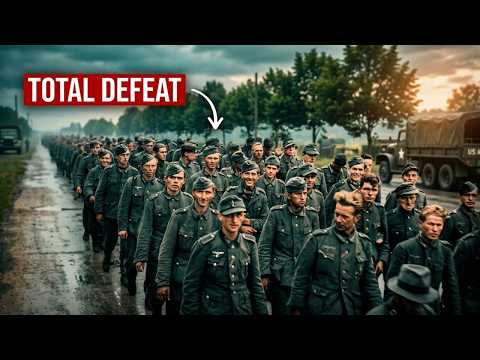
The men who scaled those cliffs belonged to the 104th Infantry Division of the United States Army. They called themselves the Timber Wolves. Their enemies would come to know them by a different reputation: the Americans who fought after dark. This is the story of what happened when American soldiers broke the unwritten rules of warfare and brought terror to German defenders in the hours after midnight. It is the story of how darkness—that ancient companion of fear—became a weapon more devastating than artillery. And it is told through the words of the German soldiers who faced it, men who thought they understood their enemy until the Americans stopped playing by the rules.
The 104th Infantry Division was activated on September 15, 1942, at Camp Adair in Oregon. From its first days, the division was different from every other unit in the United States Army. Its commander, Major General Terry de la Mesa Allen, had already earned a reputation as one of the most aggressive and unconventional officers in the service. He had led the First Infantry Division through the brutal fighting in North Africa and Sicily, where he learned lessons that would shape everything he did with the Timber Wolves.
Allen had seen what happened when American soldiers attacked entrenched German positions in daylight. He had watched his men get cut down by artillery registered on every approach, by machine guns sighted to cover every meter of open ground. He had buried too many soldiers who died because the enemy knew exactly when and where they would come. And he had noticed something else. At night, the Germans relaxed. At night, the killing stopped. Both sides seemed to accept an unspoken agreement that darkness meant rest.
Allen rejected that agreement entirely. He believed there was a better way to fight, and that better way was to attack when the enemy least expected it. He developed a training doctrine built around a single obsession: night attack. “Find them, fix them, and fight them. Take the high ground, inflict maximum damage to the enemy with minimum casualties to ourselves.” He repeated these words until they became the heartbeat of the division. While other American divisions trained 8 to 12 hours per week in darkness, Allen required his Timber Wolves to train 30 to 35 hours per week at night—three to four times the army standard.
His men learned to move through forests without making a sound. They practiced feeling their way through terrain that would be invisible in the blackness of a clouded night. They learned to communicate with hand signals, even when those hands could barely be seen. They learned to listen, to interpret the sounds of the darkness, to distinguish between the rustle of wind through trees and the movement of men through undergrowth. They practiced attacks using only bayonets and hand grenades, weapons that did not create muzzle flashes to reveal their positions.
Every rifle shot in darkness gave away the shooter’s location. Every tracer round drew a line straight back to its source. But a bayonet was silent. A grenade, once thrown, exploded without revealing who had thrown it. Allen’s men drilled until they could assault enemy positions in total darkness without a single shot fired until they were close enough to see the whites of German eyes. The training was brutal and exhausting. Men stumbled through obstacle courses they could not see. They navigated compass courses in terrain that looked completely different in darkness than in daylight. They learned that darkness was not their enemy. Darkness was their weapon.
General Omar Bradley, who would later command all American ground forces in Europe, assessed the results with characteristic bluntness: “Allen brought the only division I know of that was prepared for night combat.” The Timber Wolves arrived in France in October of 1944 and went into action almost immediately. They would spend 195 consecutive days on the front lines, fighting their way through some of the most heavily defended terrain in western Europe. And they would do much of that fighting in darkness, terrifying German defenders who had never faced anything like them.
To understand why American night attacks shocked the Germans so completely, you must first understand what the Germans expected from their enemy. Shortly after the Normandy landings, German intelligence identified a critical pattern in American combat behavior. “There was usually a lull in the fighting during the nights,” German army reports observed. “The Americans seldom continued to fight after the sun went down.” This was not mere observation. It was a vulnerability the Germans exploited ruthlessly.
Military historian Craig Chapman, a former United States Army infantry officer who spent years reviewing American unit journals from the war, confirmed what the Germans had discovered. “Only the Germans used the dark to launch attacks,” he wrote. “The Americans gave the night away.” German forces, pressed during the day by American infantry and pulverized from above by Allied aircraft, felt a huge sense of relief when darkness fell. They knew they had hours of safety ahead—hours to reorganize shattered units, to bring forward replacements, to carry ammunition and rations to the front lines using routes that would be swept by machine gun fire in daylight. They used darkness to dig new positions and reinforce old ones, to string wire and plant mines, to prepare the kill zones that would greet American attackers when the sun rose.
German commanders came to depend on this nightly respite. Their defensive plans assumed it. Their troop rotations required it. The entire rhythm of combat in the European theater was built around the understanding that when darkness fell, the fighting paused. General Günther Blumentritt, chief of staff to Field Marshal von Rundstedt at the German High Command in the west, captured the prevailing view with a single phrase: “Night is no man’s friend.” But what he meant was that night belonged to the Germans. The Americans had ceded it to them.
This failure to fight at night was rooted deep in American military doctrine. The official field manuals treated night attacks as exceptional operations requiring extensive preparation. Commanders were told they needed detailed reconnaissance of enemy positions—reconnaissance that could not be conducted in the same darkness that would cover the attack. They needed special training for the troops, training that most divisions never received. They needed dedicated rehearsals on similar terrain, rehearsals that took time divisions in combat did not have. The doctrine emphasized the difficulties of night operations but seldom mentioned the potential benefits. It treated darkness as a complication to be managed rather than an opportunity to be exploited.
Combat commanders, already exhausted from planning and supervising daytime attacks, lacked the energy and time to add nighttime operations to their burden. They had enough challenges coordinating infantry, artillery, tanks, and aircraft in daylight. The thought of doing all that in darkness, with limited communications and no visibility, seemed overwhelming. A 1944 directive from European Theater Headquarters reinforced this reluctance, recommending night operations only for special purposes. The message was clear: night attacks were risky, difficult, and not worth the trouble unless there was no other choice.
The result was predictable. American infantry attacked when the sun was up and rested when the sun went down. They followed the doctrine. They avoided the risk. And the Germans, who faced this pattern day after day, week after week, month after month, came to depend upon it. They built their entire defensive strategy around the certainty that when darkness fell, they would have time to recover. On the other side of the lines, German soldiers settling into their positions for the night felt the tension drain from their bodies. They posted sentries, of course. They maintained some level of alertness. But they knew from hard experience that the Americans would not come until morning. They could sleep. They could eat. They could write letters home by candlelight in their bunkers. The night was theirs.
This made the shock even greater when American soldiers suddenly appeared in their midst at 3:00 in the morning, bayonets fixed and grenades in hand. The Germans understood the psychology of night combat better than most. After the war, a group of former German generals and General Staff officers wrote a comprehensive study of night operations for the United States Army Historical Division. Their assessment of darkness as a psychological weapon was unambiguous. “Darkness acts as a strong stimulus to the imagination and thus burdens the nervous system,” they wrote. “A feeling of insecurity, which might eventually lead to panic, may be the outcome.”
The German officers explained how perception itself warps in darkness. “The sensitivity of eyes and ears differs between night and day, with the result that in darkness objects seem bigger and distance is greater. The ears exaggerate sounds that would hardly be perceptible during the day.” This perceptual distortion amplified the terror of night attacks. Defenders could not gauge enemy strength, direction, or distance. Every rustle in the darkness might be a single scout or an entire battalion.
On the disproportionate psychological damage inflicted by night defeats, the German officers were explicit: “A reverse or defeat suffered at night has a more lasting effect on the troops’ morale than one suffered during the day.” They noted that night attack created a fundamental asymmetry favoring the attacker. “At night, even more so than by day, he who takes the initiative has the advantage.” Complete surprise in darkness could produce, in their words, “complete stoppage of every movement, disruption of the chain of command, and panic.”
These were not abstract theories. These were lessons written in blood on the Eastern Front, where Soviet commanders like General Vasily Chuikov deliberately adopted night fighting to negate German advantages in combined arms warfare. At Stalingrad, Chuikov claimed that Wehrmacht soldiers experienced panic fear of close combat and night combat. The Germans disputed this characterization, but they could not dispute the effectiveness of Soviet night operations in the rubble of that destroyed city.
Yet somehow, the German officers who wrote this study admitted that their own pre-war doctrine had been inadequate. “The reader of the pre-war German Army Operations Manual,” they noted, “upon reaching the chapter heading night combat, found that the subject was covered very succinctly and somewhat superficially. The contents failed to reveal the tremendous importance that night combat and night movements were to assume in modern warfare.” If the Germans had underestimated night combat in their own doctrine, they had also underestimated the Americans who would eventually master it.
November 22nd, 1944. The city of Eschweiler, deep inside Germany. The Timberwolves had been in combat for barely three weeks, but they had already established a pattern that terrified German defenders in their sector. At 0300 hours, two companies of the 415th Infantry launched a pre-dawn assault on the city. Engineers cleared mines and booby traps in complete darkness as the infantry pushed forward. The Germans had fortified the city extensively. They expected any American attack to come in daylight, preceded by massive artillery barrages and supported by tanks. They expected the kind of methodical assault they had faced a hundred times before.
Instead, American soldiers were inside the city before the Germans fully understood what was happening. Within four hours, the Timberwolves had reached the heart of Eschweiler. Within five hours, they had blazed through entirely. The wartime account recorded the German reaction: “It was an incredible performance, moving through a staunchly defended German town and seizing it from a nonplussed enemy who had yet to learn how to deal with these Timberwolves who fought by night.” Simultaneously, troops who had infiltrated into the city center before dawn raised hell inside German lines at sunrise, while the main force attacked from outside. The defenders found themselves caught between two American forces, one already among them and one crashing through their outer defenses. After that single day of fighting, the city was in American hands.
The prisoners brought in for interrogation were bewildered. They continuously asked about the “automatic artillery” the Americans had used. They had never experienced such speed and volume of coordinated nighttime fire. They believed the Americans must possess some form of automated weapon system. They could not comprehend that the devastation had been inflicted by ordinary infantry and artillery working in perfect coordination in the dark. The Timberwolves were just getting started.
The battle at Lucaberg on December 2nd and 3rd became one of the most dramatic night operations of the entire war. Company 1 of the 3rd Battalion, 415th Infantry, led by Lieutenant John J. Olsen, did exactly what the Germans believed impossible. Moving in complete silence, the Americans scaled the western cliffs in pitch darkness while the German garrison slept above them.
When the Germans counterattacked furiously, Olsen made a decision unthinkable in daylight. He radioed his own position and called artillery fire on himself. Six hours of brutal fighting followed. The final tally showed only 13 American casualties against more than 200 Germans killed or captured.
Sergeant George Burns even destroyed a Tiger tank with his bazooka from just 20 feet away. The captured German officer could only shake his head. “It is just plain unfair,” he said, “to fight at night.”
Over 195 days of continuous combat, the Timber Wolves captured 51,724 German prisoners while suffering roughly 6,000 casualties of their own. They cleared 8,000 square miles of enemy-held territory.
General Blumentritt had said, “Night is no man’s friend.” The Timberwolves proved him wrong. For the soldiers who learned to fight after sunset, darkness became the best friend they had.
But the question that haunts this history remains: how many American lives might have been saved if every division had trained for the night? What do you think—was Terry Allen’s obsession with darkness the war’s most underrated tactical innovation?
Report this article
Select a reason for reporting:






