The trenches of World War I were a crucible of innovation and desperation. As the war dragged into its final years, German scientists raced to find any advantage that could break the deadly stalemate. One such scientist, a man named Schwart, believed he had found the answer: a helmet equipped with horns. But these were no Viking decorations—they were a desperate attempt to save lives. Yet, in a cruel twist of fate, the very feature meant to protect would become a death sentence.
In the muddy, blood-soaked battlefields of the Western Front, every soldier knew the terrifying sound of artillery shells and the deadly whistle of bullets. The standard steel helmets offered some protection, but head wounds remained a leading cause of death. Schwart, determined to change that, designed a helmet with two horns protruding from the sides. Inside these horns were through-holes for ventilation, but their main purpose was far more sinister: they served as mounts for an additional armored steel plate. “The developer wanted to make a bulletproof helmet,” and he succeeded—at least on paper.
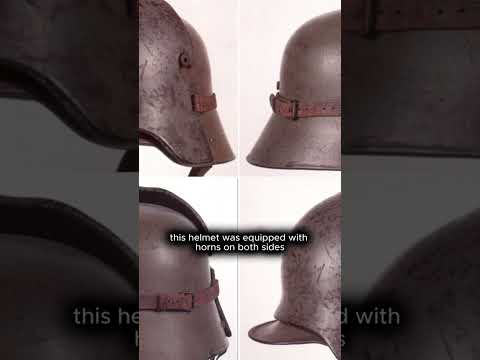
Due to wartime shortages, the new helmet was initially issued only to frontline units. But within a year, every soldier had one. The horns, however, made the helmet cumbersome and heavy. Soldiers grumbled about the extra weight, but orders were orders. What they didn’t know was that the design had a fatal flaw. “A man, unlike the helmet, could not withstand a direct shot,” the transcript reveals. The impact would break the cervical vertebrae, killing the soldier instantly. The very contraption meant to save lives had become a death trap.
Enemy soldiers, unaware of the grim reality, joked that the Germans had horns with through-holes so they could put their wives in them—a mocking reference to the soldiers’ longing for home. The taunts stung, but the Germans had little time for pride. The helmet was produced for years, a testament to human ingenuity and folly. As the war raged on, Schwart’s invention would become a symbol of desperate innovation, a cautionary tale of good intentions gone horribly wrong.
But the story doesn’t end there. The horned helmet would leave a legacy that extended far beyond the trenches of World War I. Its design would influence future armor, and its failure would teach engineers a harsh lesson: sometimes, the quest for protection can lead to unintended consequences. As we delve deeper into this strange chapter of history, we’ll uncover the full story of Schwart’s helmet—and the men who wore it.
The first reports from the field were troubling. Soldiers wearing the new helmet began suffering a strange pattern of injuries: broken necks, fractured spines, and instant deaths that seemed out of proportion to the blasts they had endured. Medical officers were baffled. “The helmet stopped the bullet,” one surgeon noted grimly, “but it snapped the man’s neck like a twig.” The armored plate, mounted on the horns, absorbed the impact of a direct hit—but the kinetic energy had to go somewhere. It traveled straight down the spine.
Schwart was summoned to a military hospital to witness the consequences of his invention firsthand. He watched as a young lieutenant, barely twenty years old, was brought in with a shattered vertebra. The boy would never walk again. The scientist returned to his workshop in silence, staring at the blueprints that had once filled him with pride. “I wanted to save them,” he whispered to a colleague. “Instead, I have condemned them.”
But the German High Command was not ready to abandon the helmet. Production continued, and the horns became a common sight in the trenches. Soldiers began to modify their helmets in secret, removing the horns or stuffing them with cloth to reduce the deadly torque. Some even refused to wear the new model, risking court-martial rather than trust their lives to a design that seemed cursed.
Meanwhile, enemy propagandists seized on the helmet as a symbol of German foolishness. British and French newspapers published cartoons of bumbling Huns with horns, tripping over their own feet. “They put horns on their heads to look like devils,” one French sergeant wrote home, “but they only succeed in looking like fools.” The mockery stung, but the real damage was to morale. German soldiers, already weary from years of war, began to see the helmet as a bad omen.
By the spring of 1918, with the German army preparing for its final great offensive, the flaws in Schwart’s design could no longer be ignored. Reports of neck injuries among frontline troops had reached alarming levels. A quiet order went out: the horns were to be removed from all helmets in active combat zones. The additional armor plates were discarded, and the through-holes were plugged with metal. The helmet was, in effect, reverted to a standard design—but the damage had been done.
Schwart himself faded into obscurity. Some say he was reassigned to a minor research post; others claim he took his own life, unable to bear the guilt. Whatever the truth, his name became a cautionary tale among military engineers. “Remember Schwart,” instructors would say, “and ask yourself: does your invention protect the man, or does it protect only the part you can see?”
Yet the story of the horned helmet had one more twist. As the war drew to a close and the German army collapsed, thousands of these helmets were left on the battlefields. They were collected by scavengers, sold as souvenirs, and displayed in museums. And in the decades that followed, a new generation of soldiers would look at them and wonder: how could anyone have thought this was a good idea?
The answer, as it turned out, was buried in the archives of a small technical institute in Berlin. In the 1920s, a former assistant of Schwart’s named Engel published a modest paper on helmet ergonomics. He revealed that the horns were never meant to be worn in combat at all. “The original design called for a removable armored plate,” Engel wrote, “intended for stationary sentries and machine-gun crews, men who did not charge across open ground.” The plate was to be clipped on only during prolonged bombardments, then taken off before an advance.
But the High Command, desperate for any edge, had ignored the instructions. They ordered the horns welded permanently in place and the plates issued to every soldier. A limited defensive tool had been turned into a universal burden. The distinction was lost in the fog of war, and men paid for it with their lives.
Engel’s paper also contained a detail that historians would later find chilling. He included a sketch of the helmet’s interior, showing a thin leather pad that was supposed to cushion the neck against exactly the kind of impact that had killed so many. “This pad was omitted from production,” Engel noted dryly, “to save leather.” A few grams of hide, sacrificed for the war effort, might have spared hundreds of spines. No one had thought to ask what the pad was for.
When the paper surfaced decades later, it ignited a fierce debate among collectors and historians. Some argued that Schwart was a victim of circumstance, a good engineer undone by military bureaucracy. Others insisted he should have fought harder against the modifications. “A designer who does not defend his own warnings,” one critic wrote, “is as guilty as the general who ignores them.”
The horned helmets themselves became relics of a peculiar kind. Unlike other war memorabilia, they carried a whiff of dark comedy. Museums displayed them with apologetic captions. Veterans, when asked about them, would shake their heads and mutter about the things men do when they are afraid. And in the quiet of the archive, Engel’s paper sat unread for years, a small correction to a very large mistake.
But there was one more thread to pull. In the 1930s, as Germany rearmed, a young officer named Brandt was assigned to review the lessons of the last war. He read Engel’s paper and, to his credit, took it seriously. The new German helmets of the next war would be sleek, hornless, and carefully tested. “We learned from Schwart,” Brandt wrote in a private memo. “We learned that protection must never become a trap.” The ghost of the horned helmet, it seemed, had finally taught its lesson—though the world would soon discover that other lessons from that war had been learned far less well.
Brandt’s memo might have closed the file, but history rarely closes so neatly. In 1943, an American ordnance officer named Whitaker, stationed in North Africa, received a captured German helmet from a battlefield near Kasserine Pass. It was plain, hornless—and yet he noticed something odd: a faint ring of weld marks on each side, as if something had been removed. He sent it to a lab in London, where a metallurgist recognized the pattern instantly. “These are mounting points,” he wrote back. “Someone was experimenting with side plates again.”
The trail led to a forgotten SS workshop in Bavaria, where engineers had quietly revived Schwart’s idea—this time with spring-loaded brackets designed to shear off on impact. The war ended before the design saw wide use, and the prototypes vanished into the chaos of 1945. But the lesson had not been fully learned; it had merely gone underground, waiting for someone else to rediscover it.
Today, a handful of these horned helmets sit behind glass in small museums, their horns polished by time. Visitors often laugh at first—they look like props from a comic opera. Then they read the placard, and the laughter dies. “The helmet stopped the bullet,” the caption reads. “But it broke the man.” A simple sentence, yet it carries the weight of every soldier who trusted a design that betrayed him.
Schwart’s name appears in few textbooks. Engel’s paper gathers dust. Brandt’s memo is a footnote. But the horned helmet endures as a warning, strange and silent: that good intentions, rushed into production, can kill as surely as any bullet. And that the gap between what an inventor intends and what a general orders is sometimes measured in human spines.
So the next time you see a horned helmet in a museum case, look closely at the horns. Ask yourself what they were really for—and who paid the price for the answer. What do you think: was Schwart a victim, a fool, or something in between? Tell us in the comments below.
Report this article
Select a reason for reporting:






