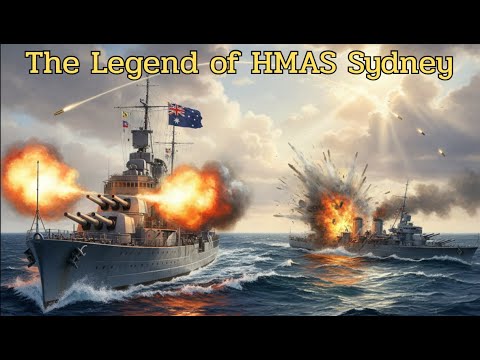
The Mediterranean in 1940 was a deadly chessboard where empires collided. Benito Mussolini, driven by dreams of a new Roman Empire, aimed to turn these waters into an Italian lake, deploying the fastest cruisers in the world to sever Allied lifelines. But when Italian arrogance met Australian discipline, the result was a clash that defied all expectations. This is the story of how a single ship from a young nation half a world away challenged the myth of Italian speed and rewrote the rules of naval warfare in the shadow of Cape Spada.
By July 1940, the azure waters of the Mediterranean had become a high-stakes theater of war. Mussolini famously called the sea Mare Nostrum—Our Sea—signaling his intent to dominate every shipping lane from Gibraltar to Suez. For the Italian Royal Navy, the Regia Marina, the start of World War II was a moment of supreme confidence. They possessed a fleet of elegant designs and unparalleled speed. The centerpiece: the Condottieri-class light cruisers, engineered to outrun any opponent they could not outgun. With speeds exceeding 40 knots, Italian leadership believed they held the ultimate advantage. They intended to use this speed to intercept Allied convoys, severing the vital arteries that kept the British Empire alive in North Africa and the Middle East.
To the planners in Rome, the Mediterranean was a private Italian lake where Allied ships would be hunted down by the fastest predators afloat. However, the arrogance of the fascist leadership overlooked a critical factor. While their ships were fast and visually magnificent, they were often lightly armored to save weight for those powerful engines. This design philosophy created a glass jaw that could be shattered by a determined and accurate opponent. The stage was being set for a confrontation that would test whether Italian speed could overcome the seasoned professional skills of a combined Allied force.
This clash, which history would record as the Battle of Cape Spada, began as a routine mission for both sides but quickly escalated into a definitive test of naval doctrine. At the center of the Allied response was a ship from a distant continent: HMAS Sydney, a Leander-class light cruiser of the Royal Australian Navy. Built for endurance and precision rather than record-breaking sprints, the Sydney and its crew represented the quiet confidence of the Australian military tradition. Under the command of Captain John Collins, they operated in the Mediterranean to support the British Mediterranean Fleet, yet maintained a distinct national identity. For the Australians, the Mediterranean was not a playground for Imperial dreams, but a battlefield where discipline and accuracy were the only currency that mattered.
As Mussolini’s fast cruisers prepared to sweep the sea of its enemies, they were unaware that they were about to sail into a trap set by an opponent who valued the cold reality of marksmanship over the flash of a high-speed hull. The chessboard was ready, and the first move was about to be made off the rugged coast of Crete.
The dawn broke over the Aegean Sea. Four British destroyers—HMS Hyperion, Ilex, Hero, and Hasty—were conducting a routine anti-submarine patrol in the Antikythera Strait. This small flotilla was far from its main base and seemingly isolated in the vast Mediterranean. However, unknown to the British crews, two Italian light cruisers were steaming toward them at high speed. These were the Bartolomeo Colleoni and the Bande Nere, two of the fastest ships in the Italian fleet. Commanded by Rear Admiral Ferdinando Casardi, the Italian squadron had been dispatched from Tripoli to intercept Allied shipping and establish Italian dominance in the waters surrounding Crete.
When the two forces sighted each other at approximately 07:20 a.m., the tactical situation appeared heavily skewed in favor of the Italians. The Italian light cruisers possessed significantly larger guns and higher speeds than the small British destroyers. To the Italian commanders, the four destroyers looked like easy prey, a minor obstacle to be brushed aside by the superior firepower of the Regia Marina. As the first Italian shells began to splash into the water, the British destroyers immediately turned away to the northeast. This maneuver looked like a desperate flight for survival, but it was in fact a masterfully executed tactical retreat. The British captains were following a prearranged plan to lure the Italian cruisers into a specific area where a much more formidable force was waiting.
Captain John Collins on HMAS Sydney, along with the destroyer HMS Havoc, was positioned roughly 40 miles to the north. As the four British destroyers fled, they maintained a precise course that drew the Italian pursuers deeper into the trap. The Italians, eager to secure a quick and glorious victory, increased their speed to close the distance. They were so focused on the retreating destroyers that they failed to realize they were being led directly toward a predator lurking just over the horizon.
Throughout this pursuit, the tension grew as the distance between the Italian guns and the British destroyers remained dangerously close. The Italian cruisers were pushing their engines to the limit, their sleek hulls slicing through the waves as they chased what they believed to be a retreating enemy. Admiral Casardi felt confident that his superior speed would soon bring him within decisive range. Little did he know that the Australian cruiser Sydney was already closing in from the north at full speed. By maintaining the pursuit, the Italians were inadvertently cutting off their own path of escape and walking into a pincer movement. The British destroyers had played their part perfectly, acting as the irresistible bait that would soon bring the fastest cruisers of Mussolini into the deadly sights of the Australian gunners.
The stage was now set for the most dramatic intervention of the early naval war in the Mediterranean. As the Italian cruisers Bartolomeo Colleoni and Bande Nere continued their aggressive pursuit of the British destroyers, they remained blissfully unaware of the catastrophe approaching from their flank. The Australian light cruiser HMAS Sydney was racing southward at top speed, yet it remained invisible to Italian eyes and ears. This was not a result of luck, but of a brilliant tactical decision by Captain John Collins. He had ordered his ship to maintain absolute radio silence and had deactivated all signal-emitting equipment. By refusing to broadcast any messages, the Sydney effectively disappeared from the electronic landscape of the Mediterranean.
While the Italians relied on their superior speed to hunt the British destroyers, they neglected to account for a hidden adversary approaching from an unexpected direction. Captain Collins understood that the element of surprise was his greatest weapon against ships that could easily outrun him in a fair chase. By approaching from the north under a veil of silence, the Sydney became a ghost ship moving through the waves without a whisper of its presence reaching the Italian Admiral Casardi. The Italian crews were so preoccupied with the targets in front of them that they failed to scan the northern horizon for new threats.
The technical contrast between the opposing forces was stark. The Italian Condottieri-class cruisers were designed for the glamour of speed, reaching up to 40 knots. They were beautiful machines of war, but their thin armor made them vulnerable to sustained fire. HMAS Sydney was a different kind of predator. It was a Leander-class light cruiser built for durability and steady performance. It did not possess the flashy speed of the Italians, but it carried a crew of some of the most highly trained and disciplined gunners in the world. The Australians had spent countless hours perfecting their marksmanship, and they were ready to prove that precision was more valuable than velocity.
The moment of realization for the Italian fleet was sudden and terrifying. At 08:29 a.m., the silence was shattered not by a radio signal, but by the thunderous roar of Sydney’s 6-inch guns. The first salvos fell from the sky like a hammer blow, the massive splashes of water appearing remarkably close to the Italian hulls. The Italians were stunned to find a fresh cruiser suddenly blocking their path and cutting off their retreat. They had expected an easy hunt of small destroyers, but they were now facing a determined Australian warship that had appeared as if from nowhere. The ghost from the north had arrived, and the Italians found themselves caught in a deadly pincer movement. Their pride in their speed was about to be tested by the cold and calculated reality of Australian naval power.
The arrival of HMAS Sydney changed the nature of the engagement from a pursuit into a fierce artillery duel. However, this was not a battle fought at close quarters. Captain John Collins ordered his gunners to open fire at a staggering distance of approximately 18,000 to 20,000 yards. At this extreme range, the ships on the horizon appeared as little more than tiny gray specks against the vast blue of the Mediterranean. To hit a moving target from such a distance while both vessels were traveling at high speeds required a level of mathematical precision and steady nerves that only the most elite crews possessed.
The Australian gunners proved they were up to the challenge. While the Italian ships Bartolomeo Colleoni and Bande Nere possessed a significant advantage in raw speed, that very speed became a liability during the exchange of fire. As the Italian cruisers pushed their engines to their limits to maneuver, the extreme vibrations and the frantic rocking of their narrow, lightly built hulls made accurate range finding nearly impossible for their crews. The Italian return fire was rapid but scattered, with shells falling harmlessly into the sea far from the Australian cruiser. The Italian philosophy of prioritizing speed over stability was failing them in the one moment where accuracy mattered most.
In contrast, the crew of the Sydney remained remarkably calm and methodical. The Australian gunnery officers utilized their optical rangefinders with chilling efficiency, compensating for the wind and the movement of the sea. Despite the intense heat and the deafening roar of the 6-inch turrets, the rhythm of the Sydney remained steady and cold. The ship acted as a stable platform for its guns, and the Australian shells began to straddle the Italian targets with terrifying consistency. This was a salutation of fire that announced the arrival of a world-class naval power from the Southern Hemisphere.
The psychological impact of this long-range bombardment was profound. The Italian sailors who had expected to be the hunters suddenly found themselves under an accurate and relentless barrage from an enemy they could barely see. Every few seconds the horizon would flash, and another set of shells would scream through the air toward them. The Australians were not merely firing at the Italians; they were conducting a master class in naval gunnery. This phase of the Battle of Cape Spada demonstrated that in the modern era of naval warfare, the ability to strike first and strike accurately from a distance was far more important than the ability to run fast. As the Sydney closed the range slightly, the precision of its fire only increased, preparing the way for a decisive blow that would change the course of the battle forever.
As the duel intensified, the relentless accuracy of the Australian gunners began to take a heavy toll. At approximately 9:23 a.m., one of Sydney’s 6-inch shells found its mark with devastating consequences. The projectile tore through the thin armor of the Bartolomeo Colleoni, striking the forward boiler room and engine compartment. The ship that had been hailed as the fastest cruiser in the world was suddenly transformed into a helpless, stationary mass of steel.
For the crew of the Colleoni, the very speed they had relied upon for protection had vanished in a single minute of fire. Captain Collins did not allow his crew to hesitate. The Australian shells systematically dismantled the upper works of the crippled cruiser. At 09:59 a.m., the pride of the Regia Marina rolled over and began its final journey to the bottom of the Mediterranean.
Its sister ship, the Bande Nere, was left to face the full fury of the Australian cruiser. Rather than closing the distance, Admiral Casardi made the immediate decision to withdraw. The pride of the Italian navy was literally running for its life, zigzagging across the water as it headed for safety. The Sydney chased the Bande Nere for miles, its guns continuing to bark until the Australian cruiser ran out of ammunition.
The results were staggering. One of Mussolini’s finest cruisers lay at the bottom of the sea, while the other limped home in disgrace. On the Australian side, the victory was nearly bloodless—only a single minor injury among its crew. The news sent shockwaves through Rome and sparked a wave of unprecedented national pride in Australia.
The Battle of Cape Spada proved that the Mediterranean was far from an Italian lake. Captain John Collins became a national hero, embodying the calm and professional spirit of the Australian military. The name HMAS Sydney was etched into naval history—a permanent reminder that a well-trained hand will always defeat a fast but poorly guided piece.
What do you think was the single most decisive factor in this David-and-Goliath naval clash—the Australian gunnery, the Italian design flaws, or the element of surprise? Share your thoughts in the comments below.
Report this article
Select a reason for reporting:






