The sky over Germany was a graveyard, and the American bombers were dying. In the fall of 1943, daylight raids into the heart of the Third Reich were costing the U.S. Army Air Forces dozens of aircraft and hundreds of men per mission. German fighters, waiting until the escorting P-47 Thunderbolts reached the limit of their fuel range, would swoop in and tear the unprotected bombers to shreds. It was a slaughter that threatened to derail the entire Allied bombing campaign.
Something had to change. A fighter was needed that could fly all the way to Berlin and back—a true long-range escort. The answer, surprisingly, came from a rejected design that had been sitting on a drawing board in America.
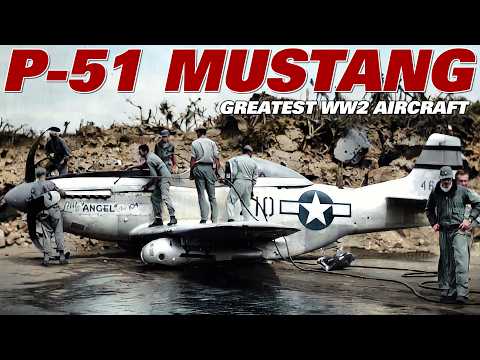
In 1940, the British Royal Air Force, desperate for fighters to counter the Luftwaffe, approached North American Aviation with a proposal. They wanted a new fighter, and they wanted it fast. In just 117 days, the company rolled out the NA-73X, a sleek, streamlined machine powered by an Allison engine. It was fast at low altitude and had exceptional range, but it performed poorly above 15,000 feet. The RAF ordered 620 of them, naming the new fighter “Mustang.”
For a while, the Mustang excelled as a low-level ground-attack aircraft. But the Americans, focused on the Pacific and still neutral, showed little interest. Then came Pearl Harbor, and everything changed.
By 1943, the need for a long-range escort was undeniable. The P-47 Thunderbolt, while a rugged and powerful fighter, gulped fuel at an alarming rate. Its range could be extended with drop tanks, but it still couldn’t reach Berlin. The bombers were on their own over the most heavily defended airspace in the world, and the losses were catastrophic. In one week of October 1943, 148 bombers and 1,500 airmen failed to return.
Desperation led to innovation. A team of engineers at Rolls-Royce in Britain had an idea: what if they replaced the Mustang’s Allison engine with the superb Merlin engine, the same one that powered the Spitfire? The Merlin was efficient at high altitude, and the result was immediate and dramatic. The Mustang’s performance was transformed. It could now outrun, outclimb, and outturn anything the Germans had.
The U.S. Army Air Forces quickly placed massive orders. The new P-51B, powered by a Packard-built Merlin, was rushed into service. It was the answer to a prayer. With its range, speed, and firepower, the Mustang could finally escort bombers all the way to Berlin and back. The tide of the air war was about to turn.
But the Mustang wasn’t finished evolving. In May 1944, the definitive version arrived: the P-51D. It featured a new bubble canopy that gave pilots unparalleled visibility, and a redesigned low-back fuselage. It was a thoroughbred, the undisputed champion of the Allied fighter stable. Pilots fell in love with it. It responded to their every command, becoming an extension of their bodies. “It was like I was part of the airplane,” one pilot recalled. “It was like I was flying.”
As the Mustang pilots grew more confident, they began to take the fight to the enemy. The Luftwaffe, once the terror of the skies, was now on the defensive. The young American pilots, many of them fresh out of training, learned quickly. They had to. The price of failure was death.
And so, the stage was set for the decisive battles over Germany—battles that would determine the outcome of the war in the air. The Mustang was ready. The pilots were ready. The only question was: who would prevail?
The first time a young Mustang pilot saw a German fighter explode under his guns, the reaction wasn’t triumph—it was nausea. “I was scared to death,” one of them admitted. “Anybody who says he wasn’t scared to death is a liar.” The bravado of the training field evaporated the moment a Focke-Wulf 190 flashed past the canopy, guns blazing.
But fear was a teacher, and the Mustang was a forgiving one. Its controls were so beautifully harmonized that pilots swore they only had to think about turning left and the plane would obey. “You’d roll your eyes to the left, and that’s all you needed,” a veteran remembered. “I was part of the airplane.”
The men who flew it were not superhuman. They were twenty-year-old kids from Iowa and Texas and Brooklyn, strapped into a machine that felt like a living thing. They played chess in the barracks between missions, convinced the unfinished game was the reason both players would come back. They named their planes after sweethearts and movie characters, and they tried not to think about the empty bunks.
On the ground, a different kind of bond formed. “The airplane belonged to the crew chief, not the pilot,” one mechanic insisted, still arguing the point fifty-five years later. “You fly it only because I let you.” The crew chiefs treated their Mustangs like daughters, inspecting every rivet, polishing every panel, and glaring at pilots who dared bring one back with a scratch.
But once the pilot climbed in and the harness locked tight, the plane changed hands. “It wasn’t his airplane anymore,” a pilot said. “It was mine.” With a thousand horsepower roaring in front of him, he was no longer a boy from Ohio. He was a weapon.
And the weapon was about to be unleashed in a way the Luftwaffe had never seen. The Mustangs had the range to go anywhere, and the pilots had the aggression to match. The Germans had learned to wait for the Thunderbolts to turn back. Now, there was no turning back.
The first time the Luftwaffe pilots saw the Mustangs still on their wing over Berlin, they knew something had changed. The hunters had become the hunted. And the men in the bubble canopies, bored and cold at 25,000 feet, were about to discover that the most dangerous moment of a long escort mission was the one they had been waiting for.
The radio crackled with a warning, and the boredom vanished in an instant. “Drop tanks! Drop tanks!” The order came sharp and urgent. The Mustangs shed their external fuel tanks and dove into the fight, engines screaming. Below them, the German fighters had already begun their attack on the bomber stream, and the sky was suddenly full of twisting aircraft.
The first pass was always the most chaotic. A pilot would spot a Focke-Wulf or a Bf 109, dive on it, and fire a burst from the six .50-caliber guns. “You don’t think about the next move,” one pilot said. “At 400 miles an hour, you’re covering 600 feet a second. A tenth of a second means sixty feet. You just do it.” The trick, the veterans taught the newcomers, was to sneak up behind an enemy who never saw you coming.
But the Germans were not easy prey. The Luftwaffe pilots who remained were the best of the best—veterans with hundreds of missions, men who knew every trick. When a Mustang dove on them, they broke hard, forcing the American to overshoot or risk a collision. The fights became a blur of split-second decisions, of blackout turns and desperate dives.
One young pilot found himself alone, separated from his flight, when a Bf 109 dropped out of the sun and opened fire. Twenty-millimeter cannon shells exploded around his cockpit, and he felt the Mustang shudder. He slammed the stick left and kicked the rudder, throwing the fighter into a violent corkscrew. The German overshot, and for a moment the two planes flew side by side, close enough that the American could see the pilot’s face.
Then the fight was on again. They chased each other down through the clouds, the German trying to escape, the American refusing to let go. The German dove for the deck, hoping to lose his pursuer in the hills and valleys, but the Mustang stayed on his tail. At 400 miles an hour, just above the treetops, there was no room for error. The German made one mistake—a fraction of a second too slow to pull up—and his wingtip clipped the ground. The fighter cartwheeled into a field and exploded.
The American pulled up hard, his heart pounding, and looked back at the burning wreck. “Then you realize these people are just like me,” he said later. “You know, he was a fighter pilot and so was I.” It was a moment of strange kinship, gone almost as soon as it came. There was no time to think, no time to feel. The radio crackled again, and he climbed back into the fight.
By the spring of 1945, the Luftwaffe was broken. The Mustangs ranged freely over Germany, hunting trains, trucks, and anything else that moved. On April 16, 1945, Mustang pilots destroyed more than 700 German aircraft, most of them on the ground. The once-proud air force of the Third Reich had been reduced to a scattering of poorly trained boys and obsolete machines.
And the men who had flown the Mustang through it all began to understand what they had accomplished. “I don’t hate the Germans,” one pilot said. “I hated the son of a bitch. It solved a lot of my problems.” It was not a noble sentiment, but it was an honest one. They had fought for their country, for their buddies, and for the simple reason that the alternative was unthinkable.
When the war in Europe ended in May 1945, the Mustang was still in the fight, now deployed to the Pacific. But the days of its greatest glory—the long escort missions over Germany—were over. The pilots who had flown it would carry those memories for the rest of their lives. “You never forget it,” one of them said. “I dream about the missions to this day.”
The Mustang had done its job. It had protected the bombers, broken the Luftwaffe, and helped win the war. But for the men who flew it, it was more than a machine. It was a friend, a partner, a part of themselves. And in the quiet moments, when the roar of the Merlin faded and the sky was still, they remembered the ones who hadn’t come home.
In the decades that followed, the Mustang became a legend. But for the men who flew it, the memories were not of statistics or victories—they were of the cold, the fear, and the bond with a machine that felt alive. “I had the time of my life,” one veteran said, his voice cracking. “I was twenty years old, and they gave me this big, beautiful airplane.”
They had fought for democracy, for their buddies, and for the simple reason that the alternative was unthinkable. “We were all committed to winning,” another recalled. “Sacrificing our lives if necessary. There was no doubt about that.” And when the war ended, they went home, built families, and tried to forget. But the sky never left them.
The P-51 Mustang was more than a fighter. It was a symbol of what could be achieved when nations combined their genius and their courage. It was the machine that turned the tide, the angel that guarded the bombers, the horse that carried young men into legend.
And as the last of those pilots fade into history, their stories remain—echoes of a time when the fate of the world depended on a few brave souls and the silver wings that carried them. What would you have done, strapped into that cockpit at 25,000 feet, with the fate of the free world riding on your shoulders?
Report this article
Select a reason for reporting:






