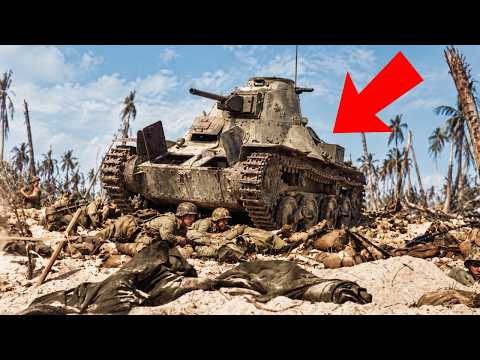
At 7 a.m. on May 29, 1944, four Japanese tanks rumbled up a coral coast road on a tiny island few Americans could find on a map. They were heading straight for a battalion of Oregon National Guardsmen—kids who had been soldiers for less than four years. Each Japanese tank weighed about 7.5 tons. What waited for them on that road weighed 30. The last time the U.S. Army had faced Japanese armor, it had lost. Now, in the sweltering heat of Biak, these farm boys were about to find out if the rematch would go any differently.
The island was called Biak, a lump of raised coral off the northwest coast of New Guinea. In the spring of 1944, it was one of the most valuable pieces of real estate in the Pacific. Three airfields—Mokmer, Borokoe, and Sorido—had been carved into the coral along the south coast, hard enough to carry heavy bombers. General Douglas MacArthur had promised the Navy that his land-based bombers would be there to support the invasion of Saipan in June. Those bombers needed Biak. From Biak, American aircraft would also sit within 800 miles of the southern Philippines—a promise MacArthur had sworn to keep. The Japanese understood the stakes just as clearly, and they fought for Biak at sea as hard as they fought for it on land.
The American division that landed on Biak on May 27 was the 41st Infantry Division—National Guardsmen from Oregon, Washington, Idaho, and Montana. They called themselves the “Jungers.” By the end of the war, they would have spent longer overseas than any other division in the U.S. Army. Japanese propaganda radio, trying to frighten them, called them “the butchers.” Their commander heard about it and said nothing could make him happier. The regiment at the center of this story was the 162nd Infantry—Oregon men who had already fought through 76 straight days of jungle combat around Salamaua. They were not green. They were ordinary army infantry, underfed and overworked, doing the long, grinding, unglamorous work of taking New Guinea back one airfield at a time.
They came ashore near a village called Bosnik, and the landing was rough before a shot was fired. Smoke from the naval bombardment and a hard current pushed one whole battalion nearly two miles off course, dumping it into a mangrove swamp. Amphibious tractors clawed over the coral reef, and landing craft were run straight up onto the reef on purpose and left there grounded so tanks and guns could crawl off. And then—almost nothing. The beach was quiet. Resistance was so light that officers started to wonder aloud whether the Japanese had simply pulled out and gone. By late afternoon, 12,000 men were ashore with their 12 Shermans and their artillery and hundreds of vehicles. It had cost them almost nothing.
That quiet was the most dangerous thing on the island, and only one man understood why. His name was Colonel Naoyuki Kuzume. He commanded the 22nd Infantry Regiment, veterans of the war in China, and he had been handed the defense of Biak. On paper, American intelligence thought he had around 4,000 men. The real number was closer to 11,000. And MacArthur’s own staff had told the troops to expect resistance that was stubborn but not serious. They were wrong by more than half, and they were about to learn it the hard way.
Kuzume had made a decision that most Japanese commanders earlier in the war would not have made. He did not defend the beach. He gave it away. He pulled his strength up into the broken coral ridges that rise behind the airfields—cliffs honeycombed with limestone caves, some with several levels, wooden floors, even electric light. Caves connected by tunnels with mouths that looked straight down on the one road the Americans would have to use. He let them land. He let them walk inland feeling lucky. And then he planned to open fire from above, from ground no tank could climb and no naval gun could reach. This was something new. Historians will tell you it was the first time the Japanese army built this kind of deep inland cave-based defense on purpose and gave up the beach to do it. If that pattern sounds familiar, it should. It is the blueprint for Peleliu, for Iwo Jima, for Okinawa. The slaughterhouses of the last year of the Pacific War were rehearsed in miniature on Biak by this one colonel against these Oregon National Guardsmen, and almost no one remembers it.
The trap closed on May 28. The 162nd pushed west along that single coast road toward Mokmer airfield. All three battalions strung out, moving fast, with no one up on the high ground to guard their flank. By midmorning, the lead battalion was within about 200 yards of the airstrip—close enough to see the prize. Then the ridges came alive. Mortar fire, machine gun fire, and artillery came straight down out of the caves onto men who had nowhere to go but the open flat and the sea. Japanese coastal guns reached out and started firing on the American destroyers offshore. And behind the lead battalions, Japanese infantry slipped down through a pinch point in the cliffs called the Parai Defile and cut the road.
Lieutenant Colonel Archibald Roosevelt’s battalion was caught in it. His message back to the beach was short and bad. He was being plastered. One of his three tanks was already gone to a lucky hit. The other two were out of gas, and he needed ammunition, plasma, morphine, and water—and he needed them now. The regiment that had walked in feeling lucky was now surrounded on three sides with the ocean at its back. That is when Kuzume sent the rest of his tanks.
Here is the question this whole story has been circling. The last time the army’s tanks met Japanese armor, they burned at Demortis and the men who survived went into prison camps. Now the rematch had come to a coral road 1,000 yards from an airfield, and it was about to be decided in under an hour.
The morning of May 29 came up hot and bright over the coral. The second battalion of the 162nd was dug in across the coast road about 1,000 yards east of Mokmer village with the first platoon of the 603rd Tank Company and its Shermans. Behind them the cliff. In front of them the road climbing away to the west. At 7 in the morning, Japanese infantry came out of the scrub, and with them came four Type 95 tanks.
Watch what happens, because it is over fast, and almost every detail of it tells you why the Pacific ground war was about to turn into a nightmare of a very particular kind.
The Shermans opened fire with armor-piercing rounds. And here is the first strange thing. At the range they were fighting, those armor-piercing shells were too much tank killer for the target. A 75 mm solid shot built to punch through German armor went into one side of a 7-ton Ha-Go and came out the other side without stopping.
The crews could see their round strike home. And for a moment, it looked like nothing was happening—because the shell punched clean through the little tank and kept going into the scrub beyond. So they switched ammunition. They loaded high explosive. High explosive does not pass through. High explosive stays and detonates.
The official army history records it in flat, terrible language. The high explosive rounds tore holes in the Japanese vehicles and blew their turrets loose. Picture that. A turret with a man inside it lifted off the hull by the blast.
Out in front of the tanks, the Japanese infantry who had come forward with the armor were caught in the open on the coral flat, and the machine guns and mortars of the infantry, as the history puts it, literally mowed them down.
The Ha-Gos shot back. 37 mm rounds hit the Shermans and did almost nothing. They scuffed the paint. They rang the hull like a bell and skidded off. The men inside felt the strikes come in and kept working their guns. Almost nothing.
One of those 37 mm rounds found the one weak spot it could reach. It struck a Sherman’s gun and jammed the 75 mm in place—locked, unable to elevate or depress. A tank with a frozen gun is a 30-ton target. The crew had two choices. Back out of the fight, or find another way to aim a gun that would no longer move.
They found another way. The driver reversed the Sherman partway into a shell hole, nose up, so that the whole tank tilted back and the dead-locked gun was suddenly pointed where the moving gun could not go. They stopped aiming the gun and started aiming the tank. And with that backward half-in-a-hole jury-rigged solution that no manual ever taught them, they put a round into a Ha-Go and destroyed it.
The first four Japanese tanks were finished. Then three more came on. A second wave rolling up the same road into the same guns, past the burning hulks of the first four. Their crews able to see exactly what was waiting—and coming anyway.
Three Shermans took them. The history gives those three Ha-Gos a single clipped sentence. They were quickly destroyed. Three tanks, three Shermans, and it was done. Seven Type 95 tanks had attacked. Seven were burning on the coast road.
Around them lay the Japanese infantry who had come forward with them. The second battalion’s estimate for the whole day running past 500 enemy dead. And the Shermans—several had been hit. One had its gun jammed and had fought on anyway from a shell hole. Not one was lost. Not one man of the tank company was killed in that fight.
So that is the answer to the question we started with. In less than an hour, on a road most Americans have never heard of, the army got its rematch against Japanese armor. And this time, the arithmetic ran the other way. Two and a half years after a lieutenant named Morren burned at Demortis, Oregon farm boys and American Shermans wiped a Japanese tank company off the map and barely paused for breath.
A man who was there saw the wreckage up close afterward. Colonel Harold Regelman, a chemical officer on the corps staff, walked past the knocked-out Japanese tanks and looked at the dead crews. He wrote that he saw their drawn faces, their beards, their eyes red from going without sleep—and that they did not complain. There is no triumph in that line. It is the thing the movies leave out. The men inside those seven tanks were professionals sent up a road in machines their own army already knew were obsolete, by a high command that had run out of better options. And they went anyway.
Now here is where the story turns. And here is the thing I told you would make no sense. The Shermans won their fight that morning. The regiment still lost the ground.
While the first platoon burned seven tanks on the coast road, the rest of Kuzume’s trap stayed shut. The Parai Defile behind the regiment remained in Japanese hands. The caves still looked down on the flat. The 162nd was still surrounded, still short of water, still taking fire from cliffs its tanks could not climb and its guns could not reach.
Winning the tank battle did not open the road. It only cleared one threat off a beach the regiment could no longer hold. Early that afternoon the order came to pull out, and the Shermans that had just destroyed seven tanks turned around to cover the retreat.
They spent the afternoon being evacuated by boat. That is the shape of Biak—a clean, lopsided victory folded inside a mess that was only just beginning.
So what did those seven burning tanks actually buy? Almost nothing, except the truth, told early and out loud: Japanese armor could not survive contact with an American medium tank.
What do you think—was the tank fight the real story of Biak, or just the easy part before the caves began their long, patient work?
Report this article
Select a reason for reporting:






