The bunker smelled of damp concrete and fear. In the final days of the Third Reich, as Soviet shells reduced Berlin to rubble, the men who had built the Nazi war machine faced a reckoning they could not escape. Some chose poison. Others chose the rope. A few simply vanished into history’s shadows.
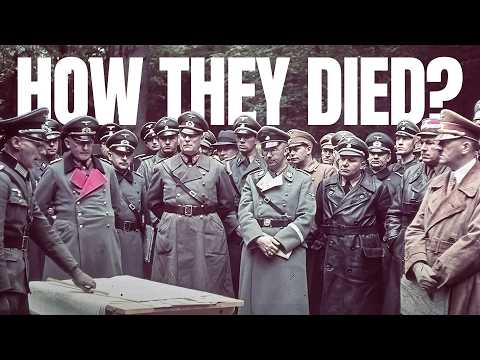
But how did each of Hitler’s most notorious lieutenants meet their end? From the gallows at Nuremberg to a partisan’s bomb hidden beneath a mattress, the deaths of the Nazi elite were as varied as they were brutal.
Wilhelm Keitel, the chief of the High Command, was known for his unconditional submission to Hitler. He signed orders authorizing summary executions and forced disappearances. In the war’s final weeks, he insisted on counterattacks with no military viability. After the surrender, he was arrested and tried at Nuremberg. Convicted of war crimes and crimes against humanity, he was sentenced to death. On October 16th, 1946, he was hanged. The execution was poorly calculated, resulting in a slow death by strangulation that lasted more than 20 minutes.
Not all deaths came at the hands of the Allies. Wilhelm Kube, General Commissioner of occupied Belarus, administered a territory marked by mass executions. On September 22nd, 1943, a time bomb hidden under his mattress exploded, killing him instantly. The device was planted by Yelena Mazanik, a Belarusian partisan working as a domestic servant in his apartment. The German reaction was brutal: more than a thousand men were executed in retaliation.
Gregor Strasser, an early influential figure of the Nazi Party, represented a more radical wing and saw his popularity as a threat to Hitler. In 1932, he was pressured to abandon his party positions. During the Night of the Long Knives in June 1934, he was arrested by the Gestapo and shot on Reinhard Heydrich’s orders. He did not die immediately; he remained bleeding for nearly an hour before dying.
As Minister of Propaganda, Joseph Goebbels coordinated the dissemination of Nazi ideology and encouraged total resistance as the war approached its end. He remained beside Hitler in the bunker until the final days. After the Führer’s suicide, he briefly assumed the position of Chancellor. On May 1st, 1945, after a failed attempt to negotiate a ceasefire with the Soviets, he and his wife Magda sedated their six children with morphine and administered cyanide capsules. Later, in the garden of the Chancellery, the couple took their own lives.
Wilhelm Canaris, head of the Abwehr, initially supported Hitler but became critical as the regime radicalized. He sabotaged strategic plans, including advising Franco to keep Spain out of the war. After the failed assassination attempt on Hitler in July 1944, Canaris was implicated as a conspirator. Arrested and brutally interrogated by the Gestapo, he was transferred to Flossenbürg concentration camp and executed by hanging on April 9th, 1945. Witnesses described the execution as especially cruel, with Canaris suspended on a butcher’s hook before being strangled.
Robert Ley, who led the German Labor Front, remained loyal to Hitler until the end. Captured near the Austrian border, he was detained by the Americans. Before he could be tried in Nuremberg, he committed suicide in his cell in October 1945 by hanging himself.
Commandant of Auschwitz Rudolf Höss organized the logistical structure that enabled the murder of more than 1 million people. With the Allied advance, he fled using a false identity and hid in northern Germany for nearly a year. In 1946, he was located by investigator Hans Alexander, who pressured his family until obtaining information about his whereabouts. Captured, he attempted to use a cyanide capsule but was prevented. Extradited to Poland, he was tried and sentenced to death. In April 1947, he was hanged near the crematorium of Auschwitz.
Hitler’s private secretary, Martin Bormann, controlled access to the Führer and exercised significant influence over political decisions. He remained in the bunker until the end and was one of the witnesses to the signing of Hitler’s political testament on April 29th, 1945. After the Nazi leader’s suicide, he attempted to escape from Berlin surrounded by the Red Army. He was last seen near the Lehrter station. Decades later, human remains identified as his were found in the area, confirming that he died during the escape attempt in May 1945.
Hermann Göring was one of the most powerful men of the Third Reich. A veteran of the First World War and a hero of German aviation, he became one of Hitler’s earliest supporters. Over the years, he accumulated strategic positions: commander of the Luftwaffe, founder of the Gestapo, and responsible for the Four-Year Plan, which aimed to prepare the German economy for total war. During the conflict, Göring promised that the German Air Force would guarantee absolute superiority in the skies. However, the failure in the Battle of Britain and later the inability to supply Stalingrad by air weakened his reputation. Despite this, he remained close to Hitler until the final collapse. After the war, he was captured by the Allies and tried at the Nuremberg Tribunal. Sentenced to death by hanging, he committed suicide with cyanide on the night before the execution, escaping the formal sentence.
Rudolf Hess held the position of Hitler’s deputy in the early years of the regime. Extremely loyal and ideologically convinced, he was seen as one of the oldest members of the Nazi inner circle. In 1941, he carried out one of the most mysterious episodes of the war: he flew alone to Scotland in an attempt to negotiate peace with the United Kingdom. The mission failed. He was immediately arrested by the British and spent the remainder of the war detained. After the conflict, he was sentenced to life imprisonment in Nuremberg. He remained incarcerated for decades in Spandau Prison in Berlin until his death in 1987 at the age of 93.
Reinhard Heydrich was considered one of the most dangerous men in the regime. As head of the Reich Main Security Office, he coordinated political repression and played a central role in organizing the so-called Final Solution. In 1942, he chaired the Wannsee Conference where the plans for the systematic extermination of European Jews were formalized. His influence was rapidly growing within the Nazi hierarchy. That same year, he became the target of Operation Anthropoid, carried out by Czech resistance fighters trained by the British in Prague. Gravely wounded in the attack, he died days later due to complications. His death triggered brutal reprisals, including the destruction of the village of Lidice.
Ernst Röhm led the SA, the Nazi paramilitary force that helped Hitler consolidate power in the early years. However, his growing influence and ambitions began to be seen as a threat. In 1934, during the so-called Night of the Long Knives, Röhm was arrested and executed on Hitler’s direct orders. His death marked the definitive consolidation of SS control over the security apparatus.
After Heydrich’s death, Ernst Kaltenbrunner assumed command of the Nazi security apparatus. Under his leadership, repression remained intense, especially during the final years of the war. He was directly associated with the administration of concentration camps and the regime’s intelligence operations. At the end of the conflict, he attempted to flee but was captured. In Nuremberg, he was sentenced to death and executed in 1946.
As admiral of the German Navy and the main architect of the submarine strategy in the Atlantic, Karl Dönitz commanded the U-boat war that initially caused severe losses to Allied maritime routes. However, the technological and industrial superiority of the Allies drastically reduced the effectiveness of the campaign from 1943 onward. In April 1945, he was appointed as Hitler’s successor. His government lasted only a few weeks. During that time, he organized Germany’s military surrender. The capitulation was signed on May 7th, 1945. Arrested by the Allies, he was tried at the Nuremberg Tribunal. He received a sentence of 10 years in prison. Released in 1956, he spent the remainder of his life away from politics. He died of a heart attack in December 1980.
Appointed as the regime’s supreme representative in occupied Norway, Josef Terboven governed with almost absolute authority. His administration was linked to the massacre of Yugoslav prisoners in Beisfjord and to violent repression against resistance movements. In 1944, faced with the Soviet advance in northern Norway, he ordered a scorched-earth policy in Finnmark. Approximately 50,000 civilians were forced to abandon their homes, and much of the infrastructure was deliberately destroyed. With Germany’s defeat imminent, and after being instructed by Dönitz to cooperate with the surrender, he refused to obey. In May 1945, he took refuge in a bunker on the Skaugum estate and detonated about 50 kg of dynamite, killing himself in the explosion.
Heinrich Müller, head of the Gestapo, was discreet and extremely efficient within the repressive machinery. He coordinated investigations, arrests, and mass persecutions. Unlike other Nazi leaders, his fate remains uncertain. He disappeared in the final days of the war in Berlin. He was never officially captured, and his body was never identified with absolute confirmation.
Heinrich Himmler was the supreme commander of the SS and one of the central figures in the regime’s extermination structure. At the beginning of 1945, as defeat became inevitable, he initiated secret contacts with Swedish representatives to negotiate a partial surrender to the Western Allies. When Hitler learned of these negotiations, he considered them treason. Himmler was stripped of all his positions and formally expelled from the Nazi Party. After Hitler’s suicide, he attempted to serve under Dönitz but was rejected. Disguised under the name Heinrich Hitzinger, he was captured by British troops near Bremen. During a routine medical examination, he bit into a cyanide capsule hidden in his mouth. He died on May 23rd, 1945, only minutes after ingesting the poison.
Albert Speer, Minister of Armaments and War Production, kept German industry functioning amid Allied bombings. He recognized that Germany would not win the war but worked to maintain the war effort, attempting to negotiate better surrender conditions and avoiding the Nero Decree. After the war, he was tried in Nuremberg, defending himself as a technocrat ignorant of the genocide. Sentenced to 20 years, he was released in 1966 and reinvented himself as an author. He died in London in 1981 from a stroke.
Arthur Seyss-Inquart served as Commissioner for the occupied Netherlands, coordinating deportations and forced labor. His administration left the country in a humanitarian crisis, especially during the hunger winter of 1944 to 1945. Captured in Hamburg, he was tried in Nuremberg and executed in October 1946 for crimes committed in occupied territory.
Joachim von Ribbentrop, Minister of Foreign Affairs, played a central role in Germany’s aggressive diplomacy, including the Molotov-Ribbentrop Pact with the Soviet Union in 1939. His actions helped pave the way for the Second World War. He was sentenced to death in Nuremberg and executed by hanging.
Fritz Sauckel commanded the forced labor program, forcing more than 5 million people to work for Nazi Germany. During the trial, he claimed he was merely following orders, but evidence showed he directly supervised abuses against workers. He was sentenced to death and hanged.
Baldur von Schirach led the Hitler Youth and governed Vienna during the occupation. Tried in Nuremberg, he admitted part of the responsibility for the ideological use of youth but claimed he had been deceived by Hitler. Sentenced to 20 years, he was released in 1966 and lived until 1974.
Wilhelm Frick, Minister of the Interior, was one of the main figures responsible for the Nuremberg Laws establishing discriminatory racial policies. His execution by hanging became notorious: the drop of the platform was miscalculated, causing a slow death with strangulation and convulsions that lasted approximately 12 minutes.
Hans Frank, Hitler’s personal lawyer and Governor-General of occupied Poland, presided over a regime of extreme repression and direct participation in mass killings. Captured in Bavaria, he attempted suicide twice. During the Nuremberg trial, he converted to Catholicism and provided his diaries as evidence of his crimes. He was sentenced to death and executed.
So the men who built the Nazi war machine met their ends in ways as varied as they were brutal. Some faced the gallows with miscalculated drops. Others cheated the rope with cyanide. A few simply vanished into history’s shadows. But the question that lingers is this: was justice truly served, or did some of them escape it entirely?
Report this article
Select a reason for reporting:






