In the rubble of Oosterbeek, a Dutch village on the edge of Arnhem, a British major crouched in a trench with an anti-tank weapon on his shoulder. A German armoured vehicle was rolling toward him. Above him, in a building, another officer was calling out its position.
The vehicle fired at the building above him. The wall was torn open, the officer who had been guiding him was killed, and masonry rained down on the trench.
The major kept firing. Then, as he turned on a second vehicle, one of his own rounds exploded right in front of him. He was thrown backwards, and when he opened his eyes, he could not see.
He later admitted he was “shouting like a hooligan.” Men dragged him to the aid post.
Half an hour later, his sight came back. He refused morphine and, against all advice, went straight back to the front line.
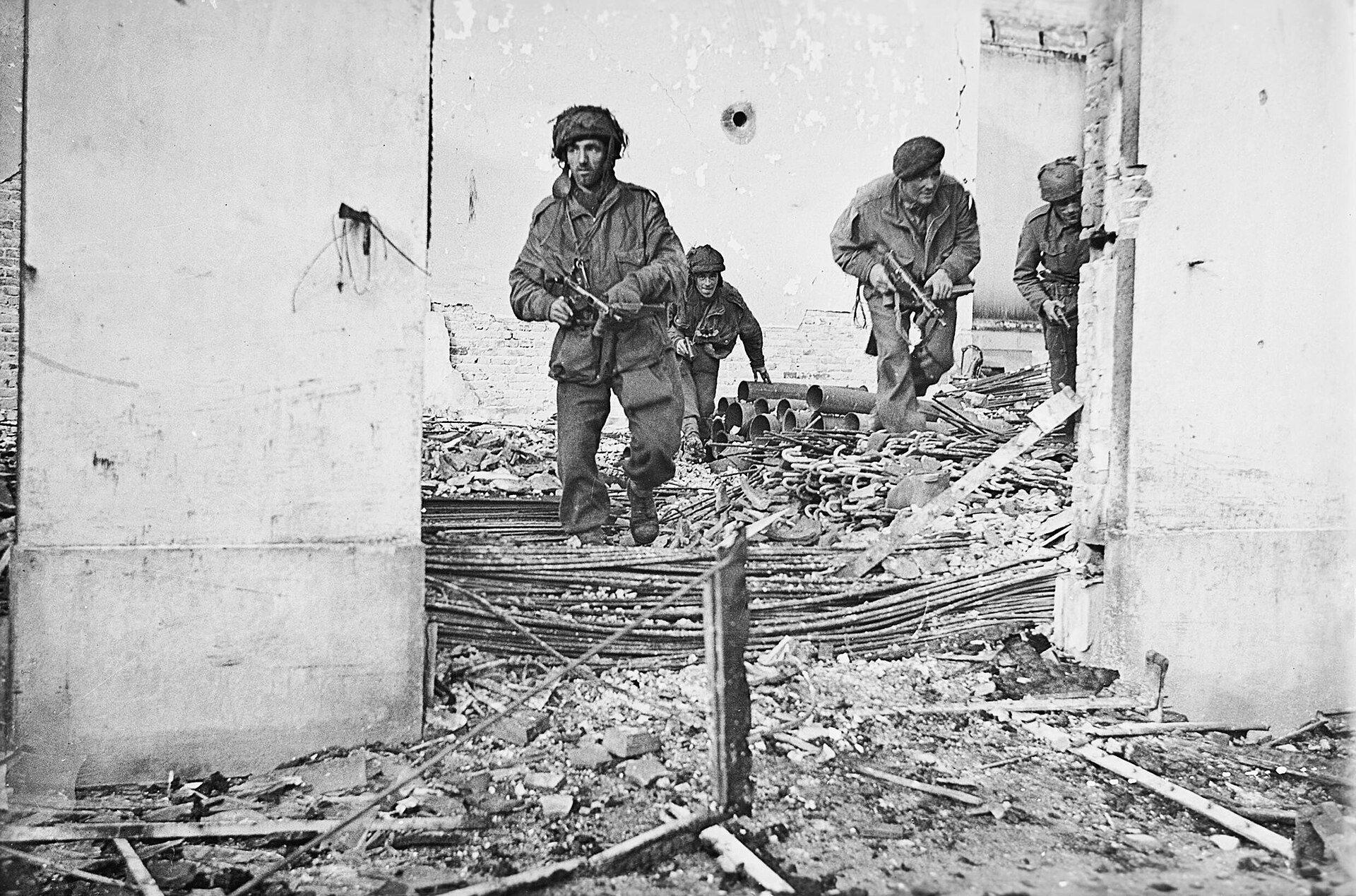
His name was Robert Henry Cain, and he was the only man who came out of the Battle of Arnhem alive with a Victoria Cross.
A viral reel from the page Voice of British tells his story in one line: he fought off German tanks single-handedly for four days. It has been watched more than 260,000 times.
The real story is both less tidy and more remarkable. He did not fight alone, and it was not four days. To see what he actually did, you have to go back to a glider that never made it across the sea.
On September 17, 1944, Major Cain took off from RAF Manston in a Horsa glider, one of the wooden aircraft that carried airborne troops into battle behind a towing plane. About five minutes into the flight, the tow rope came free.
The glider came down hard in a field and crashed through a fence, but everyone on board landed safely. Cain called it a “terrible anti-climax.”
It was an absurd start for a man who had come a long way to be there. He was born in Shanghai on January 2, 1909, to parents from the Isle of Man, and grew up on the island. Before the war he worked for Shell in Thailand and Malaya.
In 1940 the war turned the oil man into an officer. He ended up with the 2nd Battalion of the South Staffordshire Regiment, glider troops of the 1st Airborne Division, and led its B Company into Sicily in 1943. Now he was 35, a temporary major.
The operation he had just been dropped out of was called Market Garden. Airborne troops would land deep behind German lines in the Netherlands and seize a chain of bridges. The last and most important was the road bridge over the Lower Rhine at Arnhem.
What the men of the 1st Airborne Division did not know was that two SS Panzer divisions were positioned near Arnhem, with tanks, self-propelled guns and panzergrenadiers.
Cain flew out again the next day with the second lift and landed safely. By the night of September 18, he and his men had reached the outskirts of Arnhem.
The airborne plan was already falling apart. Only a small force had reached the bridge, and the battalions sent to reinforce it were stuck in the western suburbs. The South Staffords were thrown into the fight.
At 4:30 on the morning of September 19, they attacked toward the bridge. B Company pushed ahead to a dell, a small hollow in the ground, near the Arnhem city museum and St Elizabeth Hospital.
That is where Robert Cain saw German armour for the first time.
His men had no anti-tank guns. They had PIATs, a heavy anti-tank weapon fired from the shoulder at close range, and mortars. They fired everything they had, but they could not stop the tanks.
By 11:30 that morning the PIAT ammunition was gone. The commanding officer, Lieutenant Colonel McCardie, ordered them to pull back.
Few men got out. Most of the battalion’s other companies were forced to surrender.
Cain was the only senior officer of the battalion to escape. Years later he called that morning “South Staffs’ Waterloo.”
As he fell back through the lines of the 11th Parachute Battalion, he ran into Major Gilchrist. He did not ask for rest or orders. He said: “The tanks are coming, give me a P.I.A.T.”
Gilchrist had none to give.
About a hundred South Staffords were left. They were ordered to take a wooded hill called Den Brink to cover another attack, and they took it. But the tree roots and hard ground meant they could not dig in, and German mortars tore into them.
Cain made the decision to fall back to Oosterbeek. Something had changed in him that day. From now on, he was determined to destroy as much German armour as he could.
At Oosterbeek, what was left of the division was being squeezed into a small pocket west of Arnhem, with the river at its back.
Lieutenant Colonel Sheriff Thompson, whose 75mm howitzers were now exposed, went looking for the most senior officer among the retreating men. He found Cain and told him to form a defensive screen in front of the guns.
The force was later named Lonsdale Force, after Major Richard Lonsdale. Cain was one of three majors holding its sector at the southern end of the eastern edge of the perimeter.
He set himself up in the garden of a laundry, much to the annoyance of its Dutch owner. And then he started hunting.
On the afternoon of September 21, two German armoured vehicles came toward his position. Lieutenant Ian Meikle, in a building above him, called out where they were.
That is the moment this story began. Cain held his fire until the first vehicle was only 20 yards away.
It fired at the building, killing Meikle and burying Cain’s trench in masonry. He was hit by machine-gun bullets and falling stone, and he kept firing until the vehicle could no longer move.
A 75mm howitzer was brought forward to finish it off. According to his Victoria Cross citation, “Only then would he consent to have his wounds dressed.”
Then came the round that blew up in front of him, and the moment he thought he was blind.
In his own words: “I shouted to somebody to get onto the P.I.A.T. because there was another tank behind. I blubbered and yelled and used some very colourful language. They dragged me off to the aid post.”
He was back within the hour, refusing morphine. He told people he “wasn’t wounded enough to stay where [he] was.”
His citation says that the next morning he drove off three more tanks with his PIAT. Each time he left cover and took up position in open ground to fire.
On Friday, September 22, the constant explosions burst his eardrums. He stuffed field dressings into his ears and carried on. Someone saw him handing a soldier his last cigarette.
The citation captures those days in one line: “Major Cain was everywhere where danger threatened.”
It also records that he “refused rest and medical attention”, even though a perforated eardrum had seriously damaged his hearing and he was carrying multiple wounds.
On Sunday, September 24, a short truce allowed both sides to move the wounded. Shortly afterwards, Cain was told that a Tiger tank was coming.
He ran with a Royal Artillery gunner to a 6-pounder anti-tank gun, and the two of them pushed it into position. They fired and disabled the tank. Cain wanted to keep firing, but the gun’s recoil mechanism had been wrecked.
Then came Monday, September 25. The Germans launched a heavy attack on his position with self-propelled guns, flamethrowers and infantry.
By now there were no working PIATs left. Cain picked up a light 2-inch mortar, a weapon meant to lob its bombs in a high arc. The Germans were so close that he fired it almost horizontally.
His citation says that with that mortar, and “the few men still under his command,” he held the position. After more than three hours, the attackers withdrew in disorder.
That same night, the division began to withdraw across the Rhine. The battle of Arnhem was lost.
Before the withdrawal, many men blackened their faces. Cain did something else. He took off a week’s growth of beard and dried his face on his filthy, blood-soaked Denison smock.
When he reached the south bank, Brigadier “Pip” Hicks looked at him and said, “There’s one officer, at least, who’s shaved.”
Cain’s answer has become part of the legend: “I was well brought up, sir.”
He made sure all his men were over the river by dawn before he crossed himself, in a battered old boat.
Five Victoria Crosses were awarded for the Battle of Arnhem. Four were posthumous: Lance-Sergeant John Baskeyfield of Cain’s own battalion, Lieutenant John Grayburn, Flight Lieutenant David Lord and Captain Lionel Queripel.
Robert Cain was the only one who lived to receive his. The War Office announced it on November 2, 1944, and King George VI presented it at Buckingham Palace on December 6. With Baskeyfield’s award, the 2nd South Staffords became the only British battalion to win two Victoria Crosses in one engagement in the Second World War.
So what about the reel’s version?
The “four days” is wrong. The citation says that from September 19, Cain’s company was cut off and “during the next six days was closely engaged with enemy tanks, self-propelled guns and infantry.”
The “single-handedly” is wrong too, at least if you take it literally. The citation does say that he “went out alone” to face one tank.
But Meikle was spotting for him, a howitzer crew finished that vehicle, a gunner helped him with the anti-tank gun, and his men held the line with him to the end. What the citation actually praises is his leadership.
It also explains why that mattered. The Germans kept trying to infiltrate his company’s position, and had they succeeded, “the whole situation of the Airborne Troops would have been jeopardised.”
Even the famous numbers need care. He is often credited with destroying or disabling six tanks, four of them Tigers, plus several self-propelled guns. That total appears in later accounts, not in the citation.
And the citation itself has errors. Researchers have since pointed out that the first PIAT fight happened on September 21, not the 20th. The “Tiger tank” in it was actually a StuG III, a German self-propelled gun.
None of that makes him less brave. If anything, the true version is harder to believe than the viral one. This was a man who thought he had been blinded and went back anyway, who could barely hear, and who still found time to shave.
After Arnhem, Cain went to Norway with the 1st Airborne Division in May 1945 to oversee the German surrender there. He left the army at the end of 1945 with the honorary rank of major.
Then he went back to Shell. He worked in the Far East and then West Africa, and in 1951 he was elected to the House of Representatives in Nigeria. In 1965 he came home and retired to the Isle of Man.
He died of cancer in Crowborough, Sussex, on May 2, 1974. He was 65.
He and his wife had four children. One of them, his daughter Frances, did not know her father had won the Victoria Cross until after he died.
Frances later married the television presenter Jeremy Clarkson, who made a 2003 BBC documentary, The Victoria Cross: For Valour, about her father and other recipients. According to Clarkson, the reason was simple: “he’d never thought to mention it.”
Today his Victoria Cross, his Denison smock and the maroon beret he wore at Arnhem are kept at the Staffordshire Regiment Museum. He is still the only Manxman ever to receive the medal, and a bridge in Castletown now carries his name.
The last line of his citation reads: “His coolness and courage under incessant fire could not be surpassed.”
He never thought to mention it.
Which detail of Robert Cain’s story stays with you most: the walk back from the aid post, the 2-inch mortar fired flat, or the shave before the river crossing?
Report this article
Select a reason for reporting:






