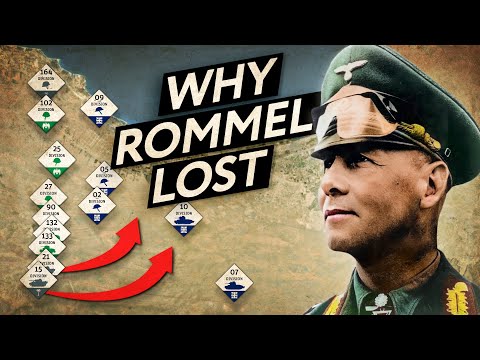
In the vast, sun-scorched deserts of North Africa, a legend was born—and then, piece by piece, it was dismantled. Field Marshal Erwin Rommel, the brilliant tactician known as the Desert Fox, had once seemed invincible. His audacious maneuvers and lightning-fast Panzer attacks had humiliated the British and earned him Hitler’s favor. But by 1943, his army was shattered, his tanks were burning wrecks, and the Axis dream of dominating the Middle East was dead. How did one of World War II’s most celebrated commanders meet such a crushing defeat? The answer lies in a story of supply lines stretched to the breaking point, a war of attrition the Germans could never win, and the relentless pressure of an enemy that learned from every mistake.
In January 1941, the British seemed on the verge of driving the Italians out of North Africa entirely. Mussolini, desperate to save his collapsing empire, begged Hitler for help. Hitler, though focused on his upcoming invasion of the Soviet Union, couldn’t afford to let his ally fall. He dispatched Rommel and a small blocking force—the Afrika Korps—with strict orders to hold the line, not to advance. But Rommel, never one to follow orders when glory beckoned, saw an opportunity. The British, exhausted and overstretched, were unprepared for his aggression. With a fraction of the forces, he launched a surprise offensive that sent the British reeling back across the desert.
His superiors were furious, but Hitler was delighted. Rommel was promoted and given command of a new armored group, the Panzerarmee Afrika. His star was rising, but so too were the challenges. The vast distances of the desert meant that every mile he advanced stretched his supply lines further. Fuel, ammunition, and spare parts had to travel from Europe across the Mediterranean, where British ships and aircraft from Malta exacted a deadly toll. “The bravest of men cannot fight without a gun,” Rommel later wrote, but his complaints often fell on deaf ears.
Meanwhile, the British were regrouping. Under General Claude Auchinleck, they launched Operation Crusader in November 1941, aiming to relieve the besieged port of Tobruk. The fighting was fierce and chaotic. Rommel, sensing a decisive moment, personally led the 21st Panzer Division in a daring dash to the Egyptian border—a gamble that became known as the “dash to the wire.” But the British didn’t collapse. Instead, they held firm, and Rommel ran out of fuel. He was forced to retreat, back to where he had started nine months earlier.
The seesaw war continued. Rommel struck again in 1942, capturing Tobruk in a stunning victory that earned him a field marshal’s baton. He pushed the British back to El Alamein, just 100 kilometers from Alexandria. But there, the tide turned. The British, now under General Bernard Montgomery, had learned from their mistakes. They had more tanks, more men, and—crucially—more supplies. Montgomery was cautious, methodical, and determined not to let Rommel run rings around him. At the Battle of Alam el Halfa, he let Rommel attack, then smashed the German armor with dug-in tanks and artillery.
The end came at the Second Battle of El Alamein in October 1942. Montgomery had overwhelming superiority—he could fire 30 artillery shells for every one the Germans could manage. The battle was a grinding, bloody affair, but the outcome was never in doubt. Rommel, sick and exhausted, was recalled to Germany. His army, left behind, was doomed. Hitler ordered them to stand and fight to the death, but Rommel defied him, saving what he could. By May 1943, the last German troops in Africa surrendered. The Desert Fox had been outfoxed—not by a single brilliant maneuver, but by the cold, hard realities of industrial warfare.
Yet the story of how exactly Rommel’s legendary Afrika Korps was ground into dust—the battles, the logistics, the personalities—is a tale of its own. And it begins with a single, fateful decision by Hitler that would set the stage for one of the most dramatic campaigns of the entire war.
That decision was Directive Number 22, issued on January 11, 1941. It was a modest document for a modest mission: hold Tripolitania, prop up the Italians, and prevent any further British advance. Rommel was explicitly forbidden from going on the offensive—his Afrika Korps was to act only as a blocking detachment, a “spearhead” under Italian command. His superiors at the Oberkommando des Heeres repeated the order: reconnaissance patrols only, no advance.
But Rommel had a talent for finding loopholes. The British, he reasoned, wouldn’t expect an attack until May. They were exhausted from months of fighting the Italians, their supply lines stretched thin, their commanders cautious. In March 1941, he moved. With far inferior forces, he outflanked the British-led Eighth Army’s static defenses at El Agheila and sent them reeling eastward in disorder.
The British tried to reform their line, failed, and withdrew from Cyrenaica. Only Tobruk held out, defended by Australian infantry who refused to crack. Rommel’s superiors in Berlin were appalled at his insubordination. General Franz Halder, the army’s chief of staff, ordered him to stop. But at the end of his supply lines, Rommel simply besieged the port and waited.
Hitler, however, was jubilant. He promoted Rommel to General of the newly formed Panzerarmee Afrika, giving him command of both the Afrika Korps and the Italian XX Corps. The Desert Fox was now Hitler’s favorite, a direct line to the Führer that would later prove both a blessing and a curse.
Then the limelight shifted. On June 22, 1941, Germany invaded the Soviet Union. Hitler decreed that the Libyan war would continue—but only after Operation Barbarossa was won. North Africa became a sideshow, and Rommel knew it. He would have to compete for every tank, every truck, every drop of fuel.
On the British side, a new commander had other ideas. General Sir Claude Auchinleck knew the hard-pressed Tobruk garrison needed relief. On November 18, 1941, he launched Operation Crusader. After seaborne commando raids, the Eighth Army surged forward, taking Rommel by surprise. Heavy armored clashes broke out throughout the desert, especially around the Sidi Rezegh airfield.
Despite initial setbacks, the German troops slowly gained the upper hand. Rommel sensed the decisive moment had arrived. On November 24, he personally took control of the 21st Panzer Division and raced after the retreating British 7th Armored Division, driving toward the Egyptian border. He hoped to repeat his early 1941 triumph and trigger a chaotic rout. His gamble—later called the “dash to the wire”—was bold. It failed.
Despite advancing up to 60 kilometers, the Eighth Army did not collapse. Auchinleck reasoned that Rommel must be reaching his supply limit, and he was right. Rommel lacked the fuel to complete his dash and had to divert to Bardia to resupply. Meanwhile, New Zealand troops took advantage of the 21st Panzer’s absence to force their attack and link up with the defenders inside Tobruk.
The dash to the wire had cost Rommel a narrow victory. Over the next few weeks, the Eighth Army brought in fresh reserves—the 2nd South African Division among them. Rommel tried to counterattack but realized he couldn’t keep up against the mounting pressure. He ordered a retreat. At the end of the year, he was back where he had started nine months earlier.
Undeterred, Rommel planned his next assault. Now close to Tripoli, he improved his logistics and developed a strong defensive position known as the Cauldron. The British were slow to capitalize on their success, and so once again, the Desert Fox went on the offensive.
On May 26, 1942, Axis forces moved toward the Gazala line and struck at Bir Hakeim, a fortified box held by Free French troops. The French fought with a fury that surprised everyone, holding out for sixteen days before finally slipping away under cover of darkness. Their resistance bought the British precious time, but Rommel was already improvising. He swung his armor north, surrounding and hitting the Allied forces from multiple sides. The British, caught off balance, abandoned their offensive plans and poured reserves into simply holding the line.
By June 21, Axis forces arrived at Tobruk—the same fortress that had held out for nine months in 1941. But this time the defenses had been allowed to decay. Panzers broke through the perimeter, and the garrison collapsed. 35,000 mostly South African defenders were captured in just two days. Hitler was ecstatic. Rommel was promoted to Generalfeldmarschall, the youngest in the German army. He later recalled, “For every one of my Africans, that 21st of June was the high point of the African War.”
The battered Eighth Army, with barely 70 tanks left, limped back to the coastal town of El Alamein. Here, the geography changed everything. The sea to the north and the impassable Qattara Depression to the south narrowed the front to just 40 kilometers—terrain that robbed Rommel of his greatest weapon: maneuver.
Axis forces continued to attack, but their tanks came up against better-prepared Allied positions. R.I. Cunningham, an anti-tank gunner with the Royal Horse Artillery, found himself in a deadly duel with a Panzer on July 3. “The enemy withdrew, leaving five tanks on the field,” he remembered. “The northernmost of these, a Panzer IV, was stopped but not destroyed and was firing steadily with high explosives at my gun.”
The battery commander ordered Cunningham to cease fire—ammunition was dangerously low. Cunningham protested, but the commander was firm. He turned and walked some eighteen meters when a shell from the same tank exploded beside him, wounding him seriously in the throat. “I then disobeyed orders and wrecked the tank with just two more rounds,” Cunningham recalled.
Prime Minister Winston Churchill urged Auchinleck to counterattack, but the general insisted the Eighth Army was exhausted. Churchill fired him for his hesitation and eventually replaced him with Bernard Law Montgomery. Montgomery, however, privately agreed with Auchinleck. The army needed rest and retraining—and El Alamein was a strong position.
Meanwhile, British signals intelligence revealed the German plan. Montgomery decided to let Rommel attack in the south, then force the panzers toward Alam el Halfa, a strong point bristling with dug-in tanks and artillery. When the Axis attack opened on August 30, Rommel fell straight into the trap. Losses were high on both sides, but the German assault failed.
With his health worsening, Rommel returned to Germany to recuperate. He was not the only one reaching the end. Dysentery, desert conditions, poor rations, and over-exertion resulted in widespread illness among German troops. A lance corporal with the 15th Panzer Division wrote home: “Lads come here and after a couple of weeks they keel over. Most of them get sent back to Germany. Still, they don’t grumble about this being all for a greater Germany.”
As the Axis forces began to buckle, the British seized the initiative. Montgomery’s Second Battle of El Alamein opened on October 23. Now on the offensive, the main obstacle for the British would be getting through the extensive German and Italian minefields. British-led units made progress, but the attack was not flawless—units advanced at different speeds, and mine-clearing took time.
German anti-tank guns inflicted a heavy toll on advancing British armor. But the Germans also suffered losses. On October 24, Rommel’s temporary replacement, Panzer General Georg Stumme, died of a heart attack. Rommel was rapidly recalled to deal with the crisis.
On November 2, Montgomery ordered Operation Supercharge to break through German positions around Kidney Ridge. The limited frontage now hindered Montgomery’s mobility, so as he told his commanders: “It’s got to be done. If necessary, I’m prepared to accept 100 casualties in both personnel and tanks.”
British efforts paid off. After a grinding battle of attrition that took its toll on both sides, the Axis forces withdrew on November 4. Hitler ordered Rommel to stand and fight to the death if necessary. Rommel defied the order and withdrew to the Tunisian border.
Shortly after, a new factor entered the theater. On November 8, Anglo-American troops landed in Morocco and Algeria as part of Operation Torch. Rommel was now fighting a two-front battle in Tunisia. Axis commanders became pessimistic—the mountainous terrain denied Rommel his methods of maneuver. His German and Italian superiors took increased control and ordered him to hold the Mareth Line, an outdated position.
By January 1943, German High Command was preparing to replace him. The Allies continued their relentless advance, with Tripoli falling on January 23. The German Army in Africa’s strategic fate had been sealed.
On March 9, Rommel flew to Germany, leaving his army behind. “We hadn’t had anything to eat for a couple of days,” recalled Hans Klein of the Hermann Göring Division. “There was no ammunition to continue the fight.” On May 12, the last Axis troops in Tunisia surrendered.
The Desert Fox had been outfoxed—not by one brilliant maneuver, but by supply lines stretched to breaking, an enemy that learned from every mistake, and a theater Hitler never truly valued. North Africa was always a sideshow. For the British, it was everything.
Rommel’s legend survives, but his defeat was inevitable. The question is: was the Desert Fox a military genius undone by circumstance, or a gambler whose luck finally ran out? What do you think?
Report this article
Select a reason for reporting:






