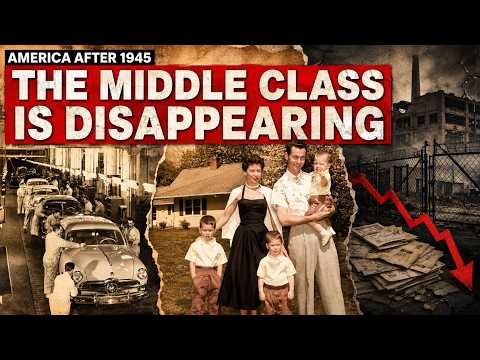
In the summer of 1945, as the last bombs fell and the smoke cleared across Europe and the Pacific, a quiet revolution began on American soil. It wasn’t a military campaign or a political upheaval—it was the birth of the middle class. Factory workers who had never owned a home suddenly held the keys to one. Sons of sharecroppers and immigrant laborers walked onto college campuses for the first time. A generation that had known only depression and war was suddenly buying cars, filling refrigerators, and raising children in suburban neighborhoods that hadn’t existed five years earlier. This was the American Dream, and for three decades, it was the most powerful economic engine the world had ever seen.
But today, that engine is sputtering. The share of American adults living in middle-income households has plummeted from 61% in 1971 to just 50% by 2021. The middle class is shrinking, and the question that haunts economists and politicians alike is: why? What forces turned the most prosperous middle class in human history into something millions can no longer afford to belong to? And more importantly, who benefited from its erosion?
The answer lies in a story of deliberate construction—and gradual dismantling. It begins in the aftermath of World War II, when America stood alone, responsible for half the world’s economic output while holding only 5% of its population. Every other industrial power lay in ruins. America’s factories were intact, its infrastructure untouched. But it wasn’t just luck—it was transformation. The war economy had cured the Great Depression, and now, with the GI Bill, the government made a decision that would define the next half-century. The GI Bill paid for college, offered low-interest home loans, and provided unemployment insurance. It rewired American society, turning higher education from a luxury into a middle-class expectation and making homeownership the norm.
The result was an economic explosion. New car sales quadrupled between 1945 and 1955. The highway system expanded massively, connecting suburbs to cities, factories to ports. The baby boom amplified everything. And crucially, the growth was shared. Between 1945 and 1973, real wages rose in lockstep with productivity. A single factory worker could support a family of four, own a home, take vacations, and save for retirement. Unions were a massive part of why this worked—at their peak, one in three workers carried a union card, setting wage standards across entire industries. The tax code reinforced this: the top marginal rate sat at 91%, effectively capping wealth accumulation and pushing corporate profits back into wages and expansion.
But the golden age was not golden for everyone. The GI Bill was administered through state and local agencies, and in the South, black veterans were systematically denied its benefits. They were steered into vocational programs and denied home loans through redlining—a practice where the Federal Housing Administration drew red lines around black communities and labeled them too risky. The suburbs that built the white middle class were, by design, overwhelmingly white. Levittown, the model suburb, explicitly barred black families through restrictive covenants. Homeownership, the primary vehicle for wealth accumulation, was effectively whites-only for its first critical decades. The racial wealth gap that exists today was engineered, in part, by the very policies that built the white middle class.
The second crack was structural. America’s manufacturing dominance depended on unique global conditions—every other industrial nation had been bombed flat. As Europe and Japan rebuilt, they became competitors again. By the late 1960s, German and Japanese manufacturers were producing goods that rivaled or exceeded American quality, often at lower cost. The American share of global manufacturing began to shrink, not because America got worse, but because everyone else got better.
And then came the ideological shift. By the early 1970s, a new economic philosophy was gaining traction: that high taxes, strong unions, and heavy regulation were holding the economy back. That the real engine of growth was individual entrepreneurship and unfettered markets. This philosophy would soon be called supply-side economics, and its most famous evangelist would be a former actor from California. But before Reagan, there was 1971—the year the post-war middle-class bargain began to unravel.
On August 15th, 1971, President Richard Nixon went on live television and announced his New Economic Policy. He proposed tax cuts and a 90-day freeze on wages and prices. But more consequentially, he suspended the convertibility of the US dollar into gold. This was the Nixon Shock, and its consequences still reverberate today. Since the end of World War II, the Bretton Woods agreement had fixed the dollar to gold at $35 per ounce, imposing discipline on government spending. But by the late 1960s, the Vietnam War and Great Society programs had created massive deficits. The government was spending far more than it took in, and foreign governments began to worry there wasn’t enough gold to back all the dollars. France started converting its dollar reserves into gold and shipping it home. Nixon’s advisers convinced him to break the link entirely. Without the gold anchor, the dollar began to float freely, and inflation began to climb. By 1973, the OPEC oil embargo quadrupled the price of petroleum overnight. The American economy entered stagflation—high inflation, high unemployment, and stagnant growth, all at once.
For the middle class, stagflation was corrosive. Wages weren’t keeping up with rising prices. Savings lost value. Interest rates climbed into double digits. And for the first time since the war, the American worker felt the ground shifting beneath their feet. This is also the moment when the relationship between productivity and wages broke. From 1945 to 1973, they had risen together almost in perfect parallel. But after 1973, the lines diverged. Productivity kept climbing—soaring by 81% between 1979 and 2024—but hourly pay for typical workers grew by only 29.4%. The gap between what workers produced and what they were paid widened into a chasm. And the difference—the enormous surplus of value that workers created but didn’t receive—flowed upward, to corporate profits, executive compensation, and shareholders.
This divergence is not a natural phenomenon. It is the result of specific decisions made by specific people and institutions over decades. And the first, and arguably most consequential, was the deliberate destruction of organized labor. When Ronald Reagan entered the White House in 1981, approximately 20% of private sector workers were unionized. By the time he left office, that number had fallen to 12%. Today, it sits near 6%. Reagan set the tone early: in August 1981, when the professional air traffic controllers went on strike, he fired all 11,000 of them. The most powerful man in the world had just declared that organized labor was the enemy, and corporate America took notice. Employers became far more aggressive in opposing unionization, hiring anti-union consultants, threatening plant closures, and replacing strikers permanently—tactics that had been considered unacceptable in the post-war era.
The decline of unions didn’t just reduce the bargaining power of union members; it removed the countervailing force that had kept wages rising for everyone. Without the threat of unionization, non-union employers had no reason to share productivity gains with their workers. The labor market became a buyer’s market, and the buyers were corporations. Simultaneously, Reagan embarked on the most ambitious overhaul of the tax code since the post-war era. The Economic Recovery Act of 1981 slashed the top marginal income tax rate from 70% to 50%, and a subsequent reform in 1986 dropped it further to 28%. Capital gains taxes were cut, corporate taxes were reduced. The theory was that cutting taxes at the top would stimulate so much investment and growth that the benefits would trickle down. The reality was something else entirely.
The economy did grow during the 1980s, but the benefits concentrated overwhelmingly at the top. In tax year 1985, the top 1% received a windfall of roughly $350,000 from the tax changes in today’s dollars. The typical household received about $3,500. And the poorest Americans received a few hundred. Meanwhile, deregulation opened the floodgates. Financial markets were deregulated, allowing banks to take on more risk and create more complex instruments. This drove a boom in Wall Street profits, but it also planted the seeds of the savings and loan crisis, which ultimately cost taxpayers roughly $130 billion. The airline industry was deregulated. The telecommunications industry was deregulated. In each case, the promise was more competition and lower prices. Sometimes that happened. But often, deregulation led to consolidation as larger firms swallowed smaller ones, reducing competition and concentrating market power.
The combined effect of tax cuts, deregulation, and the weakening of unions was a massive upward redistribution of income and wealth. The share of total income going to the top 1%, which had been relatively stable throughout the post-war era, began to climb sharply in the early 1980s. By 1989, it had already surged noticeably, and it would continue climbing for the next three decades. Then came globalization. In the 1990s, under President Bill Clinton, the United States embraced free trade with an enthusiasm that had no historical precedent. NAFTA went into effect in 1994, creating a free trade zone between the US, Canada, and Mexico. In 2000, Congress granted China permanent normal trade relations, paving the way for China’s entry into the WTO. The theory was elegant: if countries specialize and trade freely, everyone benefits. American consumers would get cheaper goods. American companies would access larger markets. The overall pie would grow, and everyone would get a bigger slice.
What actually happened was more complicated—and for millions of American workers, catastrophic. Between the late 1990s and early 2000s, an estimated 2.4 million American jobs were lost to Chinese competition alone. The manufacturing sector, the backbone of the middle class since the post-war era, was gutted. In 1950, roughly a third of American workers were employed in manufacturing. By 2019, that number had fallen to about 8%. The jobs that replaced them were overwhelmingly in the service sector—retail, hospitality, food service, healthcare—jobs that paid less, offered fewer benefits, provided less security, and were far less likely to be unionized. Entire communities were devastated. Factory towns across the Midwest and South, places that had thrived for generations on a single industry, were hollowed out almost overnight. The Rust Belt wasn’t just an economic phenomenon; it was a social catastrophe. As factories closed, tax revenues fell, schools deteriorated, infrastructure crumbled, drug addiction surged, and life expectancy in some communities actually began to decline—a phenomenon economists Anne Case and Angus Deaton would later call deaths of despair.
And then came 2008. The financial crisis was the culmination of decades of deregulation, reckless lending, and financial engineering. Banks had been issuing mortgages to borrowers who couldn’t repay them—subprime loans—and packaging them into complex securities sold to investors worldwide. Rating agencies stamped these toxic products with AAA ratings. When the housing bubble burst, the entire edifice came crashing down. Home values fell roughly 30% in real terms between 2007 and 2009, erasing over $6 trillion in housing wealth. 12 million homeowners found themselves underwater. US stock indexes lost half their value. In total, American household net worth dropped by roughly $16 trillion—a full decade of wealth accumulation wiped out in 18 months.
But here’s what made the crisis particularly devastating for the middle class: the response. The federal government stepped in with massive bailouts for the financial sector—the $700 billion TARP program, quantitative easing pumping trillions into the system. The banks were saved, the stock market recovered. By 2013, major indexes had surpassed their pre-crisis highs. But for ordinary homeowners—for the 12 million families underwater on their mortgages—no comparable bailout ever materialized. While housing made up roughly two-thirds of all middle-class wealth, it represented a much smaller share for the richest Americans, whose portfolios were dominated by stocks and financial assets. So the recovery flowed disproportionately to the wealthy, while the middle class was left to claw its way back from the wreckage.
The crisis accelerated every negative trend that had been building for decades. Wealth inequality widened further. Homeownership rates fell. Student debt exploded as young people, unable to find jobs, stayed in school longer, borrowing ever-larger sums for degrees that were supposed to be their ticket to the middle class. Total outstanding student loan debt surpassed $1.7 trillion, a burden carried disproportionately by millennials and Generation Z—the very cohorts who were supposed to be building the next middle class. And the housing market, the traditional engine of middle-class wealth accumulation, became increasingly inaccessible. Median home prices soared far beyond what median incomes could support. In many major metropolitan areas, homeownership became a mathematical impossibility for families earning the median income.
Healthcare costs added another crushing burden. The average premium for family health coverage reached over $25,000 by 2024, a 20% increase in just four years. Deductibles more than doubled since 2009. Healthcare now consumes roughly 8% of a typical household’s budget and pushes an estimated 5 million people into poverty each year. Medical debt has become a leading cause of personal bankruptcy, even among families with health insurance. And that’s the dark irony: these aren’t families who refused to work or made reckless decisions. These are families who did everything they were told. They got the education, found the jobs, bought the insurance—and they’re still drowning.
Now, there’s one more force that deserves attention, because it’s often discussed as if it’s a natural law, when in fact it’s anything but: technology. Automation and artificial intelligence have been transforming the labor market for decades. Robots replaced assembly line workers in the 1980s and 1990s. Computer algorithms replaced clerical workers. Self-checkout kiosks replaced cashiers. And now large language models and advanced AI are beginning to encroach on white-collar professions once considered automation-proof—legal research, financial analysis, medical diagnostics, software development, content creation. The standard argument is that technology destroys some jobs but creates others. Historically, that’s been true. But the new wave is different: the jobs it’s destroying are increasingly middle-skill, middle-income jobs—the exact jobs that formed the foundation of the middle class. And the jobs it’s creating cluster at the extremes: high-skill, high-pay positions for those with advanced technical education, and low-skill, low-pay positions in services that can’t easily be automated. The result is labor market polarization—a hollowing out of the middle. The well-paying, stable jobs that sustained generations of middle-class families are being replaced by a barbell economy, where you’re either doing very well or barely getting by.
So where does all of this leave us? Consider the full picture. In 1971, 61% of American adults lived in middle-income households. By 2021, that figure had fallen to around 50%. Some of that decline was driven by people moving up into higher income brackets—and that’s genuinely good news worth acknowledging. But a significant portion was driven by people falling down. And even for those who technically remain in the middle, the experience of middle-class life has fundamentally transformed. The costs of the three things that defined middle-class security—housing, healthcare, and education—have all risen far faster than incomes. Real wages, adjusted for inflation, have barely budged for the median worker in half a century. And the safety nets that once caught people when they stumbled—strong unions, employer-provided pensions, affordable public universities—have all been weakened or dismantled.
Between 1979 and 2023, real earnings for the top 0.1% grew by 354%, from roughly $618,000 to about $2.8 million. For the bottom 90%, earnings grew by just 44% over that same 44-year period, from roughly $30,000 to $43,000. The share of total income flowing to the combined upper middle class and wealthy surged from 28% in 1979 to 68% by 2024. The top 1% alone doubled their share from 5% to 9%—and even that’s likely an undercount, because the wealthiest Americans tend not to participate in the census surveys that produce these numbers. Research based on tax data suggests the real figure is closer to 17%. Credit card debt, auto loans, and personal borrowing have all surged as middle-class families use debt to maintain a standard of living their wages can no longer support. The growth in consumer debt has allowed families to sustain consumption despite income stagnation, but it has also made them enormously fragile. Any economic shock—a job loss, a medical emergency, a recession—can push a debt-laden family over the edge.
This is the central tragedy of the American middle class. It was built by a specific set of conditions and policies: massive public investment, strong labor protections, a tax code that constrained inequality, a regulatory framework that prevented financial speculation from destabilizing the real economy, and a global environment in which America had no serious industrial competitors. Over the past 50 years, every single one of those conditions has been weakened, reversed, or eliminated. Public investment dried up. Infrastructure spending fell as a share of GDP. The tax code was rewritten to benefit those at the top. Labor protections were gutted. Financial regulation was dismantled. And globalization, while enriching many at the top and bottom of the global income distribution, devastated the American manufacturing base that had been the middle class’s primary employer.
None of this was inevitable. None of it was ordained by the laws of economics or the march of technology. These were choices—made by elected officials, corporate executives, lobbyists, voters, all of us in some form or another. The Golden Age wasn’t a gift from the universe. It was something that was built. And the question now is whether anything like it can be built again. Because the consequences of failing to do so are not merely economic. A society where the middle class is shrinking is a society where social mobility declines, where trust in institutions erodes, where political extremism flourishes, and where the basic social contract—the idea that hard work and fair play should lead to a decent life—loses its credibility. You can already see this playing out in the political landscape, where frustration with the economy has become the dominant force in elections, where voters are increasingly drawn to candidates who promise to burn the system down, because the system as it exists has failed them.
The story of the American middle class is, in many ways, the story of America itself. Its rise and fall tracks with the nation’s greatest achievements and its deepest failures. And understanding how we got here—understanding the specific decisions and forces that built and then eroded the most broadly prosperous society in modern history—is not just an academic exercise. It’s the first step toward figuring out what comes next.
So what comes next? The answer isn’t written yet. History doesn’t move in one direction—it moves in cycles, and cycles can be broken. The same generation that watched factories close and pensions vanish is now the one demanding something different. The question is whether the political will exists to rebuild what was dismantled.
Because the blueprint still exists. It’s buried in the archives, in the GI Bill, in the union contracts, in the tax tables of 1955. The middle class wasn’t a natural phenomenon—it was a decision. And decisions can be reversed.
The only thing standing in the way is the belief that nothing can change. That’s the most dangerous myth of all.
So here’s the question worth asking: If the middle class was built once, what would it take to build it again—and would you be willing to pay the price?
Report this article
Select a reason for reporting: