Most people think they know how World War II ended: two atomic bombs, two devastated cities, and an emperor’s voice crackling through the radio for the first time, telling his people to bear the unbearable. It’s a clean story, a tidy narrative. America built the ultimate weapon, deployed it twice, and Japan folded. End of chapter. But here’s the problem with clean stories—they almost never survive contact with the actual evidence.
When you dig into the declassified documents, the internal Japanese War Council deliberations, the military cables flying between Moscow and Tokyo, the logistical nightmare unfolding across the Japanese home islands, you start to realize that the atomic bombs were only one thread in a much larger, much darker web of converging catastrophes. And depending on which historian you ask, they might not have even been the most important thread.
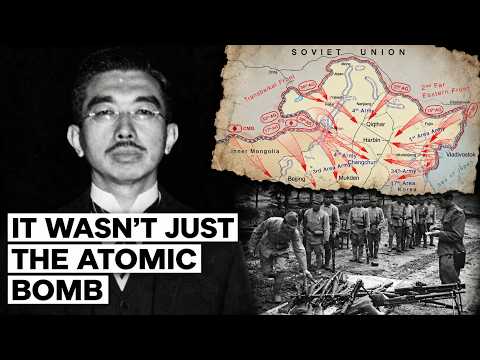
So today, we’re going to tear the whole thing open. We’ll look at what was really happening inside Japan in the summer of 1945—the internal power struggles, the desperation, the starvation, the secret diplomatic channels, the Soviet betrayal, and the near coup that almost prevented the surrender from happening at all.
Because the real story of how the bloodiest war in human history finally ended is far more complicated, far more human, and far more terrifying than the version most of us were taught.
Let me take you back to the spring of 1945, when Japan was already dying, long before the first atomic bomb ever left the ground. By March of 1945, the Empire of Japan was a nation being slowly strangled to death—not by a single blow, but by a tightening noose of fire, starvation, and isolation that most people in the West have never heard about. To understand what the atomic bombs actually meant to Japan’s leadership, you first have to understand what Japan had already endured, because it changes everything.
Let’s start with what happened on the night of March 9th, 1945. That evening, 334 American B-29 Superfortress bombers lifted off from airfields on the Mariana Islands and turned north toward Tokyo. They carried no conventional high-explosive bombs. Instead, their bomb bays were packed with 1,665 tons of incendiary munitions—primarily M-69 napalm bomblets, small canisters designed to burst open and scatter burning gel across wide areas.
The raid was code-named Operation Meeting House, and it would become the single deadliest air raid in the history of human warfare. Not Hiroshima, not Nagasaki, not Dresden—Tokyo.
The American commander behind this operation was Major General Curtis LeMay, a man who had grown deeply frustrated with the conventional high-altitude precision bombing strategy that the Army Air Forces had been using over Japan. The jet stream at high altitudes scattered bombs wildly off target, and cloud cover obscured aiming points for days or weeks at a time. LeMay decided to make a radical change. He ordered his bombers to fly low—around 5,000 feet—at night, stripped of most of their defensive armaments and crew to maximize bomb loads.
It was an enormous gamble. Flying that low over a defended city meant the bombers would be well within range of anti-aircraft guns, and they would have almost no way to defend themselves if Japanese fighters came up to meet them. But LeMay calculated that Japan’s night fighter defenses were weak enough to make it work, and he was right.
The pathfinder aircraft arrived over Tokyo first and dropped incendiaries in a giant X pattern across the densely populated Shitamachi district, a working-class residential area packed with traditional wooden structures. The main bomber force followed, laying down a carpet of fire across the target zone. Within 30 minutes, the individual fires had merged into a single monstrous firestorm. Winds generated by the inferno reached hurricane force, sucking oxygen out of the air and creating temperatures so extreme that the canals and rivers boiled. People who jumped into the water to escape the flames were cooked alive.
By the time the sun rose on March 10th, roughly 16 square miles of central Tokyo had been reduced to ash. Conservative estimates put the death toll at 80,000 people in a single night, though many historians believe the true number exceeded 100,000. Over a million people were left homeless. The Japanese later called that evening “the night of the black snow.”
And Tokyo was only the beginning. Over the next five months, LeMay’s command executed the most intense campaign of city destruction in the history of the world. Sixty-seven more Japanese cities were attacked. Nagoya, Osaka, Kobe, then smaller cities that most people in the West have never heard of—Toyama, Fukui, Hamamatsu, Numazu—because the famous cities had already been burned.
LeMay’s staff kept a chart comparing each destroyed Japanese city to an American city of similar size. Yokohama, 58% destroyed, equivalent to Cleveland. Tokyo, 51% destroyed, equivalent to New York. Toyama, burned on the night of August 1st, 1945, was approximately 99% destroyed, making it the most completely obliterated city of the entire war—including the atomic targets.
The cumulative toll of the firebombing campaign is staggering: roughly 330,000 Japanese civilians killed, around 8.5 million driven from their homes, and approximately 40% of Japan’s total urban area turned to rubble. And all of this happened before the first atomic bomb was ever dropped.
This is a crucial point, and it’s the one that most popular histories completely miss. By August of 1945, the destruction of Japanese cities from the air was not a new phenomenon. It was a five-month-old routine. Japan’s leaders had been watching their cities burn one by one, night after night, and they had not surrendered. They had not even come close.
The Supreme War Council—the six most powerful men in Japan’s wartime government—barely discussed the firebombing at all during their formal meetings. They treated the burning of their own cities as a tragic but strategically irrelevant sideshow. And that raises a question that should make you deeply uncomfortable: If the systematic incineration of 68 cities, the deaths of hundreds of thousands of civilians, and the displacement of millions of people wasn’t enough to make Japan’s leaders surrender, why would two more destroyed cities—Hiroshima and Nagasaki—be the thing that finally broke them?
The answer, according to a growing number of historians, is that it wasn’t. Or at least, it wasn’t the only thing—maybe not even the main thing. But we’ll get to that.
First, let’s talk about the other catastrophe unfolding across the Japanese home islands—one that gets almost no attention in Western history books, even though it may have been more decisive than any bomb ever dropped. Since the beginning of 1945, the United States had been waging a quiet, devastating campaign to literally starve Japan into submission.
It had two components. The first was the submarine blockade that had been strangling Japanese maritime shipping for years. American submarines had sunk so much of Japan’s merchant fleet that by early 1945, the country could barely import the oil, coal, food, and raw materials it needed to sustain itself. But the second component was something even more targeted and ruthless.
In March of 1945—the same month that Tokyo burned—the United States launched a secret operation with a name that left nothing to the imagination. It was called Operation Starvation.
Under this campaign, B-29 bombers flying from the island of Tinian began dropping thousands of naval mines into Japan’s harbors, coastal waters, rivers, and the narrow channels of the Inland Sea. Over the course of five months, approximately 12,000 mines were laid. The mines were a diabolical mix of magnetic, acoustic, and pressure-detonated types, some of which were essentially impossible for the Japanese to sweep. The variety was deliberate—even when the Japanese figured out how to neutralize one type of mine, another type was waiting beneath the surface.
The results were catastrophic. 670 Japanese ships were sunk or damaged, totaling more than 1.25 million tons of lost shipping capacity. Even more devastating, ports that weren’t directly mined were effectively shut down because ships were held in harbor waiting for mine-free passages that never came. Traffic through the Shimonoseki Straits—the critical choke point connecting the Inland Sea to the Sea of Japan—fell to just 10% of its normal rate by June of 1945. Thirty-five out of forty-seven vital Japanese convoy routes were abandoned entirely.
Japan, an island nation utterly dependent on maritime trade for its survival, was being slowly sealed off from the world. And the consequences for ordinary Japanese citizens were devastating. By the summer of 1945, the average Japanese civilian was consuming less than 80% of the minimum calories needed for basic health and physical performance. The rice harvest of that year was the worst since 1910, and with shipping virtually halted, there was no way to distribute even the meager supplies that existed. Sugar imports had stopped entirely since March. Diseases linked to malnutrition—dysentery, beriberi, typhoid, and tuberculosis—were surging. Military analysts estimated that if the war continued into the winter of 1945–46, as many as 10 million Japanese civilians could die of starvation alone. Japan’s overall industrial production in 1945 had fallen to just one-third of its level from the previous year.
And yet, Japan’s leaders still did not surrender. To understand why, you have to understand the internal politics of wartime Japan—because this is where the story gets truly bizarre and deeply human. The fate of an entire nation was being decided not by rational strategic calculations, but by an agonizing power struggle between a handful of men in a bomb shelter beneath the Imperial Palace.
At the top of Japan’s wartime decision-making structure sat the Supreme War Council, a body known as the Big Six. It consisted of the Prime Minister, the Foreign Minister, the War Minister, the Navy Minister, and the Chiefs of Staff of both the Army and the Navy. Every major decision required unanimous consent. If even one member dissented, the government was paralyzed. And the Big Six were deeply, irreconcilably divided.
On one side stood what historians call the peace faction: Prime Minister Baron Kantaro Suzuki, an elderly retired admiral; Foreign Minister Shigenori Togo, a diplomat who had been trying to find a way out of the war for months; and Navy Minister Admiral Mitsumasa Yonai, who understood better than most that Japan’s Navy had ceased to exist as an effective fighting force. These three men knew the war was lost. They had known it for some time. They were desperate to end the bloodshed, but they wanted to negotiate a surrender that preserved the one thing they considered non-negotiable: the institution of the emperor. If the Allies would guarantee that Emperor Hirohito could remain on the throne, they were willing to lay down arms.
On the other side stood the war faction: War Minister General Korechika Anami, a hardliner who commanded immense loyalty within the army; Army Chief of Staff General Yoshijiro Umezu, who believed Japan should fight a decisive final battle on the home islands; and Navy Chief of Staff Admiral Soemu Toyoda, who despite the Navy’s annihilation still advocated resistance.
These three men weren’t necessarily delusional. They knew Japan couldn’t win in any traditional sense, but they believed that if Japan could inflict catastrophic casualties on the Americans during an invasion of the home islands, it might force Washington to accept a negotiated peace with better terms for Japan than an unconditional surrender. Their strategy had a name. It was called Ketsu-Go, and it envisioned turning every beach, every hillside, and every city in Japan into a killing field.
The army had been preparing for this final battle for months. Millions of civilians, including women and children, were being trained to fight with bamboo spears, improvised explosives, and suicide tactics. Thousands of kamikaze aircraft, human torpedoes, and explosive motorboats were being stockpiled. Underground fortifications were being built across Kyushu, the southernmost main island where the Americans were expected to land first. The military leadership believed that even if Japan was ultimately defeated, making the invasion as costly as possible was a matter of national honor. Surrender without this final battle was unthinkable.
And presiding over all of this—technically above both factions, but constitutionally forbidden from intervening in political debates—was Emperor Hirohito himself. Revered as a living god by his people, the emperor was paradoxically one of the most powerless men in the room. By custom and by law, he sat silently during meetings of the Supreme War Council. He could not initiate discussion, offer his opinion, or overrule the council’s decisions. His role was ceremonial. All sides claimed to act in his name, but nobody asked what he actually thought.
This was the deadlock that held Japan hostage as the summer of 1945 ground on. Three men wanted peace. Three men wanted to fight to the death. And the one person who might have been able to break the tie wasn’t allowed to speak.
Hirohito’s voice, though, was not the only one that mattered that night. The Kyujo incident—the attempted coup by young army officers—came terrifyingly close to silencing it forever. They searched the palace for the recording, but found nothing. Had they succeeded, the war might have dragged on for months more, with Soviet forces racing toward Hokkaido and an American invasion looming.
Instead, the emperor’s broadcast went out at noon on August 15th. For most Japanese, it was the first time they had ever heard their sovereign speak. The language was archaic, nearly incomprehensible, but the meaning was clear: Japan had surrendered.
The war was over—not because of one bomb or one invasion, but because a cascade of catastrophes had finally cornered a handful of men into a choice they could no longer avoid. The world that emerged from that bunker was shaped by their desperate, human calculation. And the myths we tell about that moment still shape how we understand power, weapons, and the fragile line between annihilation and peace.
So, what do you think? Was it the bombs, the Soviets, or something else entirely that truly ended the war? Let us know in the comments.
Report this article
Select a reason for reporting:






