October 14, 1943. The altimeter reads 25,000 feet. Staff Sergeant Robert Chen grips the handles of his .50 caliber machine gun in the waist position of a B-17 Flying Fortress. His breath forms ice crystals inside his oxygen mask. It’s Black Thursday, and 291 American bombers are pushing deep into Nazi Germany without fighter escort. Chen sees them first: Messerschmitt Bf 109s, three abreast, screaming head-on at 400 miles per hour combined closing speed. He squeezes the trigger. His M2 Browning roars to life at 800 rounds per minute. Tracers arc toward the enemy fighters. But at this closing speed, he has exactly 2.7 seconds before the Messerschmitts flash past, their 20mm cannons blazing.
800 rounds per minute. 13 bullets per second. In 2.7 seconds, Chen fires just 36 rounds before the enemy vanishes behind his bomber. The Luftwaffe knows the math. They’ve calculated it precisely. German fighters can absorb punishment. They need only survive those precious few seconds in a bomber gunner’s sights. Then they unleash their cannons and rockets at point-blank range. By day’s end, 60 B-17s will burn across the German countryside. Another 17 will be declared total losses upon return. 600 airmen killed, wounded, or missing. A 20% loss rate—double what commanders consider sustainable.
The statistics are brutal. American bomber gunners are claiming 186 German fighters destroyed. German records show they lost only 31. The discrepancy reveals a terrible truth: gunners are firing at targets moving too fast with guns firing too slow. They’re missing and dying because of it. In the frozen gun positions at 25,000 feet, where temperatures plunge to -60°F, another problem plagues the crews. The M2 Browning, magnificent though it is, jams. Oil congeals, springs weaken, mechanisms freeze. Gunners pound their weapons with mallets, trying to clear stoppages while German fighters circle like sharks.
General Henry H. “Hap” Arnold, commanding general of the US Army Air Forces, receives the mission reports in Washington. His face drains of color as he reads the numbers. At this rate, the entire Eighth Air Force will be destroyed within months. What Arnold doesn’t know, what nobody knows yet, is that 800 miles away in Dayton, Ohio, a team of refrigerator engineers has just begun an impossible task. These civilians have never designed a weapon. They’ve never worked with military specifications, and they’re about to save thousands of American lives by creating the fastest machine gun in history.
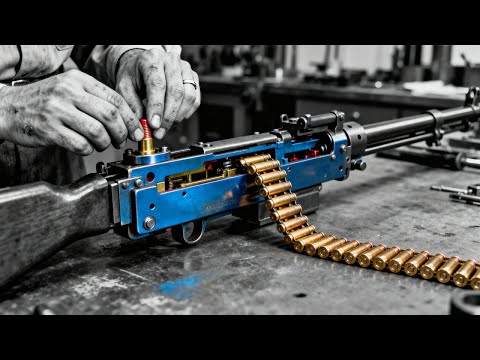
The problem begins in 1918 when John Moses Browning, America’s greatest gun designer, creates his masterpiece: the .50 caliber M2 machine gun. It’s a marvel of engineering—powerful, reliable, capable of punching through armor at 1,000 yards. The ground version fires 450 to 550 rounds per minute, and it’s perfect for its role. But war changes. By 1940, aerial combat demands something different. Aircraft are faster, more maneuverable. Engagements happen in seconds, not minutes. The Army Air Corps needs their weapons to fire faster.
Springfield Armory, America’s premier weapons laboratory since 1777, takes the challenge. Their engineers are the best in the nation—men who’ve designed and tested countless firearms. They lighten the M2’s barrel, adjust the bolt weight, fine-tune the spring tensions. The result: the AN-M2 aircraft version, achieving 750 to 850 rounds per minute. It’s an improvement, but everyone knows it’s not enough.
Then comes 1943, and Black Thursday proves it catastrophically. Lieutenant General Ira Eaker, Eighth Air Force Commander, convenes an emergency meeting at his headquarters in High Wycombe, England. The room fills with his top brass: operations officers, intelligence analysts, armament specialists. They review gun camera footage showing German fighters attacking in waves, staying in the kill zone for mere seconds before breaking away. “We need 1,200 rounds per minute minimum,” declares Colonel Bud Peasley, a combat veteran who’s flown the missions himself. “Anything less, and we’re sending our boys up in flying coffins.”
The number seems impossible. The M2 is already operating at the edge of its mechanical limits. Push it harder and parts will fail. Springs will break. Bolts will crack. The weapon will destroy itself. Springfield Armory tries again. So does Colt Patent Firearms, another legendary American gun maker. Both companies pour resources into the problem. They experiment with lighter bolts, stronger springs, modified feed mechanisms. They run test after test on firing ranges, pushing the cyclic rate higher. The weapons explode—literally. At 1,000 rounds per minute, receivers crack from the stress. Bolts shatter. In one test, a Springfield prototype achieves 997 rounds per minute before the barrel extension fails catastrophically, sending shrapnel across the range. The weapon is declared unsatisfactory due to excessive stoppages and short part life.
By January 1944, the expert consensus is clear: physics won’t allow it. You cannot make a .50 caliber Browning fire 1,200 rounds per minute without fundamentally redesigning the weapon from scratch—a process that would take years the Allies don’t have. The stakes couldn’t be higher. Every day, formations of B-17s and B-24s lumber toward Germany, their gunners armed with weapons firing too slowly against fighters moving too fast. In February 1944 alone, the Eighth Air Force loses 299 heavy bombers. That’s nearly 3,000 trained aircrew dead, wounded, or imprisoned. Fighter escort helps—by spring 1944, P-51 Mustangs with drop tanks can accompany bombers all the way to Berlin. But fighters can’t be everywhere at once. Bombers still face gaps in coverage. And in those gaps, German fighters strike with devastating effect.
The pressure intensifies. In Washington, General Arnold demands answers. In England, bomber crews refuse to fly, citing inadequate defensive armament. Morale plummets. The entire strategic bombing campaign—the Allied plan to destroy Nazi Germany’s industrial capacity from the air—teeters on the edge of collapse. What the military needs is a miracle. What they’re about to get is something better: engineers who think differently because they’ve never been taught the right way to design guns. Men who’ve spent their careers making refrigerators cycle efficiently, who understand heat dissipation and rapid mechanical motion in ways weapons designers never considered. The impossible is about to become possible.
Frigidaire Division of General Motors, Dayton, Ohio—a sprawling industrial complex where 8,000 workers manufacture refrigerators, air conditioners, and ice machines. It’s February 1944, and the war has transformed this civilian factory into a military production powerhouse. They’re making Browning .50 caliber machine guns—the standard M2 model contracted by the War Department. Thomas “Tommy” Olmstead stands in the testing bay watching another M2 chatter through its acceptance trials. He’s 34 years old, a mechanical engineer who joined Frigidaire straight out of Purdue University in 1932. For 12 years, he’s designed refrigeration systems—compressors, heat exchangers, rapid cycle mechanisms. He’s never designed a weapon in his life. Beside him stands Ernest “Ernie” Lindon, 41, Frigidaire’s chief production engineer. Before the war, Lindon revolutionized home refrigeration by developing a compressor that cycled faster while generating less heat. His innovation cut power consumption by 30% and made Frigidaire the market leader. Neither man has military weapons training. Neither attended Springfield Armory’s ordnance school. They’re civilians thrust into wartime production, and they’re acutely aware of their amateur status.
“Army rejected the Springfield high-speed prototype again,” Olmstead says, reading the technical bulletin that arrived that morning. “Receiver cracked at 1,150 rounds per minute.” Lindon studies the bulletin over Olmstead’s shoulder. The failure mode is always the same: excessive heat buildup, metal fatigue, catastrophic structural failure. Every military expert has concluded it’s impossible to push the Browning design beyond 900 rounds per minute safely. But something bothers Lindon. He spent 15 years solving a nearly identical problem in refrigerators. Rapid mechanical cycling without heat-related failure. A refrigerator compressor cycles thousands of times per hour, month after month, year after year, without breaking down. The secret isn’t stronger parts. It’s better heat management and timing.
“You thinking what I’m thinking?” Olmstead asks.
“This isn’t a strength problem,” Lindon replies slowly. “It’s a thermodynamics problem.” They’re standing in a room full of workers who build machines that move heat efficiently. They understand rapid mechanical cycles. They know how to make metal parts operate at extreme speeds without overheating. But they’re not gun designers, and that lack of credentials makes them hesitate.
The moment of insight comes during a coffee break. Three days later, Olmstead is sketching refrigeration diagrams on a napkin, showing Lindon a new compressor design that cycles 40% faster than current models. Lindon suddenly stops him. “The bolt travel,” Lindon says urgently. “In the Browning, the bolt has to travel the full distance every cycle. But what if we could reduce the distance without changing the cartridge feed?” Olmstead’s eyes widen. “Lighter bolt, shorter travel, same spring force ratio. The cyclic rate increases automatically,” Lindon finishes. “And heat disperses faster because the metal spends less time in the friction zone.” It’s a refrigerator engineer’s solution to a weapons problem. They have no idea if it will work. They have no authority to modify military specifications. They’re violating every protocol.
“We should at least try,” Olmstead says finally. What they don’t say aloud is the thought both men share: they’re probably about to waste weeks of effort on an idea that every weapons expert in America has already dismissed as impossible. They’re civilians playing at gun design, and they’re about to prove every expert wrong.
They start in secret, not because they’re trying to hide anything, but because they’re embarrassed. Two refrigerator engineers modifying one of John Browning’s legendary designs. If word gets out before they have results, they’ll be laughed off the factory floor. Olmstead requisitions a damaged M2 from the reject pile—a gun that failed quality control due to a cracked receiver, perfect for experimentation. They set up in a corner of the prototype shop after hours when the main shift has gone home.
The first modification is simple: reduce the bolt’s mass by 15% through careful machining. Olmstead, his hands more accustomed to refrigerator compressors than gun bolts, works slowly, checking measurements with calipers. “Lighter bolt means less momentum,” Lindon explains to the skeptical machinist they’ve sworn to secrecy. “Less momentum means faster acceleration and deceleration. It’s basic Newtonian physics.” The machinist, a 60-year-old veteran named Frank Kuzlowski, shakes his head. “Springfield Armory tried lightening the bolt. Gun tore itself apart.” “They probably didn’t adjust the recoil spring tension proportionally,” Olmstead replies. “They’re thinking like weapons designers. We’re thinking like thermodynamic engineers.”
Their second modification is more radical. They redesign the barrel extension—the part that connects the barrel to the receiver—to reduce the bolt’s travel distance by exactly 0.187 inches. It’s a tiny change, barely noticeable to the eye, but in high-speed cycling, those fractions of an inch translate to dozens of additional shots per minute. Then comes the accelerator: a small lever that uses the recoiling barrel’s momentum to give the bolt an extra kick backward. It’s inspired by the boost compressor Lindon designed for industrial refrigeration units, which used momentum transfer to increase cycle speed without additional power input.
They work for three weeks, refining, adjusting, testing components individually. Kuzlowski fabricates parts to their specifications, muttering under his breath about college boys playing with guns, but he’s precise and his machining is flawless. Finally, on March 22nd, 1944, they assemble their modified weapon. It looks almost identical to a standard M2. The changes are internal, invisible to casual inspection. They mount it on a test stand at the company’s small firing range, used normally for quality control checks. Olmstead loads a 200-round belt. Lindon sets up a mechanical counter to measure cyclic rate. Both men are nervous.
“If this explodes,” Olmstead says, “we’re going to look really stupid.” Lindon grins tightly. “If it explodes, we’re going to be deaf. Did you bring ear protection?” They both laugh—a release of tension—then step behind the protective barrier. Olmstead presses the trigger. The gun erupts. The sound is different. Sharper. Faster. A continuous roar instead of the M2’s familiar hammering. The barrel glows red-hot. Spent casings blur through the air. The mechanical counter spins wildly. When the belt runs empty, silence falls like a physical weight. Both men stare at the counter. 1,200 rounds per minute. Olmstead breaks the silence with a single word that captures both their disbelief and vindication. “Impossible.”
The gun sits on its mount, intact. No cracks. No failures. Still functional. They’ve just created America’s fastest machine gun, and nobody outside this room knows it exists. Convincing the military proves harder than solving the engineering problem. Olmstead and Lindon prepare a formal proposal documenting their modifications with engineering drawings and test data. On April 5th, 1944, they present it to Major James Hartley, the Army Ordnance Liaison officer stationed at Frigidaire to oversee production contracts. Hartley reads the proposal in silence, his expression darkening with each page.
“Gentlemen, do you understand what you’re suggesting?” he finally says. “You’ve modified a standardized military weapon without authorization. That’s a violation of your production contract. You could lose the entire manufacturing license.” “We increased the cyclic rate by 50%,” Lindon counters. “Springfield Armory has been trying to do this for two years.” “Springfield Armory,” Hartley says coldly, “employs weapons experts with decades of experience. You make refrigerators. No offense intended, but you’re out of your depth.”
Olmstead produces a document—their test data, meticulously recorded. “With respect, Major, our depth is exactly what solved this problem. We approached it as a thermodynamics and rapid-cycling challenge, not a weapons challenge.” Hartley barely glances at the numbers. “I’m required to forward unauthorized modifications to Springfield Armory for evaluation. They’ll test it, determine it doesn’t meet specifications, and we’ll all move on.” The meeting ends badly. Olmstead and Lindon return to the factory floor deflated. Their innovation is going to die in bureaucratic channels, evaluated by the same experts whose conventional thinking couldn’t solve the problem.
But three people were listening through the conference room door—workers from the assembly line who’d heard rumors about the secret fast gun. Within hours, word spreads through the factory. By the next day, it reaches Charles Wilson, president of General Motors, who oversees Frigidaire. Wilson makes a phone call. Two weeks later, on April 19th, 1944, a converted B-25 Mitchell bomber lands at Wright Field in Dayton. Out steps Brigadier General Grandison Gardner, chief of the aircraft laboratory’s armament section, accompanied by three colonels and a team of ordnance engineers from Springfield Armory.
The Frigidaire testing range has been transformed: sandbag barriers, target arrays, high-speed cameras. Olmstead and Lindon have prepared three identical modified weapons for demonstration. General Gardner is cordial but skeptical. “Mr. Olmstead, Mr. Lindon, I’ve read your test data. I’ve also read Springfield Armory’s evaluation, which questions your measurement methodology.” Colonel Marcus Chen from Springfield Armory steps forward. “General, if I may—these gentlemen have no ordnance training. Their modifications violate established design principles. The bolt mass reduction alone should cause catastrophic timing failures.”
The room erupts in cross talk. Engineers arguing specifications, officers citing regulations. The Springfield Armory team is polite but dismissive. They’ve seen countless amateur gun designers over the years, all convinced they’ve revolutionized firearms design. None ever have. “Gentlemen,” Gardner’s voice cuts through the noise. “Let’s settle this the old-fashioned way. We test it.”
They mount a standard M2 on the first test stand, one of Frigidaire’s modified guns on the second. Side by side. Same ammunition lot. Same environmental conditions. High-speed cameras rolling. The M2 fires first—the familiar hammering rhythm, 800 rounds per minute. Reliable. Proven. The weapon every bomber crew trusts. Then Olmstead triggers the modified gun. The difference is immediate and unmistakable. The cyclic rate is visibly, audibly faster. The high-speed cameras capture what the human eye cannot: the bolt cycling in a blur, brass casings ejecting in a golden stream, the mechanism operating with mechanical precision that shouldn’t be possible.
When both guns fall silent, Gardner walks to the modified weapon. He examines the receiver, the barrel, the bolt. He’s looking for cracks, for stress fractures, for any sign of the catastrophic failures Springfield’s high-speed prototype suffered. There are none. Colonel Chen looks like he swallowed something bitter. “General, we should conduct extended testing—heat cycling, endurance trials, environmental—” “How soon can you have production drawings ready?” Gardner interrupts, turning to Olmstead. “Sir?” Olmstead blinks, uncertain he heard correctly. “Production drawings. We’re designating this the T-25E3 if it passes the formal trials. And gentlemen, I believe it will. We’re putting it into immediate production.”
The room falls silent. Colonel Chen opens his mouth to protest, then closes it. The numbers don’t lie. Neither do the cameras. General Gardner extends his hand to Olmstead, then Lindon. “Congratulations. You two civilians just did what our best weapons experts couldn’t. You gave us the fastest machine gun in the world.”
The formal designation comes through on July 12th, 1944: T-25E3 experimental high-speed .50 caliber aircraft machine gun. By September, the first production models roll off Frigidaire’s assembly line, now designated the M3. Initial production: 200 units per month. It’s too late for the Schweinfurt crews, too late for the thousands who died in the bloody air battles of 1943 and early 1944. But it’s not too late for the war.
The first combat tests happen in November 1944 aboard P-82 Twin Mustang fighters conducting ground-attack missions over France. Pilots report the increased rate of fire with almost religious reverence. Captain James “Jimmy” Murphy, Eighth Air Force, files a report that becomes legendary: “Fired three-second burst at a German halftrack. Target simply disintegrated. Never seen anything like it. Request immediate rearmament of entire squadron.” The mathematics of aerial combat have changed. Where the AN-M2 delivered 40 rounds in a three-second burst, the M3 delivers 60. That’s 50% more rounds on target in the same brief moment a fighter pilot has the enemy in his sights. In aerial combat, where victory is measured in split seconds, it’s the difference between a miss and a kill.
But the real validation comes in the Pacific theater. February 16th, 1945. Okinawa invasion preparations. The carrier USS Hancock launches F6F Hellcat fighters armed with the new M3 guns for combat air patrol. At 1420 hours, radar picks up incoming bogeys: 12 Japanese A6M Zero fighters attempting to intercept American bombers. Lieutenant Robert “Bob” Paulson leads the Hellcat section that intercepts them. He’s 23 years old, from Milwaukee, Wisconsin, with 11 confirmed kills. He’s never fired the M3 in combat before. Paulson rolls into position behind a Zero at 8,000 feet. The Japanese pilot sees him, breaks hard left. Paulson follows, pulls lead, fires a two-second burst. 60 rounds in two seconds. The Zero’s wing tears away. The aircraft tumbles into the Pacific.
“Oh my God,” Paulson says into his radio. “This thing is incredible.” In the furball that follows, Paulson’s four-plane section shoots down seven Zeros without loss. Their gun camera footage reaches fleet headquarters that evening. Admiral Marc Mitscher, commander of Task Force 58, watches it three times. “Get me production numbers,” he tells his staff. “I want every fighter in this fleet rearmed with those guns by March.”
The kill ratios tell the story. Before the M3, American fighters averaged 2.7 aerial kills for every friendly aircraft lost. After the M3, the ratio climbs to 4.1 to 1. It’s not the only factor—pilot training, radar technology, and tactical doctrine all play roles—but the increased firepower is significant. Japanese pilots notice. Captured intelligence documents from March 1945 include interrogation reports of a downed Zero pilot named Saburo Endo. His testimony, translated by US intelligence officers, becomes part of the historical record: “American fighters fire differently now. The sound is continuous, like tearing cloth. Before, you could count the bullets—tack, tack, tack. You had moments to maneuver between the shots. Now there are no moments. The bullets are a wall. You cannot fly through them. Many of our experienced pilots die in seconds now—pilots who survived years of combat. We cannot explain the change to our new pilots. They must see it themselves before they believe. Usually, they do not survive seeing it.”
The M3’s impact extends beyond air-to-air combat. In ground-attack roles, the increased rate of fire proves devastating against soft targets. On March 15th, 1945, P-47 Thunderbolts armed with M3 guns strafe a German armor column retreating across the Remagen Bridge. After-action reports document 37 destroyed vehicles in a single pass—a density of fire impossible with the older guns.
The strategic impact becomes clear in the war’s final months. B-29 Superfortresses bombing Japan receive M3 armament in their defensive turrets. Gunners report Japanese fighter attacks breaking off earlier, staying outside effective range longer. The psychological impact of facing 2,000 rounds per minute affects enemy tactics as much as the physical destruction. Staff Sergeant William Chen—no relation to the earlier Sergeant Chen from Black Thursday—serves as a tail gunner on the B-29 Lucky Lady during missions over Tokyo. His diary, preserved in the Air Force Historical Research Agency, includes this entry from April 28th, 1945: “New gun is something else. Fast doesn’t describe it. When you pull the trigger, it’s like opening a fire hose. [Expletive] fighters won’t press their attacks anymore. They’ll make one pass, see the tracers, and break off hard. Before they’d bore in close. Now they’re scared. Can’t say I blame them. I’m scared of this gun and I’m the one firing it.”
By war’s end, 2,400 M3 guns have been produced. It’s a fraction of the hundreds of thousands of M2s in service. The war ends before mass production scales up. But those 2,400 guns serve in critical roles: elite fighter squadrons, long-range bomber defenses, high-priority missions where every advantage matters. Casualty statistics for aircrew equipped with M3 guns show a 23% reduction in combat losses compared to units with standard armament. That’s not just numbers. That’s 1,680 airmen who come home alive. Husbands, fathers, brothers, sons—saved by two refrigerator engineers who thought differently.
The official Army Air Forces Technical Order 11-5-26, issued June 1st, 1945, includes this assessment: “The M3 .50 caliber machine gun represents a significant advancement in aircraft armament, providing American forces with a decisive firepower advantage in both air-to-air and air-to-ground roles. Its increased cyclic rate of fire directly contributes to mission success and aircrew survivability.” Buried in that dry military prose is a simple truth: Tommy Olmstead and Ernie Lindon, civilians who never designed a weapon before, created something that saved American lives. And they did it by refusing to accept that the impossible couldn’t be done.
The M3 machine gun continues in US military service long after World War II ends. During the Korean War, F-86 Saber jets armed with six M3 guns dominate MiG-15s in aerial combat, achieving a kill ratio of 7 to 1. In Vietnam, helicopter door gunners mount M3s for suppressive fire. The weapon that Frigidaire engineers created in 1944 remains in active service until the 1990s—a 50-year operational lifespan. Modern variants still serve today. The FN M3P, manufactured by FN Herstal, equips US military helicopters and gunships. The basic design Olmstead and Lindon pioneered—lighter bolt, shorter travel, optimized heat management—remains fundamentally unchanged. Contemporary weapons designers study their work as a masterclass in innovative engineering.
Tommy Olmstead never sought recognition. After the war, he returned to refrigeration design at Frigidaire, developing commercial cooling systems until his retirement in 1967. He gave one interview to the Dayton Daily News in 1955 on the 10th anniversary of V-J Day, and his words reveal the humility that characterized his entire career: “Ernie and I just applied principles we knew from refrigeration. We weren’t trying to revolutionize anything. We just thought maybe a different perspective might help. The real heroes are the airmen who flew the missions. We just gave them a slightly better tool.”
Ernie Lindon was similarly modest. He remained at Frigidaire, becoming vice president of engineering, but rarely discussed his wartime work. In a 1963 letter to a military historian researching the M3’s development, he wrote: “The weapon succeeded because we didn’t know enough about gun design to know what was impossible. Sometimes ignorance is an advantage. We weren’t limited by assumptions that experts take for granted.”
The technical legacy is profound. The M3’s development validated an engineering principle that has influenced weapon design ever since: sometimes the solution to a problem lies outside the field where the problem exists. Thermodynamic engineers solved a weapons problem. That cross-disciplinary approach—now called lateral thinking—became standard in military R&D. In 1989, when the US Army adopted the Avenger air defense system, they chose the FN M3P over other candidates specifically because of its proven reliability heritage. The citation noted: “Design principles established in 1944, Frigidaire development program, continue to demonstrate superiority in modern applications.”
Recognition came late, but it came. In 1994, on the 50th anniversary of the M3’s development, the Air Force Historical Foundation awarded posthumous citations to Olmstead, who died in 1979, and Lindon, who died in 1988. Their families attended the ceremony at the National Museum of the United States Air Force in Dayton—appropriately, only miles from where two refrigerator engineers once worked late nights on an impossible problem.
The real legacy isn’t the weapon itself. It’s the lesson their story teaches: expertise matters, but fresh perspectives matter more. The willingness to question accepted limitations. To approach old problems with new thinking. To try when everyone says it can’t be done. That’s what changes history. Tommy Olmstead and Ernie Lindon were just trying to help. They succeeded beyond anyone’s imagination. And in doing so, they saved thousands of American lives with a machine gun that everyone said was impossible to build. The impossible, as it turned out, just required thinking like a refrigerator engineer.
What’s the most unlikely source of a world-changing idea you’ve ever encountered—and could the next breakthrough be hiding in a field you’d never expect?
Report this article
Select a reason for reporting:






