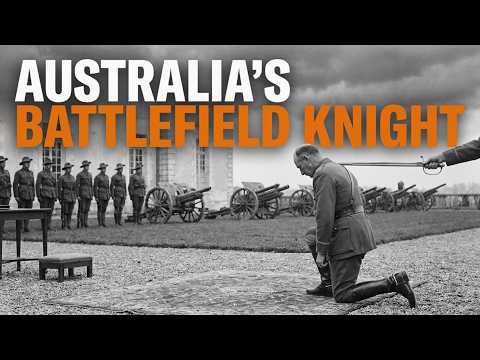
On the 12th of August 1918, a square of carpet was laid in the forecourt of a chateau at Bertangles, just outside Amiens. On it stood a small table, a footstool, and a drawn sword. Behind the carpet, rows of captured German guns and howitzers lined the lawns—trophies from a battle fought only four days earlier. King George V called a name. An Australian general of 53 stepped forward, stopped before the king, and at a sign, went down on one knee. The king took up the sword. This was the first knighthood given to a commander in the field in nearly two centuries, and the man on his knee was Lieutenant General John Monash—a soldier who had never been a professional soldier, a civil engineer who built in reinforced concrete, and a Jew of Prussian descent born in Melbourne. Very little about him matched the picture of a British general.
Four days before that carpet was laid, in dense fog at 4:20 in the morning, four of his Australian divisions had broken into the German line in front of Amiens and kept going toward their final objective. The fifth went in the next morning. The German general Erich Ludendorff would later call it “the black day of the German army in the history of this war.” The 8th of August had put the decline of the army’s fighting power beyond all doubt, he wrote, and the war would have to be ended. The Kaiser himself said they had nearly reached the limit of their powers of resistance. And yet, the honor the king bestowed at Bertangles was not quite what it seemed. The knighthood had been announced seven months earlier, before Monash had even commanded the corps. What was new was the ceremony—the king in person, at Monash’s own headquarters, with the captured guns standing behind them. But the record is unusually complete: the film, the letter Monash wrote, newsreel of the prime minister’s visit, and the German memoir. Hold on to the number four. Four days from the battle to the carpet. And through May and June, two Australians—Charles Bean, the official war correspondent, and Keith Murdoch, the journalist—had been working to get Monash moved out of the corps command altogether. They wanted the corps given to Major General Brudenell White, and they kept at it for more than two months. The general the king knighted at Bertangles was the general two of his own countrymen had been trying to shift.
John Monash was born on the 27th of June 1865 in West Melbourne, the eldest of three children and the only son. His father’s people had lived for generations at Krotoszyn in the Prussian province of Posen. In the mid-1870s, his father opened a store at Jerilderie in New South Wales, and from 1875 to 1877 John went to the public school there. Back in Melbourne, he attended Scotch College. He matriculated at 14 and in 1881 finished as equal dux of the school. At the University of Melbourne, he enrolled in arts and engineering—and failed his first-year examinations. Then he found a post on the building of Princes Bridge over the Yarra and stayed on it for more than two years. Early in 1888, he was given charge of construction on the Outer Circle railway line through the eastern suburbs. The degrees came slowly around the work. He took out his engineering degree in 1891, a master’s in engineering two years later, and arts and law in 1895. He married Hannah Victoria Moss in April 1891, and their only child, Bertha, was born in January 1893. In between, he took a post with the Melbourne Harbor Trust. In April 1894, he went into private practice with his friend J.T. Noble Anderson. Anderson held the Victorian rights to the Monier system of reinforced concrete—steel set inside the concrete to carry the load—and the partners built with it. Not all of it went well. One of their bridges at Bendigo collapsed under testing, and they rebuilt it at their own cost. The Shire of Corio and Bannockburn refused the final payment on the partners’ bridge at Fyansford, and early in 1902 the Supreme Court of Victoria found for the shire. One of his early works was the Anderson Street Bridge in Melbourne. In 1905, he formed a company to do the work: the Reinforced Concrete and Monier Pipe Construction Company. By 1913, Monash was worth more than £30,000.
The soldiering ran alongside all of it. He had first put on a uniform in 1884 as a private in the university company of the 4th Battalion, Victorian Rifles. In April 1887, he became a probationary lieutenant in the North Melbourne battery of the garrison artillery. Captain came in 1895. In 1897, he was made major and given the battery to command, and he kept it for 11 years. In 1908, he took over the Victorian section of the Australian Intelligence Corps as a lieutenant colonel. And in 1913, he was given the 13th Infantry Brigade as a colonel. By the time the war came, he had been a part-time soldier for 30 years, and he had never served a day as a regular. In the war itself, he took the 4th Brigade to Gallipoli and then the 3rd Division to Messines in 1917. None of that is the story here. What matters is the Australian Corps.
The five Australian divisions in France had been brought together under that name, and until the end of May 1918, they were commanded by a British general, William Birdwood. Then Birdwood was given the British Fifth Army, much against his own wishes. At 11 o’clock in the morning on the 31st of May, Birdwood and his chief of staff, Brudenell White, shook hands with the staff and drove off to take over their new army. Birdwood kept command of the Australian Imperial Force as a whole, and he recommended Monash to follow him at the corps. From the 1st of June, Monash was a lieutenant general, and for the first time the five Australian divisions in France were commanded as one body by an Australian. He had held the job for a little over 10 weeks when the king came to Bertangles. That appointment was what Bean and Murdoch went after. The Australian cabinet had approved Monash’s promotion in May. Murdoch cabled Prime Minister Billy Hughes and the acting prime minister at home, William Watt, urging them to hold off, and Hughes put the cabinet’s decision on hold until he reached London. The plan the two men pressed put Brudenell White in command of the corps and moved Monash up to command the Australian Imperial Force in Birdwood’s place. It sounded like a promotion. In practice, the post was largely administrative, and it would have taken Monash away from the fighting divisions.
On the 1st of June, Bean wrote in his diary that their effort had come too late, and the next day he wrote to Murdoch to concede. Then Hughes and his colleague Joseph Cook reached London in the middle of June, and it all started again. Within days, Bean was writing that Hughes was convinced. As Bean recorded it, Hughes cabled home that one command must go to Monash and the other to White, and that he wouldn’t decide which until he had seen White. White himself had neither sought any of this nor encouraged it. He had gone with Birdwood to the Fifth Army as planned. Monash knew about the campaign. When Bean called to congratulate him on his promotion to temporary lieutenant general, Monash told him he’d sooner go back to Australia than take the London post, and that everything he did in the matter he did out of complete loyalty to Birdwood. Bean still came away thinking he had more than half won him round. Either post would have been a step up. The Australian Dictionary of Biography puts it plainly: he was determined to test himself in the field at the head of a corps. Through June and into July, his position hung in the balance. He was planning a battle at the same time.
Hughes went to see for himself. On the 2nd of July, he and Cook called at the headquarters of the 5th Division at Sailly-le-Sec near Amiens, and the next day at the 2nd Division’s headquarters at Cam. A newsreel camera went with them, and the National Film and Sound Archive holds the result: 2 minutes and 36 seconds of it. Hughes gets out of the car first, and Monash follows him wearing an armband you can pick out across the frame. Cook speaks to a parade of Australian soldiers while Hughes, Monash, and Birdwood stand and listen. The two men who had started the whole business aren’t in the film. Off camera over lunch at Sailly-le-Sec on the first day, the commander of the 5th Division, Talbot Hobbs, told Hughes that he backed Monash. The other divisional commanders backed him too, and many of them were angry that two pressmen had interfered. Two days among the Australian headquarters were enough. Hughes realized that Murdoch and Bean had misled him, and he settled it by letting Monash choose between the two posts, knowing which one he would take. Monash took the corps.
On the 4th of July at Hamel, his method worked for the first time. Amiens was planned as a blow by the whole British Fourth Army with the French First Army attacking alongside it to the south. The Fourth Army’s commander, General Sir Henry Rawlinson, first told his corps commanders about it on the 21st of July. Monash wrote afterwards that the strictest secrecy was ordered and that no secret was ever better kept. His own planning conferences for the corps were held at Bertangles on the 30th of July and on the 2nd and 4th of August. Inside the Fourth Army, the British III Corps had the ground north of the Somme. South of the river, the attack belonged to two corps standing shoulder to shoulder: the Australian and the Canadian. And the Australians would go in from the ground in front of Villers-Bretonneux. The Canadians had to be brought down from the north without the Germans noticing. A detachment of two battalions, a wireless unit, and a casualty clearing station was sent to the front near Arras to make the Germans think the whole Canadian Corps was moving north into Flanders. Notices told every man to keep his mouth shut, and in the orders, the whole operation was called a raid. The hour of the attack wasn’t fixed or passed on until noon on the day before. Monash made his own adjustments. He placed his 4th and 5th Divisions closer to the start line, even though they wouldn’t attack first, and it cut 5 kilometers off the distance they’d have to march before they could fight. Along the whole army front stood about 2,000 guns. Ahead of the infantry would go the tanks. Monash counted 160 on his own front. Their routes forward were marked out on the ground with black and white tape. The totals given for the tanks across the whole attack don’t agree with each other, though several put them at more than 500.
Tanks allowed. For an hour before dawn, on several mornings before the battle, bombers flew up and down over the line so the Germans would get used to the sound. And on the morning itself, the planes kept flying to cover the noise of the engines. Behind the tanks waited armored cars and cavalry for the moment the line broke open. On the last night, a gunner named Armitage wrote in his diary that everything was utterly still and that the silence was working on their nerves. At 4:20 on the morning of the 8th of August, in dense fog, about 2,000 guns opened almost as a single crash. Then the infantry went forward behind the barrage with tanks moving among them heading east. The 2nd and 3rd Australian Divisions went first against the first objective, marked on the maps as the Green Line. At 7, Monash signaled from his headquarters that the heavy ground mist was helping the advance but holding up the news. By 7, the Green Line was theirs. Their part of the plan was done, and the rest of the morning belonged to the two divisions coming up behind them out of the fog. Then the 4th and 5th Divisions came up through them and took the advance on into open country, past the Red Line toward the day’s final objective, the Blue Line, which ran along the old outer defenses of Amiens. By midday, they held most of it. At a quarter to 12, Monash reported that Hobbs had taken Harbonnières and reached the Blue Line, and an hour later that an Australian flag had gone up over Harbonnières at noon.
East of the village, the 31st Battalion of the 5th Division came on a German railway gun. Its barrel was 28 centimeters across. It was a naval gun that had once been mounted in the German battleship Hessen, and in France it sat on a railway mounting. Men of the battalion and Australian engineers took it. Lieutenant George Burrows was decorated for his part in the capture. After the war, the gun was shipped to Australia. The barrel stands at the Australian War Memorial in Canberra today. Through the gap went the armored cars, British machines of the 17th Armored Car Battalion working with the Australians. Fallen trees blocked the road, and a tank was used to clear them. While pioneers helped open the way at the Blue Line, three sections of cars were sent down the road to Fouilloy, where a German corps had its headquarters, and a signal later reported an Australian flag flying over it. At Proyart, the cars found German troops billeted in the houses and sitting down to lunch, and they fired in through the windows. On the road, they put rounds into the boilers of German steam wagons and left them as a block across it. Near Foucaucourt, a German gun blew the wheels off one of the cars. After the war, Monash printed the car’s own report in his book on the campaign.
Measured the day the way the generals did—in ground taken—the Australians went 11 kilometers. On their right, the Canadians went 13, further than the Australians after a move from the north made in secret. North of the Somme, the British III Corps stalled on the high ground at Chipilly, and the ridge it couldn’t take on the 8th was taken on the 9th by three battalions of the American 33rd Division, who came off it with 700 prisoners and 30 guns. Across the whole front of attack, the average was about 11 kilometers. At 8 that evening, Monash signaled that the day’s prisoners would greatly exceed 6,000, with a hundred guns, heavy and railway guns among them. The final count is harder to pin down than it ought to be. The strategist published by the Australian Strategic Policy Institute gives the corps 7,295 prisoners and 173 guns for about 2,000 casualties of its own. Monash’s own book gives the same 173 guns. A history of the 22nd Battalion puts it at more than 7,000 prisoners and more than 300 guns. The memorial’s own total for the Allied armies together is 29,144 prisoners and 338 guns, which shows the scale of the thing without settling the Australian share. On the prisoners at least, the Australian counts sit close together. A single corps took more than 7,000 of them between dawn and dusk and paid for it with about 2,000 casualties.
Ludendorff wrote that by the early part of the morning of the 8th, he already had a complete impression of the situation, and it was a gloomy one. The attack, he wrote, came out of a dense fog made thicker by artificial means by the British with mainly Australian and Canadian divisions and strong squadrons of tanks. Divisional staffs had been surprised in their headquarters by tanks. When Monash quoted the passage in his own book, he added a note that it was the armored cars. Whole bodies of German soldiers, Ludendorff wrote, had surrendered to lone troopers, and men falling back had shouted at a fresh division going forward, calling them “blacklegs” and telling them they were prolonging the war. He gave the day the name it still carries: “the black day of the German army in the history of this war.” The 8th of August had put the decline of the army’s fighting power beyond all doubt, and the war would have to be ended. He asked his chief, the field marshal, to replace him if he no longer had full confidence in him. And the field marshal refused. On the 11th, the Kaiser himself said they had nearly reached the limit of their powers of resistance and that the war must be ended.
The next four days were harder. On the morning of the 9th, the 1st and 2nd Australian Divisions took up the attack, and over the following days, the advance went on through villages like Lihons and Proyart. There were fewer tanks now, and the losses were heavier for less ground. By one count, the 8th had cost the corps about 2,000 casualties. By the count of the Department of Veterans Affairs, the whole offensive cost about 6,000, most of them between the 9th and the 12th. Then on the 12th, the king came to look at the ground. According to the memorial, the king came to the Australian Corps to inspect the battlefield. Monash heard he was coming only the day before and asked one of his staff, Major Walter Brier, to find a suitable sword. The nearest one was in storage at Abbeville, about 50 kilometers away. It belonged to Major Edmund Mill of the corps staff, who went for it by car and had it back and cleaned in time. After the war, Mill gave the sword to Monash on condition that it went one day to the National War Memorial, and it’s in the memorial’s collection now. Corps headquarters was the chateau at Bertangles, a big house in its own grounds and park—the place where Monash had held his planning conferences for the 8th. Guns and other trophies were hauled in from the battlefield to line the avenues the king would come along. Monash wrote that 500 men who had fought in the battle were drawn up to watch, a hundred from each of his five divisions. The king was taken with the captured German transport horses and said he hoped they’d soon learn the Australian language.
The film shows the king arriving by car and walking past the captured German guns and howitzers on the lawns. It runs to 260 feet of 35mm film, about 5 minutes in all, and it’s silent. The reel doesn’t record a word. Monash’s letter gives the order of it. The square of carpet was in the center of the forecourt with the small table, the footstool, and the drawn sword on it. His name was called. At a sign from the king, he stepped forward and knelt, and the king touched him on the shoulder with the sword. Then the king bade him rise and put the insignia of a Knight Commander of the Bath into his hands. The photographs taken after the investiture show the king congratulating Monash on the steps of the chateau, the ribbon of a Knight Commander of the Order of the Bath around his neck and the captured German ordnance standing behind them. Brigadier General Griffiths is in the frame, and so, standing on the right, is Major General O’Keeffe, who will matter in a moment. The insignia Monash was handed—a badge for the neck and a star for the breast, made in silver gilt and enamel by Garrard and Company—are now in the memorial’s collection in Canberra.
The honor itself is the part that’s easy to misread. It had been announced in the New Year Honors of 1918, more than seven months before Bertangles, “for valuable services in connection with military operations in the field.” That was before Monash had the corps and before Hamel. What was new on the 12th of August was the delivery. The king gave it to him in person at his own headquarters, four days after the battle, with the captured guns standing on the lawn. He didn’t knight Monash alone that day either. The same day, Major General O’Keeffe, the director of medical services of the Fourth Army, was invested as a Knight Commander of the Order of St Michael and St George. O’Keeffe was a medical officer. The memorial’s line about a commander still holds, and the memorial’s own phrase is “nearly two centuries.” Charles Bean came back to the campaign of 1918 in a book published in 1957 and called his own part in it “a well-meant but ill-judged intervention.” He’d told the story in the official history, too. Field Marshal Montgomery would later name Monash as the best general on the Western Front in Europe. Monash left the AIF in November 1918 to bring the army home. As director general of repatriation, he saw 160,000 Australian soldiers back, almost all of them within eight months. In Melbourne, he took charge of the State Electricity Commission of Victoria, set up to turn the brown coal of Gippsland into power, and the power from Yallourn was switched on in 1924. From 1923 he was vice chancellor of the University of Melbourne, and from 1925 he led Melbourne’s Anzac Day march. In the last years of his life, the government made him a full general. Monash died in Melbourne on the 8th of October 1931 at his home, Iona. He was given a state funeral, and the crowds that came out for it were put at no fewer than 250,000 people—very likely the largest funeral Australia had seen to that time. He was buried in Brighton Cemetery with Jewish rites. Thirteen years earlier, the engineer from West Melbourne, who had taken his first commission in the garrison artillery in 1887, had knelt on a square of carpet at Bertangles with a row of German guns behind him. In 1958, a new university in Melbourne was named after him. On the 15th of May 1996, the Reserve Bank of Australia issued its first polymer $100 note. On the front is the soprano Nellie Melba. On the back is John Monash. The bank describes her as an internationally renowned soprano and him as an engineer, soldier, and civic leader—in that order. Seventy-eight years after Bertangles, the bank had put him on the largest note the country prints. When the Reserve Bank redesigned its notes, the new hundred went into general circulation on the 29th of October 2020. Melba is still on the front. Monash is still on the back.
And so the record closes where it opened: with a square of carpet, a borrowed sword, and a king who came to look at the ground his Australian corps had broken open. Four days from the black day of the German army to the knighthood on the lawn. Two pressmen had spent the early summer trying to move him; the men who fought under him had backed him instead. Ludendorff named the defeat; Monash took the call.
He went home to build bridges, light a state, and lead a university—and when he died, a quarter of a million people lined the streets. The engineer from West Melbourne, buried with Jewish rites, still stands on the back of the hundred-dollar note. The guns, the film, the letter, the sword—all of it kept, all of it matching.
So here is the question the record leaves with us: was Bertangles the reward for the 8th of August, or was the ceremony itself the real honor—a king kneeling history down in front of the men who won the day?
Report this article
Select a reason for reporting:






