June 22, 1944. Saipan. The sun had not yet risen, but the air was already thick with the smell of coral dust, salt, and death. Behind a wall of sandbags and jagged coral rock, a 26-year-old Marine corporal named Jack McFarland lay perfectly still, his eye pressed to a scratched field scope. He had not slept in two days. Beside him, another Marine breathed in slow, shallow gasps. Neither spoke. Across the valley, somewhere in the limestone caves and charred banyan trees, Japanese snipers were waking up. They would eat cold rice. They would clean the dust from their scopes. Then they would start killing Americans again at ranges no Marine on Saipan could match.
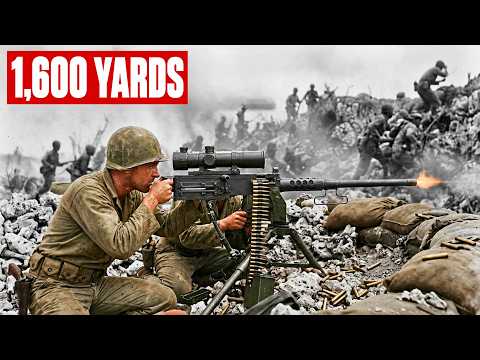
McFarland lowered the scope. He put his hand on the receiver of the weapon in front of him. It was not a rifle. It had never been a rifle. But this morning, for the first time in the war, it was about to be used as one.
Seven days earlier, the sea had seemed to boil. At 4:40 a.m. on June 15, 1944, the first wave of Marines crossed the reef off Saipan’s western coast, heading for a strip of black sand called Chalan Kanoa. The landing was ten minutes late. Vice Admiral Richmond Kelly Turner needed the waves to align better with his landing craft. In those ten minutes, the men crouched in the amtracs heard nothing but the muffled roar of engines and the faint, prayer-like breathing of the man beside them. Then the ramp dropped.
Corporal Jack McFarland fell into water up to his ankles and did not raise his head until he reached the sand. When he did, what he saw was nothing like the training films at Camp Pendleton. There was no orderly beach, no clear line of advance. There were craters the size of trucks, burning landing craft on the reef spewing thick black smoke into the windless heat. There were bodies—Marines still wearing their landing belts, half in the waves and half out, swaying with the tide as if trying to make up their minds. And above it all, dominating the island, was Mount Tapochau: 1,554 feet of volcanic rock and jungle, the highest point on Saipan.
From its summit, Japanese artillery observers had watched the American fleet for hours. They had surveyed every inch of the beach. They knew the exact coordinates of the coral heads offshore. They knew where the landing craft would come in. They knew where the Marines would set up their first aid stations. They had mapped it all in faint, neat handwriting, later found in a cave high on the slope.
By the evening of June 15, more than 2,000 Marines were dead or wounded. The 2nd Marine Division held a narrow strip of beach near Chalan Kanoa. The 4th Marine Division held a strip to the south near Agingan Point. Between them was a foothold, behind them the ocean, and in front of them a towering mountain.
McFarland spent that first night in a shell hole, listening to a wounded corporal call for his mother, the voice growing fainter until it stopped. He did not know the man’s name. In the morning, at first light, McFarland crawled over and closed his eyes, because someone had to. Then he went to find his gun.
The gun was not new. It was almost as old as he was. John Browning had designed the M1917A1 Browning machine gun during the winter of the previous world war. And though the Marine Corps had newer weapons—the air-cooled M1919, the .50-caliber M2 anti-aircraft gun—the water-cooled M1917 was still in service across the Pacific. Marines loved it because it did not overheat. You could fire it all night if you had the ammo and the water. And on an island like Saipan, ammo and water were the two things men might kill each other for.
The gun weighed 41 pounds without the tripod. The M1917A1 tripod added another 53 pounds. The water in the jacket, when full, added 7 and 12 pounds. 101 pounds of steel, brass, and coolant, chambered for the standard American .30 caliber, fed from a cloth belt holding 250 rounds.
Corporal Jack McFarland was 26 years old, 5 feet 10 inches tall, and weighed 168 pounds after five weeks at sea. He had grown up on 80 acres of cornfields and pasture outside Cedar Falls, Iowa, the middle of three sons of a Protestant farmer who did not believe in raising his voice. McFarland talked the way his father did—quietly, and only when necessary. He listened more than he spoke, and watched more than he listened, which made him, in the eyes of his officers, the ideal machine gunner. A patient man behind a patient weapon.
His assistant gunner was Sergeant Thomas Harding, 29, from the South Side of Chicago. Harding had worked a metal press at a stove factory before the war, and his hands were like a boxer’s—thick, scarred, and fast. His voice was louder than McFarland’s. He laughed more. He complained more. Between them, over 18 months as a crew, they had developed a kind of silent understanding that was rare in the Army and rarer under enemy fire. When McFarland wanted a new belt, he did not ask. Harding was already loading it.
Above them, on paper, sat First Lieutenant Robert Phillips of the heavy weapons platoon. Phillips was 27, a University of Michigan graduate, and had a mustache. He was not old enough to know better, and he possessed something more valuable than tactical brilliance. He was willing to listen to enlisted men. That last quality was about to make a difference larger than any of them realized.
The doctrine was clear. In fact, the doctrine was so clear that no machine gunner in the Pacific had ever been asked to question it. The heavy machine gun was an area weapon. You did not aim it like a rifle. You pointed it at a general area—a tree line, a ridge, a suspected concentration of troops—and you squeezed the trigger and sprayed a cone of bullets across the field of fire while riflemen maneuvered. The weapon’s design was built entirely around this idea. The traversing mechanism let you sweep. The elevating mechanism let you raise and lower. The tripod, which weighed 53 pounds, was meant to absorb the recoil of continuous fire, not to lock the gun down for a single, deliberate shot. The manual stated that the effective range against point targets was 1,800 yards. No one believed it. No one tested it. At 1,800 yards, you might as well spray a hillside and hope to hit something.
Precision was the rifleman’s job. Long-range precision was the job of a designated marksman with a specialized rifle—a Springfield 1903 A4 with a Weaver 2.5X scope in the hands of a graduate of the Marine Corps sniper school at Camp Pendleton or Green’s Farm. McFarland was not that man. He had never attended sniper school. In fact, he had never fired a scoped rifle in the United States Marine Corps. What he had done for 8,000 hours of his childhood was walk quietly through the wooded creek bottoms east of the Cedar River, carrying his father’s old Springfield, waiting for a whitetail deer to appear in a gap. He had shot his first deer at 320 yards when he was 14, and his fifth at 680 yards. He had never taken a course in ballistics. He had never read a manual on trajectory. Everything he knew about long-range shooting he had learned from an old farmer with a Springfield and a notebook, and from thousands of hours of walking softly on wet leaves, and from watching a bullet arc toward an animal that was fighting hard to stay alive.
But that was not the war he had trained for. The war he had trained for was in front of him now, and its rules were not open to debate.
By June 18, the Marines had pushed inland enough to start taking casualties from a new direction. The Japanese defenders, under Lieutenant General Yoshitsugu Saito, had studied Saipan for years. Saito, 53, a cavalry officer from Tokyo who had served in Manchuria, had prepared his positions with the patience of a man who did not expect to survive the battle but intended to make the enemy pay. He had already expended his artillery, and his tanks were nearly destroyed. But his snipers, perhaps his most effective weapon on the island, he had deployed in small teams throughout the cave complexes on the western slopes of Mount Tapochau.
The snipers carried the Type 99 Arisaka rifle—a bolt-action 7.7mm weapon fitted with a 2.5x or 4x scope, one of the Japanese Army’s best-kept secrets. The cartridge produced almost no flash when fired. In the humidity of the Mariana Islands, at ranges of a thousand yards or more, an American observer would see nothing when a Type 99 fired. There was no smoke, no light, no sound until the bullet arrived, silent and perfectly aimed, and killed whatever it hit.
By June 20, McFarland’s battalion was losing men to fire from ridges that an M1 Garand could not reach. The Garand was effective at 500 yards. The Springfield sniper rifle, in trained hands, could reach about 800 yards. Beyond that, the American infantryman on Saipan was completely helpless. The Japanese knew this. They watched from 1,200 to 1,400 yards up the slope as McFarland’s platoon dug its foxholes on the edge of what would later be called Death Valley. They marked their targets and did not hurry.
Corporal Manuel Rodriguez died at 6:14 a.m. on June 20. He was checking a communication wire between the platoon command post and the forward observation post. He was 31, from El Paso, Texas. Married, with two daughters. The bullet entered his throat just below the jaw and traveled another 100 yards before lodging in the trunk of a charred ironwood tree. He was dead before Harding could crawl to him. No one heard the shot.
They found the entry wound, measured the angle, and Lieutenant Phillips plotted the direction along the ridge line. By his estimate, the bullet had come from somewhere in the cave complex at coordinate 175 Tango, about 1,400 yards to the northwest. 1,400 yards—nearly twice the effective range of an M1 Garand.
Rodriguez was carried to the beach that afternoon and laid in a row with 11 other Marines who had been killed since dawn.
Private Frank Johnson died the next morning, June 21, at about 10:07 a.m., while bringing water to his squad. He was 19. He was from a small town outside Baltimore that Harding had never heard of. The bullet hit him in the temple. This time, one of the men in the trench line thought he heard a rifle shot, but before he could place the direction, the shooter was gone.
That evening, the evening of the 21st, Lieutenant Phillips came to McFarland’s gun position with two things: a face pale with exhaustion and a piece of cardboard he had been drawing on for six days. “1,600 yards,” he said. He put the cardboard on a sandbag. “The far cave is 1,650, maybe 1,700. That’s where they’re shooting from. That’s where they’ve been shooting from since we got here.”
McFarland studied the cardboard without a word. Phillips repeated: “1,600 yards.” He rubbed his eyes. “Too far to answer.”
Harding, sitting cross-legged behind them with a rag and a can of oil, looked up from his cleaning kit and said nothing. He was watching McFarland. McFarland did not move. He was staring past the range card, past the sandbag, past the ridge line entirely. He was looking at his weapon. He was looking at the M1917A1. The way a man looks at something he has known all his life and suddenly does not recognize.
It was not the weapon that had changed. It was the way he was seeing it.
For 18 months of training and seven days of combat, Corporal Jack McFarland had understood the Browning M1917A1 as an area weapon. A hose. A broad brush. Something you pointed at a general place and used to keep the enemy’s head down. That was the doctrine. That was every manual he had ever read. That was every instructor who had stood behind him at Camp Pendleton and shouted about beaten zones and grazing fire and cone calculations.
But as McFarland sat there in the fading light on Saipan, with two of his friends already carried to the beach and a third about to join them if someone did not find a way to reach 1,600 yards, he began to see the weapon differently for the first time. He saw the tripod—a gun mount, a tripod, a sandbag, and water. A gun that did not move when fired. That tripod was the most stable firing platform any American infantryman had on Saipan. He saw the water jacket—a sleeve of brass and steel around the barrel that weighted the muzzle, dampened the vibration, and held the temperature steady through the first 400 rounds. He saw the ammunition—the standard .30-06 cartridge, the same cartridge fired by the Springfield 1903. The same cartridge he had loaded into his father’s rifle a thousand times as a boy. 2,740 feet per second at the muzzle. Effective in the hands of a skilled shooter to well beyond 1,000 yards. He saw the rate of fire—450 rounds per minute if you held the trigger down, but no one was forcing you to. A single round could be fired from an M1917A1, or a burst of three, or five, or twenty. It could be fired like a rifle, and it could be aimed.
McFarland had never thought about this before. No one had ever asked him to think about it. The doctrine did not want him to think about it. It wanted him to spray. But the doctrine had not answered the 1,600-yard question. The doctrine had not saved Rodriguez. The doctrine had not saved Johnson.
Later that night, in the dark of the gun pit, McFarland lay on his back on a folded half-shelter and stared at the black Pacific sky, brilliant with stars. He was thinking of a November morning in 1936, when he was 18, lying on his belly in the dry grass at the edge of a soybean field, three-quarters of a mile from a whitetail buck working its way along a treeline toward a scrape he had not yet seen. The rifle was a .30-06 Springfield, his father’s, with iron sights and a leather sling. There was no scope. There was no wind indicator. There was, in fact, no equipment at all except the rifle and the boy and a small notebook in his shirt pocket in which his father had written, three winters before, in precise pencil strokes, the drop and drift tables that McFarland had memorized before he memorized the Twenty-Third Psalm.
What he understood, lying there under the Pacific stars, was that his problem with the machine gun was not really a machine gun problem. It was a shooting problem. A shooting problem was what he had been solving since he was 14 years old. The Browning M1917A1 fired the same cartridge as his father’s Springfield. It dropped the same amount at the same distance. It drifted the same way in the same wind. The only difference was that instead of being braced against his shoulder, it was fired from a tripod weighing about 45 kilograms. Which meant that if it was steady enough—and it was always steady enough—the bullet would not miss because of the tremble of his hands. It would miss only if he got the wind wrong, or if he miscalculated the drop, and neither of those had happened in Iowa in a very long time.
The stars began to fade. Somewhere on the beach, a coral dust-down man was singing quietly to himself as he worked. Farther out in the dark of the reef, the wounded were being loaded onto a landing craft for evacuation.
McFarland got up. His shirt was soaked with sweat and coral dust. Tom, across the pit, stirred on his half-shelter. “Yeah.” “Tomorrow morning, before first light, I want to try something.”
There was a long silence. Harding was thinking. Then his voice came back in the dark, low and careful: “Try what?”
McFarland looked at his weapon. It stood tall and heavy on its tripod, its muzzle pointed north toward the ridge, its water jacket dull with condensation. He did not answer for a moment. And when he did, he did not speak the way a man speaks when he is proposing a simple idea. He spoke the way his father had spoken on the morning he first put a Springfield in his hands and said, “Now you will hunt.”
McFarland said: “I want to see how far this gun can really shoot.”
Above the ridge line, 1,600 yards to the north, the first faint threads of dawn were beginning to show. It was June 22, 1944.
The morning of June 22, 1944, began without wind. McFarland noticed it first. He had been awake since 2 a.m., and by 5 he was behind the gun, watching the pale eastern sky over Magicienne Bay turn slowly to gold. The smoke from a burning fuel depot three miles down the coast rose vertically, like a rope pulled from the sky. No crosswind at the muzzle. Perhaps no crosswind at 1,400 yards.
Beside him, Harding worked a stub of pencil on a ration carton, checking numbers—not a Marine sergeant’s numbers, but a mechanic’s. He handed the card to McFarland without speaking. McFarland read it. Nodded once. Then he began adjusting the elevating lever on the M1917A1.
He did not adjust it the way the manual said. The manual assumed you were sweeping a wide area. McFarland was aiming. He turned the lever until the muzzle sat exactly as Iowa hunters did, elevated just enough to compensate for eleven feet of drop across 1,400 yards of hot Pacific air. He tightened the traversing locks so the gun could only swing within a twenty-degree arc. He placed a sandbag under the front of the tripod and another behind his right shoulder. He was not going to fire a burst. He was going to fire one round.
Through a borrowed field scope, Harding watched the third cave from the left on the opposite ridge. At 5:22, as daylight grew, something moved. A Japanese soldier stepped out onto the natural balcony. He stretched. He lit a cigarette. “Jack,” Harding whispered. McFarland did not answer. He had already seen him.
He thought of Rodriguez. Not with anger. The way a man thinks of a face in a photograph—a wife, two small girls in matching Easter dresses, a little stucco house in El Paso with a desert-colored yard. He took a deep breath. Let half of it out. Squeezed the trigger the way a boy in Iowa once squeezed his father’s Springfield.
One round. Clean, sharp, its echo bouncing off the coral slopes behind them. The bullet took just over two seconds to arrive. The Japanese soldier never raised the cigarette to his mouth. The impact spun him half around and laid him gently on his side. Through the scope, McFarland watched the cigarette keep burning on the stone where it fell.
Behind the gun, Sergeant Thomas Harding lowered his field scope slowly and looked at McFarland. He did not smile. He did not swear. He said one word, very quietly: “My God.”
News travels fast in a Marine battalion. By 10 a.m., three riflemen from Baker Company had crawled over to inspect the gun. By noon, Lieutenant Phillips arrived with a thin, nervous intelligence captain named Whitaker, who carried a clipboard and asked questions McFarland and Harding did not want to answer. “You hit him,” Whitaker said. “You’re sure you hit him?” McFarland said. “With the machine gun.” Whitaker looked at the M1917A1. He looked at the jury-rigged scope mount, the sandbag under the tripod, the range card taped to the receiver, the small pile of .30-caliber casings on the coral beside McFarland’s right knee. Three casings. All that had been fired since dawn. He wrote something on his clipboard. He did not say what. Then he asked, in a voice that had become quieter and more careful: “Corporal, is there any chance of repeating that?” McFarland thought about it. “I don’t know, sir.”
The afternoon stayed quiet. Harding watched the ridge again through the scope and saw a Japanese observation officer walking slowly along a small rock ledge above the third cave. He carried binoculars around his neck and a map case on his hip, with the confident posture of a man inspecting his defenses. At 1,550 yards, McFarland fired one round. The officer’s binoculars swung out on their strap as his body folded at the waist from the impact. His body slid off the ledge and came to rest against a tree trunk. It did not move again.
By the evening of June 22, Corporal Jack McFarland’s M1917A1 had killed four men at ranges the entire United States Marine Corps had officially declared impossible.
Across the valley, in the caves on the ridge that had been considered impregnable since the American landing seven days earlier, something began to change. The Japanese began to feel fear. They did not know at first what was frightening them. Later, after the battle, when American translators reviewed the papers recovered from the bodies of Japanese officers on Saipan, they found scattered references in unit logs to what Japanese command called the “ghost sniper” of the western slopes. The reports assumed the killings were the work of a small, elite American sniper team, operating with unusual patience and unusual range. Countermeasures were ordered. Reinforcements were requested. A skilled sniper from the 47th Independent Mixed Brigade—a corporal who had won marksmanship awards at the Toyama Military School before the war—was reassigned from the northern defenses to hunt the American who was killing officers at impossible ranges from somewhere above Death Valley. He was looking for a rifle. He was looking for the wrong weapon, because the weapon was not hidden. It was in broad daylight, in the same machine gun position Japanese observers had been watching for a full week.
By June 24, the tactical situation in central Saipan began to shift, though most of the men fighting on the island could not see its outlines clearly. In Death Valley, where the U.S. Army’s 27th Infantry Division had been ordered to advance across open ground between two Marine divisions, the fighting turned into a slaughter. Japanese machine guns and mortars, dug into the hills on both sides, poured interlocking fire onto men who had nowhere to hide. That day, the hill east of the valley earned a name that would be remembered in every history written about the Marines and the Army afterward: Purple Heart Ridge.
Lieutenant General Holland M. Smith, the 62-year-old, red-faced, quick-tempered commander of the V Amphibious Corps, had been watching reports from Death Valley with a fury that had been building since the landings. Smith had been called mad throughout his career, for reasons that would soon become national news. He believed the 27th Infantry was moving too slowly, and that its commander, Major General Ralph C. Smith of the Army, was not driving his men hard enough. On June 24, Holland Smith did something no Marine officer had ever done in the history of the U.S. Army: he relieved an Army division commander in the middle of a battle. Ralph Smith was flown off Saipan. The scandal would poison interservice relations for the rest of the war. None of this was clear to McFarland. He was a corporal on a machine gun. He knew nothing of the fighting between generals.
All he knew was that on June 24, pressure along the American line increased, and the Japanese—thrown into confusion by the sniper of the 22nd—now began to reply with a coordinated intelligence they had not shown before. At 4 p.m. that day, a bullet cracked past McFarland’s head and buried itself in the sandbag two inches from his right shoulder. Harding dropped flat. A second round hit the coral barricade directly in front of the gun, spraying rock fragments across the position. McFarland slid sideways off his M1917A1 and lay perfectly still. “They’ve got us,” Harding said from the dust. McFarland said: “Yes. The hunter has become the hunted.”
Corporal Toyama had been on the ridge since the previous night. He had not at first believed the sniper was firing from the machine gun position. He studied that position through his own scope for six hours, then dismissed it as his officers had dismissed it—a routine heavy weapons emplacement. He searched for the sniper elsewhere: in an observation post among the ironwood shrubs, in a shell hole on the American forward slope, in a carefully concealed position behind a fallen tree. He found nothing. Then at 3:06 a.m. on the 24th, he saw a muzzle flash from the machine gun and, in the same instant, a Japanese soldier running across the causeway to the east, stumbling forward in mid-stride. The soldier was carrying a message. He was walking, not running, because he too believed he was outside American range. He was 1,580 yards from the machine gun.
Corporal Toyama lowered his scope. He thought in Japanese what the Japanese soldier in the third cave had said to himself two days earlier: “It cannot be the machine gun, but it is.” Then he began hunting it.
McFarland and Harding spent the afternoon of the 24th building a trap. They did it during the periods when Japanese observation was limited by the smoke rising from the artillery exchange on the ridge. They crawled on their hands and knees to avoid exposing their position to the eastern ridge. They took a spare barrel from a burned-out M1917 that a neighboring platoon had abandoned. They wrapped it in a piece of tarpaulin. They mounted it on a pile of sandbags fifty yards east of their real position, and placed a helmet on a broken entrenching tool behind it, so that any observer scanning the position through a scope would see what appeared to be the head of a gunner above the sandbags. Then they moved the real M1917A1 into a shallow depression in the coral behind them, six feet below the original pit, with a natural roof of ironwood roots above it. From this new position, their field of fire narrowed. They lost most of their coverage of the northern ridges, but they were nearly invisible to any observer above them. They spent the rest of the afternoon and most of the night recalculating. Every range card Harding had prepared over the past week was useless now. Every reference point they had memorized—the fallen ironwood trunk at 1,100 yards, the pale coral outcrop at 1,300, the small pyramid of rubble at 1,550—had to be re-imaged from the new angle. Distances changed. Elevations changed. The wind, which had been calm for two days, began to blow from the west, and McFarland realized, without needing to say it, that they were about to enter a phase of shooting where the margin for error shrank to zero.
They slept two hours, in shifts. Above them, on Mount Tapochau, a battalion of the 8th Marines and a battalion of the 29th Marines, under a smoke screen ordered by Holland Smith to be laid on the eastern flank, were about to make the boldest maneuver of the entire Saipan campaign. On the morning of June 25, they would climb the eastern slope of the mountain in single file, unseen, and reach the summit without losing a single man. By the evening of the 25th, the highest point on Saipan would be in American hands. The observation posts that had rained artillery on the beaches for ten days would fall silent, and the war on Saipan would enter, for reasons that had nothing to do with McFarland, its final and most savage phase.
At dawn on the 25th, before Tapochau fell, and before McFarland knew anything of it, a Japanese rifle bullet struck the camouflage helmet fifty yards east of him and knocked it into the coral dust. He was ready. He had been ready since 4 a.m. Through his scope, McFarland watched for the sign that would reveal the enemy sniper’s position. The sign came a second and a half later. A small puff of powder smoke, thinner than any smoke a Type 99 was supposed to produce, rose from a cluster of rocks on the ridge at about 1,500 yards. Corporal Toyama was skilled. He was better than any Japanese sniper McFarland would face on Saipan. He was using a rifle that was almost invisible, from a position that was almost invisible, at a range that would have dropped 99 out of 100 American snipers. But he had fired at a helmet mounted on a broken shovel, and McFarland had seen him do it.
McFarland adjusted the elevation two clicks. He read the wind from the smoke of a small brush fire on the nearby slope. Three miles per hour from the west. A slight correction at 1,500 yards for a right-handed shooter using a steady tripod. He fired one round. The bullet arrived two and a half seconds later. It struck three inches left of Corporal Toyama’s head, buried itself in the rock behind him, and sprayed limestone fragments across the side of his face. The corporal did not die. Something worse happened. From his point of view, he flinched, recoiled from his rifle, and rolled sideways for cover—and in that instant, with his body’s slight compression against the coral, he understood what the American machine gun on the distant ridge had just told him. He had entered, that morning, the field of view of a man who had been waiting for him for two days.
By the evening of June 25, Mount Tapochau had fallen. Marine observation posts now overlooked Japanese positions instead of the reverse. The strategic situation on Saipan had been turned upside down in eighteen hours. McFarland heard about it from a runner after dark, but he did not celebrate. He was cleaning the barrel of the M1917A1, running an oiled rag through it in the light of a shielded flashlight, and he only nodded when the runner told him. The runner asked him what was wrong. McFarland thought about it, and kept running the rag. Then he said quietly: “They’ll withdraw now. Into the caves. To the far north.” The runner did not understand. McFarland did not explain. He was thinking that when the Japanese withdrew into the caves at the northern end of the island, his 100-pound, tripod-mounted, water-cooled machine gun—a sniper’s dream—would have to move with the advance. It would have to be broken down. It would have to be carried across the same open ground the Japanese had been watching for ten days. The elevated pit, the ironwood roof, the range cards, the reference points—all of it would be left behind. He would be shooting from unprepared positions at unmeasured targets in terrain that had not yet been mapped. The great advantage of the Death Valley sniper, the so-called ghost sniper, was his stillness. But that stillness was about to end.
Above the northern horizon, the first stars of the Pacific night were beginning to appear over the caves where Lieutenant General Yoshitsugu Saito was, at that moment, planning a decision that would cost 3,000 of his men their lives, and would haunt the American Marines who survived him for the rest of theirs.
By July 1, the face of the war on Saipan had changed. The Japanese had been driven from the southern half of the island, and Mount Tapochau was under American control. Aslito Airfield in the far south had been renamed Isley Field, after Commander Robert H. Isley, a Navy pilot killed in the pre-invasion approach. American aircraft were flying combat missions from its coral runway. The 4th Marine Division was advancing east and north across the Kagman Peninsula, while the 2nd Marine Division fought its way up the western coast toward Garapan, the old Japanese administrative capital. The 27th Infantry Division, which had been mauled in Death Valley, advanced slowly in the center, and Corporal Jack McFarland advanced with them.
The M1917A1 came off its tripod on the morning of June 29. It weighed 41 pounds without the mount. The tripod weighed 53. The water that had collected in the jacket, when drained into the coral dust, made a small, disappointing sound, like a canteen poured out on a dry field. Harding wrapped the jury-rigged scope in a piece of oilcloth and fixed it in the inside pocket of his shirt, where he could feel it against his ribs as he walked. They left the sandbagged pit that had killed at least 11 Japanese soldiers in 8 days. They did not look back.
The advance north was not the advance they had trained for. At Camp Pendleton, they had trained to move as a heavy weapons crew: one man carrying the gun, one carrying the tripod, a third and fourth carrying ammunition belts and water cans. On Saipan, in the broiling heat of early July, they moved as a team of two. All the other men were either dead, wounded, or on another gun somewhere in the column. McFarland carried the receiver and barrel on his shoulders like a yoke. Harding carried the tripod on his back. Neither of them could carry more than 400 rounds of .30-caliber, and that was all the ammunition they would get for the next three days, because the supply convoys were stalled behind them on roads the engineers had not yet cleared.
The heat was worse than the fighting. By 11 a.m., the temperature in the open cane fields north of Tapochau reached 40 degrees Celsius. Marines who had survived the beaches, Death Valley, and the ridges collapsed from heat exhaustion. Salt tablets ran out. The water discipline broke down. Men drank from ditches and paid for it that night with cramps so severe some of them could not stand to fight. McFarland kept moving. He was a farmer’s son. He had pitched hay in August in Iowa. He had learned at twelve that a man who stops in the heat does not start again. Harding stayed beside him, swearing silently for two days.
On July 2, they set up the M1917A1 on a small rise overlooking a coconut grove north of the town of Chacha. They had no range card, no reference points. They had the scope mounted on the receiver, 400 rounds of .30-06, and a horizon they had never studied. In short, they had everything they had been trying to avoid.
Lieutenant Phillips found them that afternoon. He looked worse than either of them. His face was pale with sunburn. There was a bandage on his left forearm from a shell fragment he had caught outside Death Valley on the 28th, and he had lost 14 pounds since the landing. He sat down heavily behind the gun and did not speak for a while. Then he said: “Our ammunition is running out.” He meant the ammunition. He meant everything. Phillips had been told that morning by the battalion supply officer, a captain McFarland had never met, that .30-caliber machine gun ammunition on the northern front had been reduced to two belts per crew per day. The consumption in the first two weeks of the campaign had been catastrophic. Every Marine and Army unit on Saipan was burning machine gun ammunition faster than the supply planners had anticipated. The beaches were still under intermittent Japanese artillery fire from Tinian, three miles across the strait. The landing craft that were supposed to be bringing ammunition were being diverted to bring wounded instead. Two belts. 500 rounds. For a normal machine gun crew in a normal battle, 500 rounds was enough for a 15-minute fight. For McFarland and Harding, the way they had learned to fight, 500 rounds was enough for a week of killing. But only if every round mattered.
Phillips left them at sunset. McFarland sat behind the gun, his back against a sandbag, watching the sky turn from copper to purple to black. The stars came out over the northern ridges the way they had come out over Iowa when he was a boy, one at a time, in an order he could almost remember. He was very tired. He was thinking of a letter he had not written. He had not written to his mother since June 12. He had not written to his younger brother, Nathan, who was 17 and had already told their father he would join the Navy the day he turned 18 in November. He had not written to the girl he had courted in Cedar Falls the summer before he joined the Marines, whose name was Ruth, who worked at her father’s pharmacy on Main Street, and who had asked him on the last night before he left whether he thought God knew what men did to each other in wars. He had told her that night that he did not know, and he still did not know.
Beside him in the dark, Harding said quietly: “Sleep, Jack.” McFarland did not answer. He was staring at the stars and thinking of a soldier on a balcony 1,600 yards away, lighting a cigarette he would never finish.
The counterattack began on July 5. At first, on the American lines, no one understood what it was. Japanese pressure had been building all week, with night patrols and probing attacks. Small groups of infantry moving in the dark to test the American perimeter. More artillery than the Japanese should have had at this stage of the campaign. Prisoners from the 27th Division on July 4 spoke during interrogation of an order issued by General Saito personally. The order was called “Gyokusai.” It meant, literally, “shattering the jewel.” It meant that every Japanese soldier still alive on Saipan was expected to attack the American lines in a final act and die. It was not a rumor. It was an operational order. Saito, 53, was at that hour writing his farewell message in a cave near the northern coast. His artillery was nearly gone, and his rice was gone. His wounded, on his orders, were being quietly killed by their comrades so they would not slow the final attack. Beside him sat Vice Admiral Chuichi Nagumo, 57, who had commanded the six carriers that struck Pearl Harbor two and a half years earlier, silent, cleaning his pistol. Both of them would be dead by the next morning.
But on the American lines that night, McFarland and Harding knew nothing of this. They knew only what they saw and heard. They saw, in the light of July 5, an unusual number of Japanese soldiers crossing the ridge line to the north in the open, no longer hiding. And they heard, in the darkness, a little after 2 a.m., the sound of thousands of feet moving through the cane fields west of their position. Not toward them, but behind them, toward the sector held by the 1st and 2nd Battalions of the U.S. Army’s 105th Infantry Regiment on the low coastal plain near the village of Tanapag.
The Gyokusai attack of July 7, 1944, was the largest banzai charge of the Pacific War. More than 3,000 Japanese soldiers, sailors, and civilians—some armed with rifles, some with bayonets tied to bamboo poles, some with nothing but grenades—came out of the northern valleys in the pre-dawn dark and fell on the American perimeter along the coastal plain. Among them were wounded men on crutches, cooks and clerks, officers with drawn swords, the last samurai of a island that had not been Japanese soil until a post–World War I treaty. They came silently at first, then they came screaming. They overran the guns of the 1st Battalion, 105th Infantry, who were outnumbered 8 to 1 along the sector where the attack fell, and fought them hand to hand with bayonets and pistols, and finally in a killing ground where one man killed another with his hands. The 1st and 2nd Battalions of the 105th were effectively destroyed as combat units before sunrise. They took nearly 650 casualties in a matter of hours. Some rifle companies lost more than 80 percent of their strength, but they did not break. They held in their positions long enough for American artillery, and the reserves that moved forward through the smoke, to stop the attack.
McFarland and Harding, positioned on high ground to the east, were not in the path of the main attack, but they were close enough to hear it. At 3:15 a.m. on July 7, in the pitch dark of a moonless night, McFarland fixed his eye to the jury-rigged scope and looked west toward the coast. He could see nothing but muzzle flashes, thousands of them in the low ground, blinking like a cornfield on fire. He could hear the sound of small arms fire merging into a continuous, rolling roar. He could hear, at intervals, the louder, faster sound of American machine guns firing without pause. M1917A1s, like his own, mounted on tripods in the trench lines of the 105th Infantry, firing 450 rounds a minute at targets that were now inside the wire.
Somewhere out there, in that noise, a captain in the Army was doing something that would not be officially recognized for 58 years. His name was Ben L. Salomon. He was 29 years old. He was a dentist. Before the war, Ben Salomon had graduated from the University of Southern California’s dental school in 1937 and opened a small practice in Los Angeles. He was drafted into the Army in 1940 as an infantry private. He rose to sergeant, then was selected for officer candidate school, and because the Army was short of dentists and long on infantry, he was reassigned to the Dental Corps as a first lieutenant. By July 1944, he had been promoted to captain. On Saipan, he served as the dental officer of the 105th Infantry Regiment. And on the morning of July 7, he was a surgeon at a forward aid station on the coastal plain, after the regular surgeon had been killed the day before.
The aid station fell in the first minutes of the attack. Salomon killed a Japanese soldier who had bayoneted a wounded American on a stretcher beside him. He killed another with the wounded man’s rifle. He ordered the walking wounded to evacuate to the rear. He stayed behind with four other men to cover their withdrawal. After his four men were killed, he found an abandoned M1917A1 whose crew had been killed in their position. He crawled behind it and opened fire. He kept firing until he was killed. When his body was recovered days later, after the American lines had been reestablished, he was still behind the gun. In front of him were 98 dead Japanese in a semicircle. His body had 76 bullet and bayonet wounds, 24 of them inflicted while he was still alive and firing. Captain Ben Salomon, a dentist in the U.S. Army Dental Corps, was recommended for the Medal of Honor by his commander within a week. But he did not receive it until 2002. The delay was due in part to the Geneva Conventions. A medical officer, technically a noncombatant, is not supposed to fire a machine gun at anyone. Salomon knew that, and he did it anyway.
McFarland heard the guns of the 105th on the coastal plain, firing through the early morning hours. He did not know Ben Salomon. He did not know that a dentist from Los Angeles was at that moment doing with an M1917A1 what McFarland had refused to do with his for the past two weeks—firing burst after burst at close range into a human tide that was coming at him faster than any rifle could kill. McFarland’s job that morning was different. Phillips had come to him at midnight with new orders. The forward observers of the 27th Division needed McFarland’s precision. There were Japanese officers coordinating the attack from small hills behind the assault waves. Officers with signal flags, binoculars, and radios. The American artillery was going to drop on the attack itself. It would kill the leading waves. But it would not reach the officers who were pushing the leading waves forward. McFarland could reach the officers at 1,500 yards in the dark, using tracer rounds to correct his aim.
He and Harding fired 43 rounds between 3:00 and 5:00 a.m. Those 43 rounds were the most precise McFarland had fired since the war began. Every round was a man. Every man was a decision. In the light of the muzzle flashes and the flames rising through the wavering, unclear vision of a hunting scope mounted on a receiver, McFarland saw officers standing on the ridge lines with drawn swords, urging their men forward. He watched some of them turn as the men in front of them fell, raise their swords in the air, and open their mouths to scream, and he fired, and the scream did not come.
By 5 a.m., the Gyokusai attack was collapsing under the weight of the dead. By 6 a.m., the sun was rising on a coastal plain covered with bodies. By 7 a.m., the American lines had closed again. The morning of July 7 was very quiet once the firing stopped. McFarland, who had not slept, sat behind his gun and watched the light come up. On the low ridges, small groups of Marines and soldiers moved through the brush, looking for wounded Japanese who might be pretending to be dead. Some of them were. Most of them were not. By full daylight, the dead were beyond counting. Later, graves registration teams would report burying more than 4,000 Japanese soldiers along the coastal plain and in the valleys leading to it.
McFarland cleaned his gun. He worked slowly. He was not thinking precisely. He was letting his hands do what they knew, because his mind, if he let it think, would go to places he did not want it to go. Harding sat cross-legged on the coral beside him, silent. At about 10 a.m., a runner came up from the ridge with news. General Yoshitsugu Saito was dead. He had committed seppuku in his cave before dawn, facing north, in the presence of his officers. Vice Admiral Chuichi Nagumo was dead as well. His body had been found later in a nearby cave with his personal pistol. By that morning, organized Japanese resistance on Saipan had effectively ended.
McFarland nodded when the runner told him, and did not stop cleaning his gun.
The end of Saipan came in the days that followed. Between July 9 and 12, as the last pockets of Japanese resistance shrank in the northern part of the island, something began to happen at the far northern cliffs of Saipan—something that no soldier, photographer, or correspondent who witnessed it would ever be able to describe completely. The Japanese civilians of Saipan had been told by their own army for months that the Americans were monsters, that they would torture them, that they would rape their daughters, and above all that surrender was a shame worse than death. At the cliffs of Marpi Point on the northern tip of the island, the civilians of Saipan began, at the urging of the last Japanese soldiers, to jump. They jumped as families. Mothers threw their infants over the cliff and then followed them. Fathers pushed their children and then jumped. Grandfathers walked calmly to the edge, folded their hands, and jumped. American Marines on the beaches below waved from landing craft and shouted through loudspeakers in Japanese that had been hastily written on transport ships, and begged in every language they could find. Some civilians were pulled back at the last moment. Most were not. Marines watched from a hundred yards away as women in kimonos stepped off the black rock at Marpi Point and fell into the surf without a sound. There is film of this. Marines filmed it. The film is in the National Archives today, and it is very hard to watch.
Corporal Jack McFarland did not see Marpi himself. He saw it in the eyes of the Marines from Baker Company who came back that evening from a patrol along the northern cliffs. They did not talk. One of them, a Marine McFarland had known since boot camp, sat down next to McFarland’s gun, put his face in his hands, and cried silently for almost an hour. McFarland, who had killed at least 30 men on Saipan with a machine gun he had turned into a rifle, did not know what to say to him. In the end, he said nothing. He put his hand on the man’s shoulder and kept it there until sunset.
The Battle of Saipan was declared over on July 9, 1944. 2,949 Americans were killed, and more than 10,000 wounded. Nearly 29,000 Japanese soldiers were killed, and nearly 22,000 Japanese civilians died, most, though not all, at Marpi Point. Saipan was at that moment the most costly battle the United States had fought in the Pacific. It would be surpassed the following year at Iwo Jima, and then at Okinawa.
The airfield at Isley Field was to be extended and reinforced. On November 24, 1944, 111 B-29 Superfortresses took off from Saipan in the first American air raid on Tokyo since Doolittle’s raid of 1942. The strategic importance of Saipan—and the reason 2,949 Americans had died for it—would become clear in the fires that began to sweep the Japanese home islands that winter.
Corporal Jack McFarland was not present to see it. He was evacuated from Saipan on July 16, 1944, suffering from severe heat exhaustion, diarrhea, and what the surgeon on the hospital ship USS Solace described in his medical file as combat fatigue. He spent three weeks at Pearl Harbor and regained 11 of the 22 pounds he had lost. He was then transferred, at his own request, to the Marine Corps training center at Camp Elliott, California, where he remained for the rest of the war.
He tried more than once to write a report about what he had done with the M1917A1 on Saipan, but he could never get it right. The jury-rigged scope, still wrapped in a piece of oilcloth in an inside pocket, went home with him to Iowa in November 1945, and he put it in a drawer and did not look at it again for forty years.
The lesson of Saipan was not absorbed, as far as any Marine knew. The reports Lieutenant Phillips filed with battalion headquarters about the effectiveness of long-range precision machine gun fire were not passed up the administrative chain, as far as anyone knew. The doctrine did not change. The manuals did not change. The M1917A1 was still described in every American training film produced during the war as an area weapon.
Six years later, in the mountains of Korea, under fire from Chinese and North Korean infantry at ranges beyond the effective range of the M1 Garand, American soldiers began, on their own initiative, to mount telescopic sights on their heavy machine guns. Some of them, veterans of the Pacific, did it the way McFarland had, with mounting brackets and brass shims and Weaver hunting scopes salvaged from broken rifles. Fifteen years after the Korean War, a Marine gunnery sergeant named Carlos Norman Hathcock sat behind a scoped M2 .50-caliber machine gun on a tripod in Vietnam and killed a Viet Cong soldier at 2,460 yards, setting a record for the longest confirmed sniper kill that would stand for 35 years. The technique, in all its essentials, had already existed on Saipan in a coral pit above Death Valley in the summer of 1944. No one remembered.
Corporal Jack McFarland returned to his home in Cedar Falls, Iowa, in the winter of 1945. He married Ruth, the girl from the pharmacy, in the spring of 1946. They had three children. He worked the 80 acres of his father’s land, and later bought another 60. He served on the school board and was an elder in his church. He did not talk about Saipan voluntarily for the rest of his life. When his grandchildren began asking him about the war for school projects in the 1980s, he told them politely that he had been a Marine, that he had been on an island called Saipan, and that he did not remember most of what happened. That last part was a lie. He remembered everything. He remembered a Japanese soldier on a balcony smoking a cigarette. He remembered an officer with a signal flag on a hilltop. He remembered the sound of the 105th Infantry’s machine guns on the coastal plain in the dark. He remembered a Marine from Baker Company crying silently on his shoulder on the evening after boot camp ended. He remembered a dentist he had never met, and would never know the name of, who died behind a gun on the beach on the same morning he did. McFarland had fired 43 precise rounds at officers with drawn swords. He remembered all of it.
And on the last night of his life, in a bed in a nursing home in Cedar Falls in 2003, with his wife Ruth asleep in the chair beside him and his eldest son reading the Bible in the corner, Corporal Jack McFarland opened his eyes and looked out the window at a Midwestern night sky he had not seen clearly in years, and said, very quietly, so that no one heard him: “I’m sorry.” Then he closed his eyes.
Outside, the stars over Iowa were the same stars that had come out one by one over the caves of Saipan on the night of July 5, 1944. They were still coming out. They always would.
What would you have done, lying behind that gun at 1,600 yards—obeyed the manual, or rewritten it?
Report this article
Select a reason for reporting:






