The boy was eighteen years old. His ship was sinking beneath his feet. He had been ordered to abandon ship. He had been wounded twice. He turned around. He walked back to the gun. He strapped himself in. He held the grips and kept firing.
This is the story of December 1, 1942. The small Australian corvette HMAS Armidale, only six months in service, came under attack from thirteen Japanese aircraft from a base at Koepang. By the end of that day, she was at the bottom of the ocean. Most of her 149 crew and passengers were dead. One of them, an ordinary seaman from a small Tasmanian town called Latrobe, did something so incredible that the Royal Australian Navy is still debating how to honor him.
His name was Edward Sheean. The men he served with called him Teddy. He was the youngest of fourteen children. His hair was black, his eyes brown, and he stood 174 centimeters barefoot. At midday on the day Armidale died, he became the only man in the history of the Royal Australian Navy to be awarded the Victoria Cross.
But this story is not just about Teddy Sheean. On December 1, there were two other places where men waited and died, changing the meaning of words like duty and abandonment. To understand what Sheean did on that deck, you have to understand the men he was sailing toward, the ship that carried him there, and the long thread that bound them all together. Three places, one day, three strands of a single rope. And at the moment the rope snapped, a country boy of eighteen did something that was supposed to be impossible.
Trace the path of Portuguese Timor, the mountain spine of the island somewhere in the highlands between Mois and Hato-Puco. On the morning of December 1, the men of the 2/22nd Independent Company had been fighting alone on the island of Timor for nearly nine months. They were Australians. They had landed in late 1941 as a single company of 250 commandos with orders no one at home expected them to be able to carry out. The Japanese invaded the island in February 1942. The main Australian force, the 2/40th Battalion, was overwhelmed, besieged, and forced to surrender on February 23. The Japanese massed 22,000 troops on Timor. Against them, the men of the 2/22nd refused to lay down their arms. They took to the mountains and began a guerrilla war that tied down an entire Japanese division for nearly a year.
They received no supplies. For weeks on end, they were completely cut off from Australia. Between February and April 1942, there was nothing. No food supplies arrived, no orders, no messages, and they had no idea if the war was still going on or if the country they had left still existed. They lived on what the Timorese gave them: rice, buffalo meat when there was any, coffee made by villagers who knew they would be executed if caught feeding the Australians. The locals sheltered them, hid them, guided them, carried their equipment on small mountain horses, and sacrificed their lives for them. Hundreds of Timorese civilians were tortured and killed by the Japanese for this loyalty. The men of 2/22nd never forgot it.
They grew beards because they had no razors, and because beards helped them blend into the villages, wearing whatever clothes had survived the wet season. They were thin, sick, malarial, and highly distinctive in their work. In April, a signaler named Joe Loveless built a transmitter from parts scavenged from a shack in the jungle. He called it Winnie, the War Winner. On April 19, 1942, after weeks of work, Loveless sent his first message to Darwin. The men in Darwin thought it was a Japanese trick, so they asked Loveless’s signaller to identify a person. The Australian signaller pointed to a sergeant in the Sparrow Force. In that moment, Australia learned it had men still fighting on the island of Timor.
After that, the supply situation improved, with aircraft dropping what they could. Small boats, including a slow 76-foot wooden vessel called HMAS Kuru, began moving from Darwin to the south coast of the island. By November 1942, the remaining Australian and Dutch troops on Timor numbered about 600 men, hardened by survival, exhausted by malaria, and slowly retreating before a Japanese counteroffensive that began in August. They were critically short of ammunition and quinine, and the men who had stayed longest on the island were on the verge of collapse.
On November 11, Colonel Spence sent a signal to Darwin that the 2/22nd Independent Company had to be evacuated; it could not hold out any longer. Darwin approved the plan, which was simple in theory and brutal in practice. Three ships were to sail to Betano Bay on the south coast of Portuguese Timor on the night of November 30 to land a relief force of 61 soldiers of the Dutch East Indies forces and three Australian Bren gunners. The ships were also to take off the exhausted commandos, about 190 Dutch soldiers and about 150 Portuguese civilians who had requested evacuation. The operation was to be repeated four more times until all who needed to leave the island were evacuated. The first operation was set for the night of November 30 and the morning of December 1, and the three ships were: HMAS Kuru, HMAS Castlemaine, and HMAS Armidale.
On the morning of December 1, the men of the 2/22nd were waiting in the jungle near Betano. They had brought down what civilians they could from the mountains, brought down their wounded, and were waiting for the ships. They did not know that Japanese aircraft had spotted the ships the day before, nor that the commander of Castlemaine, Lieutenant Commander Philip Sullivan, had sent a radio message to Darwin requesting that the operation be postponed, nor that Darwin had refused.
What they did hear faintly from time to time was the sound of aircraft engines to the south, aircraft flying over the sea, and aircraft returning. It meant nothing to them yet. They were tired, hungry, waiting.
Path B: the Arafura Sea. Aboard HMAS Armidale. Morning of December 1.
Armidale was a Bathurst-class corvette. Built in Australia, fitted with Australian equipment, one of sixty of her kind constructed during the war. The men who sailed on them called her sisters “maid of all work” because they did everything. Convoy escort, mine sweeping, anti-submarine patrols, coastal defense, cargo transport. They were small, tough ships, 220 feet long, displacing about 650 tons, armed with a 4-inch gun forward and a handful of light anti-aircraft weapons scattered across her decks. Sailors who served on them said they would roll on wet grass, meaning they rolled in any sea. They were not warships in the conventional sense. They were working ships.
Armidale had commissioned in Sydney on June 11, 1942. By December 1, she had been in service only 173 days. Her commanding officer was Lieutenant Commander David Richards, a Royal Australian Naval Reserve officer who had taken command at commissioning. He was a precise and experienced sailor. In the month after June, he had sailed his ship along the east coast of Australia through the waters of Port Moresby and Milne Bay in New Guinea, then north in October to Darwin to join the 24th Flotilla. By the end of November, Armidale’s crew had settled into the rhythm of life aboard. She carried 83 sailors plus three Bren gunners of the Australian Imperial Force attached for the Timor operation. Add to that 61 soldiers of the Dutch East Indies and two Dutch officers bound for Betano, and Armidale had 149 souls aboard when she left Darwin just after midnight on November 29 in company with Castlemaine.
The first morning passed quietly. Then on the morning of November 30, while still about 120 miles from Betano Bay, the two ships were spotted. A single Japanese reconnaissance aircraft circled overhead and turned away. The ships had been sighted, and both captains knew exactly what that meant. There was no place along their route they could reasonably go but Timor. Kendari in the Celebes was a major Japanese airbase. From Kendari to Armidale’s position, Japanese torpedo range was within reach. Now the Japanese would have nine, ten, eleven hours of daylight to find them again.
Sullivan aboard Castlemaine signaled Darwin requesting the operation be postponed. The reply came from Darwin: proceed with the mission. Proceed. Aircraft attacked them twice during the daylight of November 30. The corvettes maneuvered, the gunners fired. Neither ship was hit, but the attacks delayed the mission and the rendezvous with Kuru at Betano was missed. By the morning of December 1, Armidale and Castlemaine were ordered to attempt a daylight delivery separately and then withdraw. Armidale was to proceed independently. She was alone in the Arafura Sea, alone in the daylight, alone with the knowledge that she had been sighted and that the Japanese knew her destination.
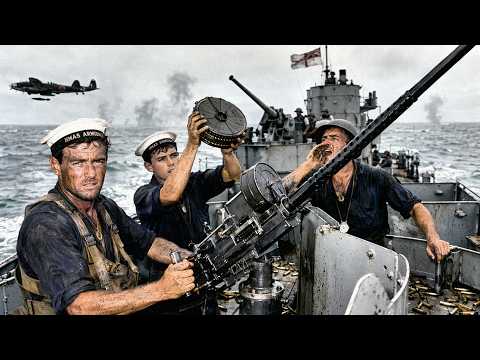
The crew went about their routine. The cooks served what they could. The signalmen watched. The lookouts scanned the sky. Lieutenant Commander Richards paced the bridge. Armidale carried three 20mm Oerlikon anti-aircraft guns. Each Oerlikon was served by a crew of three or four men. A gun captain who designated and reported targets. A gunner strapped into the weapon by a waist belt and braced by shoulder rests, whose job was to hit the target. A loader who fed 60-round drum magazines into the top of the gun. Sometimes there was a second loader. The aft Oerlikon, the port gun, was tucked just behind the mainmast where it had a wide field of fire across the stern of the ship. That was Teddy Sheean’s gun. He was not the gunner that morning. He was the loader. He was eighteen years old, and he was about to discover what young men sometimes discover in hard days, which is the true core of themselves.
The first torpedo struck at 15:17. The second hit seconds later. The order to abandon ship rang out across a deck already tilting toward the sea.
Teddy Sheean was wounded twice before he ever reached the rail. He helped launch a raft. He helped drag men toward the side. Then he stopped, turned, and climbed back toward the aft Oerlikon.
He strapped himself into the gun. Alone, bleeding, with the deck sliding beneath his feet, he fed the magazines himself and opened fire.
William Lamshied, floating in the water, looked back and saw the tracer rising from the sinking ship. He watched it climb into a Zero diving on the survivors. He watched the Zero trail smoke and crash into the sea half a mile away. He watched the gun keep firing.
Ray Leonard saw it too. He would never deny what he saw.
The water reached the base of the gun. The stern rose steeply. The Oerlikon kept firing anyway. Then the sea closed over it, and for a few long seconds, light rose from beneath the surface. Then nothing.
He was eighteen years old. He never came home.
His sister Ivie kept a single photograph of him waving from a train window at Latrobe station. She kept it all her life.
For decades, survivors and families argued that what he did deserved the Victoria Cross. A submarine was named for him. A walkway. A statue. But the bronze cross itself was refused, then debated, then refused again.
In August 2020, the decision was reversed. Edward Sheean was awarded the Victoria Cross posthumously — the first Australian sailor ever to receive it.
On November 11, 2024, a bronze statue was unveiled in Latrobe’s main street. It shows him as he was in his final moments: strapped into his harness, hands on the gun, head up, firing.
Three places. One day. Three strands of a single rope. The rope snapped at 15:17, and a country boy held it together for thirty seconds.
His submarine’s motto says: “Fight On.” His cross says: “For Valour.”
Both are true. But here is what I keep returning to: what would you have done, standing on that tilting deck, wounded twice, with the sea rising and the order to save yourself still ringing in your ears? Would you have turned back?
Report this article
Select a reason for reporting:






