In the annals of World War II, few stories are as captivating and tragic as the rise and fall of the Luftwaffe, Nazi Germany’s once-invincible air force. At the dawn of the conflict, it was a terrifying machine, a spearhead of the Blitzkrieg that crushed nations and dominated the skies over Europe. Yet, by war’s end, it was a shattered force, its airfields in ruins, its pilots hopelessly outnumbered, and its revolutionary jet fighters—like the Messerschmitt Me 262—reduced to desperate, last-ditch weapons in a lost cause. How did a force that began with such overwhelming superiority find itself annihilated? The answer lies not in a single battle, but in a series of catastrophic decisions, fatal miscalculations, and the toxic hubris of the Nazi leadership.
In 1933, as Adolf Hitler consolidated his power, the seeds of the Luftwaffe were sown. Under the leadership of Hermann Göring, a World War I flying ace with a deep-seated disdain for modern technology, the force was officially born in 1935. Göring famously scoffed at advanced instruments, preferring the romanticized image of the daring, brave pilot. “This device is a box with files and I don’t like boxes with files,” he reportedly said, dismissing the very technology that would define the coming war. This mindset, combined with Germany’s top-tier aircraft industry—symbolized by names like Messerschmitt, Dornier, and Heinkel—created a formidable but flawed foundation. By 1938, production had soared to over 5,000 aircraft, and a year later, it exceeded 8,000, a clear testament to the Nazi regime’s emphasis on air power.
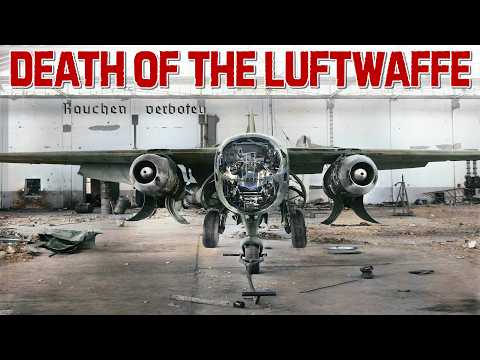
The Luftwaffe was designed for a specific kind of war: a short, violent, tactical conflict. It excelled at supporting ground forces, as demonstrated in the devastatingly effective campaigns against Poland, Norway, and France. However, this focus came at the expense of strategic bombing, a critical capability championed by General Walther Wever. Wever passionately advocated for the “Ural Bomber,” a long-range aircraft capable of striking deep into enemy territory, particularly the Soviet Union. “Air power carries the war into the heart of the enemy country from the moment hostilities break out,” Wever wrote. But his death in a 1936 plane crash sealed the fate of the program. Göring, convinced that the war would be short and that “the Führer did not ask me how big my bombers are, but how many,” cancelled the initiative. This decision, while economically sound given Germany’s limited resources, would haunt the Luftwaffe for the rest of the war.
As the war expanded, the cracks in the Luftwaffe’s foundation widened. The Battle of Britain exposed a critical lack of coordination with the Kriegsmarine, the German navy. Göring, obsessed with control, famously declared, “Everything that flies is mine,” and bitterly fought any attempt by the navy to gain its own air arm. This rivalry prevented the Luftwaffe from effectively targeting Britain’s vital Atlantic supply lines, a missed opportunity that could have starved the island nation out of the war. The Focke-Wulf 200 Condor, a long-range maritime patrol aircraft, proved devastatingly effective against shipping, sinking over 300,000 tons of cargo with just a handful of planes, but it was never integrated into a cohesive naval strategy.
The invasion of the Soviet Union in 1941 opened a new, catastrophic chapter. Operation Barbarossa stretched the Luftwaffe to its breaking point. The decision to use fewer than 3,000 aircraft, a smaller force than was deployed against France, proved disastrous. The vast distances and harsh conditions of the Eastern Front exposed a fatal flaw: the Luftwaffe’s maintenance and repair system. Damaged aircraft had to be shipped back to Germany for repairs, a process that took weeks or even months. By 1941, less than 30% of Luftwaffe airfields were operational, a fact that Field Marshal Erhard Milch later admitted was due to the Luftwaffe’s organizational structure being “glaringly inadequate” for a war beyond the Reich’s borders. The ghosts of General Wever’s Ural Bomber returned to haunt them as Soviet factories, relocated beyond the Ural Mountains, churned out war materiel with impunity, out of reach of German bombers.
Hitler’s declaration of war on the United States in December 1941 added a new, insurmountable enemy to the list. America’s industrial might was unparalleled. By 1944, the U.S. was producing over 96,000 aircraft per year—one every five minutes—more than double Germany’s output. While Germany struggled with shortages of aluminum and copper, America had vast reserves of raw materials and, protected by two oceans, could produce without the threat of bombing. The Luftwaffe’s procurement process, described as irrational and chaotic, further crippled its ability to compete. Prototypes were built and abandoned, only to be rebuilt and modified at Hitler’s whim, often entering production as completely different aircraft from what the designers intended. This lack of planning and foresight was epitomized by the appointment of Ernst Udet, a World War I ace with no technical knowledge, to head Luftwaffe production in 1936.
Udet’s tenure was a disaster. He championed the dive bomber, ordering even the four-engine Heinkel 177 to be designed as a dive bomber, a requirement that led to its infamous and fatal engine configuration. The Heinkel 177, with its twin coupled engines, was a complete catastrophe from start to finish, earning the nickname “the dead racehorse.” Similarly, the Messerschmitt 210, intended as a replacement for the Me-110, was rushed into mass production despite being riddled with problems, resulting in a machine that was almost unflyable. Udet’s suicide in 1941 left the Luftwaffe in chaos, and his legacy was a series of failed projects that squandered precious resources and time.
By 1944, the war had turned decisively against Germany. The Soviet victory at Stalingrad marked the beginning of the end, and the combined bomber offensive from Britain and America was systematically destroying German cities and factories. The Luftwaffe, now under the direction of Albert Speer and Erhard Milch, managed to increase production to 25,000 aircraft per year, but it was too little, too late. The Allies were outproducing Germany by more than four to one. The Luftwaffe’s failure to fully utilize its allies’ production capabilities—Italy, Romania, Hungary, and Finland—was another tragic mistake. Italy could have tripled its aircraft production with German assistance, potentially altering the balance in the Mediterranean, but Nazi arrogance and disdain for their allies prevented any meaningful cooperation.
In a desperate bid to turn the tide, Germany unleashed its secret weapons: the jet-powered Messerschmitt Me 262 and the rocket-powered Me 163 Komet. The Me 262 was a revolutionary aircraft, years ahead of its time, with sleek lines and performance that dwarfed anything the Allies had. With a top speed of 568 mph, it was nearly 100 mph faster than the best Allied fighter, the Spitfire Mark XIV. However, its potential was squandered by Hitler’s obsession with using it as a bomber. After Professor Messerschmitt told Hitler the aircraft could carry 1,000 kg of bombs, the Führer insisted it be used in that role. “The Führer in a fit of rage told Field Marshal Milch that even the smallest child could see that the 262 was a fighter and not a bomber,” Milch later recounted. This meddling delayed its deployment as a fighter, and by the time it entered combat, the war was already lost.
Even if the Me 262 had been deployed earlier, its impact would have been limited by Germany’s lack of trained pilots. The Luftwaffe’s pilot training program, once the envy of the world, had been drastically cut back. By 1944, German pilots received less than 100 hours of flight training, compared to over 300 for their Allied counterparts. With air superiority lost, American and British pilots had a field day, easily shooting down the few German fighters that managed to take off. The Me 262, despite its brilliance, was plagued by unreliable engines with a service life of only 12.5 hours and a lack of air brakes, making it difficult to handle in combat. It was a wonder weapon that arrived too late, in too few numbers, and in the hands of pilots who were barely trained.
The story of the Me 163 Komet is even more emblematic of the Luftwaffe’s desperate final years. This tailless, rocket-powered interceptor was less an aircraft and more a manned missile. It could climb to 40,000 feet in just over three minutes, a performance that was nothing short of astonishing. But its speed was both its greatest strength and its fatal weakness. The Komet approached its targets at such a velocity that the pilot had mere seconds to aim and fire before overshooting entirely. With no air brakes and a notoriously volatile fuel mixture of T-Stoff and C-Stoff that could dissolve a human body on contact, the Me 163 was as lethal to its own pilots as it was to the enemy.
The program was championed by test pilot Hanna Reitsch, a personal friend of Hitler and one of the most remarkable aviators of the twentieth century. She lobbied relentlessly for the chance to fly the Komet, eventually completing five flights. On her final flight, the aircraft’s takeoff dolly failed to release, forcing her into a violent crash landing that left her severely injured and out of the cockpit for five months. It was a microcosm of the entire German war effort: extraordinary bravery and technical daring, undone by flawed planning and impossible circumstances.
Other pilots like Rudolf Opitz and Heinrich Dittmar were equally valuable to the program, their extensive glider experience making them uniquely suited to the Komet’s unpowered landing profile. Yet even their skill could not overcome the aircraft’s fundamental limitations. The Me 163 required a small army of ground crew and specialized equipment just to get airborne, and its landing skid made every return to earth a potential disaster. It was a weapon that demanded perfect conditions in a war that offered none.
By the time these wonder weapons reached the front lines, the strategic situation had deteriorated beyond repair. The Allied bombing campaign had systematically dismantled Germany’s fuel production, meaning that even the few jets and rockets that were operational often sat idle, grounded by a lack of fuel. Albert Speer’s production miracle of 25,000 aircraft in 1944 was a hollow victory, for there were neither the pilots to fly them nor the fuel to power them. The Luftwaffe had become an air force in name only.
In the end, the collapse of the Luftwaffe was not the result of a single catastrophic defeat, but of a thousand self-inflicted wounds. Göring’s technological contempt, Wever’s untimely death, Udet’s incompetence, Hitler’s erratic interference, and the regime’s arrogant refusal to cooperate with its allies all contributed to the downfall. The Luftwaffe was built for a war that Germany could win quickly, and when that war became a long, industrial contest of attrition, it was doomed. The men who flew its aircraft were among the bravest of their generation, but they were sent into battle by a leadership that had already lost the war in the conference rooms and design bureaus long before the first shot was fired.
So, we are left with the haunting question: was the Luftwaffe’s defeat inevitable from the very start, or could a different path—one that embraced strategic vision over tactical brilliance—have altered the course of history? What do you think was the single most decisive mistake that sealed its fate?
Report this article
Select a reason for reporting:






