In the pre-dawn darkness of November 20, 1917, the earth trembled with a mechanical roar that signaled the end of an era. German soldiers, entrenched along the formidable Hindenburg Line in northern France, peered into the mist with growing dread. What emerged from the shadows was not a wave of infantry, but hundreds of armored beasts—the first mass tank assault in history. Among them was Deborah, a Mark IV tank, and her crew, whose story would become a legend buried for decades.
The Battle of Cambrai was a desperate gamble by the British to break the stalemate of the Western Front. After the mud-soaked horrors of Passchendaele, morale was low, and commanders sought a decisive blow. Cambrai, a quiet sector, offered ideal terrain for tanks. The plan was audacious: a surprise attack without a preliminary bombardment, using nearly 500 tanks to crush the enemy wire and overrun the Hindenburg Line. Success would hinge on these iron monsters and the brave men who crewed them.
Inside Deborah, 24-year-old Second Lieutenant Frank Heap commanded a crew of eight. The Mark IV tank was a claustrophobic hell—engines roared at deafening levels, temperatures soared to 50°C, and carbon monoxide fumes threatened to poison the men. Crews wore chain-mail masks to protect against ‘splash’—sharp metal fragments that flew when bullets struck the armor. Visibility was nearly nonexistent, and the tank’s top speed was a mere 4 mph. Yet these volunteers pressed on, driven by duty and a chance to end the war.
As dawn broke, the assault began. Tanks rolled forward, their fascines—bundles of wood—dropped into trenches to create bridges. The first wave smashed through the German outpost zone with stunning ease. Wire entanglements were flattened, and infantry poured through the gaps. But the advance was not without cost. Mechanical failures, ditches, and enemy artillery took their toll. By mid-morning, the first objective, the Blue Line, was secured. Now it was Deborah’s turn.
At 8:35 AM, Heap and his crew advanced toward the village of Flesquières and the Brown Line beyond. The pause had allowed German defenders to regroup, and hidden artillery batteries were waiting. As Deborah crested a rise, shells screamed in. To the west, eight tanks were knocked out in minutes. To the east, seven of eight tanks in Deborah’s company were destroyed. Suddenly, Deborah was alone, surrounded by enemy guns.
Heap ordered the driver forward, straight into the village. With all guns blazing, Deborah tore through Flesquières, sending German infantry fleeing. For a brief moment, it seemed they might succeed. But as they emerged from the cover of buildings, two artillery batteries opened fire. Shells ripped through the tank’s thin armor, showering the crew in red-hot fragments. Fuel and ammunition ignited. Within seconds, Deborah was engulfed in flames.
Three men survived: Heap, Lance Corporal Marsden, and one unidentified soldier. They fled through enemy territory, eventually reaching safety. Heap was awarded the Military Cross for his gallantry. But four men—George Foot, Joseph Chevon, William Galway, and Fred Turpin—perished. They were buried in Flesquières Hill British Cemetery, just yards from where their tank fell.
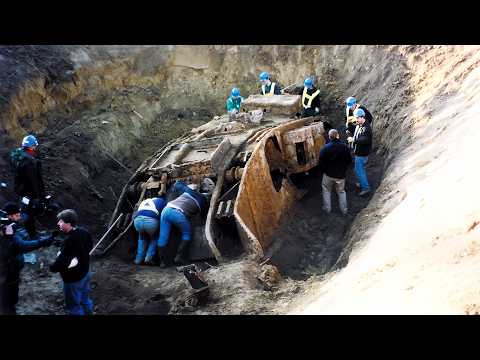
Deborah herself was lost to history, buried in a shell hole, until 1998 when a team exhumed her. Today, she rests in a museum, a silent witness to courage and sacrifice. This is the story of a tank that time forgot, and the men who fought and died inside her.
The four men who died inside Deborah that morning—George Foot, Joseph Chevon, William Galway, and Fred Turpin—were not forgotten by their comrades. In the chaos of the battle’s aftermath, their bodies were recovered and laid to rest in Flesquières Hill British Cemetery, a small plot on the slope where the tank had made its final charge. Today, their headstones stand in a quiet row, just a stone’s throw from the museum where Deborah now resides.
For decades, the story of Deborah and her crew remained a footnote in the broader narrative of Cambrai. The battle itself was judged a tactical failure—the gains of the first day were squandered, and the German counterattack in early December retook nearly all the ground that had been won. Yet the lessons of Cambrai were not lost. The mass use of tanks had proven decisive in breaking the deadlock, and the techniques pioneered there would shape armored warfare for generations.
Frank Heap returned to England a decorated hero. He rarely spoke of the war, but those who knew him said he carried the weight of that day for the rest of his life. After the war, he ran a hotel in Blackpool, married, and raised a family. He died in 1956, at the age of 64. Lance Corporal David Marsden, Deborah’s driver, survived the war as well, though his wounds troubled him for years. He passed away in 1969, aged 82.
The unidentified survivor—the third man who escaped the burning tank—remains a mystery. Records from the time are incomplete, and despite the best efforts of historians, his name has been lost. He may have been a gunner, a gearman, or one of the many support crew who served aboard tanks. His story, like so many from the Great War, is one of countless untold acts of courage.
Deborah’s rediscovery in 1998 was a triumph of local memory and historical detective work. Philip Ginski, the historian who first heard rumors of a buried tank, spent years piecing together the puzzle. When the excavation finally began, the team was astonished to find the tank largely intact. The hull was riddled with shell holes, and inside, remnants of the crew’s equipment—a chain-mail mask, a rusted tool, a boot—were still scattered where they had fallen.
For two decades, Deborah sat in a barn, visited only by those who knew where to look. Then, in 2018, a campaign was launched to give her a proper home. The town of Flesquières donated land, and a museum was built just yards from where she had been knocked out. Today, Deborah is the centerpiece of the Flesquières Tank Museum, drawing visitors from around the world.
But the story does not end there. In 2017, a century after the battle, a commemorative ceremony was held at the museum. Descendants of the crew gathered—Frank Heap’s grandson, Joseph Chevon’s great-niece—and stood beside the tank that had carried their ancestors into history. For them, Deborah was more than a machine; she was a link to the past, a tangible connection to the men who had fought and died inside her.
As the sun set over the fields of Cambrai that evening, the old tank seemed to stand a little taller. Her battle scars were still visible, but so was the care that had gone into preserving her. She is a reminder of what happened here—not just the horror of war, but the bravery of ordinary men who climbed into a steel box and rolled into the unknown.
The years after the war were not kind to the men who survived Deborah. Frank Heap, despite his Military Cross, rarely spoke of Cambrai. His family recalled that he kept a photograph of the tank in his study, but he never discussed the details of that November morning. He had lost four men under his command, and the weight of that responsibility never fully lifted. He threw himself into civilian life, running a hotel in Blackpool, but those who knew him best said he was a changed man—quieter, more withdrawn, prone to long silences.
David Marsden, the driver, fared little better. His wounds healed, but the memories did not. He found work as a mechanic, a trade that kept his hands busy and his mind occupied. Yet he too kept his silence about the war, sharing his story only with a few close friends. When he died in 1969, his family discovered a small diary among his belongings, its pages filled with cramped handwriting describing the heat, the noise, and the terror of that day.
The third survivor—the unidentified man—remained a ghost. Historians combed through service records, pension files, and regimental diaries, but no name emerged. He may have been one of the many replacements drafted in at the last minute, his paperwork lost in the chaos of war. His anonymity became a symbol of the countless soldiers whose stories were never told, their sacrifices known only to God.
As the decades passed, the fields around Flesquières returned to farmland. The trenches were filled in, the wire cleared, and the shell holes ploughed over. Farmers grew wheat and sugar beet where tanks had once rolled. But the memory of Deborah persisted, kept alive by local legends and the occasional curious visitor.
Philip Ginski, the historian who spearheaded the search, was a boy when he first heard the stories. An old farmer told him of a tank buried in a field, its crew still inside—a ghost story, most thought. But Ginski believed there was truth in the tale. He spent years interviewing locals, cross-referencing maps, and studying aerial photographs. His breakthrough came when he found a wartime sketch showing a tank knocked out near a specific farmhouse—the very field where Deborah would eventually be found.
The excavation in November 1998 was a media sensation. Crowds gathered as the diggers carefully removed the earth, revealing the rusted hull inch by inch. When the tank’s side came into view, still bearing the scars of German shells, a hush fell over the crowd. It was a moment of collective remembrance, a tangible link to a battle that had faded from living memory.
Inside the tank, the team found personal effects that brought the crew back to life: a shaving kit, a letter from home, a pair of spectacles. These small items spoke volumes about the men who had lived and died in that steel box. They were not just soldiers but husbands, sons, and brothers, with hopes and fears like anyone else.
Deborah’s restoration was a labour of love. Volunteers spent thousands of hours cleaning, preserving, and researching her history. When she was finally placed in her purpose-built museum in 2018, it was a homecoming—a return to the village she had helped to attack over a century earlier.
The museum itself is a modest building, but inside it holds a weight far greater than its size. School groups file past Deborah’s hull, their teachers explaining the mechanics of the Mark IV while the children stare at the shell holes, trying to imagine the noise and the fire. For them, it is a history lesson. For the descendants, it is a pilgrimage.
In 2017, the centenary ceremony brought together families who had never met. They exchanged photographs and stories, piecing together fragments of their shared past. Frank Heap’s grandson stood beside Joseph Chevon’s great-niece, both of them silent for a long moment. Then he said, simply: ‘They were boys, weren’t they? Just boys.’
That is the truth that Deborah preserves. Not the grand strategy of Cambrai, not the debates over tactics and technology, but the human cost. Four young men—Foot, Chevon, Galway, Turpin—climbed into a steel box and never came out. Three others survived, but carried the scars forever.
Today, Deborah sits in her museum, the light falling softly on her battered hull. Visitors can still see the dents from German shells, the rusted tracks, the narrow vision slits through which Heap and his crew glimpsed their last moments of battle. She is not just a machine; she is a tombstone, a memorial, and a teacher all at once.
The fields of Flesquières are quiet now. The guns are silent, the wire long gone. Yet if you stand in the cemetery on a November morning, when the mist rolls in from the east, you might hear something—a distant rumble, a mechanical growl, a ghost of the first tank assault in history.
And you might wonder: what would those men think if they could see Deborah now—preserved, honoured, remembered? Would they be proud? Surprised? Or would they simply nod, and say that they were only doing their duty?
What would you have done, if you had been inside Deborah that morning? Share your thoughts in the comments below.
Report this article
Select a reason for reporting:






