The desert night was supposed to belong to the Germans. Rommel’s Afrika Korps had swept across North Africa with lightning speed, their panzers unstoppable in the open sun. But as the sun set over the fortress of Tobruk, a different kind of war began—one that would shatter German nerves and earn a group of Australians a terrifying reputation.
They came without warning. Small teams of six to twelve men, slipping through the darkness in complete silence. Grenades would crack, submachine guns would stutter, and by the time the Germans responded, the attackers had vanished like ghosts. “It was like fighting ghosts,” one German officer wrote. These were the men of the Australian 9th Division, and they were about to turn the siege of Tobruk into a nightmare.
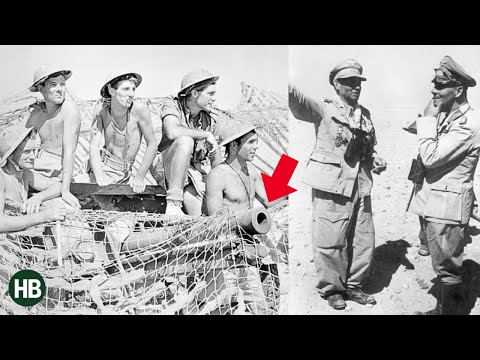
The siege began in April 1941. Rommel’s forces had pushed the British back to the Egyptian border, but Tobruk—a vital supply port—held out. Inside the perimeter, the Australians weren’t content to simply defend. They stripped off their shirts, wore wide-brimmed hats, and commandeered captured Italian trucks. They moved fast, traveled light, and launched relentless night raids that left German commanders baffled and their troops exhausted.
“You couldn’t sleep. Every sound could be an Australian patrol. Every shadow could be the enemy,” a German veteran later recalled. The darkness became a source of dread. The Australians mapped German positions meticulously, identified weak points, and exploited every gap. They gathered intelligence, took prisoners, and disrupted communications. The Germans had tanks; the Australians had nerve.
But the raids were only part of the terror. The Australians combined physical aggression with tactical deception. They moved their guns constantly, so German counter-battery fire always hit empty positions. They used decoys—canvas and sandbags—to draw attention. Their radio discipline frustrated German signals intelligence. The Germans intercepted less, predicted less, and found their own intelligence constantly outdated. “You never knew what was real,” a captured German lieutenant admitted.
The psychological toll was devastating. German medical reports from Tobruk show a dramatic increase in combat stress casualties—men unable to sleep, suffering nervous exhaustion, some requesting transfer even at risk of punishment. These were veterans of France and Poland, men who had faced British regulars and French colonial troops. But the Australians broke them differently. Not through overwhelming force, but through relentless, unpredictable aggression that gave no rest.
For 241 days, the Australians held Tobruk, earning the nickname “the Rats of Tobruk” and embracing it as a badge of honor. But among the Afrika Korps, a different name spread—the Desert Devils. And their story was far from over.
By July 1942, Rommel’s renewed offensive had pushed deep into Egypt, and once again his men found themselves facing the Australians of the 9th Division. This time the ground was Tel el Eisa, a low ridge in the northern sector of El Alamein. Rommel considered the sector secure. He was wrong.
July 10th, 2:30 a.m. The 25-pounders opened up first—not a sustained barrage, but precision fire on pre-registered targets. German strong points, machine gun nests, communication trenches. Crack, crack, crack. The shells walked forward in a creeping barrage, and the Australian infantry followed a hundred yards behind, moving through the darkness with practiced coordination.
The Germans had expected the Allies to attack in daylight with armor support. Instead they faced an infantry assault in darkness—the one environment where their defensive doctrine broke down. Grenades first, submachine gun bursts, bayonets if needed. They cleared trenches systematically, one position at a time, with a speed that gave defenders no time to organize.
By dawn, Tel el Eisa was in Australian hands. Over a thousand prisoners taken. German lines shattered. Rommel’s northern flank exposed. But more importantly, German morale took another devastating hit. This wasn’t a raid. This was proof the Australians could coordinate large-scale operations with the same aggression they’d shown in small teams.
And now broader deception operations amplified their edge. British deception units flooded the airwaves with false intelligence, suggesting a massive Allied push forming in the south. Rommel shifted his reserves to meet it. But the real assault came from the north, led by the Australians. The Germans couldn’t trust their intelligence. They couldn’t predict Australian movements. And now they couldn’t even rely on darkness for security.
Veterans described the sensory overload of these night assaults. Tracer rounds arcing through the darkness like deadly fireflies. The distinctive crack of 25-pounders mixed with the thump of mortars. Sand kicked up by explosions turning the air thick and choking. And through it all, the Australians advancing with mechanical precision—not the wild charges of desperate defenders, but controlled aggression backed by coordination that shouldn’t be possible in darkness.
One Australian officer later recalled the shift in German behavior. “We didn’t even need to attack every night. The Germans would be on alert, expecting us, exhaust themselves, and be vulnerable when we did hit them.” By October, the threat alone did the work. Fatigue and false alarms hollowed out German positions before the first grenade blew.
Captured documents from this period tell the story. German unit diaries mention constant infiltration attempts, aggressive enemy patrols, and inability to rest forward positions. The posthumously compiled Rommel papers note fatigue, confusion, and fear of infiltration following repeated Australian raids. This was the breaking point—not a single catastrophic defeat, but a cumulative psychological collapse.
The fear of darkness. The knowledge that any night could bring grenades and submachine guns into your trench. The realization that your officers couldn’t protect you, your defenses couldn’t stop them, and your intelligence couldn’t warn you.
One German NCO, captured near Ruin Ridge, put it simply. “We were trained to fight armies. They fought like hunters, and we were the game.” His words echoed across the Afrika Korps, a quiet admission that the rules of desert warfare had been rewritten by men who refused to play by them.
By late October 1942, the final phase of El Alamein was underway. Montgomery’s offensive pushed west, but in the northern sector, the Australians fought a different kind of battle—one fought in the mind as much as in the sand. The veterans of Tobruk among their ranks understood exactly what they were doing. Every shadow, every false alarm, every silent night became a weapon.
German unit diaries from this period grew increasingly desperate. Entries spoke of “constant infiltration attempts,” “aggressive enemy patrols,” and “inability to rest forward positions.” Officers rotated sentries every two hours, but exhaustion still crept in. Men began to dread the setting sun.
Then came the night of October 25th. The Australians launched a coordinated assault on a German strongpoint near Ruin Ridge—not a raid, but a full-scale night attack. Artillery opened first, then the infantry surged forward. But this time, something unexpected happened. The Germans didn’t wait to be overrun. They broke.
“Units that had sworn to hold to the last man retreated in disorder,” one Australian officer noted with surprise. Officers who had led charges in France and Russia struggled to maintain cohesion. The psychological foundation of German military confidence—built on discipline, doctrine, and daylight superiority—had cracked. And it cracked because a group of Australians had spent eighteen months teaching them to fear the dark.
When the final breakthrough came at El Alamein, the northern sector collapsed faster than anywhere else on the line. The Australian 9th Division sector wasn’t just defeated—it was demoralized. The Desert Devils had done their work.
The 9th Division’s story didn’t end in the desert. When the Australians rotated to the Pacific theater, they carried those lessons with them. The jungle wasn’t the sand, but the principles held. Small unit coordination, aggressive patrolling, disrupting enemy sleep and morale, making darkness an ally rather than an enemy. The same men who had hunted Germans in the desert now hunted Japanese in the jungle.
Australian commando units pioneered infiltration tactics that descended directly from desert patrol methods—forward observation, intelligence gathering, hit and fade, psychological pressure. Japanese war diaries from New Guinea mention Australian patrols with the same dread German diaries had shown. Constant harassment, no rest, uncertainty about enemy positions. The lessons of Tobruk and El Alamein became formal doctrine, written into Australian Army training manuals as standard practice.
What the 9th Division pioneered under siege became the foundation of Australian infantry tactics for the rest of the war. Elements echoed in British commando and American unit patrolling doctrines across multiple theaters. The aggressive patrolling, the psychological pressure, the mastery of darkness—all of it traced back to a group of shirtless men in wide-brimmed hats who refused to let their enemy rest.
Even Rommel’s own papers, compiled after the war, called the Australians “the best soldiers he faced in North Africa.” High praise from a commander who had fought across Europe and Africa. But the papers were diplomatic. They didn’t mention the fear, the psychological toll, the way his troops dreaded facing them. That truth came from the enlisted men—the soldiers who had spent months staring into the darkness, waiting for the Desert Devils to strike.
The legacy continues. Modern Australian special forces trace their lineage directly to these desert raiders. The same emphasis on small unit excellence. The same aggressive mindset. The same willingness to take the fight to the enemy regardless of circumstances. From Tobruk to Kokoda, from El Alamein to Vietnam, from the Middle East to Afghanistan, the thread runs through Australian military culture: adapt, be aggressive, master the environment, make the enemy fear you.
The 9th Division wrote that doctrine in sand and blood. And the Germans learned it the hard way—one sleepless night at a time. The Australians: quick to fight, quick to adapt, and absolutely relentless when it mattered most.
So what do you think? Was it the night raids, the deception, or the sheer psychological pressure that truly broke the Afrika Korps—and does the legend of the Desert Devils still shape how we understand warfare today? Let us know in the comments below.
Report this article
Select a reason for reporting:






