September 12, 1943. The dust cloud appeared on the horizon long before the truck itself, a brown smear against the endless blue of the Montana sky. Jake Morrison pulled his hat low and watched it grow, his stomach tight with a feeling he couldn’t name. Beside him, Frank Hutchinson stood with arms crossed, his jaw set like stone. Neither man spoke. They had been told what to expect, but nothing could have prepared them for what emerged when the canvas flap was pulled back.
They were young. That was the first thing Jake noticed. Not hardened soldiers, not the enemy he had pictured in his mind, but women—exhausted, frightened, blinking against the harsh sunlight. Twenty-seven of them climbed down from the truck, their faces pale and drawn, their eyes wide as they took in the vast landscape that stretched in every direction. For a moment, no one moved.
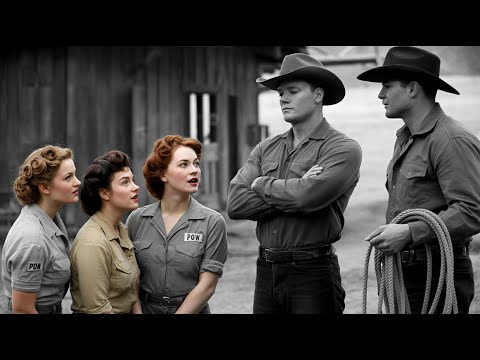
Jake studied them one by one. One woman in particular caught his attention—she stood slightly apart from the others, her posture straight despite obvious fatigue. Her blonde hair was pulled back severely, and her sharp features might have been beautiful if not marked by such weariness. Her eyes moved constantly, calculating, assessing. He didn’t know her name yet. He didn’t know that within a year, she would save his life in a blizzard, or that he would ask her to marry him on Martha Collins’s porch. All he knew was that something about her unsettled him.
Major William Carter stepped forward to address the new arrivals. His voice carried across the dusty yard as he explained the rules—six days of work per week, small wages in camp script, adequate food and shelter, treatment according to Geneva Convention standards. Escape would be pointless and dangerous. Cooperation would make their time here tolerable.
Frank Hutchinson listened with barely concealed hostility. His two sons were fighting in Europe. The idea of German prisoners working his land felt like betrayal. But they needed hands desperately, and the government offered favorable terms. He gestured toward a massive field where hay bales needed loading, barked a few words in rough English, then walked away without checking if they understood.
The women looked at each other uncertainly before setting to work. The bales were heavier than they appeared, and the Montana sun, gentle in the early morning, became punishing by midday. Greta Schiller, a former communications officer from Berlin, felt blisters forming on her hands within the first hour. But she didn’t complain. None of them did. Complaining would only confirm whatever negative assumptions their captors already held.
At the Reeves Ranch, nineteen-year-old Lisel Hoffman found herself mending fence lines that stretched for miles across rolling hills. She had grown up in Hamburg, where buildings pressed close together and streets were narrow corridors between stone walls. This openness felt unnatural, almost threatening. She whispered to Greta in German, “Where does it end?” But Greta had no answer.
Anelise Vulkar, twenty-six, had studied maps during the long journey west, trying to comprehend the scale of America. But studying maps and standing in the actual landscape were entirely different experiences. The vastness unsettled her in ways she couldn’t articulate. She had served as a supply coordinator for the Wehrmacht before her capture, and she understood logistics, understood planning. But nothing in her training had prepared her for this—the way the land swallowed the sky, the way silence could feel like a physical weight.
Jake Morrison approached the situation differently than the other ranchers. When he saw Anelise and her two companions standing uncertainly by the barn, he didn’t bark orders. He walked over slowly, his limp more pronounced in the early morning stiffness, and spoke in a measured tone. “Morning, ladies. I know you probably don’t speak much English, but we’ll figure it out. Today, we’re moving cattle from the south pasture to better grazing. Ever worked with cows before?”
The women stared at him blankly. Anelise understood some English but wasn’t confident enough to respond. Jake smiled slightly, not unkindly, and gestured for them to follow. Actions would teach better than words.
He led them to a corral where a dozen horses stood, their breath creating small clouds in the cool air. Hilda gasped audibly—she had never been this close to a horse. They seemed impossibly large, powerful creatures that could crush her without effort. Jake noticed her fear and approached one of the gentler mares, a dappled gray named Rosie. He ran his hand along the horse’s neck, speaking softly, demonstrating that these animals responded to calm confidence rather than force.
Then he did something unexpected. He took Anelise’s hand, still rough from weeks of labor in the New York facility, and placed it against Rosie’s warm shoulder. The horse’s skin twitched slightly, but she didn’t move. Anelise felt the animal’s heat, its breathing, the solid realness of this creature. Something shifted in that moment. This wasn’t theoretical war or political ideology. This was simply life, immediate and demanding.
By the end of the first week, the German women had begun to understand the rhythm of ranch life. It was a language spoken not in words but in actions—in the movement of animals and the changing light across endless grassland. The work was brutal for women unaccustomed to such physical demands. But it was also strangely honest. There were no politics here, no ideologies to navigate, just cattle that needed moving, fences that needed mending, and land that required constant attention.
Greta discovered muscles she never knew existed. Her back ached from lifting hay bales, her shoulders burned from hours of repetitive motion, and her hands had developed calluses that would have horrified her former self. Yet there was satisfaction in the exhaustion. At night she fell into dreamless sleep, too tired for the nightmares that had plagued her in the holding facility. The work left no energy for dwelling on the past or worrying about an uncertain future.
Lisel found unexpected beauty in the daily routine. She had always been the artistic one in her family, sketching in margins and seeing poetry in ordinary moments. Montana gave her more material than she could process—the way morning light turned the mountains pink and gold, the patterns wind made in the tall grass, the silhouettes of cattle moving like dark clouds across distant hills. She began keeping a small journal, sketching when she had spare moments, trying to capture this strange new world.
Anelise’s transformation was more subtle, but perhaps most profound. She had always been the practical one, the organizer who made things run efficiently. Jake recognized this quality almost immediately. He started giving her more responsibility, showing her how to anticipate what needed doing before being told. Within days, she was helping coordinate the work of the other women, translating his instructions and organizing tasks in the most efficient sequence.
One afternoon, as they worked together repairing a water trough, he attempted conversation. “Where in Germany?” he asked, his English slow and clear.
“Berlin,” Anelise replied carefully, her accent thick but understandable.
Jake nodded. “Big city. This must be very different.”
She looked around at the endless landscape, searching for words. “So large,” she finally said, gesturing at the space around them. “We couldn’t look away.”
It was the first real exchange between them—brief and simple, but it opened a door that had been closed. Jake realized these women weren’t the enemy in any meaningful sense. They were just people caught in circumstances beyond their control, trying to survive with whatever dignity they could maintain.
That evening, as the women returned to camp, Greta noticed something had changed in how they moved. They walked with less hesitation, less fear. The landscape that had seemed threatening now felt merely vast. They were beginning to understand that Montana demanded respect, but offered something in return—space to breathe, work that mattered, and the possibility of being seen as something other than enemy prisoners.
October brought the first serious cold snap, and with it an unexpected shift in the daily routine. Martha Collins, the widow whose ranch employed Anelise’s crew, made a decision that would ripple through the entire camp. She invited the three German women to eat lunch inside her farmhouse rather than in the field. Jake looked surprised when Martha announced this, but he knew better than to argue with the old woman. She had her own sense of what was right, and it rarely aligned with conventional thinking.
That first meal was awkward beyond description. The women sat stiffly at Martha’s kitchen table, overwhelmed by the simple kindness of being treated as guests rather than prisoners. Martha served beef stew and fresh bread, pouring coffee without asking if they wanted any. She spoke to them as she would to anyone, seemingly unconcerned that they understood perhaps one word in five. Anelise tried to express gratitude in her limited English. “Thank you, Mrs. Very kind.”
Martha waved off the thanks. “You work hard. You eat proper. That’s how it works here.”
The warmth of the kitchen, the smell of home cooking, the simple act of sitting at a table like human beings rather than enemies—it cracked something open in all three women. Hilda began to cry quietly, tears running down her face as she ate. She was remembering her mother’s kitchen in Munich, meals shared before the world fell apart.
Within two weeks, other ranchers began following Martha’s example. Frank Hutchinson remained resistant, but his wife, Eleanor, had other ideas. She started bringing hot soup to the fields at midday, serving the German women alongside the regular ranch hands. Tom Reeves allowed his housekeeper to set up a table in the barn where workers could eat together out of the wind. These small gestures of basic humanity changed the atmosphere entirely. Cowboys who had maintained cold distance began making small talk, teaching the women English words for various tools and animals.
Jake noticed how Anelise’s English improved rapidly through these daily interactions. She had a gift for languages, picking up not just words, but the rhythm and tone of how Montana people spoke. She began serving as an unofficial translator for the other women. But more than that, she became a bridge between two groups that had started as enemies.
One evening in late October, as Jake drove the women back to camp, Anelise surprised him with a question. “Mr. Jake, why you help us? You could be angry. Your country and my country fighting.”
Jake was quiet for a long moment, considering his answer. Finally, he said, “I figure you didn’t start this war any more than I did. We’re all just trying to get through it best we can.”
Anelise nodded slowly, understanding more than just his words. She was beginning to grasp something fundamental about the American character, at least as it expressed itself here in Montana. These people judged you by your work and your character, not by where you came from or what uniform you once wore.
November arrived with the first snow, dusting the mountains white and signaling the approaching end of the outdoor work season. The ranches shifted into winter mode, focusing on maintaining livestock and preparing for the brutal months ahead. The German women had now been in Montana for nearly three months, and the transformation was visible in more than just their calloused hands and sun-weathered faces. They moved with confidence across terrain that had once terrified them. They understood the rhythms of ranch life, anticipated needs before being told, and had earned grudging respect from even the most skeptical cowboys.
But it was the Thanksgiving holiday that truly marked the turning point in their integration into this strange new world. Major Carter had debated whether to acknowledge the American holiday at all. These were prisoners of war, after all, not guests. But he had received letters from several of the ranchers requesting permission to include the women in their family celebrations. Martha Collins had been particularly insistent, arguing that Christian charity demanded nothing less.
On Thanksgiving Day, instead of returning to camp, the women found themselves invited into American homes. Greta and her crew were brought to the Hutchinson Ranch, where Eleanor had prepared a feast that made the German women’s eyes widen—turkey, mashed potatoes, three kinds of vegetables, fresh rolls, and pies that filled the kitchen with the scent of cinnamon and apples. Frank Hutchinson sat at the head of the table, his discomfort obvious, but his manners intact. His wife had made her wishes clear, and he would honor them, even if grudgingly.
As the meal progressed, something unexpected happened. Eleanor asked Greta, through a combination of simple English and gestures, about her family in Germany. Greta’s eyes filled with tears as she tried to explain. “Mother, father in Hamburg. Don’t know if…” She paused, unable to finish.
Eleanor reached across the table and squeezed her hand. “We’ll pray they’re safe.”
Frank looked away, his jaw tight. His own sons were somewhere in Europe facing German soldiers. Yet here sat this German girl crying for her family just as his own wife cried for their boys. The enemy had a face now, and it looked heartbreakingly human.
At Martha’s farmhouse, Anelise sat between Jake and Martha, struggling to follow the rapid conversation but catching enough to understand the warmth. Martha’s daughter had come from Billings with her two children, and the kids were fascinated by the German women, asking endless questions with the thoughtless curiosity of youth. Jake found himself translating his own understanding of Anelise’s limited English, helping bridge the gap. He noticed how naturally she smiled at the children, how her whole face softened when the little girl showed her a doll.
As the evening wound down and Jake prepared to drive the women back to camp, Martha pulled him aside. “That Anelise,” she said quietly. “She’s got good character. You can see it in how she works, how she treats people.”
Jake nodded, not trusting himself to say more. He had been thinking the same thing, but hadn’t wanted to acknowledge it even to himself.
December brought letters from Germany that shattered the fragile peace. Greta learned her parents were dead, killed in the bombing of Hamburg. She lay on her bunk for two days without speaking. Leisel’s neighborhood had been firebombed; her mother and brothers were presumed dead, her father arrested after the July 20th plot. Anelise received nothing at all. The silence was somehow worse than bad news.
Then the blizzard hit on December 18th. Twenty below zero, wind driving snow like needles. Three cows were missing, and Jake knew exposure meant death within hours. Anelise insisted on coming. “You cannot go alone. Two persons more safe.” They roped themselves together with fifty feet of line between them.
They found one cow dead, the second alive but weakening. Then Jake’s bad leg gave out on an icy patch. He went down hard. “Go back. Get help.” But Anelise had lived through Russian winters as a child. She got his arm over her shoulder and half carried, half dragged him toward the barn. It took forty minutes to cover what should have been ten. When Martha’s farmhouse finally emerged from the white chaos, they collapsed through the door together.
Jake’s leg was badly sprained, not broken. Anelise had mild frostbite on her fingers. During his recovery, she took over the ranch operations with a competence that surprised everyone, including herself. In the evenings they talked—about Berlin, about survival, about what came after the war. “What will you do when the war ends?” Jake asked. “Will you go back?”
“I don’t know what Germany will be anymore,” she said softly. “But here I know what is expected. Work hard. Be honest. Treat people with respect. Is simple. Is clear.”
By February, Jake was teaching her to rope. “You saved my life in that storm. As far as I’m concerned, that makes you more than just a prisoner.” On her third attempt, the loop settled perfectly around a heifer’s neck. Jake laughed with genuine pleasure. “There you go. Now you’re a real ranch hand.”
Spring arrived late. May 8th, 1945—Victory in Europe. Germany had surrendered. At the camp, Major Carter explained that repatriation would begin within weeks. The women would be going home. But what home awaited them? Cities in ruins, families scattered or dead.
Greta and Leisel both chose to stay. Their sponsors had offered work and belonging. Then both turned to Anelise. She had Jake to consider now, though neither had spoken openly of what existed between them. She also had a mother and brother who might still be alive in the Soviet zone.
Major Carter called her into his office. Jake was there too, hat in his hands. “Mr. Morrison has submitted a formal request. He’s asking that you be allowed to remain in the United States under a special visa provision for displaced persons. He’s prepared to sponsor you.”
Anelise spoke slowly, carefully. “Here I can work. I can build something. Maybe later I can search for my family. Maybe I can help them come here. Is this wrong to choose this?”
The major shook his head. “It’s not wrong to choose survival. It’s not wrong to choose a future. Your country asked you to serve and you did. But that country doesn’t exist anymore.”
Jake finally spoke, his voice rough. “I can’t tell you what to do. This has to be your choice. But if you stay, you won’t be alone. I care about what happens to you.”
“I will stay,” she said finally. “I will work hard. I will not forget Germany, not forget my family, but I choose this.”
Of the twenty-seven women who had arrived that September, fourteen chose to remain. Anelise married Jake in November of 1945, a small ceremony at Martha’s farmhouse. Martha cried openly during the vows. Some in the community muttered about an American marrying an enemy national, but for every critic there were two supporters who understood the ceremony represented something larger than one couple’s happiness.
The years that followed brought challenges and unexpected joys. Anelise and Jake built a life on the land they both loved, expanding Martha’s ranch after the old woman passed away in 1948. Her will contained a handwritten note Anelise treasured: You proved that home isn’t where you’re born, but where you choose to build something good.
Greta married a local veterinarian in 1947 and raised three children. Leisel became a respected artist, her paintings of Montana landscapes gaining recognition beyond Park County. She never married, finding fulfillment in her art and in teaching children to see the beauty around them.
In 1953, Anelise finally received news from Germany. Her mother had survived and was living in West Berlin. Her brother had been killed in the final days of fighting. The news brought renewed grief, but also relief. In 1958, she sponsored her mother’s immigration to America. The reunion at the Billings train station was emotional beyond words. “You found what we were all searching for,” her mother said. “A place where you could be yourself without fear, where your work mattered, where kindness was not weakness.”
Fifty years after that September day, the survivors gathered for a final reunion. It was 1993, and age had taken its toll. Of the fourteen women who had chosen to stay, only eight remained alive. They met at what had been Martha Collins’s ranch, now owned by Anelise and Jake’s son, who had converted the old barn into a community center.
A local historian asked them to reflect on their experiences. Anelise, now seventy-four, spoke about the day she arrived and how terrifying the openness had seemed. “So large we couldn’t look away. That’s what we told each other. And once we stopped looking away, once we really saw it, we couldn’t leave.”
Greta talked about the moment she received news of her parents’ death and how Eleanor Hutchinson’s simple kindness had kept her from drowning in despair. “She saved me by treating me like I mattered. Not like a prisoner, not like an enemy, but like a person who deserved comfort.”
Leisel described discovering that she could capture beauty even after witnessing so much ugliness. “This landscape taught me that the world could still be beautiful if you were willing to see it. That was a kind of redemption I didn’t know was possible.”
The historian asked the question that had driven her research. “Why did you choose to stay when you could have gone home?”
The women looked at each other, and Anelise spoke for all of them. “Germany was where we were born, but it was never truly home. Home was what we built here through work and kindness and second chances. Home was people who judged us by our character rather than our nationality. Home was land that didn’t care about our past, only about our willingness to respect it.”
That evening, as the reunion concluded, the women stood together outside the old barn. The Montana sky stretched above them, vast and indifferent, as it had always been. Mountains rose in the distance, eternal and unchanging. The prairie grass moved in waves under the wind, the same wind that had blown on the day they arrived fifty years earlier.
Jake Morrison, now seventy-six and moving slowly with a cane, joined his wife. Together they watched the sunset paint the sky in brilliant colors. “You ever regret it?” he asked quietly. “Staying here instead of going back?”
Anelise took his hand, the calluses of a lifetime’s work rough against his palm. “Not once,” she said. “Not for a single moment. This land gave us everything. It gave us work that mattered, people who cared, and the chance to become better than we were.”
She looked out at the endless prairie, the place that had once terrified her with its vastness, and smiled. “We couldn’t look away. And thank God we didn’t.”
What would you have chosen—the ruins of home, or the terrifying freedom of an unknown horizon?
Report this article
Select a reason for reporting:






