When Reinhard Heydrich died in June 1942, the Nazi regime staged a lavish funeral and vowed to protect his family. But for his widow and four children, his death was only the beginning of a long, harrowing journey from absolute privilege to an existence shadowed by suspicion and legal battles. The name Heydrich, once a symbol of terrifying power, would soon become a permanent burden.
In the final chaotic months of the war, as the Red Army advanced, Lena Heydrich made a desperate decision: she fled westward with her children, leaving behind their idyllic estate in occupied Czechoslovakia. They became refugees in their own country, trading a life of comfort for the precarious existence of displaced persons in Bavaria.
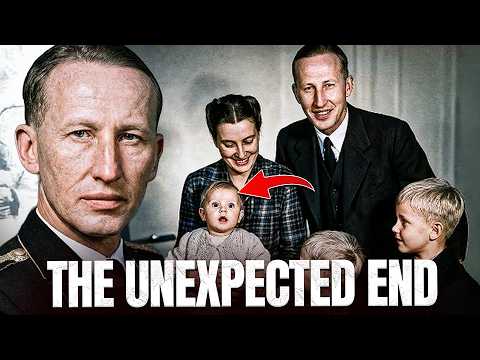
By the end of 1945, the family was crammed into temporary housing, relying on relatives and meager financial assistance. The collapse of the Third Reich had stripped them of everything—their home, their income, and the political networks that had once shielded them. “We had nothing,” Lena would later recall, though her definition of ‘nothing’ was far from the reality of most post-war Germans.
From 1946 onward, Lena faced a relentless series of denazification hearings. Investigators scrutinized her early membership in the Nazi Party, her privileged access to SS circles, and the material advantages she had enjoyed as the wife of one of the regime’s most feared men. Lena defended herself with a familiar refrain: “I was just a young, idealistic woman. I never participated in my husband’s decisions.” But the authorities noted that her party membership predated Hitler’s rise to power—a detail that suggested conviction, not opportunism.
Despite the suspicions, in 1949 Lena was classified as a Mitläuferin—a follower, not an active participant. The decision spared her from severe sanctions but did little to solve her financial woes. Without a profession or assets, she set her sights on a new goal: securing a widow’s pension as the spouse of a German officer.
The legal question at the heart of her claim was as delicate as it was controversial: Could Reinhard Heydrich, the architect of the Holocaust and head of the Reich Main Security Office, still be considered a qualified member of the German armed forces at the time of his death? The answer would not only determine the family’s financial future but also ignite one of the most heated judicial debates in post-war Germany.
In 1954, a Munich court delivered its verdict. The judges ruled that despite his central role in the regime’s terror apparatus, Heydrich met the legal criteria for a military member. Lena was granted a widow’s pension. The decision sparked public outrage. Critics decried it as a moral travesty, equating a mass murderer with soldiers who had died in combat. Others defended the court, arguing that it had merely followed the letter of the law.
With the pension secured, Lena achieved a measure of stability. In the early 1950s, she settled on the island of Fehmarn in northern West Germany and opened a guest house, the Pension Imbria. It became her main source of income and a hub for former acquaintances from the pre-1945 era. “She never hid who she was,” one local recalled. “But she never spoke of the past either.”
Lena’s stance remained unchanged. She portrayed herself as a victim of post-war circumstances, a widow and mother struggling to survive. In 1976, she published her memoirs, Life with a War Criminal, which reignited debates about Heydrich and her own role. Critics accused her of selective memory and self-protection, while some readers saw a sincere attempt to preserve family history. Historians noted that she frequently questioned documentary evidence and shifted responsibility to abstract structures of the regime.
Interest in Lena surged again in the 1970s and 1980s when journalists visited her in Fehmarn. One of the most cited accounts came from interviews recorded by journalist Nancy Doherty. According to Doherty, Lena spoke with conviction, rejecting any suggestion that her husband had been rightly judged by history. “She had no doubts,” Doherty observed. “She defended him until the end.”
Lena Heydrich died on August 14, 1985, at the age of 73. Her life spanned the rise and fall of the Third Reich and four decades of unresolved debates over memory and responsibility. But while she remained publicly tied to her husband’s legacy, her children chose a different path—one marked by anonymity, silence, and the inescapable weight of their surname.
Klaus, the eldest, never had the chance to choose. In October 1943, he was riding his bicycle near the family estate when he collided with a delivery truck. He died instantly. Lena was devastated. “She spoke of Klaus constantly,” a friend later said. “It was the one loss she could never rationalize.” SS officials attended the funeral, and Hitler sent formal condolences—a stark reminder of the family’s continued ties to the regime.
Heider, the second son, became the most publicly visible of the surviving children. After fleeing to Bavaria in 1945, he completed his engineering studies and built a quiet career. For decades, he refused all interview requests about his father. “He wanted nothing to do with that history,” an acquaintance noted. But in 2009, Heider made an exception, speaking with author John Martin for his book The Mirror Caught the Sun: Operation Anthropoid, 1942. In the interview, he defended his father’s reputation, insisting that history had treated him unfairly.
Two years later, Heider briefly returned to the headlines when he offered support for the restoration of the former family residence in Panenské Břežany, now in the Czech Republic. The proposal provoked outrage. Local authorities stressed that Heider had left the property as a small child and dismissed the gesture as an attempt to whitewash history. “The name Heydrich still carries the weight of the occupation,” a Czech official stated. “We cannot separate the house from what happened there.”
The younger daughters, Silke and Marte, chose lives far from public view. Reliable information about Silke is scarce; one unconfirmed account suggests she may have emigrated to the United States, but no verifiable sources exist. Marte, who now uses the surname Bayer, remained in Fehmarn and runs a small clothing shop. She avoids interviews and has said in rare comments that she never knew her father and knows little about him.
In an observation published by the German magazine Stern, Marte commented that few people can understand the burden of carrying a surname like hers. “My father’s identity accompanies me constantly,” she said. “It is always there, whether I want it or not.” Within the extended family, interpretations vary. Reinhard, Marte’s son, stated that no one fully knows the extent of his grandfather’s actions. Peter Thomas Heydrich, a nephew of Reinhard Heydrich, publicly stated that he considers it regrettable that the children never distanced themselves from their father’s actions or acknowledged even symbolically the suffering caused under his authority.
Despite these divergences, one common point unites the surviving children: none became involved in extremist politics or militancy associated with the Third Reich. Their life paths contrasted sharply with the stance adopted by Lena, who maintained her defense until the end of her life. While she remained tied to the memory of the regime, the children sought anonymity, avoiding public confrontation and rejecting any active role in the historical debates that continued to surround the Heydrich name.
Yet the silence of the children did not mean the past stayed buried. In the decades after Lena’s death, the Heydrich name resurfaced repeatedly—not through the family’s actions, but through the relentless pull of history. Scholars, journalists, and filmmakers kept returning to the same questions: How had a single family navigated the collapse of a murderous regime? And what did their choices reveal about memory, complicity, and survival?
Heider’s rare 2009 interview became a case study in how descendants of perpetrators grapple with inherited guilt. He had insisted that his father was a “soldier” and that history had been unkind to him. “He was my father,” Heider reportedly said. “I cannot judge him as a politician. I can only remember him as a man who played with us in the garden.” The statement infuriated many, but it also exposed a painful truth: for the children, the monster and the parent were the same person.
Marte’s quiet life in Fehmarn offered a different kind of reckoning. She ran her clothing shop, greeted customers, and rarely spoke of her father. But locals knew. “People would whisper when she walked by,” a longtime resident recalled. “Not because she did anything wrong—but because of the name.” Marte never sought to change it, nor did she defend it. She simply endured.
In 2011, the controversy over the Panenské Břežany residence flared again when a Czech historical group proposed turning the site into a memorial to the victims of Nazi occupation. Heider’s earlier support for restoration had been withdrawn, but the debate reignited questions about what should happen to the homes of perpetrators. Some argued for demolition; others insisted on preservation as a warning. “The house is not the crime,” one historian noted. “But it is the stage. And stages can teach.”
The Czech government ultimately rejected both restoration and demolition, opting instead for a quiet, unmarked plaque that mentioned the building’s wartime history without naming Heydrich directly. The compromise satisfied no one. For the families of victims, it was too little. For those who saw the house as a family home, it was too much. The Heydrich children, now elderly, stayed silent.
As the 2010s wore on, the family’s story began to appear in academic studies of intergenerational trauma. Researchers interviewed descendants of Nazi officials and found a common pattern: a refusal to engage with the past, paired with a deep, unspoken shame. “They grew up in the shadow of a father who was both absent and omnipresent,” one psychologist wrote. “They could never separate their love for him from the horror of what he did.”
Silke, the youngest daughter, remained the most elusive. Rumors of her emigration to the United States persisted, but no journalist could confirm her whereabouts. Some speculated she had changed her name entirely. Others believed she had died young. “Silke disappeared,” a distant relative said. “Not physically—but from the family story. It was easier that way.”
By the 2020s, the surviving children were in their eighties. Heider died in 2021, largely unnoticed outside Germany. His obituary made no mention of his father. Marte, still in Fehmarn, stopped giving interviews altogether. The clothing shop closed, and she retreated into privacy. The Heydrich name, once feared across Europe, now belonged to a handful of elderly people who wanted only to be left alone.
But history had one more twist. In 2023, a German television documentary unearthed a cache of letters Lena had written in the 1950s—letters she had never published. They revealed a woman far more aware of her husband’s crimes than she had ever admitted publicly. In one letter, she wrote: “I know what they say about him. I know what he did. But he was my husband, and I will not betray him.” The discovery complicated the narrative once more. Was Lena a deluded widow or a calculating defender? The letters suggested both.
The children, when asked for comment, said nothing. They had spent their lives refusing to explain themselves. And perhaps that, too, was a kind of answer—a refusal to engage with a legacy that had never been theirs to choose, but would always be theirs to carry.
The documentary’s revelation sparked a brief media storm, but the family remained silent. Marte, now in her late eighties, reportedly told a neighbor, “I have nothing to add. The letters are hers, not mine.”
With Heider gone and Silke untraceable, the public’s fascination slowly faded. The Heydrich name no longer commanded headlines—only academic footnotes and occasional online debates.
Yet the questions linger. How do families of perpetrators live with the weight of history? And when the last of them is gone, what will we be left to remember?
What do you think—should the children have spoken out, or was their silence a form of survival? Share your thoughts in the comments below.
Report this article
Select a reason for reporting:






