In the autumn of 1941, a new shape appeared over the English Channel, and Spitfire pilots began dying in ways they couldn’t explain. It turned tighter than anything they had. It dived away and vanished, and it was faster at every altitude. Then came the order no one wanted to hear. When you meet this thing, do not climb. Do not climb to escape it. The one instinct every fighter pilot was trained to trust—trading speed for altitude to get above the enemy—had just become a death sentence. That aircraft was the Focke-Wulf 190. This is the story no one tells.
That order broke a rule pilots had trusted since World War I. Altitude was safety. Altitude was credit in the bank you could spend in a fight. If someone attacked you, you climbed. You got above them and turned their attack into yours. Every young pilot learned that in training, and against the Focke-Wulf 190, it was killing them.
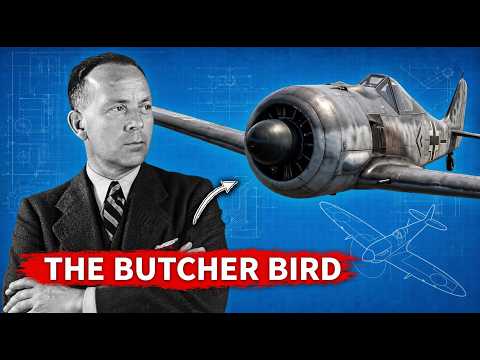
To understand why, you have to stop looking at the sky over France and go back three years, to a design office in Bremen, and to a man who believed the entire idea of a fighter plane had been built wrong. His name was Kurt Tank. He ran the design department at Focke-Wulf and held a low opinion of the fighters everyone admired, like the Messerschmitt 109 and the Spitfire—beautiful machines with pure performance. Tank compared them to racehorses. Give a racehorse a smooth track and delicate handling, and it will beat anything alive. Run it over rough ground and its leg breaks. He said it in almost those words.
What he wanted instead was a Dienstpferd—a cavalry horse. Something that could take off from a ruined forward field, be kept running by barely trained mechanics, absorb punishment, and still carry its rider home. It sounded like a compromise, a worse fighter that was merely tougher. And for a while, that was exactly the impression. Then Tank made the decision that shaped everything, including that deadly climb. He chose the wrong engine. Or what looked like the wrong engine.
Every serious fighter in Europe used a sleek, liquid-cooled inline engine. The Spitfire had the Merlin; the 109 had the Daimler-Benz. Narrow, smooth, fast. Tank chose a big, air-cooled radial—a huge cylinder of an engine that punched a wide hole in the air. On paper, it was slower and more complex. But look at what it gave him. A liquid-cooled engine is really a plumbing system. Radiators, coolant lines, a network of pipes—one bullet in the wrong tube drains the coolant and stops the engine in minutes. The radial engine had none of that. It could take hits and keep turning. It didn’t compete for the scarce Daimler-Benz engines the 109 was consuming by the thousand, and it delivered more raw power. The cavalry horse idea began to make sense.
The prototype first flew on June 1, 1939, and almost from the start, the powerful, dependable engine tried to fail the whole project. That big radial was crammed into a tight cowling, making it run hot—dangerously hot. Temperatures inside the cockpit rose beyond anything a pilot should endure. As the design neared front-line service, the overheating got worse instead of better. Oil lines burst, fuel leaked, and fumes leaked with it until pilots were landing half-poisoned, some so disoriented they couldn’t climb out unaided. The Luftwaffe had to move a test unit to an airfield near Paris just to chase those defects. Mechanics tore engines apart hunting the heat source, finding a cooling system that didn’t work and torn lines, and slowly, part by part, they fixed it. The machine built to be simple and reliable spent its early life being neither.
But once the problems were solved, they got something no one expected. And here’s the part people forget. Tank didn’t just build a tough airframe. He built the whole aircraft around the pilot. When the British later got their hands on one and studied the cockpit, their report was admiring. They wrote that the designer had clearly given a great deal of thought to the man who flies it. The controls were light. The visibility was the best they had seen in any fighter. The pilot sat well protected by armor, and the engine had a device no one else had: an early control unit that managed fuel, mixture, propeller pitch, and supercharger—all through one lever. In other fighters, the pilot juggled several controls mid-combat. In the 190, he just pushed the throttle and flew. Easy to fly, easy to fix, hard to destroy. The cavalry horse, exactly as promised.
So when the FW 190 reached the front over France in autumn 1941, it didn’t fly like a slow, sturdy workhorse. It flew like a predator. The Germans called it Würger—the shrike, a small bird that impales its prey. The RAF learned to call it the Butcher Bird. And the RAF kept running into it because Fighter Command was on the offensive in 1941, sweeping over occupied France day after day, trying to draw out the Luftwaffe and wear it down. That meant fighting over German-held ground. A Spitfire that went down took its pilot with it—dead or captured. A 190 that went down returned its pilot to friendly soil to fight again tomorrow. That imbalance doubled the weight of every flaw, and the flaws were piling up.
The 190 was faster by a clear margin at every altitude they met. It turned so fast the Spitfire couldn’t follow. The German pilot could snap from one bank angle to another and vanish. It could dive in a way the Spitfire couldn’t match, and part of the reason lay inside those two different engines. Push a Spitfire’s nose hard down in a dive, and the Merlin’s carburetor starves for a moment and coughs. The engine cuts out at the exact moment you need it most. The 190’s direct-fuel-injection engine didn’t care which way it was pointing. It kept pulling. So the 190 could dive straight and escape, while the Spitfire pilot had to roll first to keep his engine running—wasting half a second that cost men their lives.
Then there was the climb, the one that connects directly to that order. When both aircraft climbed together, the 190 pulled ahead and left the Spitfire behind. Now think about what that did to every fighter skill a pilot had. Attacking from above, his trained escape was to break, dive, and climb back to regain height. Against the 190, every path in that plan ended in a dead end. Dive? It out-dives you. Turn to shake it? It out-turns you. Climb away to regain energy? It climbs with you, then overtakes you—and now you’re slow, nose-high, hanging in the air like a target on a wire while a cannon-armed fighter slides in behind you.
There was almost nothing left in the bag. Panic reached the highest levels. The head of Fighter Command wrote it down in the summer of 1942, and the message still stings like a punch. He admitted he had only 14 of the newest Spitfire marks, while the enemy had 200 to 300 FW 190s. And the most terrifying part, he wrote, was the direction of travel. The Spitfire’s Merlin had reached the end of its development, while the 190 was just getting started. They weren’t just behind—they were falling behind on a curve that got worse.
There was one thing the RAF lacked and wanted desperately: a real FW 190 to take apart. They wanted it so badly they planned to steal one. The plan was real. Commandos would land on the French coast, and the chief test pilot of the Spitfire volunteered to be smuggled into a German airfield, climb into a 190, and fly it home. That was the kind of plan that gets people killed. They never had to carry it out.
On June 23, 1942, a German pilot named Armin Faber got into a fierce fight with Spitfires over the south coast of England. He shot one down, then became disoriented, ran low on fuel, and got confused—making a mistake that seems impossible until you feel how disorienting air combat really is. He mistook the Bristol Channel for the English Channel. He flew north believing he was heading back to France. He found an airfield, made a perfect landing, and rolled to a stop at RAF Pembrey in Wales.
The duty pilot on the ground realized what he was seeing, grabbed a flare pistol, ran at the aircraft, and climbed onto its wing before Faber understood where he was. The most valuable aircraft the RAF could have imagined had just been handed to them on a golden platter. They didn’t waste the chance. The 190 went to Farnborough, was repainted in RAF colors, and sent to the unit whose only job was to answer one question: how good is this thing, and how do we beat it?
All summer they tested it in flight against the Spitfire V, then against everything they had, in careful comparative trials. The report they finished in August 1942 confirmed the nightmare with cold, specific detail. Faster at every altitude by roughly 25 to 35 miles per hour. Better acceleration in all flight conditions. Better turning ability. Better diving ability. And in the climb—the thing pilots yearned to do—the report’s language was astonishingly calm. When both aircraft climbed from a dive, the 190 pulled away rapidly, and the Spitfire had no hope of catching it.
No hope of catching it. That is the hidden flaw inside the climb. Not a crack in the metal, but a flaw in the tactic, in the physics of the fight itself. And now, here is where the popular account gets one thing wrong, and the truth turns out to be more interesting.
That famous report stated the 190 out-climbed the Spitfire at all altitudes in a steady, sustained climb with the nose held high. For decades, that was repeated as proof that the German fighter was simply a better climbing machine, decisively. Except the British made an unintentional error. The engine of the captured aircraft had been performance-restricted by the Germans, limited to a lower power setting. The RAF test pushed the engine beyond those limits, at power greater than Luftwaffe pilots were ever allowed to run. They raised the captured engine’s rpm past the permitted limit and recorded the results. Some of the reported climb rates were the product of running the engine beyond its technical rules.
So was the deadly climb rate just a myth too? No. And this is the most important part. The real reason Spitfire pilots were dying wasn’t the sustained climb rate. It was the zoom climb—the sharp climb made while flying fast. That depends on acceleration and energy, not on your ability to hold a steady climb. The 190 was heavier and more powerful. It gained speed faster and kept it better. So when it converted that speed into altitude, it had a bigger balance to spend.
The figure in the report was a little exaggerated. But the truth underneath it was entirely real. Even with the engine settings corrected, the warning stood unchanged. Do not attempt a zoom climb against this aircraft. So the RAF wrote it down and put it in pilots’ hands. In August 1942, instructions went out to the Spitfire squadrons, and their core was blunt and direct. To beat the 190 and avoid losses, they were told: You must fly your aircraft at the maximum possible speed whenever you are near the combat area. Never let your speed bleed away. Never slow down—which is exactly what climbing forces you to do.
One version put it in plain language: Near the enemy, fly at maximum performance and at the right time. Gain your speed before you need it, not after it’s too late. The whole combat doctrine was built on denying the 190 the situation it preferred: a slow Spitfire in a climbing attitude with no other option. But you can’t just tell pilots what not to do. You have to give them the one tool that still worked, and there was only one.
A notice went around the squadrons. One copy carried a provocative title: Who’s afraid of the little damned wolf? It laid the matter out plainly. The Spitfire’s only real advantage over the 190 in the air was its ability to turn in a tighter circle. That was all. One winning card in the whole game. But the notice said: And that is a lot.
Because turning was the one place a 190 pilot couldn’t follow you without losing. If he turns with you, he loses. If he dives with you, he loses. If he climbs with you, he loses. But if you turn hard and keep turning, the Spitfire will creep inside until the German advice becomes its exact mirror: Never let a Spitfire drag you into a turning fight. One RAF pilot summed up the trap in a single sentence. He said: We could out-turn it, but you can’t turn all day. Sooner or later, you had to come out of the turn. And the moment you come out and point for the sky to climb away, you’re back in the 190’s world.
Then came the day that proved it in front of everyone. On August 19, 1942, the Allies sent a raiding force against the French port of Dieppe, and above it the RAF fought the largest air battle of the war so far. Two full Luftwaffe wings were waiting—around 200 fighters, most of them FW 190s. The RAF sent dozens of squadrons, most flying the outclassed Spitfire V. By the end of that day, the RAF had lost roughly 106 aircraft, most of them fighters. Dozens were Spitfires. It was the worst day Fighter Command ever suffered.
The Germans lost about half that number, and many of those were bombers, not 190s. The aircraft the report had warned about did, in broad daylight, over a beach full of witnesses, exactly what the report said it would do. Tactics kept you alive. But they weren’t enough to win.
The real answer had to come from engineering, and it came faster than expected because the captured 190 had shown the British its weaknesses precisely. Remember Tank’s engine—that big, powerful, tough radial? It had a limited altitude ceiling. Its supercharger was designed to work at the low and medium altitudes where the 190 ruled the sky. Above roughly 22,000 feet, its performance fell off and it lost energy in the thin air. The Butcher Bird was lethal down low but out of breath up high.
So the RAF aimed at that gap. They took the Spitfire and gave it a new two-stage Merlin—an engine that kept making power where the 190 was gasping. That aircraft became the Spitfire Mark 9. It reclaimed the high altitudes. It reclaimed its speed. And when tested against the captured 190, it finally matched it in head-to-head contests. Faster up high, able to maneuver in the turn, and competitive even in the climb where it had been humiliated a year before.
They rushed it to the squadrons. The gap Faber’s wrong turn had exposed, the new Merlin closed. But don’t let the story end too neatly, because the FW 190 never stopped being dangerous. Even against the Mark 9, it kept the tricks Tank had designed into its bones. It still out-rolled the Spitfire by a wide margin. It could snap into a fast diving turn in the opposite direction and vanish before the Spitfire could follow. A move Allied pilots were now explicitly trained to expect. At low altitude, where most fights actually began, it stayed deadly. The altitude rule didn’t disappear entirely. It just narrowed to the heights where the Butcher Bird still ruled.
And here lies the deeper correction, the one the numbers force on you. No single aircraft decided any of this. The RAF spent 1941 and 1942 convinced it was winning the air war over France, counting German aircraft it believed it had shot down, and deciding the trade was worthwhile. It wasn’t. In the first half of 1942, the RAF lost more than 200 Spitfires over France and believed it had destroyed nearly 200 German aircraft. The real German figure was closer to 60. They were losing that trade badly, two of theirs for every one of the enemy’s, and they didn’t fully know it.
What won in the end wasn’t a magic airplane. It was a better engine, tactics paid for with the mistakes of dead men, an airframe captured and made to reveal every secret, steadily improving pilot training, and an aircraft industry that could simply build and replace faster than Germany could. The machines mattered enormously. But they never fought alone.
So what happened to the people at the heart of these events? Armin Faber, the man who handed the Allies their answer by getting lost, spent the rest of the war as a prisoner. The story goes that he convinced the authorities he suffered from epilepsy. In 1944, he was actually repatriated in a prisoner exchange and returned to flying operations. The most valuable delivery a Luftwaffe pilot ever made to the enemy, and he still talked his way home.
Kurt Tank kept building. He developed the 190 into a long-nosed high-altitude version, the Ta 152, meant to fix the weakness the British had found and exploited—but it arrived too late and in numbers too small to change anything. After the war, with Germany forbidden from building aircraft entirely, Tank carried his ideas abroad and designed jet aircraft in Argentina and later in India. The cavalry-horse thinking outlived the war, the company, and the country it was built to protect.
And that brings us back to the order we started with. Do not climb. Do not climb. To a young Spitfire pilot in 1941, it must have felt like being told to forget how to fly. But it was never about the Focke-Wulf being a magical climbing machine. The report that said so was misreading a strained engine. It was about a choice one designer made years earlier in an office in Bremen, when he chose power and toughness and stored energy over grace, and built a fighter that punishes you for making the instinctive move every pilot trusted. The Spitfire could turn around it all day. It just couldn’t keep turning all day. And the moment you stop turning and point for the sky, the flaw built into every climb is already waiting for you.
So here’s the question that still hangs over every dogfight ever fought: when your instincts are the very thing the enemy has designed against, how do you unlearn what kept you alive long enough to learn it?
Report this article
Select a reason for reporting:






