In the annals of aerial warfare, two names stand above all others: Erich Hartmann, the highest-scoring ace in history with 352 victories, and Hans-Joachim Marseille, the legendary ‘Star of Africa’ who achieved 158 kills in just 13 months. On paper, Hartmann’s numbers dwarf Marseille’s. But ask the pilots who flew alongside them, and a different story emerges—one where Marseille, the rebellious virtuoso, might have been the greatest of them all.
Hartmann was the consummate professional: disciplined, precise, and deadly. Marseille was a jazz-loving, womanizing maverick who flouted authority and fought like a man possessed. Their contrasting styles—Hartmann’s cold calculation versus Marseille’s fearless improvisation—raise a tantalizing question: if they had faced each other in the same aircraft, who would have emerged victorious?
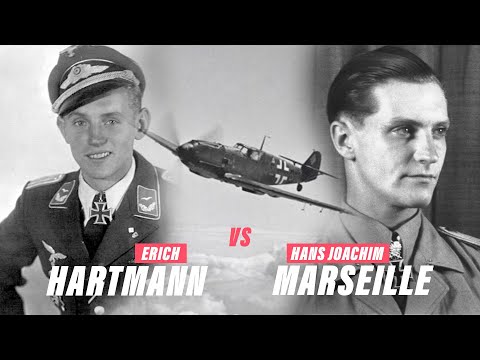
Marseille’s career began in chaos. A troubled youth marked by family tragedy—his sister murdered by her partner—left him rebellious and unfocused. At flight school, he showed promise but clashed with superiors. During the Battle of Britain, he abandoned his wingman to chase a kill, and later abandoned his squadron leader, who was shot down and killed as a result. His commanding officer tore up his evaluation papers and had him removed from the squadron.
Transferred to the elite JG 52, Marseille’s antics continued. He played jazz piano—technically illegal in Nazi Germany—drank heavily, and chased women. Fellow ace Johannes Steinhoff found him unreliable as a wingman and had him transferred again. But under the tutelage of Eduard Neumann in JG 27, Marseille began to harness his talents.
Sent to North Africa in April 1941, Marseille initially struggled. He was shot down multiple times, his aggressive diving attacks often leaving his aircraft badly damaged. Neumann encouraged him to adopt deflection shooting and improve his G-tolerance. By August 1941, something clicked. From then on, Marseille became unstoppable.
In the clean desert air, Marseille perfected his technique. He would attack from angles, targeting engines with deflection shots—lining up the enemy from the side, pulling the nose ahead, and firing. He claimed that a single aircraft had the advantage over a group because it could act freely while enemies would stumble over each other defensively. His friend Hans-Arnold Stahlschmidt noted that Marseille deliberately flew unpredictably, never doing the same thing twice.
Marseille’s daring was legendary. He once engaged three Allied aces simultaneously and emerged victorious. In another instance, he shot down seven P-40 fighters in a single day. Adolf Galland called him ‘an unrivaled virtuoso.’ Günther Rall admitted he would not want to fight Marseille because he believed Marseille was ‘out of his mind’—a testament to his fearless nature.
But Marseille’s career was cut short. On September 30, 1942, his cockpit filled with smoke, and he bailed out—only to strike the tailplane and fall to his death. He was just 22 years old.
Hartmann, by contrast, was a methodical hunter. Taught to fly by his mother, a pioneering glider pilot, he joined the Luftwaffe at 18 and was sent to the Eastern Front in 1942. His first mission was a disaster: he broke formation, dove at enemies, missed, nearly collided with another aircraft, and crashed after running out of fuel. His commander, Edmund Roßmann, refused to fly with him again.
But Hartmann learned. He developed the ‘see—decide—attack—break’ tactic: carefully assess the enemy, position himself unseen, strike quickly, and disengage. He preferred hit-and-run attacks over dogfights, exploiting altitude and angles. Flying with the best—Günther Rall, Gerhard Barkhorn—he honed his skills. Hartmann would go on to score 352 victories, but he never lost a wingman in combat.
Their approaches couldn’t have been more different. Marseille was a lone wolf who thrived in chaotic dogfights; Hartmann was a team player who avoided them. Marseille took reckless risks; Hartmann calculated odds and withdrew if the chance of victory was low. Marseille flew 380 sorties and scored 4 kills per sortie; Hartmann flew 1,400 sorties and scored 0.2 kills per sortie.
Yet both possessed a rare gift: a high tolerance for danger that allowed them to remain calm and precise under extreme stress. As historian note, this ‘nerves of steel’ may have been their greatest weapon—more important than tactics or aircraft.
So who was the better pilot? The answer may lie not in the numbers, but in the words of those who knew them. Günther Rall, Johannes Steinhoff, and even Hartmann himself admitted that the greatest pilot in their eyes was Hans-Joachim Marseille.
But the debate is far from settled. What if Marseille had survived? What if he had flown on the Eastern Front? And what if the two men had met in the skies, each at the peak of his powers? The answers lie in the details of their tactics, their personalities, and the unforgiving crucible of war.
To understand why Marseille’s peers rated him so highly, one must examine the kill counts more closely. Hartmann’s 352 victories were amassed over four years of continuous combat on the Eastern Front, where he flew 1,400 sorties. Marseille’s 158 came in just 13 months and 380 sorties. That works out to roughly four kills per sortie for Marseille—twenty times Hartmann’s rate.
Of course, raw ratios can mislead. Hartmann’s longevity was itself a testament to his skill; surviving 1,400 sorties against any enemy required extraordinary situational awareness. Marseille, for all his brilliance, was shot down repeatedly in his early months and died in a botched bailout at just 22.
But consider the quality of the opposition. Marseille fought the RAF’s Desert Air Force—veteran pilots flying Spitfires and P-40s, many of them aces themselves. On September 1, 1942, he shot down 17 British aircraft in a single day, including eight in one sortie. No other pilot in history has matched that single-day tally.
Hartmann’s opponents were often less experienced. Many Soviet pilots received minimal training before being thrown into combat, and their aircraft—while rugged—were frequently outclassed by the Bf 109. This is not to diminish Hartmann’s achievement; he still had to shoot them down, and the Eastern Front produced its own formidable aces. But the comparison is not apples to apples.
There is another dimension that historians rarely discuss: leadership. Hartmann was a natural wingman and mentor. He protected his comrades obsessively, and his squadron’s morale reflected his steady presence. ‘My greatest achievement,’ Hartmann once said, ‘was that I never lost a wingman.’
Marseille, by contrast, was a solitary predator. He had no interest in leading formations or nurturing rookies. In the mess hall he was charming; in the air he was a ghost. His wingmen learned to give him space, knowing he would vanish into a dogfight and reappear minutes later with another victory—or not at all.
This difference in temperament shaped their legacies. Hartmann became the model of the modern fighter pilot: disciplined, team-oriented, and sustainable. Marseille became a romantic figure—the doomed artist of the skies, burning twice as bright and half as long.
Yet even Hartmann acknowledged Marseille’s genius. In his memoirs, he confessed that he had studied Marseille’s deflection-shooting techniques and found them nearly impossible to replicate. ‘Marseille could do things with a fighter that no one else could,’ Hartmann admitted. ‘I was a marksman. He was an artist.’
So the debate continues. Statisticians point to Hartmann’s 352. Romantics point to Marseille’s 17-in-a-day. And the men who flew against them—British, Soviet, and German alike—offer a verdict that transcends numbers.
Perhaps the final word belongs to Eduard Neumann, Marseille’s commander in North Africa. ‘If I had to choose one pilot to fly into battle,’ Neumann said, ‘I would choose Marseille. But if I had to choose one pilot to survive the war, I would choose Hartmann.’
It is a fitting epitaph for two men who represented opposite poles of aerial warfare—and whose unfinished contest remains one of history’s most tantalizing what-ifs.
Yet the what-if cuts deeper than mere numbers. Consider the circumstances of their final years. Hartmann survived the war, only to spend a decade in Soviet captivity—an ordeal that tested a different kind of steel. Marseille never had the chance to adapt, to grow, to face the late-war skies where the Luftwaffe’s advantage eroded month by month.
Would Marseille have thrived against the Mustangs and Thunderbolts that swarmed over Germany in 1944? His deflection shooting and improvisational genius might have served him well—or his recklessness might have finally caught up with him. Hartmann, by contrast, proved he could adapt; his tactics worked against Western aircraft as effectively as against Soviet ones.
There is also the matter of the aircraft themselves. Marseille flew early-model Bf 109s against early-model Spitfires and P-40s—a relatively even match. Hartmann flew later 109 variants against everything from obsolete Yaks to the finest Soviet and Western fighters. When Hartmann was offered the revolutionary Me 262 jet, he refused, preferring to stay with his comrades in JG 52. That loyalty cost him kills—but it defined him.
Perhaps the most revealing comparison lies in how each man faced death. Marseille’s end was almost absurdly cruel: a brilliant pilot undone by a mechanical failure, his body striking the tailplane he had mastered a thousand times. Hartmann’s survival seemed equally improbable—he was shot down or crash-landed over a dozen times, yet always walked away.
‘I was lucky,’ Hartmann admitted late in life. ‘Marseille was not.’ It was a rare moment of humility from a man who rarely indulged in introspection. But it hinted at something deeper: the recognition that greatness in combat is not solely a product of skill. Timing, circumstance, and sheer fortune play their parts.
The pilots who flew against Marseille never forgot him. British aces spoke of his attacks with a mixture of dread and admiration. One RAF veteran recalled: ‘You never saw him until he was firing. And when he fired, you were already falling.’ No such mythology grew around Hartmann among his enemies—he was feared, certainly, but as a relentless predator rather than an artist.
And yet, Hartmann’s record stands unchallenged. Three hundred and fifty-two victories. Four years of continuous combat. A wingman never lost. These are facts that no amount of romanticism can erase.
So the argument returns to where it began: two men, two philosophies, one war. Marseille the virtuoso, Hartmann the technician. One burned bright and brief; the other endured and endured.
Perhaps the truest measure isn’t who shot down more, but what each left behind. Marseille left a legend—a young man who made impossible shots look effortless, who laughed at death and died anyway. Hartmann left a record—a testament to discipline, loyalty, and the quiet heroism of bringing your comrades home.
In the end, the Luftwaffe produced both, and perhaps that is the point. The war demanded different men for different skies: the artist for the desert, the hunter for the steppe. Each was supreme in his element.
But the question lingers, as it has for eighty years: if you could only choose one to fight beside you—the genius or the survivor—whom would you trust?
Let us know in the comments below.
Report this article
Select a reason for reporting:






