September 1944. The war was turning against Germany, and thousands of Wehrmacht soldiers were being loaded onto trains and ships, bound for prisoner-of-war camps in Britain. Among them was Hans Müller, a machinist from Hamburg, who had been taught since childhood that black people were subhuman—mere beasts of burden unfit for civilization. He expected to see them scrubbing floors and cleaning latrines. He expected white British guards to treat them with contempt. He expected the world to confirm everything Nazi propaganda had drilled into him.
He was wrong.
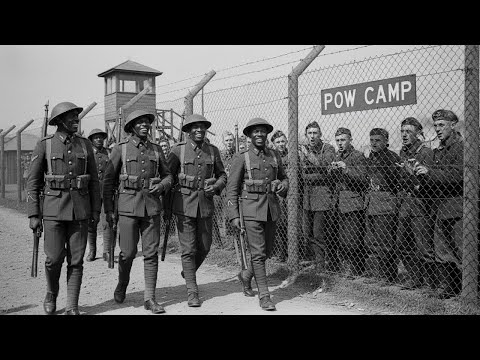
Camp 186 sat in the Yorkshire countryside, a sprawling compound of curved Nissen huts surrounded by barbed wire and stone walls. Roughly 4,000 German prisoners shuffled through the gates, exhausted and confused. Many were barely out of their teens; others were hardened veterans who had fought since Poland. They came from factories, farms, and cities across the Reich, but they all carried the same poisonous lessons about race.
The shock began at intake. A British sergeant walked down the line with a clipboard, his uniform pressed, his boots gleaming, his authority unmistakable. He was black. He spoke clear English with a Caribbean accent, ordering the Germans to form straight lines, checking their names against his list. Müller felt his stomach tighten. This was not supposed to be possible.
But what truly shattered him was watching the white British guards. They showed the Jamaican sergeant complete respect—not tolerance, not forced politeness, but genuine military deference. When he gave an order, they followed it immediately. One white corporal even saluted him.
Müller later wrote in his diary: “A black man in full uniform ordered us around, and the British guards showed him the same respect they would show any other sergeant.”
The dissonance grew stronger each day. In the mess hall, black and white guards ate together, shared cigarettes, and laughed like old friends. A black corporal from Trinidad supervised work details, and white soldiers obeyed without hesitation. To men raised on Nazi racial doctrine, this was not just surprising—it was fundamentally impossible, like watching water flow uphill.
The contradictions multiplied. During off-duty football matches, black and white British soldiers played on the same teams, passing the ball, celebrating goals, arguing over out-of-bounds calls with equal voice. In the camp library, Ernst Vber pored over British newspapers showing black air-raid wardens, factory workers, and civil-defense volunteers working side by side with white Britons. The articles described their contributions in the same respectful tone regardless of skin color.
Vber was deeply confused. Nazi propaganda had always claimed that racial mixing destroyed a nation’s strength. Yet here was Britain mixing races freely—and Britain was winning the war.
The camp infirmary delivered another blow. A medical officer from British Guiana—a black man who had studied medicine in London—ran the facility with professional precision. When Otto Schmidt developed a severe infection from a barbed-wire cut, the doctor recognized the danger immediately, administered sulfa drugs, and checked on him daily until the infection cleared. Schmidt later admitted the doctor had saved his hand, possibly his life.
Christmas 1944 brought another lesson. A black quartermaster sergeant from British West Africa managed the distribution of 200 Red Cross parcels with meticulous fairness, cross-referencing names against a master list to prevent double-dipping. Ernst Vber remarked to Müller that the British trusted this black sergeant with supplies worth thousands of pounds—something the Wehrmacht would never do with a Slavic person.
British civilians near the camp sometimes hired prisoner work crews. The Germans found themselves taking orders from Jamaican corporals and African sergeants who knew farming inside and out. These supervisors organized efficient schedules, demonstrated proper techniques, and maintained discipline without cruelty. During breaks, they taught the Germans British songs and shared stories about their homelands. The prisoners watched as farmers’ wives served tea to these black supervisors first, their teenage daughters chatting with them casually, without fear or disgust.
The moment of ideological collapse came differently for each man. For Hans Müller, it arrived in March 1945, when a Royal Air Force pilot—a black man from Trinidad—came to speak at the camp. The pilot wore his RAF wings proudly, ribbons showing dozens of combat missions. He spoke for nearly an hour about complex tactical operations, bomber formations, and the technical specifications of the Lancaster bomber, rattling off engine power, bomb capacity, and altitude figures as easily as reciting a poem. He answered questions with precision, sketching calculations on a notepad, describing evasive maneuvers he had performed while flak exploded around him. He spoke three languages fluently and had attended university before the war.
Müller sat in the audience feeling something inside him shatter. Everything the Nazis taught him was a lie. Not a slight bending of truth, but complete and fundamental falsehood. If they had lied about something this basic and obvious, what else had they hidden?
The work details continued through the spring. German prisoners labored under black supervisors who demonstrated deep agricultural knowledge, organized harvests efficiently, and corrected mistakes calmly. When someone worked hard, they offered genuine praise. The prisoners found themselves singing along to British songs, stumbling over pronunciation but enjoying the shared humanity.
Ernst Vber wrote in a letter home—censored but preserved in British archives—that the Nazis called the British Empire weak and corrupted by racial mixing, yet he was witnessing efficient organization, industrial abundance, and soldiers of all colors working as brothers in arms. How could a weak nation dominate half the world? How could they be winning the war?
The most dramatic transformation happened to Otto Schmidt in April 1945, when he developed acute appendicitis. The camp’s regular surgeon was away, and the only available surgeon was the black doctor from Sierra Leone. Schmidt lay on the operating table, terrified—not of the surgery, but of his own indoctrination. Could a black man really perform delicate surgery? Would his hands be steady?
The doctor made a precise incision, removed the inflamed appendix cleanly, and stitched the wound with neat sutures. Within two weeks, Schmidt was back to full health. He later admitted that lying on that table was a moment of truth. A black man had held his life in his hands and saved him with skill and knowledge. Dignity and capability had nothing to do with skin color. They came from education, practice, and character. The Nazi ideology was not just wrong—it was evil, because it blinded people to the humanity of others.
When Hans Müller returned to Hamburg in late 1946, he carried three things: a duffel bag, fifteen extra pounds from regular meals, and a completely transformed worldview. The train ride took hours because so many rail lines had been destroyed. Hamburg was unrecognizable—60% of its buildings reduced to rubble, survivors hollow-eyed and scavenging. His mother looked twenty years older. Over watery soup, he tried to explain what he had seen in Britain. She listened silently, then said the propaganda had lied about everything. “What a waste,” she whispered. “What a terrible, senseless waste.”
Many returning prisoners became quiet advocates for change. Ernst Vber joined anti-fascist education programs, telling young Germans that he learned more about true humanity in a British POW camp than in a lifetime of Nazi schooling. Friedrich Hoffman returned to teaching mathematics in Berlin, incorporating lessons about critical thinking. He told his students that when evidence contradicts a theory, you must change the theory—not ignore the evidence. Otto Schmidt studied medicine, inspired by the surgeon who saved him, and refused to turn away any patient based on nationality or background.
The irony was profound. Nazi racial ideology was supposed to make Germany stronger, but it weakened the nation by cutting it off from the talents of millions. Britain’s willingness to use talent regardless of skin color gave it enormous advantages. As Friedrich Hoffman wrote in 1947: “Prejudice does not protect the strong. It blinds them to the strength of others. This blindness cost Germany everything.”
The prisoners who witnessed Britain’s imperfect but functional racial integration carried home a truth: human dignity, capability, and worth transcend the boundaries people draw between races. In losing the war, they gained a more accurate understanding of humanity itself—a lesson that would help shape a new Germany rising from the ashes.
But for now, in the spring of 1945, the war in Europe was entering its final weeks, and the men of Camp 186 were still watching, still learning, still struggling to reconcile everything they had been taught with everything they were seeing.
The final weeks of the war brought a new urgency to Camp 186. News of the Allied advance into Germany reached the prisoners through the camp’s newspapers and the guarded conversations of the British guards. Some men wept openly. Others sat in stunned silence, staring at the barbed wire as if it could somehow answer the questions churning inside them.
Hans Müller found himself in the camp library one gray April morning, staring at a photograph on the front page of a British newspaper. It showed American and British soldiers—white and black—advancing together through a ruined German town. The caption described them as liberators. Liberators of his own country. The word felt foreign, almost obscene, and yet he could not look away.
Ernst Vber sat down beside him. Neither man spoke for a long moment. Then Vber said quietly that he had been thinking about the lies—not just the big ones about race, but the smaller ones that had prepared the ground for them. The stories of German invincibility. The claims that Britain was decadent and weak. The assurances that the war would be over by Christmas.
“They lied about everything,” Vber said. “And we believed them because we wanted to.”
That admission hung in the air between them. Müller realized that the propaganda had not worked alone. It had required something from the German people themselves—a willingness to accept easy answers, to blame others for their nation’s problems, to feel superior without earning it. The Nazis had built a cathedral of lies, and the German people had supplied the bricks.
The camp commandant, a British major named Whitfield, called a meeting in late April. He stood before several hundred assembled prisoners and announced that the war in Europe was nearly over. Hitler was dead by his own hand in Berlin. The Third Reich was collapsing. The prisoners would soon be processed for release.
A strange silence followed. Müller had expected cheering, or at least relief. Instead, the men stood motionless, their faces a mixture of exhaustion, grief, and something harder to name. Shame, perhaps. Or the first stirrings of understanding.
Major Whitfield seemed to sense it. He said that he had read some of the prisoners’ letters and diaries, and that he understood many of them were wrestling with difficult questions. He told them that Britain would not seek revenge. The war was ending. What mattered now was what came next.
Over the following weeks, the atmosphere in the camp shifted. The guards relaxed their vigilance. Work details became lighter. The prisoners were allowed to walk the perimeter of the camp without supervision, though most chose not to. They gathered in small groups, talking in low voices about what they had seen and what it meant.
Friedrich Hoffman began holding informal lectures in the barracks. He was a mathematics teacher by training, but he spoke now about logic and evidence, about how a person could be taught to believe something false and never question it. He used examples from their own experience—the black sergeant who processed them at intake, the Trinidadian pilot who flew bombers, the Sierra Leoneian surgeon who saved Otto Schmidt’s life.
“Each of these men was living proof,” Hoffman told them, “that everything we were taught was a lie. And yet we did not see it until we were forced to. That is how prejudice works. It blinds you to what is right in front of your eyes.”
Otto Schmidt, still recovering from his surgery, spent long hours sitting outside the infirmary, watching the camp doctor make his rounds. He had begun to think of the man not as a black doctor, but simply as a doctor—skilled, patient, and dedicated. The realization felt like a door opening inside him, revealing a room he had never known existed.
One afternoon, Schmidt approached the doctor and thanked him again for saving his life. The doctor nodded, then asked Schmidt what he planned to do when he returned to Germany. Schmidt admitted he did not know. His father’s bakery was gone, destroyed in the bombing. He had no trade, no prospects.
The doctor was quiet for a moment. Then he said that Germany would need builders and healers in the years ahead. He suggested that Schmidt consider studying medicine. “You have a good mind,” he said. “And you have seen something most people never see. That is worth something.”
Schmidt carried those words with him for the rest of his life.
The release processing began in early summer. Each prisoner was interviewed by British officers, given a travel document, and issued a small amount of money for the journey home. The men lined up at the camp gates, clutching their belongings, their faces pale and uncertain.
Hans Müller stood in line with Ernst Vber and Friedrich Hoffman. The three men had become friends over the long months, bound together by their shared experience of ideological collapse. They spoke little now. There was nothing left to say that had not already been said.
When Müller’s turn came, the British sergeant at the gate—a white man with kind eyes—handed him his papers and wished him luck. Müller hesitated, then asked if he could say something to the camp commandant before leaving. The sergeant nodded and led him to Major Whitfield’s office.
Whitfield looked up from his desk, surprised. Müller stood awkwardly in the doorway, unsure how to begin. Finally, he said that he wanted to thank the major for the way the prisoners had been treated. He said that he had learned things in this camp that he never would have learned anywhere else. He said that he was ashamed of what he had believed, and that he would spend the rest of his life trying to make amends.
Whitfield studied him for a long moment. Then he stood and extended his hand. “That is all any of us can do, Müller,” he said. “Learn from what we have seen, and try to do better.”
Müller shook his hand and walked out of the office into the summer sunlight. The gates of Camp 186 stood open before him. Beyond them lay the road to the coast, the ship across the North Sea, and a Germany he barely recognized—a nation in ruins, but also a nation with a chance to begin again.
He thought of his mother, waiting in the basement of their shattered home. He thought of his brother, buried somewhere on the Eastern Front. He thought of the black sergeant who had ordered him to form a straight line, and the Trinidadian pilot who had spoken of bomber formations and engine efficiency, and the Sierra Leoneian doctor who had saved Otto Schmidt’s life.
These memories would travel home with him, packed alongside his few belongings. They would shape everything that came next—the difficult years of rebuilding, the slow work of confronting the past, the small daily choices to treat every person with the dignity they deserved.
As Müller stepped through the gate, he paused and looked back at the camp one last time. The Nissen huts, the barbed wire, the guard towers—all of it was already fading into memory. But the lessons remained, sharp and clear, like a scar that would never fully heal.
He turned away and began walking toward the road that led home.
The road to the coast was long, but Müller did not walk it alone. Vber and Hoffman had arranged to travel with him as far as the port, and the three men spoke little of the past, as though naming it too often might summon it back. Instead they talked about the future—small, ordinary things. Bread that did not taste of sawdust. Windows without blackout curtains. A Germany where a man might be judged by his work rather than his blood.
At the dock, they shook hands, and Vber said something Müller would remember for the rest of his life: “We went to Britain as soldiers of a lie. We come home as students of the truth.”
The ship crossed a gray and restless sea. Müller stood at the rail, watching the water, and thought of the black sergeant with his clipboard, the pilot with his calculations, the surgeon with his steady hands. He had entered that camp certain of his superiority. He was leaving it certain of nothing except this: that every human being carried within them a worth no ideology could erase.
Behind him, Europe smoldered. Ahead, a ruined city waited for its sons to rebuild it—not with slogans, but with honest hands.
What would you have carried home from Camp 186?
Report this article
Select a reason for reporting:






