Marilyn Monroe was not Marilyn Monroe when they locked the door. She was “Faye Miller,” a name she gave at the admissions desk of Payne Whitney Psychiatric Clinic in February 1961. Within hours, she understood the truth: the window wouldn’t open, the door had a glass panel watched by staff, and she was on a floor for seriously disturbed patients. She was 34, freshly divorced from Arthur Miller, and The Misfits—the film he wrote for her—had just flopped. Her psychiatrist had promised rest. Instead, she got a cell.
She pounded on the door. She threw a chair against the glass. The staff took that as proof she belonged there. It took Joe DiMaggio—her ex-husband of six years—flying in from Florida and threatening to tear the building apart to get her out after four days. She was moved to a regular floor at Columbia Presbyterian for three more weeks. The fear that gripped her wasn’t just about the locked ward. Her mother, Gladys, had spent most of her adult life in state hospitals with paranoid schizophrenia. Her grandmother had died in one. Marilyn grew up in foster homes and an orphanage, terrified she’d end up the same way. In 1961, she spent four days in a padded room believing she might.
Television audiences knew her, too. She was a guest on The Jack Benny Program in 1953 and sat for Edward R. Murrow’s Person to Person in 1955, shyly admitting she wanted to be taken seriously. Gentlemen Prefer Blondes and Some Like It Hot still air somewhere every week. She lived another year and a half after Payne Whitney. She returned to Los Angeles, bought a small Spanish-style house in Brentwood—the only house she ever owned—with tiles by the front door that read Cursum Perficio: “I am finishing my journey.” In June 1962, Fox fired her from Something’s Got to Give, then quietly started talks to hire her back. A month earlier, she’d stood on the stage of Madison Square Garden in a sheer, beaded dress and sang “Happy Birthday” to President Kennedy in front of 15,000 people, filmed and shown on television news around the country. Nobody watching knew she’d been on a locked ward 15 months earlier. She died at home in August 1962 at 36 of an overdose of barbiturates. The coroner ruled it a probable suicide.
Lawrence Tierney was the toughest man in the movies—and he didn’t stop being that man when the camera was off. Born in Brooklyn in 1919, a low-budget gangster picture called Dillinger made him a star in 1945. Two years later, he gave the best performance of his life in Born to Kill as a drifter who murders without much reason. RKO had real hopes for him, casting him twice as Jesse James. But between 1944 and 1951, he was arrested at least a dozen times in Los Angeles alone, almost always for drinking and brawling. In summer 1951, he did 90 days in New York for breaking a college student’s jaw in a bar. He came out that October and went to Chicago. Within days, police found him inside a church in a confused and disheveled state. This time, they didn’t take him to jail. The Chicago Daily Tribune reported on October 9, 1951, that Tierney had been taken to a neurological hospital—described in accounts of his life as a mental hospital. Nobody published how long he was kept there or what the doctors decided. A man found by authorities in that condition was not likely to have had much say about going.
It didn’t change much. He was back in court the next year, and by the end of the decade, the studios had stopped calling. For a while, he worked as a bartender and construction laborer in New York. Television kept him alive as an actor—guest parts through the 1960s and 1970s in shows like The Naked City, and in the 1980s, Hill Street Blues. A whole new audience met him in 1991 when he played Elaine’s father, the novelist Alton Benes, on Seinfeld. He was supposed to come back. By the accounts of people who worked on that show, he pocketed a kitchen knife from the set, and when caught, pretended to stab someone with it. He was never invited again. Quentin Tarantino cast him as the crime boss in Reservoir Dogs the next year and later said Tierney had been almost impossible to work with. His younger brother was actor Scott Brady, who had his own television western, Shotgun Slade. Another brother, Edward, acted too. The family knew exactly what the business could do to a man who couldn’t hold himself together. He died in Los Angeles in 2002 at 82, never once talking publicly about the hospital in Chicago.
On a March night in 1961, at a party in his Moscow hotel suite, Paul Robeson locked himself in a room and cut his wrists. He was 62, and for 30 years he’d been one of the most famous men on Earth. Born in Princeton, New Jersey, in 1898, the son of a minister who had escaped slavery, he’d been an All-American football player at Rutgers and taken a law degree at Columbia before ever singing a note in public. He starred in The Emperor Jones in 1933 and sang “Ol’ Man River” in Show Boat in 1936 in a way nobody forgot. His Othello on Broadway in the 1940s ran longer than any Shakespeare production there before it. Then his politics cost him almost all of it. In 1949, he was booked for an outdoor concert near Peekskill, New York, and mobs attacked the concertgoers—first before the show could start, then again a week later when it went ahead, throwing rocks through car windows while state troopers stood by. Dozens were hurt. He was outspoken in his support of the Soviet Union and civil rights, and in 1950 the State Department took away his passport. Concert halls closed to him. NBC canceled an appearance on Eleanor Roosevelt’s television program. He got the passport back in 1958 after a Supreme Court decision and left for Europe almost immediately. For a couple of years, it looked like his career might come back. Then came Moscow.
His son later said his father told him he’d felt an overwhelming paranoia that night, that the walls of the room seemed to move. He was treated in a Soviet sanatorium for months, and within days of returning to London that September, he became suicidal again. He was admitted to The Priory, a private psychiatric hospital in southwest London, and stayed close to two years. His biographer Martin Duberman counted more than 50 electroconvulsive treatments during that time, along with heavy medication and no talk therapy at all. In 1963 his family moved him to a clinic in East Berlin, where doctors cut his drugs back sharply and said afterward he’d been badly overtreated in London. His son spent years asking whether American intelligence had a hand in his father’s treatment. He never proved it. Paul Robeson came home in 1963 and never really performed again. His wife, Eslanda, who had managed his career for decades, died of cancer in 1965. In 1973 Carnegie Hall held a 75th birthday salute with Harry Belafonte, Sidney Poitier, and Dizzy Gillespie. He was too ill to attend, so he sent a recorded message played to the hall instead. He lived quietly with his sister in Philadelphia, turning down nearly every interview request. He died there in January 1976.
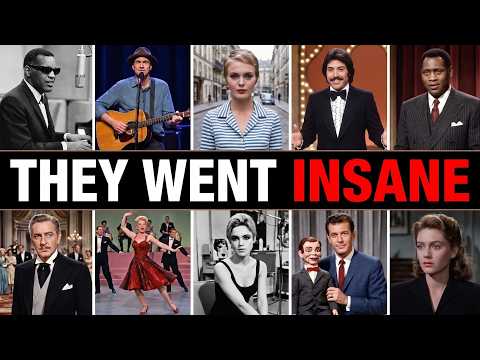
The stories continue—Peter Robbins, the voice of Charlie Brown, who battled bipolar disorder and paranoid schizophrenia behind bars; Clara Bow, the original It Girl, who checked herself into a psychiatric hospital decades after her mother held a butcher knife to her throat; Red Skelton, who collapsed from exhaustion and a nervous breakdown during World War II; Connie Francis, committed by her own father; Betty Hutton, whose headline read “put in a mental hospital”; Roseanne Barr, who spent eight months in a state mental hospital as a teenager; and Jean Seberg, hounded by the FBI into a breakdown that ended in tragedy. Each one a reminder that fame is no armor against the dark.
Peter Robbins never wanted to be known only for the arrests. Most people heard him and never saw his face. In 1965, when he was nine, he was the voice of Charlie Brown in A Charlie Brown Christmas, and he went on to voice the character in six more television specials and the 1969 feature film. That flat, worried voice saying “Good grief” was his. Born Louis Nanassy in Los Angeles in 1956, he worked his way around the sitcoms like a lot of busy child actors in the ’60s—The Munsters, F Troop, Get Smart—and in 1968 CBS made him a regular as Alexander in a short-lived Blondie series. He made a last appearance on My Three Sons in 1972, then stopped acting. The Peanuts producers always used real children instead of adults pretending, which is why each one was replaced as soon as his voice started to change.
He went to college at UC San Diego and made his living in real estate. For about forty years, that was his whole story. Then, in January 2013, he was arrested at the San Ysidro border crossing and charged with stalking and making threats against several people, one of them a former girlfriend. He was sentenced to a year and allowed to serve it in a residential treatment program. In 2015 he was arrested again for violating probation, and after an outburst in a San Diego courtroom, he was ordered to undergo a mental health evaluation. That December, he was sentenced to four years and eight months in state prison for sending threatening letters to the manager of a mobile home park in Oceanside. He told the court himself that he had bipolar disorder and paranoid schizophrenia, and he served the sentence at the California Institution for Men in Chino, where he later said he was finally treated for the illness.
The Charlie Brown specials were airing every Christmas and every Halloween on national television the whole time he was locked up. He got out in 2019 and gave a few interviews in which he talked openly about the illness, said he was taking his medication, and wanted to stay well. He went to fan conventions and signed autographs for people who’d grown up with his voice. He had Charlie Brown and Snoopy tattooed on his arm years before any of the trouble started. In one interview he said he hoped people who heard about him would get help sooner than he did. In January 2022 his family announced he had died by suicide at his home in Oceanside. He was 65.
Clara Bow was the most famous young woman in America in 1927—the It Girl. After a silent picture called It made her the face of an entire generation, twenty-two years passed before she checked herself into a psychiatric hospital in Connecticut. Born in Brooklyn in 1905 into poverty that was hard even by the standards of the neighborhood, she got into pictures by winning a Fame and Fortune contest run by a fan magazine in 1921, with photographs her father paid for. Her mother was furious, convinced acting would make her daughter a prostitute. Sarah had epilepsy and what biographers describe as serious mental illness, and when Clara was sixteen her mother came into her room one night with a butcher knife and held it to her throat. Clara got away. Sarah was committed to an asylum where she died not long after. Clara never really slept properly again.
In Hollywood she made Wings, which won the very first Academy Award for Best Picture, and dozens of other films. But by 1930 the studio was exhausted with her. Newspapers printed lies about her private life, and her former secretary, Daisy DeVoe, was put on trial for stealing from her—a trial that dragged every detail of Clara’s spending and romances into the papers. She had a breakdown in 1931 and spent time in a sanitarium in Glendale. That same year she married the cowboy actor Rex Bell and moved with him to a ranch in Nevada. She made two more pictures and quit for good in 1933, before she was thirty.
The worst came later, long after anyone was watching. In 1949, by then the mother of two sons, she entered the Institute of Living in Hartford, Connecticut, for treatment of her insomnia and depression. Her biographer David Stenn reports that she was given shock treatments there and that the doctors diagnosed schizophrenia—a diagnosis she refused to accept—and that she left after several months against their advice. She never went back to the ranch. She spent the rest of her life living apart from her husband in a small house in Culver City, near the studios she’d left, with a nurse looking after her. Her husband, by then lieutenant governor of Nevada, visited when he could.
She did come back once, sort of. In 1947 she was the secret voice of Mrs. Hush on the radio quiz Truth or Consequences, a contest in which listeners had to guess the identity of a famous person from a few recorded words. It was weeks before anybody named her. Rex Bell died of a heart attack in 1962 while campaigning for governor. Clara Bow died in 1965, at sixty, of a heart attack. The nurse who found her said she’d been up late watching an old Gary Cooper picture on television. She’d been his leading lady and, for a while, his girlfriend.
Red Skelton went into the army a private and came out a private—and left the hospital out of the joke. In Italy in 1945, after months of as many as twelve shows a day, he collapsed. The accounts describe exhaustion and a nervous breakdown, and about three months in hospitals before his discharge that September. He came out with a stutter. Part of his recovery was at the army hospital at Camp Pickett in Virginia, where the story goes that he met a badly wounded soldier and made it his job to make the man laugh—and his own stutter faded as he did it.
He was back on the radio by December 1945. On television he was bigger still: The Red Skelton Show began in 1951 and ran twenty years, closing every episode with a quiet “God bless.” In private he lost a great deal. His son Richard died of leukemia in 1958 at only nine. In 1970 CBS canceled his show while it was still in the top 20, and he stayed bitter for the rest of his life. He painted clowns that sold for real money and kept performing into his 80s. He died in 1997 at 84.
Connie Francis sold millions of records before she was 25—and in the 1980s her own father had her committed more than once. Born Concetta Franconero in Newark in 1937, she was pushed onto the stage with an accordion by her father George, who controlled almost everything, including who she saw. She wrote that when she fell in love with Bobby Darin, her father ran him out of a rehearsal with a gun. Then her life came apart in pieces: a knife-point rape in a motel room in 1974, a nose operation that cost her voice, and in 1981 her brother George shot dead outside his home in a murder never solved. By her own account she spent years in psychiatric hospitals, some involuntary, arranged by her father. She was diagnosed with manic depression—bipolar disorder—and spent years speaking out about mental health and patients’ rights. She kept performing into her 70s, and in 2025, the year she died, “Pretty Little Baby” went around the internet with millions of young people who’d never heard of her. She was thrilled. She died in Florida that July at 87.
On December 14th, 1974, the Los Angeles Times ran a headline that said Betty Hutton had been put in a mental hospital. She was 53. She’d grown up singing for customers in the speakeasy her mother ran out of their home, and years later learned from a telegram that her father had taken his own life. Thirty years earlier she’d been the loudest, fastest comic actress at Paramount—The Miracle of Morgan’s Creek, The Greatest Show on Earth, and Annie Oakley in Annie Get Your Gun after MGM fired Judy Garland. In 1952 she walked out on Paramount in a fight over a director, and no other studio picked her up.
The next fifteen years took nearly everything. Her mother died in a house fire. Her fourth marriage ended. She declared bankruptcy, became dependent on pills and alcohol, lost her singing voice, had a nervous breakdown, and attempted suicide. The papers said she’d been hospitalized for emotional exhaustion after a failed comeback. Her recovery came from an unlikely place: a Roman Catholic priest in Portsmouth, Rhode Island, Father Peter Maguire, took her in, and she worked for years as a cook and housekeeper in his rectory. Strangers who recognized her at the church couldn’t believe the woman frying eggs in the kitchen had once been one of Paramount’s biggest stars. She earned a master’s degree, returned to Broadway in 1980 as Miss Hannigan in Annie, and the audiences stood up for her. She died in Palm Springs in 2007 at 86.
When Roseanne went on the air in 1988, it was the most honest sitcom about a working family television had ever seen—and the woman at the center had spent eight months as a teenager in a state mental hospital. Born in Salt Lake City in 1952, she was hit by a car at 16, the hood ornament striking her head. Profiles in Vanity Fair and the Philadelphia Daily News report her behavior changed so much that she was institutionalized at the Utah State Hospital in Provo for eight months. She was a minor; none of the accounts suggest she had a choice. At 18 she told her parents she was visiting a friend in Colorado and never came home.
In Colorado she married a motel clerk, raised three children, and started doing stand-up in Denver bars—a housewife tired of being told how to feel about it. She called herself a domestic goddess. In 1985 Johnny Carson called her over to the couch, which in those days meant you’d made it. Three years later ABC built a sitcom around her, and within a season it was the number one show in America. What’s unusual is that she never hid the hospital. It was in print by 1989, at the exact moment her show was becoming the biggest thing on television. In 1993 she won the Emmy for best actress in a comedy series—the one thing the industry seemed never going to give her.
In 1964, Jean Seberg played a patient in a private psychiatric hospital in a film called Lilith. Six years later, it stopped being a part. Born in Marshalltown, Iowa, in 1938, she was 17 when Otto Preminger chose her out of thousands to play Joan of Arc in Saint Joan—and during the burning scene, the fire got away from the crew and she was actually burned. The picture failed, but Godard’s Breathless made her famous all over the world. She gave money to civil rights groups and the Black Panther Party, and the FBI opened a file on her. In 1970, while she was pregnant, the bureau planted a false story claiming the father of her baby was a Black Panther. Newsweek printed it with her name. She went into labor two months early; her daughter Nina was born August 23rd, 1970, and died two days later.
Seberg took the baby’s body home to Marshalltown and held the funeral with the casket open so reporters could see the child was white. She and her husband, Romain Gary, sued Newsweek and won. But Gary said the story had broken something in her that never healed, and that she attempted suicide on the anniversary of the baby’s death year after year. She was hospitalized repeatedly in the 1970s for severe depression. In August 1979 she disappeared from her Paris apartment. Nine days later she was found wrapped in a blanket in the back seat of her car, with a bottle of barbiturates and a note to her son, asking him to forgive her and saying she couldn’t live with her nerves anymore. She was 40. Within weeks of her death, the FBI released its files and admitted publicly what it had done to her. Romain Gary died by suicide in Paris the following year. Breathless still plays in film classes all over the world, and every year a new class watches her walk down the Champs-Élysées calling out “New York Herald Tribune,” with no idea what was coming for her.
Ten names. Ten locked doors. Some walked out and never spoke of it; some never stopped speaking of it; some never walked out at all. Which of these stories stayed with you the longest—and why?
Report this article
Select a reason for reporting:






