The air on Morotai was thick with heat and history. Ten thousand Allied soldiers stood in silent ranks under the blistering sun, their eyes fixed on a small wooden table. The date was September 9, 1945. The war was over, but the reckoning was about to begin.
General Teishima, commander of 126,000 Japanese troops, walked toward the table. His face was a mask of composure, but the weight of defeat hung heavy on his shoulders. At the table stood Australian General Thomas Blamey, a man who had witnessed the horrors of war firsthand. In his hand, Blamey held a short speech—a speech that would echo through history.
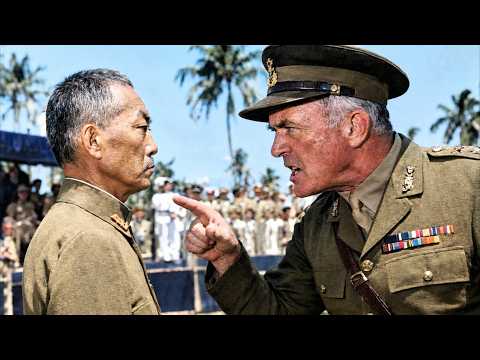
The silence was absolute. Only the crunch of coral under the Japanese delegation’s boots and the flutter of a signal flag broke the stillness. Every soldier in the field knew what Blamey was about to say. They had been waiting for this moment for years.
Blamey began to read. “In accepting your surrender, I do not recognize you as an honorable and gallant foe.” The words cut through the air like a blade. This was not a traditional surrender ceremony. There would be no acknowledgment of martial honor, no return of the sword as a gesture of respect. Blamey’s words were deliberate, each one chosen to convey a message that went beyond the battlefield.
He spoke of the treacherous attack on China, the surprise assault on the British Empire and the United States, and the atrocities committed against Australian prisoners of war. “I remember the atrocities committed against Australian citizens as prisoners of war and internees, designed to humiliate them by punishment and starvation even to slavery.” The words were a catalog of grievances, a litany of pain that had been building for years.
The Japanese general stood motionless, his face betraying nothing. He had been instructed to comply, to sign the document, and to ensure his men followed orders. But the refusal to recognize his honor was a blow that went deeper than any military defeat.
Blamey continued, outlining the strict terms of the surrender. “I will enforce strictly all orders issued to you.” There would be no leniency, no soft treatment. The Japanese soldiers would be treated with the “decency due but stern in all things”—a phrase that would define Australia’s approach to occupation.
As Blamey finished, the ceremony was far from over. The sword that Teishima had surrendered was placed on a separate table, never to be returned. It was a symbolic act, one designed to strip the Japanese officers of their dignity. But in that moment, something unexpected happened. Teishima moved with such speed and precision that the cameras, poised to capture his humiliation, missed the moment entirely. There was no photograph of the sword being handed over—only a few fleeting seconds of film.
The ceremony lasted just twenty minutes, but its impact would last for generations. As the Japanese delegation was led away, the soldiers in the field began to disperse. Some clutched program cards as souvenirs, others stood in quiet reflection. The war was over, but the story of what happened on that coral island was just beginning.
For Blamey, the words he spoke were not just a condemnation of the enemy—they were a statement of Australian values. The strict decency he promised would be tested in the months and years to come, as Australia took charge of occupying forces and war crimes trials. But on that September morning, the message was clear: Australia would not forget, and it would not forgive.
The sword that Teishima surrendered never returned to Japan. It became a relic of a war that had scarred a generation. And the man who had stood so stoically at the table would fade into history, remembered not for his rank or his troops, but for the twenty minutes that defined the end of an era.
But the story of that morning did not end when the Japanese delegation drove away toward the airfield. In the days that followed, the ceremony at Morotai became something else—a template. Word of Blamey’s words spread through the Australian units scattered across the archipelago, carried by signals traffic and by men who had stood in the ranks and would never forget what they heard.
Copies of the speech were requested by officers commanding surrender ceremonies on Ambon, on Timor, on Bougainville. Not all of them used it. Some commanders, mindful of local conditions or of the temperament of the Japanese officers they faced, chose softer language. But enough of them read Blamey’s words aloud that the phrase “I do not recognize you as an honorable and gallant foe” became a kind of password among Australian troops in the southwest Pacific—a shorthand for the position their army had taken.
The occupation machinery moved quickly. Within weeks, Australian officers were fanning out across the former Japanese command area, accompanied by interpreters and small detachments of military police. They found what the surrender documents had promised: Japanese garrisons strung across islands, many of them starving, many of them sick, all of them still armed.
On Ceram, an Australian major named Whitcombe reported finding a Japanese colonel who had not received word of the surrender for eleven days. The colonel had kept his men at their posts, drilling them each morning, rationing the last of the rice. When Whitcombe read him the terms, the colonel bowed, then asked permission to address his troops. He spoke for ten minutes. Whitcombe, who did not understand Japanese, later wrote that he had never seen men weep the way those soldiers wept.
The weapons collection was its own kind of theater. On Ambon, the Japanese garrison stacked rifles in pyramids on the beach—thousands of them, oiled and cleaned, arranged with a precision that seemed almost defiant. Australian soldiers walked among the stacks, counting, cataloguing, and quietly removing bayonets and officers’ swords for shipment back to Australia.
The swords were the most sensitive items. Each one had to be logged, tagged, and packed. Some officers tried to explain the history of their blades—a family sword passed down through generations, a gift from a father, a symbol of a lineage that predated the modern army. The Australian instructions were clear: all swords would be retained. No exceptions.
There were incidents. On Halmahera, a Japanese captain refused to surrender his sword, drawing it instead and holding it across his body. The Australian lieutenant facing him, a young man from Victoria named Fraser, later wrote that he had never been so frightened in his life. But he remembered Blamey’s words—“decency due but stern in all things”—and he did not order his men to fire. He talked instead. For twenty minutes, through an interpreter, he explained what would happen if the captain resisted, and what would happen if he complied. The captain listened. Then he handed over the sword.
Fraser kept a copy of Blamey’s speech in his kit for the rest of his service. He would later say that it had saved his life that day—not because of the words themselves, but because they had given him something to hold onto when everything else was chaos.
By the end of September, the disarmament was largely complete. The Japanese troops were being moved to concentration areas, fed, treated, and prepared for repatriation. The first ships carrying them home would not leave until October, and the last would not sail until well into 1946. In the interim, the Australians found themselves in the strange position of guarding and feeding the men they had spent years trying to kill.
It was not always easy. There were soldiers in the Australian ranks who could not forget Ambon, who could not look at a Japanese uniform without seeing the faces of friends who had never come home. Some of them asked to be transferred rather than serve as guards. Others did their duty, grimly, and said nothing.
Blamey himself did not linger on Morotai. Within days of the ceremony, he was back in the air, moving between commands, overseeing the vast machinery of occupation. But he did not forget the morning on the coral island. In a letter to his wife, written the night after the ceremony, he described the day in a few spare lines. He noted the heat, the silence of the crowd, the composure of the Japanese general. He wrote that he had said what needed to be said, and that he hoped it would be enough.
The letter is preserved in the Australian War Memorial, along with the program cards, the photographs, and the few seconds of film that captured the sword leaving Teishima’s hand. Together they form a record of a morning that was, in its way, as important as any battle of the Pacific War—a morning when words were chosen with the same care as bullets, and when the meaning of victory was defined not by what was taken, but by what was refused.
The war crimes trials that followed gave Blamey’s words their final shape. In the courtrooms at Morotai, at Rabaul, at Ambon, the phrase “decency due but stern in all things” was read aloud by prosecutors as a kind of preamble. The men who had starved prisoners, who had beaten them, who had ordered their execution, were not treated as honorable foes. They were treated as criminals. But they were also fed, clothed, given counsel, and tried under the rules their own army had ignored.
Teishima himself was never charged. He had commanded from a distance, and the evidence against him was thin. He returned to Japan in 1946, a man in his sixties with no future in a ruined country. He lived another decade in obscurity, and his name would have vanished entirely were it not for the twenty minutes on Morotai.
The sword never came back. It sits in a case at the Australian War Memorial, catalogued and numbered, a strip of paper still tied to its hilt. On the paper, in careful Japanese characters, is a request: “Please return this sword to my family.” The request was not granted. It never would be.
But here is the thing about that morning that the histories rarely say. Blamey refused Teishima the courtesy of the returned blade, and he refused him the title of honorable foe. Yet he also refused to let his men take revenge. He refused summary executions. He refused the easy cruelty that victory can bring. The sternness he promised was real, but so was the decency. And in the end, it was the decency that Australia remembered.
The men who stood in those ranks are almost all gone now. The program cards are yellowed. The film is grainy. But the words remain, and the question they asked remains too: when you have won, and the enemy is at your mercy, what do you owe him?
What would you have said, standing at that table on that September morning—and would you have returned the sword?
Report this article
Select a reason for reporting:






